How to Become a Daraz Seller in Bangladesh: Registration, Fees & Growth
Learn how to become a Daraz seller in Bangladesh, register an account, list products, understand fees, manage orders, and grow…
 by Sheikh Ornob

Learn how Sanchaya Patra in Bangladesh works: types, eligibility, current rates, tax deduction, and how to buy from NSD-approved banks or post offices.
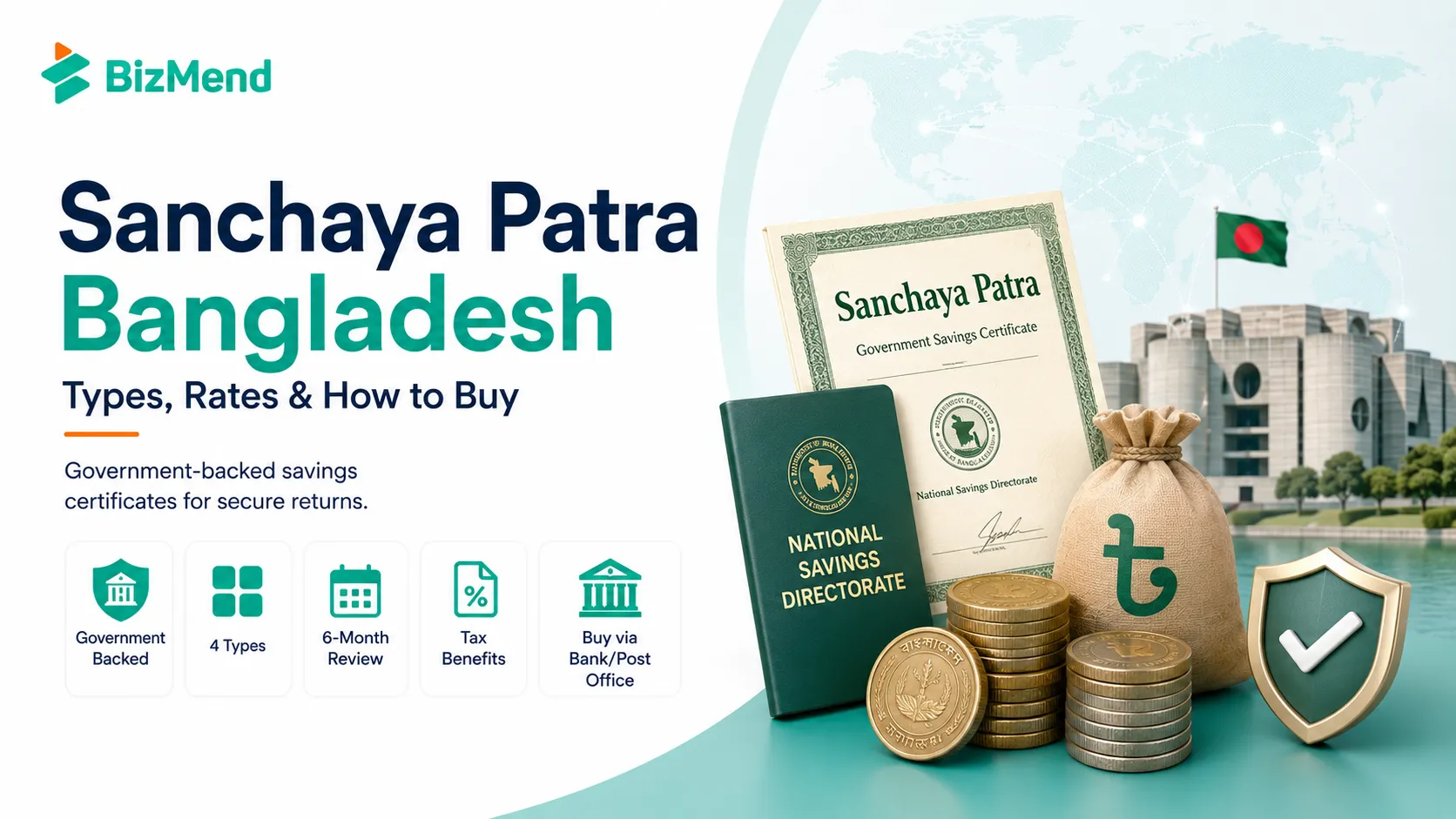
Most Bangladeshis have heard of Sanchayapatra. But surprisingly few know the four types, why rates changed three times in under 18 months, or who’s actually allowed to buy each one. Sanchaya Patra in Bangladesh is the government’s most trusted savings tool for everyday people, but the rules have shifted significantly since 2025. This guide covers everything you need to know before buying, clearly and without the jargon.
Quick answer: Sanchaya Patra in Bangladesh is a government-backed savings certificate issued by the National Savings Directorate (NSD). There are four main types: 5-Year Bangladesh Sanchayapatra, 3-Monthly Profit-Bearing, Pensioner, and Family (Paribar). Interest rates are reviewed every six months and vary by investment amount. Always verify current rates at nsd.gov.bd before purchasing.
Sanchayapatra, also called National Savings Certificate, is a fixed-income savings instrument issued by the National Savings Directorate (NSD) of Bangladesh, which operates under the Ministry of Finance. Put simply: you give the government your money, they pay you regular interest and return your principal at the end.
It’s been around for decades. And for good reason. It’s backed by the Government of Bangladesh, meaning it carries virtually no default risk. For retirees, women with limited formal financial access, and middle-income families looking for a predictable return, it’s still one of the most practical savings tools in the country.
The NSD operates its own digital portal at www.nsd.gov.bd, and you can also purchase Sanchayapatra at most scheduled banks, Bangladesh Bank branches, and Bangladesh Post Offices across the country.
A bank Fixed Deposit Receipt (FDR) gives you a return based on the bank’s own rate, which fluctuates and isn’t government-guaranteed. Sanchayapatra’s return is backed by the state. If you’re comparing Sanchayapatra to other savings options in Bangladesh like FDRs or treasury bonds, the government backing is the key difference.
There’s also a tax rebate benefit that FDRs don’t offer in the same way. More on that in the tax section below.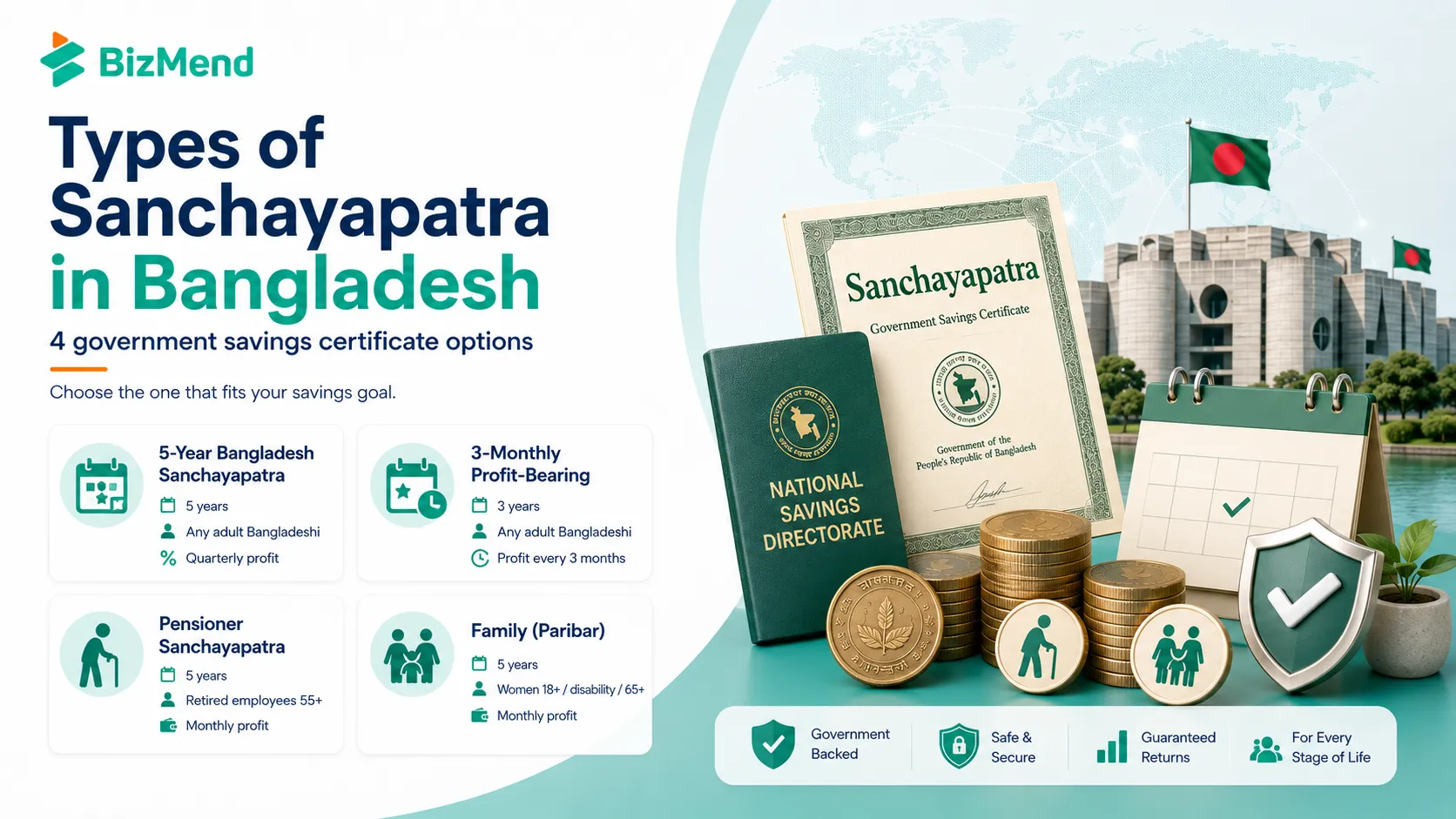
There isn’t one Sanchayapatra. There are four main types, each designed for a different group of savers. Here’s a quick comparison:
| Type | Term | Who Can Buy | Profit Payment |
|---|---|---|---|
| 5-Year Bangladesh Sanchayapatra | 5 years | Any adult Bangladeshi | Quarterly option; main at maturity |
| 3-Monthly Profit-Bearing | 3 years | Any adult Bangladeshi | Every 3 months |
| Pensioner Sanchayapatra | 5 years | Retired govt/autonomous employees, 55+ | Monthly |
| Family (Paribar) Sanchayapatra | 5 years | Women 18+, disabled, people 65+ | Monthly |
This is the most widely bought type. Any adult Bangladeshi citizen can purchase it, individually or jointly. The term is 5 years, and it offers quarterly profit payments.
Individual purchase limit: Tk 30 lakh. Joint purchase limit: Tk 60 lakh. Institutional investors like recognized provident funds can invest up to 50% of their total fund balance, capped at Tk 50 crore.
For anyone exploring investment options for fixed-income earners in Bangladesh, this certificate gives you predictable, locked-in returns for the full term.
This is a 3-year certificate and pays profit every three months. So if you need regular income from your savings, not just a lump sum at the end, this is the more practical choice.
Purchase limit: Single Tk 30 lakh, joint Tk 60 lakh. Any adult Bangladeshi citizen can buy it.
Honestly, most people who rely on Sanchayapatra for monthly expenses prefer the 3-monthly scheme. It functions like a pension for people who don’t have one.
This is specifically for retired government employees, semi-government, and autonomous body employees who’ve reached age 55. Retired Supreme Court justices and retired armed forces personnel are also eligible. The spouse or children of a deceased government employee who are already receiving family pension can also buy this.
The profit is paid monthly. Minimum purchase: Tk 50,000. Investment limit: the total combined value of pension, gratuity, and provident fund received upon retirement. The limit was updated in 2025; verify the exact maximum with the NSD or your bank before purchasing.
A January 16, 2025 amendment expanded the eligibility. The Paribar Sanchayapatra now covers: Bangladeshi women aged 18 and above, all Bangladeshi citizens with physical disabilities regardless of gender, and Bangladeshi men and women aged 65 and above.
The profit is paid monthly. Minimum purchase: Tk 10,000. Maximum for a female investor: Tk 45 lakh (verify with NSD as the January 2025 policy amendment may have updated the limit).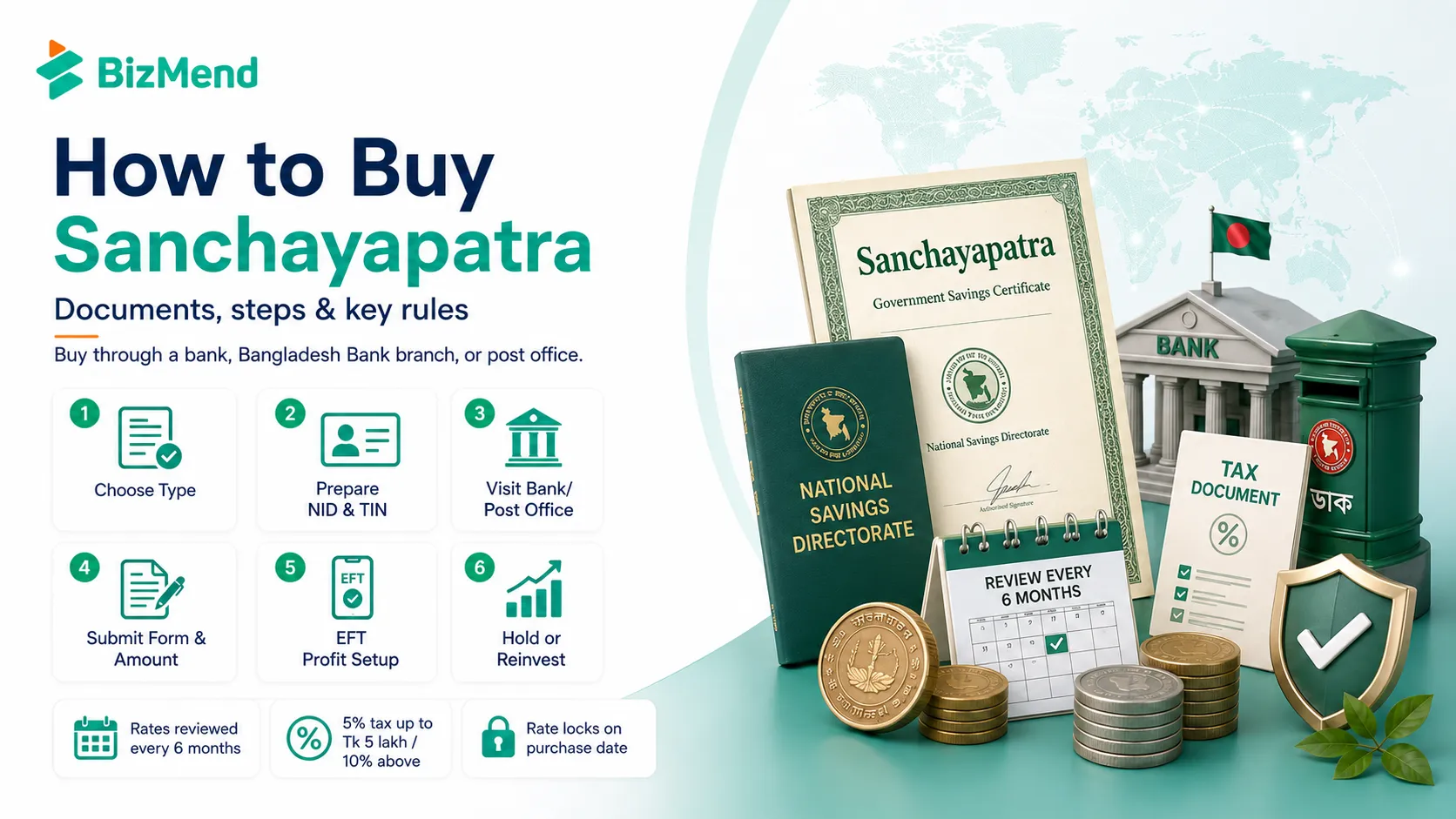
Since January 2025, the way Sanchayapatra interest rates are set changed completely. Most guides don’t explain this.
Bangladesh introduced a market-based interest rate system for savings certificates effective January 1, 2025. Sanchayapatra rates are now tied to the weighted average yields of government 5-year and 2-year treasury bonds, with a premium of up to 50 basis points added on top.
Rates are reviewed and potentially adjusted every six months: once in January and once in July. The rate you get when you purchase is locked in for the entire duration of your investment, even if rates change later. Two investors who buy the same certificate six months apart could earn different rates for their entire term.
Before January 2025, rates ranged from about 11.04% to 11.76%. Then:
Confirmed rates effective January 1, 2026 (for new purchases):
| Type | Up to Tk 7.5 lakh (at maturity) | Above Tk 7.5 lakh |
|---|---|---|
| 5-Year Bangladesh Sanchayapatra | 11.83% | 11.80% |
| 3-Monthly Profit-Bearing | 11.82% | 11.77% |
| Pensioner Sanchayapatra | 11.98% | 11.801% |
| Family (Paribar) Sanchayapatra | 11.93% | 11.80% |
Important: Rates are reviewed every 6 months. Always check the current rates at nsd.gov.bd or at your bank before purchasing. The rate on your purchase date applies to your entire investment term.
To understand how the broader fixed-income investment landscape in Bangladesh compares, bank deposit rates generally range lower than Sanchayapatra returns, though the gap has narrowed.
For most types, any adult Bangladeshi citizen can buy Sanchayapatra. General eligibility:
For Pensioner Sanchayapatra: additionally need proof of retirement from a qualifying government/autonomous institution and must be age 55 or above.
For Family (Paribar) Sanchayapatra: women 18+, people with physical disabilities (any gender), and citizens 65+ of either gender (expanded via January 16, 2025 amendment).
NRBs (Non-Resident Bangladeshis) have separate instruments: Wage Earners’ Development Bond and US Dollar Investment Bond. For NRBs exploring investment options in Bangladesh from abroad, these dedicated instruments are the more appropriate route.
| Type | Single Name | Joint Name |
|---|---|---|
| 5-Year Bangladesh Sanchayapatra | Tk 30 lakh | Tk 60 lakh |
| 3-Monthly Profit-Bearing | Tk 30 lakh | Tk 60 lakh |
| Pensioner Sanchayapatra | Limited to pension/gratuity/PF drawn | N/A |
| Family (Paribar) Sanchayapatra | Tk 45 lakh (verify with NSD) | N/A |
Your total Sanchayapatra holdings across all types are aggregated. If your combined investments exceed Tk 7.5 lakh, the higher portion earns the slightly lower rate. The Tk 7.5 lakh threshold applies per investor in total, not per individual certificate.
Two separate tax benefits apply to Sanchayapatra. They’re different and often confused.
Tax at source (withholding tax on profit):
Tax rebate on the investment amount: Investments in Sanchayapatra are eligible for a tax rebate under the Income Tax Act, 2023. Understanding the tax rebate on investments in Bangladesh is especially useful if you’re in a taxable income bracket. The rebate is applied when filing your annual income tax return. You need your TIN and must have submitted your return.
For businesses and institutions thinking about registering or running a company in Bangladesh and managing provident fund assets, the 5-year Bangladesh Sanchayapatra allows recognized institutional provident funds to invest up to 50% of their total balance, max Tk 50 crore.
When your certificate matures, you can either encash (take back principal plus any remaining unpaid profit, minus source tax) or reinvest. If you reinvest, the rate in effect on the reinvestment date applies, not your original rate.
Early encashment is allowed, but you’ll earn a lower annual return. In general, the earlier you cash out, the lower the rate. For example, under the January-June 2025 rates, a 5-year Bangladesh Sanchayapatra encashed in the first year earned around 10.13% annually instead of the full 12.40% at maturity.
After the certificate holder’s death, the named nominee can either encash the certificate or retain it until maturity and continue receiving regular profit payments.
Sanchayapatra isn’t risk-free in every sense.
Inflation risk: Rates dropped from a peak of 12.55% in early 2025 to 10.59% by January 2026. Bangladesh’s inflation stood at 8.29% in November 2025, per Bangladesh Bureau of Statistics data. At these levels, the real return on some certificates is quite thin. CPD executive director Fahmida Khatun noted in January 2026 that the rate cuts “disproportionately affect fixed-income earners and retirees.”
Liquidity constraints: Early encashment reduces your return. Don’t put money in Sanchayapatra that you might need in the next 6-12 months.
Compared to mutual funds in Bangladesh as an alternative, Sanchayapatra offers lower return potential but virtually no market risk, making it suitable for very conservative savers.
For savings and investment planning for retirees in Bangladesh, combining Sanchayapatra (for stability) with other instruments like mutual funds (for growth) is a practical approach.
Sanchaya Patra (Sanchayapatra) is a government-issued savings certificate managed by the National Savings Directorate (NSD) under Bangladesh’s Ministry of Finance. It’s a fixed-income instrument where you invest money for a fixed term (3 or 5 years) and receive regular interest payments plus your principal at maturity. It’s considered one of the safest savings options in Bangladesh.
As of January 1, 2026, confirmed rates for new purchases are: Family Savings Certificate 10.54%, Pensioner Sanchayapatra 10.59%, 5-year Bangladesh Sanchayapatra 10.44%, and 3-monthly profit-bearing certificate 10.48% (all for investments up to Tk 7.5 lakh). Rates for amounts above Tk 7.5 lakh are slightly lower. Rates change every 6 months, so always verify at nsd.gov.bd before purchasing.
Any adult Bangladeshi citizen with a valid NID and TIN can buy most types of Sanchayapatra. The Pensioner Sanchayapatra is for retired government, semi-government, and autonomous body employees age 55+, plus surviving family members receiving family pension. The Family (Paribar) Sanchayapatra is for women 18+, people with physical disabilities, and citizens aged 65+ of either gender (expanded via January 16, 2025 amendment).
Visit any scheduled bank, Bangladesh Bank branch, or Bangladesh Post Office with your NID, TIN certificate, photographs, and the investment amount. Fill in the purchase form, deposit your funds, and receive your certificate. The NSD is gradually digitizing this process at nsd.gov.bd. Profit is usually paid to your bank account via Electronic Fund Transfer (EFT).
For the 5-year Bangladesh Sanchayapatra and 3-monthly certificates: Tk 30 lakh single, Tk 60 lakh jointly. For the Family Sanchayapatra: Tk 45 lakh for a female investor (verify current limit with NSD). For Pensioner Sanchayapatra: limited to the combined pension, gratuity, and provident fund received on retirement. These limits apply across your total Sanchayapatra holdings, not per individual certificate.
Source tax is deducted directly from your profit before payment. If your total Sanchayapatra investment across all types is Tk 5 lakh or below, 5% tax applies. If your total investment exceeds Tk 5 lakh, 10% applies. Separately, your investment qualifies for a tax rebate on the invested amount when filing your annual income tax return under the Income Tax Act, 2023.
Yes. You can encash before maturity, but you’ll earn a lower annual return than if you wait. The rate increases the longer you hold. For example, under the January-June 2025 rates, early encashment in the first year of the 5-year scheme earned around 10.13% annually, vs the full 12.40% at maturity. Any excess profit already paid will be deducted from your principal before you receive the remainder.
Since January 2025, rates are reviewed every 6 months and adjusted based on treasury bond yields. Changes happen on January 1 and July 1 each year. The rate at the time of your specific purchase is locked in for your entire term. Reinvestments receive the rate in effect on the date of reinvestment, not your original rate.
Sanchayapatra is primarily for resident Bangladeshi citizens. NRBs have separate dedicated instruments: the Wage Earners’ Development Bond, the US Dollar Investment Bond, and the US Dollar Premium Bond. These offer competitive returns and can be held in foreign currency accounts. NRBs should check Bangladesh Bank or nsd.gov.bd for current NRB-specific instruments.
The investor can name one or more nominees when purchasing. After the investor’s death, the nominee can either encash the certificate (receiving principal plus accrued profit minus applicable source tax) or retain the certificate until maturity and continue receiving regular profit payments. No immediate re-registration in the nominee’s name is required.
Sanchayapatra in Bangladesh has changed more in the past 18 months than it did in the decade before. The move to a market-based rate system is the right long-term direction, but it means what you read in a three-year-old article could be completely wrong today. The rates, limits, and eligibility rules all matter, and they’re all subject to revision.
Before you buy, check nsd.gov.bd for the current rate. Calculate what your after-tax return looks like against your inflation expectation. And if you’re unsure which type suits your situation, ask your bank’s savings officer directly. What aspect of Sanchayapatra do you still have questions about?

Learn how to become a Daraz seller in Bangladesh, register an account, list products, understand fees, manage orders, and grow…
by Sheikh Ornob
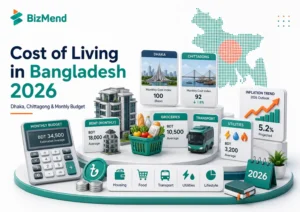
Compare the cost of living in Bangladesh in 2026, including Dhaka and Chittagong rent, food, transport, utilities, inflation, and monthly…
by Sheikh Ornob

Learn MoA and AoA requirements in Bangladesh, key clauses, drafting basics, RJSC filing steps, amendments, and common company-registration mistakes. Suggested…
by Sheikh Ornob