How to Become a Daraz Seller in Bangladesh: Registration, Fees & Growth
Learn how to become a Daraz seller in Bangladesh, register an account, list products, understand fees, manage orders, and grow…
 by Sheikh Ornob

Open a BO account in Bangladesh step by step. CDBL process, required documents, online and offline steps, and NRB guide
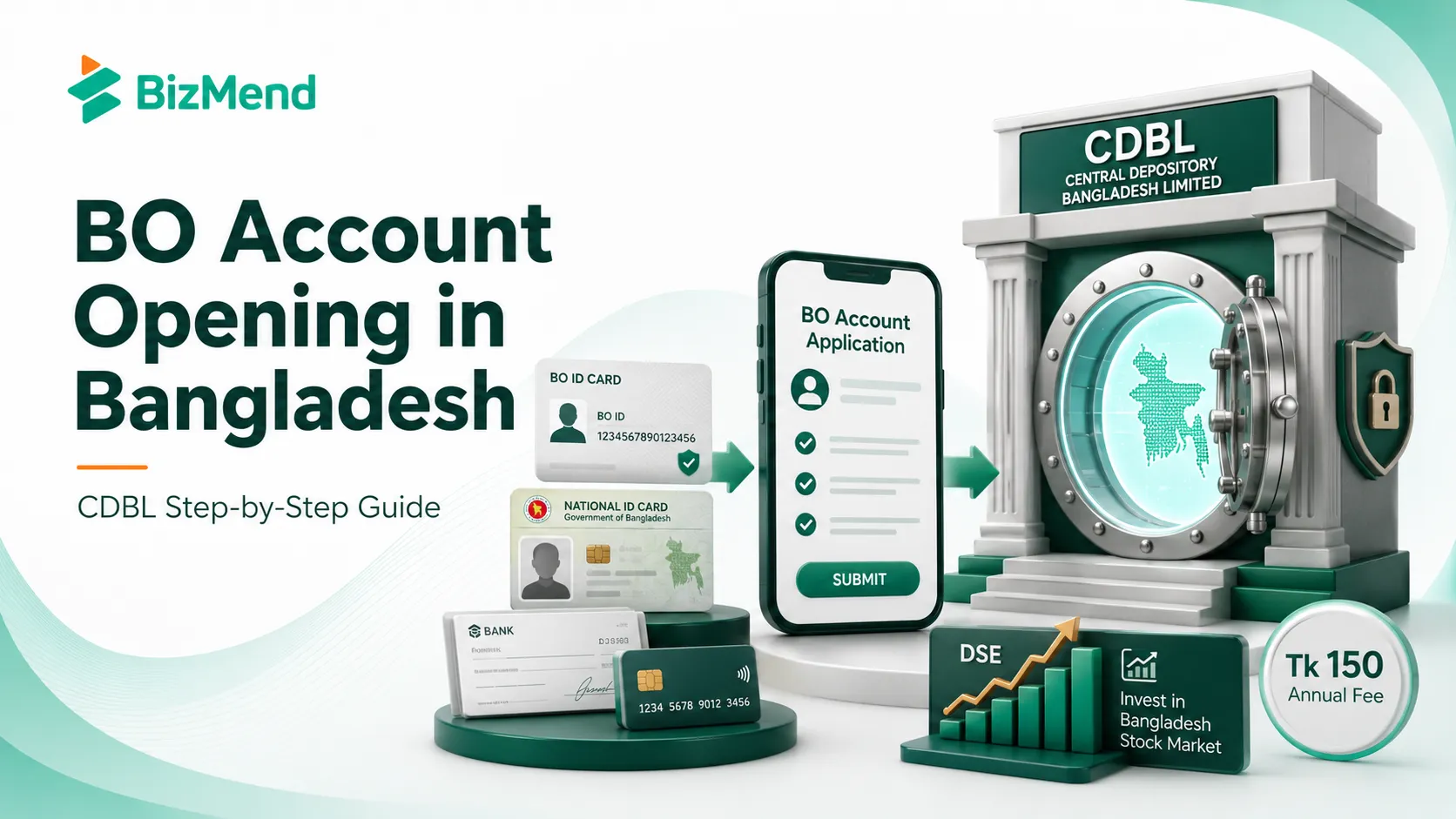
So you want to invest in the Bangladesh stock market. Good decision. But before you buy a single share on the Dhaka Stock Exchange (DSE) or Chittagong Stock Exchange (CSE), there’s one thing you absolutely need first: a BO account.
This guide walks you through exactly how to open a BO account in Bangladesh, what documents you’ll need, the updated fees for FY2025-26, how the online and offline processes work, and what NRBs have to do differently. No jargon. Just the actual steps.
| Quick answer: To open a BO account in Bangladesh, apply through a licensed depository participant (brokerage house or merchant bank) in person or online at cdbl.com.bd/bo. You’ll need your NID, bank account details, and passport-size photos. CDBL manages all BO accounts nationwide. The current annual maintenance fee is Tk 150 (effective from FY2025-26). After approval, you receive a unique 16-digit BO ID to trade on DSE or CSE. |
BO stands for Beneficiary Owner. A BO account is your digital securities account. It holds your shares electronically, the same way a bank account holds your cash.
Every share you buy on Bangladesh’s stock market gets stored in your BO account. You can’t trade on DSE or CSE, apply for IPOs, or receive bonus shares without one. It’s non-negotiable.
The whole BO account system is run by Central Depository Bangladesh Limited (CDBL), the country’s sole securities depository. CDBL has been operating since 2000 and currently supports over 1,663,318 BO Accounts Operable in CDS, updated 12 May 2026
Your BO account comes with a unique 16-digit BO ID, your permanent investor identity in Bangladesh’s capital market. Every share you own, every IPO application you submit, every dividend you receive flows through this ID.
To understand the broader regulatory picture before you start investing, this breakdown of investment banking regulations in Bangladesh is a solid starting point.
Before you open one, know which type fits your situation.
| Account Type | Who It’s For | Key Feature |
| Individual | A single investor | Most common: one NID per account |
| Joint | Two or more investors (typically family) | All holders must sign transactions |
| Corporate | Companies and institutions | Registered under a company name |
Most first-time investors open an individual account. Joint accounts are common for spouses or business partners. Corporate BO accounts are for companies investing in securities.
One hard rule: you cannot have two individual BO accounts using the same NID. CDBL tracks this strictly, and violations can lead to both accounts being suspended.
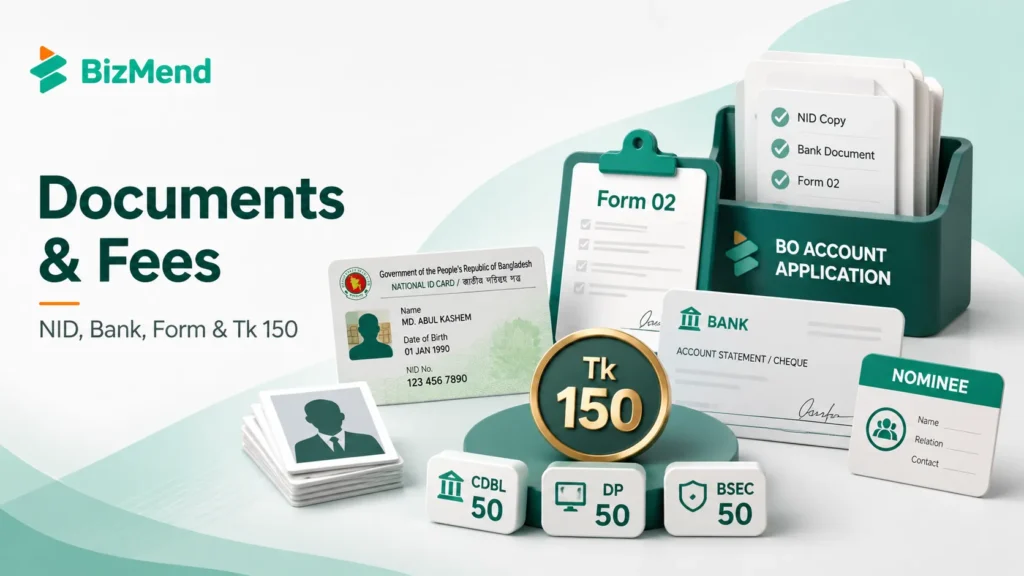
Get your documents ready before you go. This is where most delays happen.
• National ID Card (NID) : mandatory; no substitute is accepted
• Passport-size photographs : 2 to 3 recent copies (your broker will specify)
• Bank account details : a cancelled check or bank statement. No bank account yet? This guide on how to open a bank account in Bangladesh walks you through it first.
• Nominee information : NID and photograph of your nominated person
• Completed CDBL Form 02 : the official BO Account Opening Form (Bye Law 7.3.3(b)), available at any broker or from cdbl.com.bd
• TIN certificate : not mandatory, but some brokers may request it
The NID and bank account details are the two things that cause the most rejections. Make sure the name on your NID matches your bank account exactly.
If you’re living abroad and want to invest in Bangladesh’s stock market, the process has a few extra layers. But it’s absolutely doable.
• Valid passport (including visa and entry/exit pages)
• Residence permit, work permit, or equivalent from your host country
• NITA account — a Non-Resident Investor’s Taka Account at an authorized dealer bank in Bangladesh. Mandatory for buying and selling shares.
• FC (Foreign Currency) account : for remitting funds from abroad
• Attested photographs : attested by the Bangladesh High Commission or Embassy in your country
• All documents in English : translate and attest if in another language
Your BO account links directly to your NITA. Remit foreign currency to your FC account, the bank converts it to Taka in your NITA, and you trade through your broker.
NRBs thinking about setting up a business internationally alongside investing at home might find US LLC formation from Bangladesh a useful parallel option.
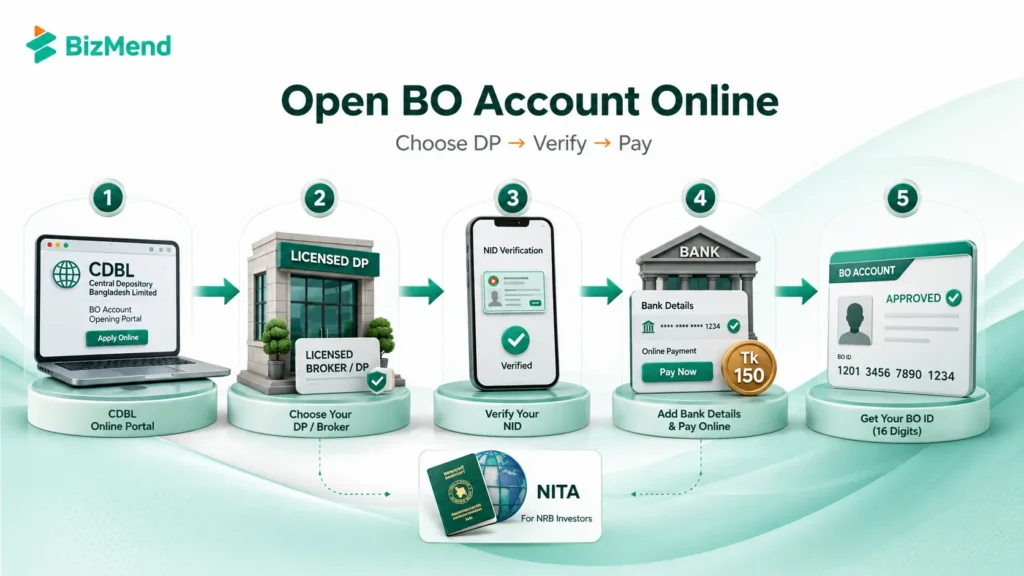
CDBL launched its online BO account opening system on February 9, 2021. Here’s how to do it.
1. Visit cdbl.com.bd/bo : the official CDBL online BO account portal.
2. Click ‘Start’ and read the instructions before proceeding.
3. Select your Depository Participant (DP) : your broker. Pick a licensed DSE or CSE member from the list.
4. Enter your NID number and verify your identity. The system pulls your details automatically.
5. Fill in your bank account details and verify them. A confirmation appears if the information is correct.
6. Upload your passport-size photo and scanned signature, and provide nominee details only if you choose to nominate someone
7. Review everything, accept CDBL’s terms and conditions, and submit.
8. Pay the annual maintenance fee online. The current fee is Tk 150 per year (effective from FY2025-26).
9. After approval, your 16-digit BO ID arrives via SMS or email from your DP.
Approval typically takes 1 to 3 working days. Track your application by logging back into the portal.
Prefer doing it in person? Plenty of people do. Here’s how.
10. Choose a licensed brokerage house or merchant bank that is a registered CDBL Depository Participant.
11. Visit their branch and collect the BO Account Opening Form (CDBL Form 02).
12. Fill out the form in CAPITAL LETTERS. Your name must match your NID exactly.
13. Attach your documents: NID copy, photos, bank account proof, and nominee details/Form 23 only if you choose to nominate someone.
14. Sign the DP agreement, outlining your rights and the broker’s obligations under CDBL regulations.
15. The DP submits your application to CDBL and opens the account on your behalf.
16. Pay the annual maintenance fee (Tk 150 for FY2025-26) as directed by your broker.
Once processed, your broker notifies you with your BO ID. CDBL requires statements at least monthly if there are transactions and quarterly even when there are no movements.
Here’s something most older guides get wrong: they still quote Tk 450. That figure is outdated.
The Bangladesh Securities and Exchange Commission (BSEC) officially reduced the annual BO account maintenance fee to Tk 150 per year, effective from FY2025-26. The BSEC approved this on September 2, 2025, specifically to bring inactive accounts back into the market. Many investors had stopped renewing due to the previous Tk 450 fee.
| Recipient | Annual Amount |
| CDBL (Central Depository Bangladesh Limited) | Tk 50 |
| Depository Participant (your broker) | Tk 50 |
| BSEC (Bangladesh Securities and Exchange Commission) | Tk 50 |
| Total Annual Fee | Tk 150 |
Important: Any BO account fees overdue up to FY2024-25 are still collected at the old Tk 450 rate. Normally, annual BO maintenance fees are collected by June 30 and defaulted accounts may be suspended or closed by July 31; for FY2025-26, the payment timeframe was extended to October 15, 2025.
Your DP is the broker or institution that opens and manages your BO account. CDBL has licensed DPs in Dhaka, Chittagong, Sylhet, Rajshahi, Barisal, Khulna, and Bogra. A searchable list is at cdbl.com.bd.
A few things to check before committing:
• DSE or CSE membership : confirm the broker is a licensed exchange member
• BSEC license : verify their authorization at bsec.gov.bd
• Digital trading platform : check for a reliable app if you want to trade from your phone
• Customer support quality : especially important for beginners and NRBs managing accounts from abroad
• Brokerage commission ; regulated by BSEC, but additional service charges vary
For a broader look at investment institutions, the list of top investment banks in Bangladesh is a useful reference. If you prefer Shariah-compliant banking for your linked account, there are strong options among the top Islamic banks in Bangladesh with DP-connected services. And many commercial banks in Bangladesh have brokerage subsidiaries offering a one-stop banking and investing experience.
These are genuinely common. Worth knowing before you submit anything.
Name mismatch between NID and bank account. If your NID says ‘Mohammad Hasan’ but your bank account says ‘Md. Hasan,’ the application may bounce. Names must match exactly.
Opening more than one individual BO account. You get one individual BO account per NID. CDBL flags duplicates, and both accounts can be suspended.
Missing the annual fee deadline. Normally, BO maintenance fees are handled around June 30, but FY2025-26 had an extended payment timeframe up to October 15, 2025; unpaid accounts may face suspension or closure under CDBL rules.
Leaving nominee information blank. Optional on the form, but skipping it is a bad idea. Without a nominee, your shares can be tied up for a long time if something happens to you.
NRBs using the wrong bank account type. Using a regular savings account instead of a NITA for share purchases creates serious problems when repatriating proceeds later. The account structure is the legal trail that lets your money leave the country.
• A BO account is mandatory to trade on DSE or CSE, apply for IPOs, or receive shares in Bangladesh. You simply can’t invest without one.
• Annual fee is now Tk 150 from FY2025-26, officially cut by BSEC on September 2, 2025. Split: Tk 50 each to CDBL, the depository participant, and BSEC.
• Online opening works well via cdbl.com.bd/bo since February 2021. Your NID is the primary verification. Approval takes 1 to 3 working days.
• NRBs must have a NITA account at an authorized dealer bank before trading. The BO account links directly to the NITA for fund settlement.
• One NID : One NID should not be used for multiple individual BO accounts. Duplicate NID, mobile number, or bank account information should be corrected through the DP; avoid claiming both accounts are automatically suspended unless CDBL or the DP confirms it
• Pay the annual fee by June 30. Miss it and CDBL can suspend your account by July 31. Overdue fees from before FY26 are charged at the old Tk 450 rate.
• Choosing the right DP matters. Verify BSEC licensing, exchange membership, and digital platform quality before committing to a broker.
A BO (Beneficiary Owner) account is an electronic securities account managed by CDBL that holds your shares and securities. It’s required to trade on DSE or CSE, apply for IPOs, and receive dividends. Every account gets a unique 16-digit BO ID as your permanent investor identifier.
The annual maintenance fee is Tk 150 (effective from FY2025-26), split equally between CDBL, your broker/DP, and BSEC (Tk 50 each). Overdue fees from fiscal years before FY26 are still collected at the previous Tk 450 rate.
Yes. CDBL launched online account opening on February 9, 2021. Visit cdbl.com.bd/bo, select your depository participant, verify your NID, fill in bank details, upload your photo and nominee information, and pay the annual fee. Approval typically takes 1 to 3 working days.
Resident Bangladeshis need: NID, 2 to 3 passport-size photos, bank account details (cancelled cheque or statement), and completed CDBL Form 02. If they choose to nominate someone, nominee details/Form 23 are also needed. TIN is optional. NRBs additionally need a valid passport/residence proof and NITA account details.
Yes. NRBs can open a BO account through any licensed brokerage house. They must also open a NITA (Non-Resident Investor’s Taka Account) at an authorized bank in Bangladesh, which gets linked to the BO account for all trading transactions. Documents must be attested by the Bangladesh High Commission or a reputable international bank.
You cannot hold more than one individual BO account under the same NID. CDBL enforces this strictly. However, you can have one individual account and also be a joint account holder on a separate joint BO account.
A DP is a licensed broker, merchant bank, or financial institution authorized by CDBL to open and manage BO accounts. Most brokerage houses and some commercial bank subsidiaries are registered DPs. The complete updated list is at cdbl.com.bd.
If you don’t pay the Tk 150 annual fee by June 30, CDBL may suspend or close your account by July 31. Trading access is lost on a suspended account. Reactivation requires paying overdue fees. Fees from before FY2025-26 are charged at the previous Tk 450 rate.
Online: typically 1 to 3 working days after submission. Offline through a broker: usually 2 to 5 working days, depending on the broker and whether your documents are complete and correctly filled.
Your BO ID is the unique 16-digit number assigned to your BO account by CDBL. It’s your investor identity for all capital market transactions in Bangladesh. Use it when applying for IPOs, receiving shares, and as the reference for all buy and sell transactions on DSE or CSE.
Getting a BO account sorted is genuinely the simplest part of investing in Bangladesh’s stock market. The online process works, the documents are straightforward, and with the annual fee now at Tk 150 instead of Tk 450, the cost barrier has essentially disappeared. If you have your NID and a bank account, you’re closer to being ready than you probably think.
What happens after you get your BO ID is where the real learning starts. Picking stocks, managing risk, staying updated on the market that take more time and thought. Start there. The account is just the door.

Learn how to become a Daraz seller in Bangladesh, register an account, list products, understand fees, manage orders, and grow…
by Sheikh Ornob

Compare the cost of living in Bangladesh in 2026, including Dhaka and Chittagong rent, food, transport, utilities, inflation, and monthly…
by Sheikh Ornob
Learn MoA and AoA requirements in Bangladesh, key clauses, drafting basics, RJSC filing steps, amendments, and common company-registration mistakes. Suggested…
by Sheikh Ornob