
 by Sheikh Ornob
Most people in Bangladesh have heard of the Dhaka Stock Exchange. Few actually understand how it works. How are the indices built? Who governs it? How do you actually buy a share? The DSE handles roughly 95% of Bangladesh’s entire capital market trading volume, yet it remains a mystery to most beginners.
This guide explains everything, start to finish, using verified, current facts so you’re not working with guesswork.
Quick answer: The Dhaka Stock Exchange (DSE) is Bangladesh’s primary stock exchange, incorporated on April 28, 1954, and operating from DSE Tower, Plot 46, Road 21, Nikunja-2, Dhaka. It’s open Sunday through Thursday, 10:00 AM to 2:30 PM BST. The main benchmark is the DSEX index, which reflects approximately 97% of the listed equity market cap and was trading around 5,234–5,248 in April/May 2026 (Investing.com).
What Is the Dhaka Stock Exchange?
The Dhaka Stock Exchange (DSE) is a public limited company and Bangladesh’s principal securities exchange. It’s where publicly listed companies raise capital and investors buy or sell shares, bonds, mutual fund units, and government securities.
DSE handles roughly 95% of Bangladesh’s total capital market trading volume, per its own annual report. The Chittagong Stock Exchange (CSE) handles most of the remainder. So when people say “the market,” they mean DSE.
Trading is fully electronic. DSE switched to automated order-matching in 1998. When you place a buy order at a price that matches a seller’s ask, the system executes the trade without human intervention.
All of DSE’s operations fall under the Bangladesh Securities and Exchange Commission (BSEC), established on June 8, 1993, and an ‘A’ category member of IOSCO since December 22, 2013. For investors also building their financial foundation, understanding the available commercial banks in Bangladesh is useful, since you’ll need a bank account linked to your brokerage to fund trades.
The DSE’s History: From 1954 to Today
- April 28, 1954: DSE is incorporated as a public limited company.
- 1956: Formal trading begins.
- May 14, 1964: The exchange is renamed “Dacca Stock Exchange Ltd.”
- 1998: Automated electronic trading system introduced, ending floor-based trading.
- January 28, 2013: DSEX (Broad Index) and DS30 Index are launched, both designed using S&P Dow Jones Indices methodology.
- April 29, 2013: The Exchanges Demutualization Act 2013 is enacted.
- November 21, 2013: DSE officially completes its demutualization, transitioning to a for-profit public limited company.
- January 20, 2014: The DSES (DSE Shariah Index) is launched.
- May 2018: A Chinese consortium (Shenzhen Stock Exchange and Shanghai Stock Exchange) acquires a 25% strategic stake: 450 million shares at Tk. 22 each, total deal value $125 million including premium (BenarNews, May 2018). The consortium holds one board seat.
- January 2023: DSE and Nasdaq announce a technology partnership.
- November 2023: DSE establishes a Rated-3 data center at DSE Tower (DSE Annual Report 2023-24).
The Four DSE Indices Explained
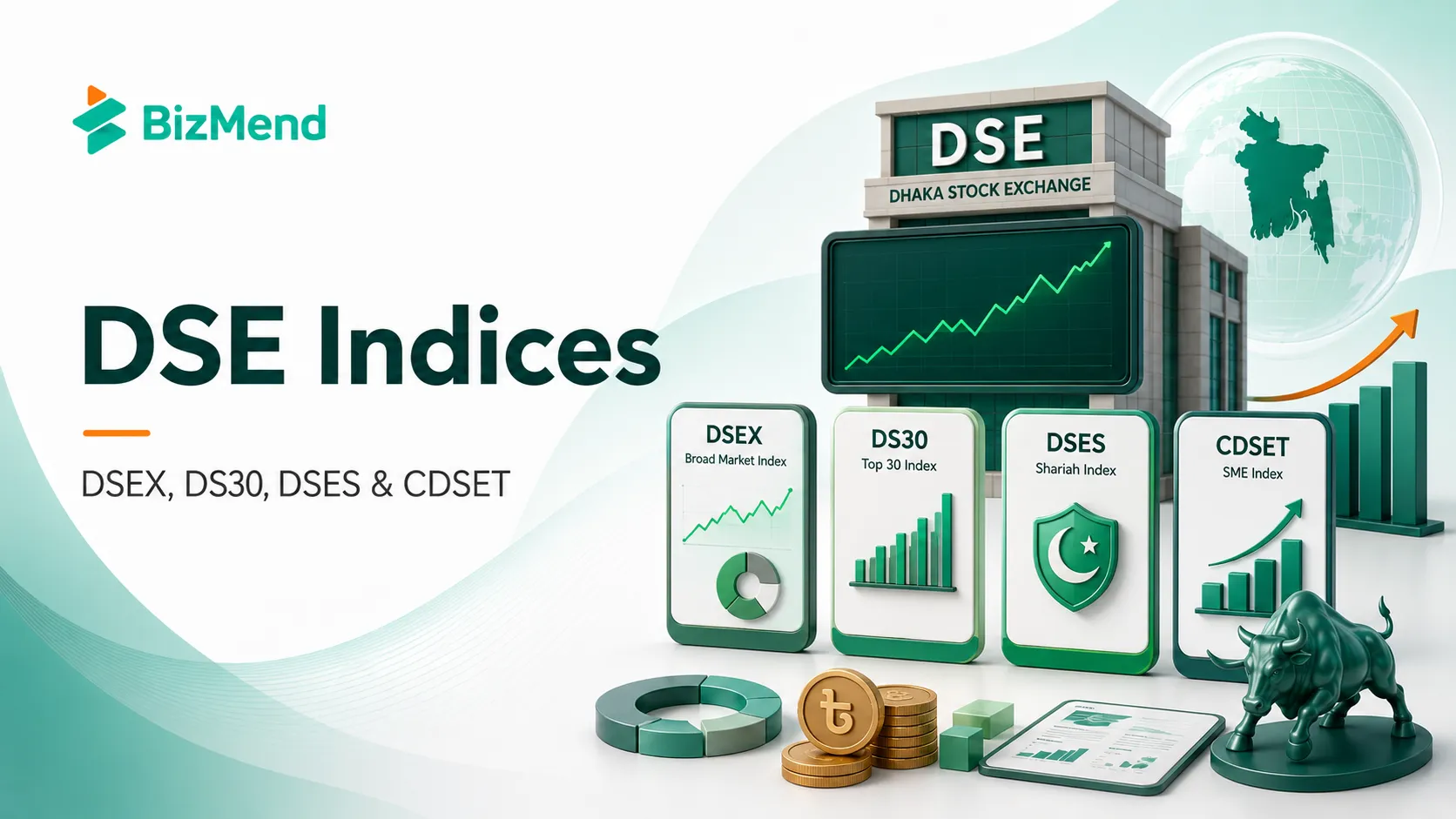
| Index | Launched | Coverage | Key Feature |
|---|---|---|---|
| DSEX | Jan 28, 2013 | ~97% of equity market cap | Main broad benchmark; S&P Dow Jones methodology |
| DS30 | Jan 28, 2013 | ~51% of equity market cap | Top 30 companies; rebalanced every 6 months |
| DSES | Jan 20, 2014 | Shariah-compliant subset of DSEX | For Islamic finance investors |
| CDSET | — | SME platform companies | Tracks small and medium enterprise listings |
DSEX: The Main Benchmark
DSEX (DSE Broad Index) is the number every analyst quotes. Launched January 28, 2013 with base year 2008 and base value 1,000, it was designed by S&P Dow Jones Indices using float-adjusted market cap weighting and covers approximately 97% of DSE’s equity market capitalization.
Real performance data, all from primary sources:
- All-time high: 7,329 points in September 2021 (CEIC)
- September 2, 2025: 5,621 points, crossing 5,600 for the first time in 11 months (BSS News)
- December 2025: approximately 4,865 points (CEIC)
- April/May 2026: approximately 5,234–5,248; 52-week range 4,588–5,674 (Investing.com)
- P/E ratio (October 2025): 9.9 (CEIC)
DS30: The Blue-Chip 30
DS30 tracks the 30 largest companies by float-adjusted market cap and reflects approximately 51% of total DSE equity market cap. Constituents are reviewed every six months. Minimum float-adjusted market cap for eligibility: BDT 100 million. Launched alongside DSEX on January 28, 2013.
DSES: For Shariah-Compliant Investing
DSES (DSE Shariah Index) was launched on January 20, 2014 as a Shariah-compliant subset of DSEX. S&P Dow Jones Indices consulted on its methodology. If you invest according to Islamic finance principles, DSES is your primary reference for which DSE-listed stocks qualify. The screening is rules-based, not discretionary.
CDSET: The SME Index
CDSET tracks companies on DSE’s SME platform. It’s smaller and less liquid than the main indices but relevant for investors interested in growth-stage companies seeking early capital.
How DSE Trading Works
Trading Hours and Sessions
DSE is open Sunday through Thursday, 10:00 AM to 2:30 PM Bangladesh Standard Time (BST). During Ramadan, the session shortens to 10:00 AM to 2:00 PM BST. The exchange is closed on Fridays, Saturdays, and gazetted public holidays.
Real-world scale: on April 27, 2026, DSE recorded 235,384 total trades, with 290,559,104 shares traded and a session turnover of Tk. 9,560.103 million (~Tk. 956 crore), per DSE official data.
What’s Traded on DSE
- Equity shares: Ordinary shares in listed companies
- Mutual fund units: Both open-end and closed-end funds
- Government treasury bonds: 233 listed as of October 2025 (CEIC)
- Corporate bonds: 16 listed as of October 2025 (CEIC)
- Debentures: Various fixed-income debt instruments
Settlement for all equity transactions runs through CDBL (Central Depository Bangladesh Limited), the country’s only securities depository. Every share you buy gets credited electronically to your BO account after settlement.
What’s listed on the DSE?
DSE organizes its companies into 22 industrial sectors. Based on September 2025 session data (BSS News), the most active by daily trading volume are: Pharmaceutical and Chemicals (approximately 12.9% of turnover), Engineering (approximately 11.5%), and Bank (approximately 11.0%).
Other significant sectors include Food and Allied, Fuel and Power, Insurance, Textile, Financial Institution, IT, Cement, Ceramics, Jute, and Telecom.
| Metric | Figure | Source |
|---|---|---|
| Listed companies | ~625 | Wikipedia (April 2026) |
| Industrial sectors | 22 | DSE |
| Listed corporate bonds | 16 | CEIC (October 2025) |
| Listed treasury bonds | 233 | CEIC (October 2025) |
| Market cap (2024) | BDT 6.62 trillion | DSE / CEIC |
| USD equivalent (2024) | ~USD 87.9 billion | World Bank |
| Market cap (2023) | BDT 7.70 trillion | CEIC |
Notable listed companies include Grameenphone (telecom), BATBC (British American Tobacco Bangladesh), BRAC Bank, Square Pharmaceuticals, Berger Paints Bangladesh, Summit Power, and Marico Bangladesh, among others.
DSE Governance and Ownership
Who Governs DSE
DSE is run by a 25-member board of directors:
- 12 directors elected from DSE trading members (TREC holders)
- 12 directors selected from different trade bodies and relevant organizations
- 1 CEO, serving as the 25th ex-officio member
This structure was put in place as part of the 2013 demutualization to separate ownership from trading rights and reduce conflicts of interest.
The Chinese Stake
Since May 2018, the Shenzhen Stock Exchange (SZSE) and Shanghai Stock Exchange (SSE) collectively hold a 25% strategic stake in DSE. They purchased 450 million shares at Tk. 22 each. The total deal value including premium was $125 million (DSE Managing Director, Reuters via BenarNews, May 2018). The consortium holds one board seat and committed to approximately Tk. 300 crore in technical support.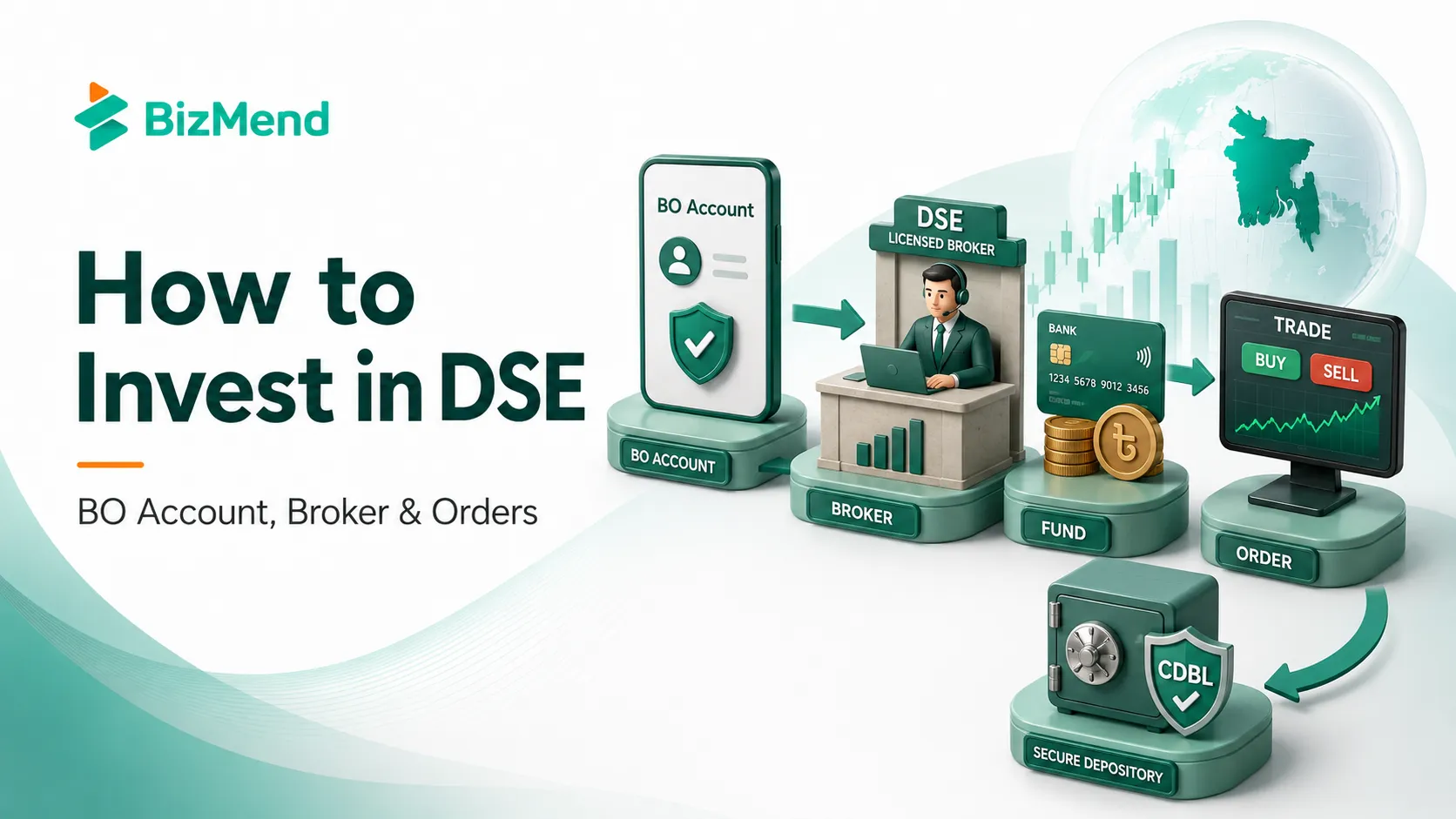
How to Start Investing on the DSE
Step 1: Open a BO Account
Every investor needs a BO (Beneficiary Owner) account through CDBL. Open one online at cdbl.com.bd/bo by selecting a BSEC-licensed depository participant.
Documents needed for a Single or Joint BO account: 2 passport-sized photos, NID or passport copy, bank account details (cheque copy), and nominee information with photo and NID.
If you’re building your banking infrastructure alongside your investment account, the guide on how to open a business bank account in Bangladesh covers the most important steps.
Step 2: Choose a Licensed Broker
Buy and sell shares through a BSEC-licensed stock broker (TREC holder). Always verify your broker at sec.gov.bd before depositing funds. Most brokers now offer online platforms and mobile apps.
When comparing brokers, consider which bank they partner with for fund transfers. The guide on best private banks in Bangladesh covers banks with strong digital capabilities for investors.
Step 3: Fund Your Account and Place Orders
Deposit taka into your broker’s client account through your linked bank. Place buy orders via your broker’s platform: specify the company, price, and quantity. When your order matches a seller’s price in the DSE order book, the trade executes. Shares arrive in your BO account after settlement via CDBL.
To sell: place a sell order, wait for a match, and receive the proceeds in your brokerage account after settlement.
IPOs on the DSE: What You Need to Know
When a private company lists on DSE for the first time, it does so through an Initial Public Offering (IPO). You apply through your BO account during the subscription window. If the IPO is oversubscribed, a lottery determines who gets shares.
Key rule for NRBs: 10% of shares in every IPO are reserved specifically for Non-Resident Bangladeshis under BSEC regulations.
No new companies were approved for IPO listings in 2024 (Wikipedia, April 2026). That’s an unprecedented freeze, reflecting structural issues around governance and disclosure requirements that family-owned businesses are unwilling to meet.
NRBs interested in investing through an internationally structured entity can also explore US company formation from Bangladesh as part of broader financial planning.
The Honest Performance Picture: What the Data Actually Shows
The numbers aren’t great. I’ll be direct about that.
The DSEX peaked at 7,329 points in September 2021. By December 2025 it fell to approximately 4,865 points, a roughly 34% drop. It’s since recovered to the 5,230–5,280 range by April/May 2026 (Investing.com), but remains well below its 2021 peak.
- Turnover collapse: Daily trading volume is down over 60% from 2021 levels (IJSSCFRT Capital Market Research, 2025). Thin markets limit your ability to exit positions quickly.
- Foreign capital flight: Foreign equity holdings fell approximately 70% over five years, from $2,995 million in 2020 to $914.58 million at end of December 2025 (Bangladesh Bank data, LankaBD). Total foreign portfolio investment fell from $4.731 billion (2020) to $1.56 billion (end-2025).
- IPO freeze: Zero new IPO approvals in 2024. A healthy exchange needs quality listings. Their absence is a clear signal.
- Market cap at 20% of GDP: Well below comparable emerging market exchanges.
- Manipulation history: The 2010–2011 crash was followed by a government panel finding systematic manipulation at multiple levels.
For investors exploring products outside equities, the guide on non-bank financial institutions in Bangladesh covers alternative investment vehicles. If you’re also building a business, the guide on how to start a business in Bangladesh gives you the legal and financial structure you’ll need. For NRBs funding accounts from abroad, the guide on top foreign banks in Bangladesh covers the strongest cross-border remittance options.
Key Insights
- DSE was incorporated April 28, 1954, began trading in 1956, and was renamed “Dacca Stock Exchange Ltd” on May 14, 1964 (DSE Annual Report 2023-24). It demutualized on November 21, 2013.
- Four indices run concurrently: DSEX (~97% of equity market cap, main benchmark), DS30 (top 30 companies, ~51% of cap), DSES (Shariah-compliant subset), and CDSET (SME platform). All use S&P Dow Jones Indices methodology.
- A Chinese consortium holds 25% of DSE since May 2018: 450 million shares at Tk. 22 each, $125 million including premium (BenarNews, May 2018), one board seat, and ~Tk. 300 crore technical support commitment.
- DSEX’s 52-week range as of May 2026: 4,588 to 5,674 (Investing.com). It peaked at 7,329 in September 2021 and fell to ~4,865 by December 2025 before partially recovering.
- To invest, you need a BO account at cdbl.com.bd/bo, a BSEC-licensed broker (verify at sec.gov.bd), and a linked bank account. NRBs get 10% of every IPO reserved exclusively for them.
- No new IPOs were approved in 2024 (Wikipedia, April 2026). Foreign equity holdings fell ~70% to $914.58 million by end-2025 (Bangladesh Bank). Daily turnover is down 60%+ from 2021.
- DSE handles ~95% of Bangladesh’s total capital market turnover, operating Sunday–Thursday, 10:00 AM–2:30 PM BST, with automated trading since 1998.
Frequently Asked Questions
What is the Dhaka Stock Exchange and where is it located?
The Dhaka Stock Exchange (DSE) is Bangladesh’s primary stock exchange, incorporated on April 28, 1954 and located at DSE Tower, Plot 46, Road 21, Nikunja-2, Dhaka-1229. It accounts for approximately 95% of Bangladesh’s total capital market trading turnover and is regulated by BSEC. Website: dsebd.org.
What are the trading hours of the Dhaka Stock Exchange?
DSE is open Sunday through Thursday, 10:00 AM to 2:30 PM Bangladesh Standard Time (BST). During Ramadan, hours shorten to 10:00 AM to 2:00 PM BST. The exchange is closed on Fridays, Saturdays, and official public holidays declared by the exchange.
What is the DSEX index and how does it work?
DSEX (DSE Broad Index) is DSE’s main benchmark, launched January 28, 2013 with base year 2008 and base value 1,000. Designed by S&P Dow Jones Indices using float-adjusted market cap weighting, it covers approximately 97% of DSE’s equity market cap. As of April/May 2026, it traded around 5,234–5,248 (Investing.com). Its all-time high was 7,329 points in September 2021 (CEIC).
What is the difference between DSEX and DS30?
DSEX is DSE’s broad-market index covering all eligible listed companies, reflecting ~97% of equity market cap. DS30 tracks only the 30 largest by float-adjusted market cap and reflects ~51% of equity market cap. DS30 constituents are reviewed every six months; minimum float-adjusted market cap required is BDT 100 million. Both were launched January 28, 2013.
Who owns and governs the Dhaka Stock Exchange?
DSE is governed by a 25-member board: 12 directors elected from trading members (TREC holders), 12 from trade bodies and organizations, and the CEO as the 25th ex-officio member. A Chinese consortium (Shenzhen and Shanghai stock exchanges) holds a 25% strategic stake acquired in May 2018 for $125 million including premium.
How do I invest in the Dhaka Stock Exchange?
Open a BO account at cdbl.com.bd/bo through a BSEC-licensed broker, fund your brokerage account through a linked bank, and place buy orders through your broker’s trading platform or app. Shares are credited to your BO account after settlement via CDBL. Always verify your broker’s license at sec.gov.bd before transferring funds.
What sectors are listed on the Dhaka Stock Exchange?
DSE has 22 industrial sectors including Bank, Engineering, Pharmaceutical and Chemicals, Food and Allied, Fuel and Power, Insurance, Textile, Financial Institution, IT, Cement, Ceramics, and Mutual Fund. Based on September 2025 session data, pharmaceutical (12.9%), engineering (11.5%), and banking (11.0%) sectors were most active by daily turnover (BSS News, September 2025).
Can NRBs invest in the Dhaka Stock Exchange?
Yes. Non-Resident Bangladeshis (NRBs) can open an NRB BO account through a BSEC-licensed broker and invest in DSE-listed securities. They need a foreign currency (FC) account in Bangladesh for remittances. 10% of shares in each DSE IPO are reserved specifically for NRB investors under BSEC regulations.
What are the main risks of investing in the DSE?
The main risks are: DSEX down approximately 34% from its September 2021 all-time high; daily turnover down 60%+ from 2021 peak; foreign equity holdings down ~70% over five years to $914.58 million at end-2025 (Bangladesh Bank); zero new IPO approvals in 2024; market cap at only ~20% of GDP; and a documented history of market manipulation (2010–2011 crisis).
Final Thoughts
Honestly, the Dhaka Stock Exchange is a market with genuine long-term promise trapped in a short-term credibility problem. A P/E of 9.9 sounds cheap on paper. But foreign capital has been walking out for five years, there were no new IPOs in 2024, and daily turnover is a fraction of what it was at the 2021 peak. These aren’t signs of a market about to snap back just because valuations look low.
If you’re thinking about entering DSE right now, I’d start small, open a BO account, put modest money into a mutual fund, and spend the first six months simply watching before picking individual stocks. What piece of information would change your mind about investing in DSE today?