How to Become a Daraz Seller in Bangladesh: Registration, Fees & Growth
Learn how to become a Daraz seller in Bangladesh, register an account, list products, understand fees, manage orders, and grow…
 by Sheikh Ornob

A practical guide to real estate investment in Bangladesh. Compare rental yields, property prices, buying costs, risks, and legal steps for Dhaka investors.
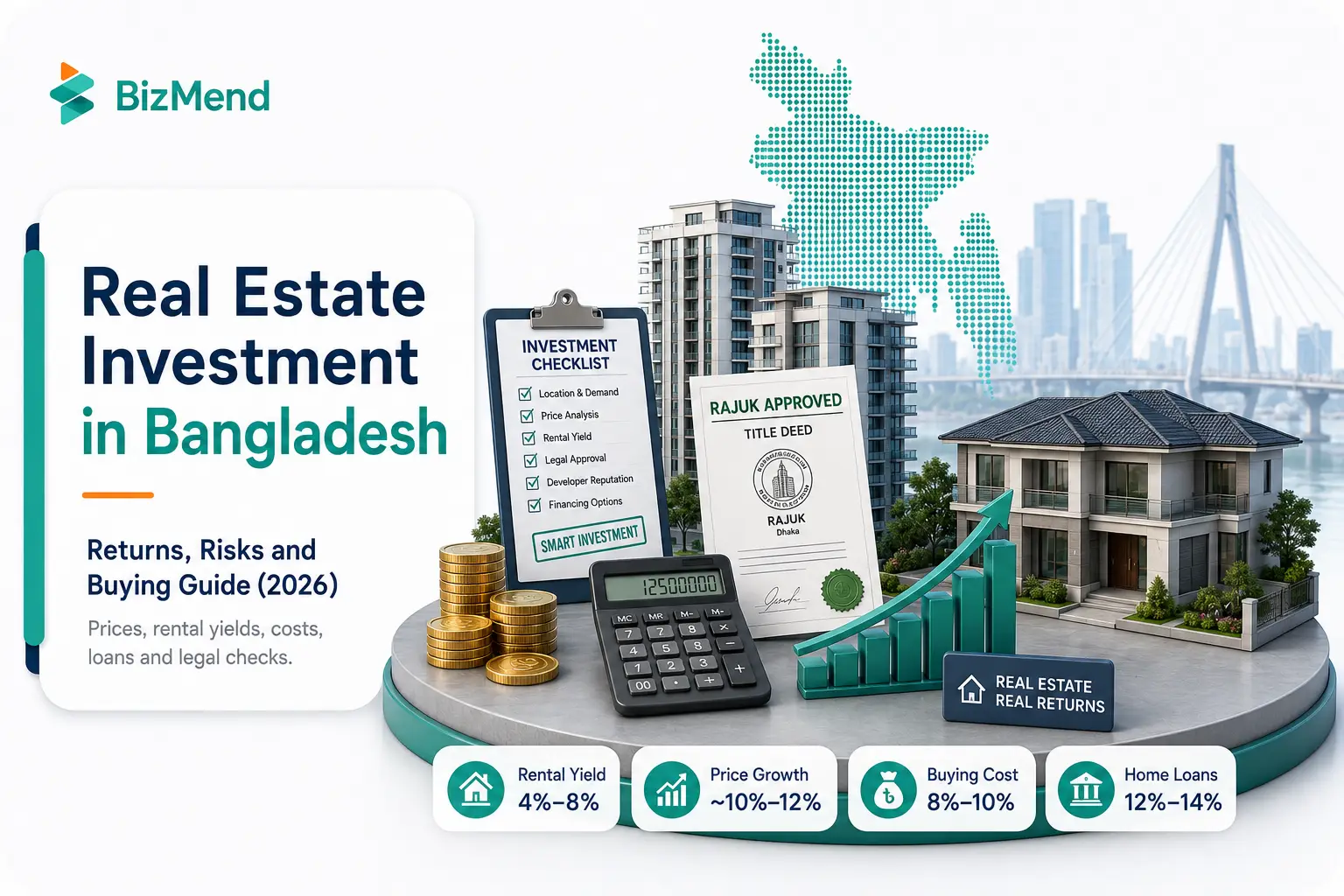
Property is still how most Bangladeshis build wealth. It beats keeping money in a savings account for many people, and that won’t change anytime soon. But the market in 2026 is more complicated than most guides let on. Interest rates hit historic highs, regulatory changes slowed sales, and title fraud remains a real risk. This guide covers real estate investment in Bangladesh honestly, including price ranges, actual rental yields, registration costs, home loan realities, and the legal checks that protect your money.
Quick Answer: Real estate investment in Bangladesh can offer rental income and long-term capital appreciation, but returns vary heavily by location, property type, purchase price, financing cost, and market timing. Apartment prices in Dhaka range from BDT 6,000 to BDT 45,000 per square foot depending on location. Total buying costs including stamp duty, registration, VAT, and mutation fees typically reach 8-10% of the purchase price in 2026.
A large share of Dhaka residents depend on rental housing, creating steady tenant demand, especially in employment-heavy and transit-connected areas. That’s an enormous permanent tenant pool. Combine that with strong urban population growth and Dhaka’s continued pull for workers from across the country, and you get a market where rental demand remains significant.
Property also functions as an inflation hedge here. When inflation runs high, as it did through 2024 and 2025, cash loses value fast. Land and apartments hold real value because they’re tied to physical assets in a supply-constrained city.
That said, the easy-money era is over. High borrowing costs, regulatory revisions, and political uncertainty in 2024-2025 reshaped who is actually buying and at what price.
Dhaka has over 22 million people, per BBS population projections. The government banks in Bangladesh Infrastructure projects such as the MRT Metro Rail and Dhaka Elevated Expressway are improving connectivity, which can support property demand and prices in connected areas. Purbachal, Keraniganj, and Uttara sectors are seeing faster price growth than central zones precisely because of these infrastructure links.
The Real Estate and Housing Association of Bangladesh (REHAB) states the real estate sector contributes approximately 7-8% to national GDP and employs over 3.5 million people directly and indirectly. This scale means the government has strong incentive to keep the sector functioning.
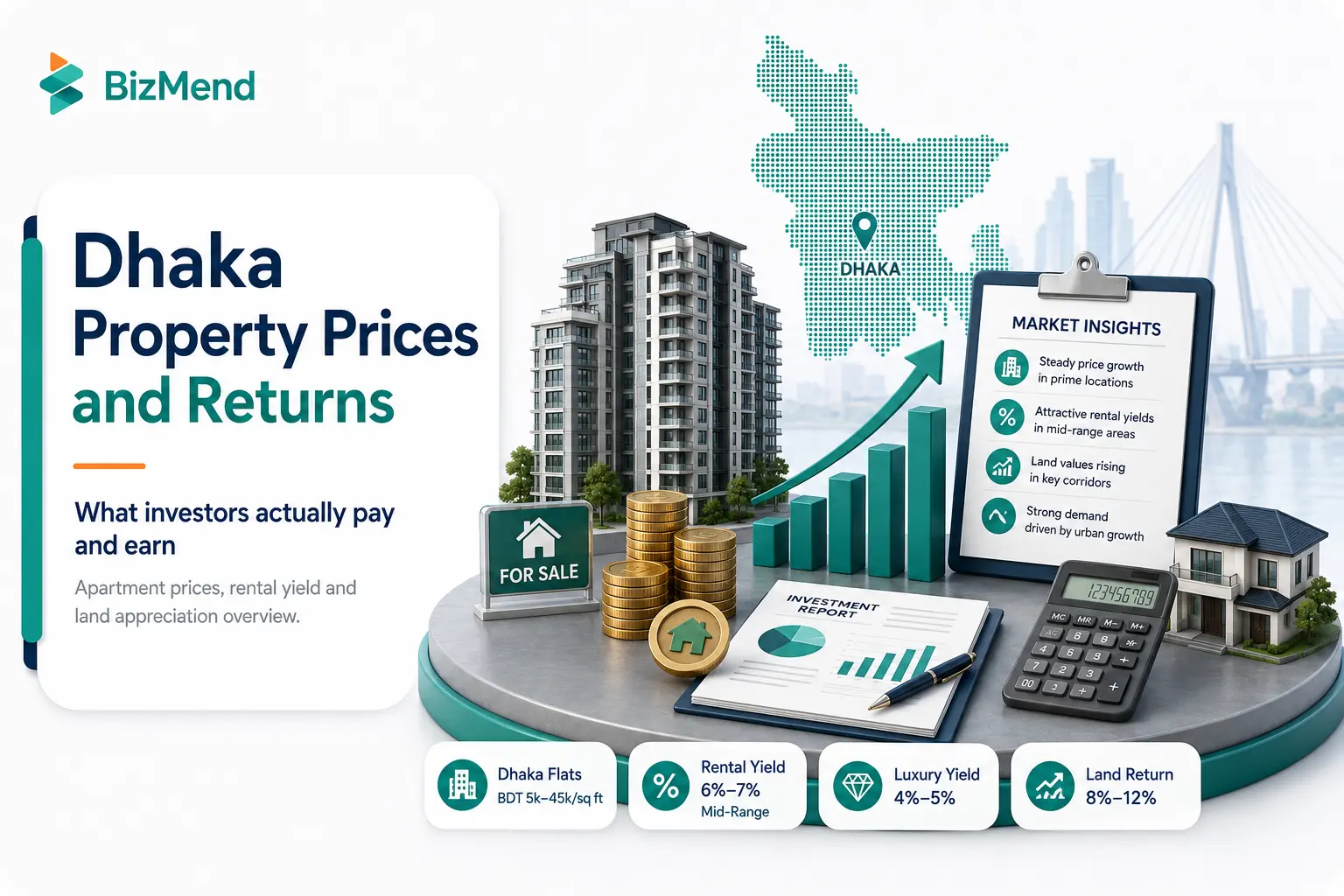
Prices vary enormously by location. Here’s an estimated market breakdown of apartment prices per square foot across Dhaka’s main zones in 2025, based on developer sources and property market analysis:
| Area | Price Range (per sq ft) | Buyer Profile |
|---|---|---|
| Gulshan | BDT 15,000 to 45,000 | NRBs, executives, diplomats |
| Banani | BDT 13,000 to 40,000 | Corporate professionals, NRBs |
| Baridhara | BDT 14,000 to 40,000 | Foreign missions, high-net-worth buyers |
| Dhanmondi | BDT 8,000 to 35,000 | Upper-middle class, families |
| Bashundhara | BDT 8,000 to 18,000 | Mid-to-high income families |
| Uttara | BDT 5,000 to 16,000 | Families, young professionals |
| Mirpur | BDT 5,000 to 18,000 | Budget investors, middle-income |
Note: Rates are averages from developer and market data as of 2025. Prices shift based on developer reputation, floor level, orientation, and specific project features. Always verify current rates before committing.
Construction costs jumped approximately 20% in 2024, per industry reports. That cost increase has fed directly into apartment prices, so don’t expect the premium zones to get cheaper.
Land remains a popular long-term bet in Bangladesh. Semi-urban areas like Purbachal, Keraniganj, Savar, and Narayanganj outskirts attract investors willing to wait 5-10 years. Some market reports suggest land prices in emerging areas like Purbachal have appreciated over time, but exact returns vary by plot location, title status, access road, and development progress. Returns on land in semi-urban zones can vary widely depending on location, infrastructure development, legal status, and holding period.
The appeal: no maintenance costs, no tenant headaches, and supply that doesn’t increase. The downside: zero rental income while you wait, and title verification is more complex in peri-urban zones where land records are less organized. For investors with capital tied up in business entities, the non-bank financial institutions in Bangladesh offer project financing options for land development that commercial banks sometimes won’t touch.
Gross rental yields in Dhaka vary widely by area, property type, and purchase price, so investors should calculate yield property-by-property. That number looks reasonable until you compare it to current home loan rates of 12-14%. If you’re financing a property to rent it out, the math gets tight fast.
Here’s how yields break down by zone in Dhaka:
The mid-range zone often beats luxury in rental yield terms. A two-bedroom flat near an MRT station in Mirpur typically stays occupied and delivers better yield than a premium Gulshan apartment where rents, while higher in absolute terms, don’t keep pace with the far higher purchase price. Rents have been rising approximately 5-6% per year, according to Global Property Guide data cited by industry sources.
Commercial property in Gulshan, Banani, and Motijheel delivers 8-12% rental yield and tenants often sign 5-10 year leases, giving stability. But entry capital is significantly higher. You need at least BDT 1 crore for meaningful commercial space, and vacancy during political uncertainty can be prolonged. Residential property is lower yield but more liquid and easier to manage for individual investors.
Most buyers focus on the apartment price and forget everything else. Don’t do that. Total buying costs in Bangladesh can be significant and vary by property type, location, declared value, and current government rules. Buyers should confirm the latest costs with the Sub-Registrar Office, NBR, and a property lawyer before closing.
Here’s what makes up that 8-10%:
For a BDT 1 crore flat, you’re looking at BDT 8-10 lakh in additional costs on top of the purchase price. Budget for this from day one. Understanding your banking options ahead of any purchase matters. A quick look at the types of bank accounts in Bangladesh helps you understand which account structures work best for property financing and fund management during the purchase process.
This is the section most guides skip because it’s uncomfortable. Here’s the truth.
According to Bangladesh Bank data reported by The Daily Star in March 2026, housing loan interest rates rose to as high as 17% in January 2024, up from a maximum of 9% in January 2022. Rates remained elevated through January 2026.
Industry sources reported a significant sales decline in 2026, with some developers seeing 20-25% lower sales volume. Even stable developers like Concord Group reported 20-25% volume drops. High monthly installments pushed many salaried buyers out of the market entirely.
Most sources cite current home mortgage rates at 12-14% from private commercial banks in 2026. State-owned banks sometimes offer slightly lower rates but involve longer processing times. Islamic banking options like Ijara and Murabaha are available through dedicated Islamic banks for buyers seeking interest-free structures.
Banks typically finance 70% of the property value, with loan tenures of 15-25 years. Minimum monthly income requirements vary: most private banks ask for at least BDT 30,000-50,000 monthly gross income. Before taking any home loan, compare offers across multiple banks. The top private banks in Bangladesh shows which institutions are financially sound, which matters when you’re committing to a 20-year loan. And check whether the bank is in Bangladesh Bank’s green zone before signing anything. The red, yellow, and green zone bank classifications are publicly maintained and updated regularly.
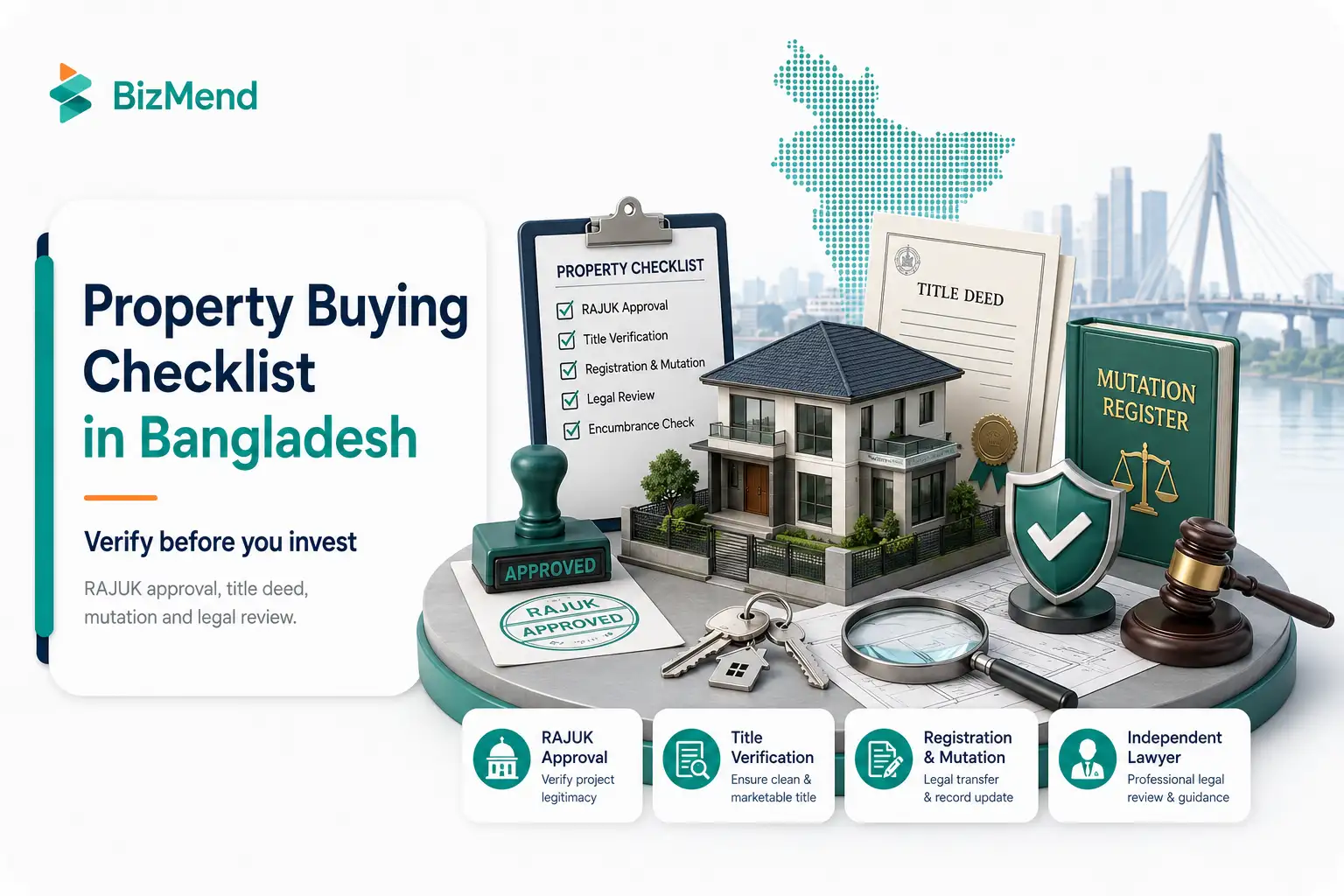
This step is where most buyers fail. A cheap apartment from an unknown developer with no RAJUK approval is a legal and financial trap. Here’s what to verify:
Step 1: Check RAJUK approval. All residential projects in Dhaka require building construction permission from RAJUK (Rajdhani Unnayan Kartripakkha). Ask for the approved building plan and land use clearance certificate. RAJUK uses an online construction permitting system, but buyers should check the current portal status and verify approval documents directly before purchasing.
Step 2: Confirm REHAB membership. REHAB (Real Estate and Housing Association of Bangladesh) membership adds credibility. Founding members like BTI, Concord, Sheltech, and Navana have long track records and transparent documentation. Check the REHAB member directory before buying from an unfamiliar developer.
Step 3: Verify the land title. Request the CS, SA, RS, and BS Khatian documents from the seller or developer. Check for encumbrances, mortgages, or disputes via the Sub-Registry Office. Hire an independent lawyer, not one recommended by the developer, to review the deed and ownership chain.
Step 4: Check mutation and land tax receipts. Mutation confirms legal ownership in government records. Missing mutation is a red flag. Unpaid land taxes can block registration.
Step 5: Confirm the developer’s track record. Ask for completed project addresses. Visit them. Talk to residents. A developer who can’t show you finished buildings is a risk.
Under the Real Estate Development and Management Act 2010, developers must have approved designs before selling and cannot make unilateral changes to agreed floor plans or facilities. If a developer fails to hand over on time, they are legally liable for compensation.
Real estate investment in Bangladesh isn’t risk-free. Honest assessment before you invest matters more than any promotional brochure.
Title disputes and fraud: Fake deed chains and forged ownership documents are a documented problem. Legal practitioners quoted by The Daily Star have noted that a significant number of property disputes stem from improper documentation verification. Always use an independent lawyer.
DAP regulatory uncertainty: RAJUK’s Detailed Area Plan revisions since 2023 created extended uncertainty for developers. Repeated changes to allowable building heights and floor area ratios slowed new project launches. The policy framework took nearly three years to finalize, per Tropical Homes Limited’s director quoted in The Daily Star.
High borrowing costs in 2025-2026: Home loan rates remain elevated. If you’re financing a purchase with a 13-14% mortgage and earning 6-7% gross rental yield, the numbers don’t work without significant equity upfront.
Liquidity risk: Property in Bangladesh is not easy to sell quickly. If you need cash fast, selling a Dhaka apartment in a depressed market can take months and require price reductions.
Political and economic uncertainty: Sales fell 30% industry-wide in 2026. Market confidence is slowly returning, but volatility risk remains. The investment banking in Bangladesh context is useful here for understanding how to compare property against other asset classes with a clear head.
Non-Resident Bangladeshis are a significant driver of the Dhaka property market, particularly in premium zones like Gulshan, Baridhara, and Bashundhara. Bangladesh Bank allows NRBs to take home loans in local currency for property purchases inside Bangladesh. Some banks may offer dedicated NRB home-loan products, but tax treatment, registration fees, and documentation requirements should be confirmed directly with the bank, NBR, embassy/high commission, and a property lawyer.
For NRBs buying from abroad, working through REHAB-member developers reduces transaction risk significantly. Documents need verification by the relevant Bangladeshi embassy or high commission in the buyer’s country of residence. NRBs who also have business interests back home often need to formally register business entities before purchasing commercial property. Business Globalizer’s guide on how to register a company in Bangladesh is a useful reference for that side of the equation.
Yes, with careful planning. Dhaka apartments currently deliver average gross rental yields of approximately 6.8-6.9%, with capital appreciation running at about 10-12% annually in key areas. However, high home loan interest rates of 12-14% in 2026 make leveraged investment difficult. Investors using significant personal equity tend to see better net returns than those financing heavily through bank loans at current rates.
Apartment prices in Dhaka range from BDT 6,000 to BDT 45,000 per square foot depending on location. Gulshan and Banani command BDT 15,000 to 45,000 per square foot. Mid-range areas like Mirpur and Uttara sit at BDT 5,000 to 18,000 per square foot. These figures reflect 2026 developer and market analysis data and should be verified with current listings before any purchase decision.
Total property registration costs in Bangladesh typically reach 8-10% of the purchase price in 2026 after recent government reforms, reduced from 14-15% previously. This includes stamp duty (approximately 4-5% of declared value), a registration fee (1-2% of assessed value), VAT on developer-sold flats, mutation fees, and legal charges. Confirm current rates at the relevant Sub-Registrar Office before closing.
Housing loan interest rates in Bangladesh rose to as high as 17% in January 2024 per Bangladesh Bank data reported by The Daily Star in March 2026, and remained elevated through early 2026. Most private commercial banks offered mortgages at 12-14% through 2026. Always compare current rates across multiple banks before applying, as rates are linked to market benchmarks and revised every six months by most lenders.
RAJUK (Rajdhani Unnayan Kartripakkha) is Dhaka’s urban development authority that issues building construction permissions. All residential projects in Dhaka require RAJUK approval before construction begins. Buying a flat in an unapproved building puts you at risk of demolition orders, blocked registration, and difficulty reselling. Always request and independently verify the approved building plan before signing any purchase agreement.
Non-Resident Bangladeshis can buy property in Bangladesh and access home loans in local currency through Bangladesh Bank-approved arrangements. Working through REHAB-member developers reduces transaction risk when purchasing from abroad. Documents typically need verification by the Bangladeshi embassy or high commission in the buyer’s country of residence. Some banks offer NRBs specific tax relief and reduced registration fees in certain circumstances.
Key risks include title fraud through forged ownership documents, regulatory uncertainty from RAJUK’s Detailed Area Plan revisions, elevated home loan rates that compress net returns, market liquidity issues making quick resale difficult, and political or economic instability affecting buyer confidence. Industry-wide sales fell approximately 30% in 2025. Independent legal due diligence is the most effective risk mitigation tool available to buyers.
They serve different goals. Land in semi-urban areas like Purbachal, Keraniganj, and Savar has delivered annualized appreciation of 8-12% with no maintenance costs, but zero rental income while you wait. Apartments deliver rental income of 6-7% gross yield in mid-range areas alongside capital appreciation. For passive income: apartments. For long-term wealth building with patient capital: land in emerging zones. Both require thorough title verification.
Check for RAJUK building plan approval for the specific project, confirm REHAB membership, request completed project addresses and visit them, and hire an independent lawyer to verify CS, SA, RS, and BS Khatian land documents. Check for encumbrances at the Sub-Registry Office and review the developer’s track record on project delivery timelines. Under the Real Estate Development and Management Act 2010, developers cannot make unilateral changes to agreed designs after contracts are signed.
Honestly, Bangladesh real estate still makes sense as a long-term investment for the right buyer. The demand fundamentals, 80% of Dhaka renting, urbanization at 3.5% annually, infrastructure buildout in every direction, those aren’t going away. But 2026 has been a rough year for the market, and the honest truth is that high interest rates, regulatory uncertainty, and political headwinds have made this a more complicated decision than it was three years ago.
If I were advising a first-time investor today, I’d say this: verify the title and the RAJUK approval with an independent lawyer before anything else. Not after you’ve fallen in love with the flat. Before. That one step eliminates most of the real horror stories. What’s your current biggest question about buying or investing in Bangladesh property? (Based on – 2025)

Learn how to become a Daraz seller in Bangladesh, register an account, list products, understand fees, manage orders, and grow…
by Sheikh Ornob
Compare the cost of living in Bangladesh in 2026, including Dhaka and Chittagong rent, food, transport, utilities, inflation, and monthly…
by Sheikh Ornob

Learn MoA and AoA requirements in Bangladesh, key clauses, drafting basics, RJSC filing steps, amendments, and common company-registration mistakes. Suggested…
by Sheikh Ornob