

 by Sheikh Ornob
Withholding tax in Bangladesh matters because it shows up in the ordinary flow of business, not just at year-end. When you pay a contractor, rent an office, settle a professional fee, or process salaries, tax can attach to that payment before the money even reaches the other side.
That is why this topic matters in Bangladesh. The National Board of Revenue, or NBR, treats source tax as a live compliance step, not a year-end cleanup. If you deduct too little, too late, or skip the paperwork, the cash pain can land on your business, not just the payee. Let’s make it plain.
Quick answer: In Bangladesh, withholding tax means the payer deducts tax before releasing money for salaries, rent, contracts, services, commissions, royalties, and some non resident payments. Under section 177 of the Income Tax Act, 2023, withholding returns are generally filed monthly by the 25th, and a wrong deduction can leave your business paying the shortfall.
Key Takeaways
- In everyday business language, withholding tax, source tax, and TDS often point to the same idea: tax is deducted or collected when payment is made.
- The legal trigger is tied to the nature of the payment, not just the size of your business, so a small company can still have a withholding duty.
- Bangladesh uses many payment-specific rules, which is why salary, rent, contractor bills, technical fees, commission, local LC purchases, and non-resident remittances are not handled the same way.
- Some rates are fixed in the law, while others sit within a prescribed range and depend on the exact service type, payment slab, or the payee’s tax status.
- A missing TIN or eTIN can increase the rate in several cases, especially for professional fees and deposit interest.
- Source tax work does not end at deductions. You also need timely deposits, challan support, certificate handling, return filing, and recordkeeping.
- Section 176 of the Income Tax Act treats failure to deduct, underdeduction, or non-deposit as a default, and it can lead to recovery of the short tax plus additional monthly costs.
- The safest habit is to classify the payment before you release it, not after your accounts team is already trying to fix month-end entries.
What Does Withholding Tax Mean in Bangladesh?
Withholding tax in Bangladesh means you do not always pay the full invoice amount to the recipient. You hold back the tax portion, deposit that amount to the government, and pay the balance to the supplier, employee, landlord, consultant, or other recipient.
You will also hear three labels in Bangladesh: withholding tax, source tax, and tax deduction at source. Most businesses use them almost interchangeably. The useful distinction is this: withholding tax describes the outcome, while tax deduction at source describes the action. Either way, the National Board of Revenue is focused on the same question: Did the right payer deduct the right amount at the right time?
Part 7 of the Income Tax Act, 2023, lays out many of these deduction rules by payment type. That is why the answer is rarely a single flat rate for every bill. A payroll payment is treated differently from rent. A contractor bill is treated differently from a royalty payment. That split is where most confusion starts.
Who Actually Has to Deduct It?
The short answer is the payer, if the payment falls under a withholding provision. In practice that can mean a company, partnership, bank, school, hospital, mobile operator, importer, government office, or another specified person under the law.
For salary, section 86 places the duty on the person responsible for the payment. For payments to contractors, suppliers, and similar resident recipients, section 89 applies to payments made by a specified person. For service payments, section 90 does the same. For royalties and similar intangible property payments, section 91 applies. That structure matters because you cannot defend a missed deduction by saying the supplier should have handled the tax personally.
Think of it like a gatekeeping job. Once your business becomes the paying party for a covered transaction, the tax obligation sits with you first. If your accounts team releases the money without checking, the problem does not stay with the vendor. It comes back to your own books.
Withholding tax is a payer-side compliance duty first and a tax assessment question second.
Common Payments That Usually Trigger Source Tax
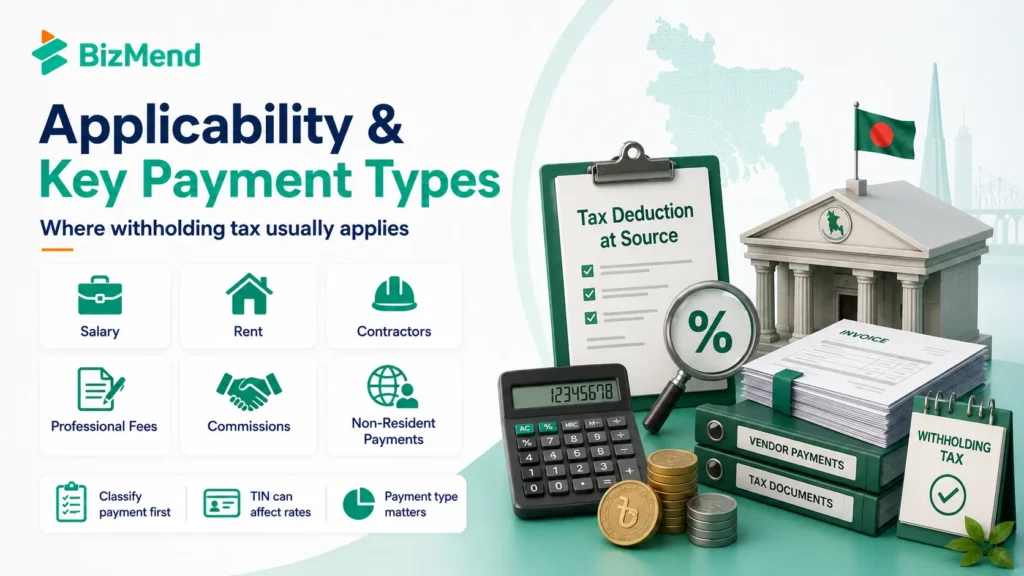
This is the part most operators care about. You want to know which routine payments deserve a tax check before approval. The answer usually includes salaries, contractor and supplier payments, professional or technical fees, rent, commissions, deposit interest, royalties, local LC purchases, and some payments to non-residents.
A recent NBR publication titled Information about Deduction of Income Tax at Source, published in April 2026, gives a practical rate guide that businesses still use for day-to-day classification. It lists, for example, slab-based deductions on the supply of goods or contract execution; 5 percent on gross rent for house property in listed tenant situations; and 10 percent or 15 percent treatment for some professional or technical service payments depending on tax identification status.
| Payment type | Current practical example | Why teams trip up |
|---|---|---|
| Salary | Average rate based on estimated annual taxable salary | Payroll has to reflect the employee’s annual tax position, not just one month |
| Supply of goods or contracts | From nil up to 5 percent depending on total payment volume | Teams often apply one flat rate to every vendor bill |
| Professional or technical fees | 10 percent with e-TIN and 15 percent without e-TIN in a common case | Missing tax identification data changes the deduction |
| House rent | 5 percent of gross rent for specified tenant categories | People assume rent is outside source tax because it is not a service invoice |
| Commission and dealer incentives | Section 94 includes 10 percent in common distribution and marketing cases | Incentive payments are often booked under vague ledger names |
| Royalty and intangible property | Section 91 states 10 percent up to Tk 25 lakh and 12 percent above that base amount | Software, trademark, and license payments are often misclassified as generic services |
| Local LC purchase | NBR guide lists 3 percent where purchase through local LC exceeds Tk 5 lakh | Procurement teams may not coordinate with tax teams before the bank process starts |
Two cautions matter here. First, exact rates depend on the legal bucket, the amount, and sometimes the status of the payee. Second, some older business habits still use ordinance era section numbers, while the current framework sits under the Income Tax Act, 2023. So if you are checking a chart, make sure it lines up with the latest NBR guidance and current law.

How Rates Work Without Turning This Into a Law Lecture
Bangladesh does not use one master withholding rate. The law splits payments into categories and then applies either a fixed rate, a rate cap with prescribed treatment, or a slab approach. That is why section 89 says payments to contractors and suppliers can be deducted at a prescribed rate not exceeding 10 percent on the base value, while section 90 allows service payments at a rate not exceeding 20 percent depending on the service.
Some categories are clearer. Section 91 sets 10 percent for certain royalty and intangible property payments up to Tk 25 lakh, then 12 percent above that. Section 92 sets 5 percent on the advertisement income of media. Section 94 covers commission, discount, fees, incentives, and similar distribution or marketing payments and includes 10 percent in one common scenario plus 1.5 percent for some promotion-related payments.
Then there are taxpayer status effects. The NBR TDS guide shows that professional or technical services can move from 10 percent to 15 percent where an e-TIN is not submitted. Interest on deposits also changes in common cases, with 10 percent where TIN is available and 15 percent where it is not. So the rate decision is not just about what you are paying for. It is also about who you are paying and what tax profile they have on file.
The expensive mistake is not usually forgetting a rate table. It is classifying the payment under the wrong heading in the first place.
What Compliance Looks Like in Real Life
1. Classify the payment before release
Do not wait until month end. Check whether the payment is salary, rent, a contractor bill, a service fee, a commission, a royalty, a local LC purchase, or a non-resident remittance before it leaves the approval desk.
2. Confirm the correct rate and tax status
Match the payment to the current law and NBR guidance. Then verify whether the payee has a TIN or eTIN, whether any threshold or slab applies, and whether a treaty or reduced rate certificate is relevant for a non-resident case.
3. Deduct and deposit the tax
Rule 13 of the Income Tax Rules states that sums deducted or collected at source are to be paid to the government within two weeks from the end of the month of deduction or collection. Rule 14 describes payment through income tax challan or electronic transfer. If your internal team waits for the supplier to remind you, you are already late.
4. Keep the supporting trail
Keep the invoice, payment advice, vendor identification, challan details, rate basis, and any certificate or treaty support together. This is where clean bookkeeping saves hours later. If the deduction is questioned, you need to show why that rate was used.
5. File the withholding return
Section 177 of the Income Tax Act, 2023, says the applicable return for the preceding month is generally filed by the 25th of every month, or the next working day if that date falls on a weekly or public holiday. That makes withholding tax a recurring monthly discipline, not a once-a-year cleanup job.
6. Reconcile with ledgers and vendor balances
The deducted amount, the net paid amount, the challan, and the return should all agree. When they do not, problems show up later in supplier disputes, tax assessments, and audit comments.
What Happens If You Get It Wrong?
Section 176 of the Income Tax Act is the part nobody enjoys reading, but it matters. If a person fails to deduct, deducts less than required, or deducts and then fails to deposit the tax, that person can be treated as an assessee in default.
The cost is not only the missing tax. The law also allows recovery of the amount not deducted, less the amount deducted, or not deposited. On top of that, section 176 adds an additional amount at 2 percent per month on the relevant shortfall, computed from the date fixed for deduction or collection to the date of deposit, subject to the statutory cap.
That is why withholding errors hurt twice. First, you may have to fund the tax from your own cash because the payment already left. Second, your monthly compliance record starts looking shaky. For a growing business that needs bank lines, investment comfort, or cleaner audits, that is not a small headache.
Common Mistakes Businesses in Bangladesh Keep Making
- Treating every vendor invoice as a generic service payment when the law uses narrower categories.
- Missing rent-related deduction because the team thinks source tax only applies to suppliers and consultants.
- Ignoring TIN or e-TIN status and therefore deducting at the wrong rate.
- Letting procurement, finance, and accounts payable work in separate lanes with no tax review before payment.
- Depositing tax late because challan preparation is pushed to the end of the month.
- Filing the monthly withholding return without reconciling it to actual deductions and deposits.
- Using old section references without checking how the current Income Tax Act, 2023, recodified the rules.
None of these mistakes are exotic. They happen because the source tax sits in the middle of operations, taxes, and accounting. If ownership is fuzzy, the error rate climbs fast.
Final Thoughts
Withholding tax in Bangladesh is not just a tax rule. It is a payment control rule. If you classify payments early, verify rates before release, and treat the monthly return as a standing task, the system stays manageable. If you leave it for cleanup later, it gets expensive very quickly.
Frequently Asked Questions
Is withholding tax the same as source tax in Bangladesh?
In everyday business use, yes, people usually mean the same thing. Both refer to tax that is deducted or collected when payment is made. If you want to be precise, tax deduction at source describes the action, while withholding tax describes the broader system.
Do all business payments in Bangladesh attract withholding tax?
No. The obligation depends on the payment type and the relevant legal provision. That is why your team should classify whether the payment is for salary, rent, goods, a contract, a service, commission, royalty, interest, a local LC purchase, or a non-resident remittance before releasing funds.
When is the withholding return filed?
Under section 177 of the Income Tax Act, 2023, the applicable return for the preceding month is generally filed by the 25th of every month. If the 25th falls on a weekly or public holiday, the next working day applies.
When should deducted tax be deposited?
Rule 13 of the Income Tax Rules says deducted or collected tax is to be paid to the government within two weeks from the end of the month of deduction or collection. Because procedures can be updated by notification, it is smart to confirm the current payment mechanics before relying on an old office habit.
What if I pay a non-resident supplier or licensor?
You should not assume the resident rules apply. Nonresident payments need separate checking under the relevant withholding provisions, and treaty relief can matter. The Act also allows the Board to issue a reduced rate or no-tax certificate in eligible cases, so cross-border payments need more than a quick ledger code.