How to Become a Daraz Seller in Bangladesh: Registration, Fees & Growth
Learn how to become a Daraz seller in Bangladesh, register an account, list products, understand fees, manage orders, and grow…
 by Sheikh Ornob

Compare the average salary in Bangladesh in 2026 by sector, role, experience, city, banking, IT, software, and government pay.
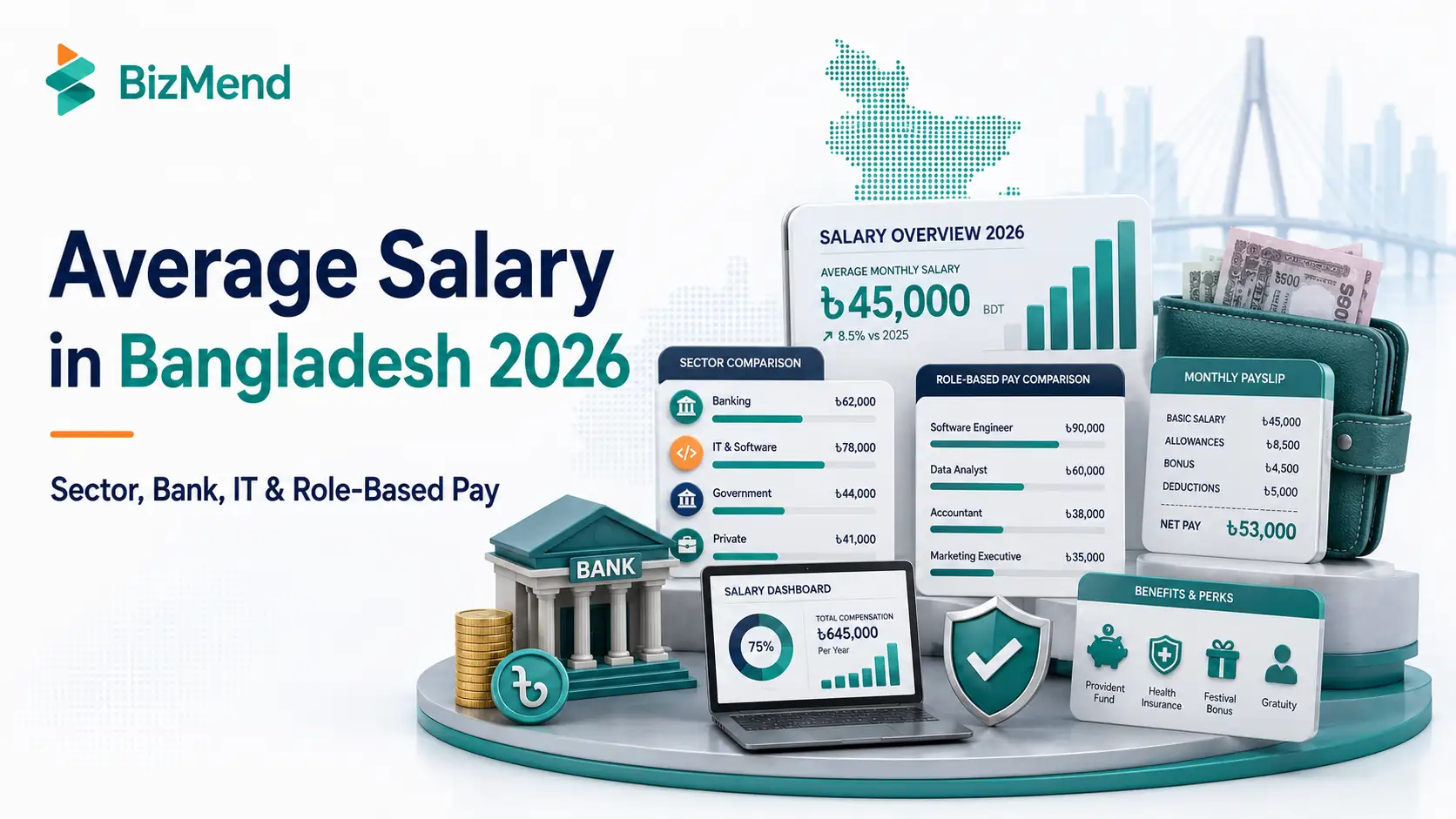
The average salary in Bangladesh varies sharply by sector, role, city, experience, employer size, and total benefits. A single national figure can be misleading because a garment worker, bank officer, software engineer, government employee, and sales manager operate under very different pay structures.
This 2026 guide uses current regulatory context, public-sector pay references, published wage information, and editorial planning ranges based on market observation; the role-based figures are not official national averages. The role-based figures are planning ranges, not guaranteed offers. Always compare a live job description, the employer’s full compensation package, and the date of the source before making a career decision.
Quick Answer: Bangladesh has no single reliable 2026 salary figure for every worker. Many formal entry-level private roles may fall around Tk 18,000-40,000 monthly, while skilled banking, IT, software, finance, and management roles can rise far higher depending on employer, city, benefits, and verified market demand. Sector, experience, city, employer, benefits, and measurable skills matter more than a national average.
An average salary is usually calculated by adding reported salaries and dividing by the number of workers. That number is useful only when the dataset is clearly defined. It may cover formal employees, a specific city, a profession, or self-reported users on a salary platform. It may also exclude informal workers, bonuses, overtime, and benefits.
For Bangladesh, the safer approach is to use a salary band rather than one headline number. A useful salary guide should separate entry-level, mid-level, and senior pay; identify whether the number is basic or gross; and state whether bonuses, provident fund, commission, or allowances are included.
A commonly circulated national salary figure may come from crowdsourced cost-of-living or salary databases rather than an official 2026 payroll census. Treat such figures as directional, not as a legal or universal benchmark.
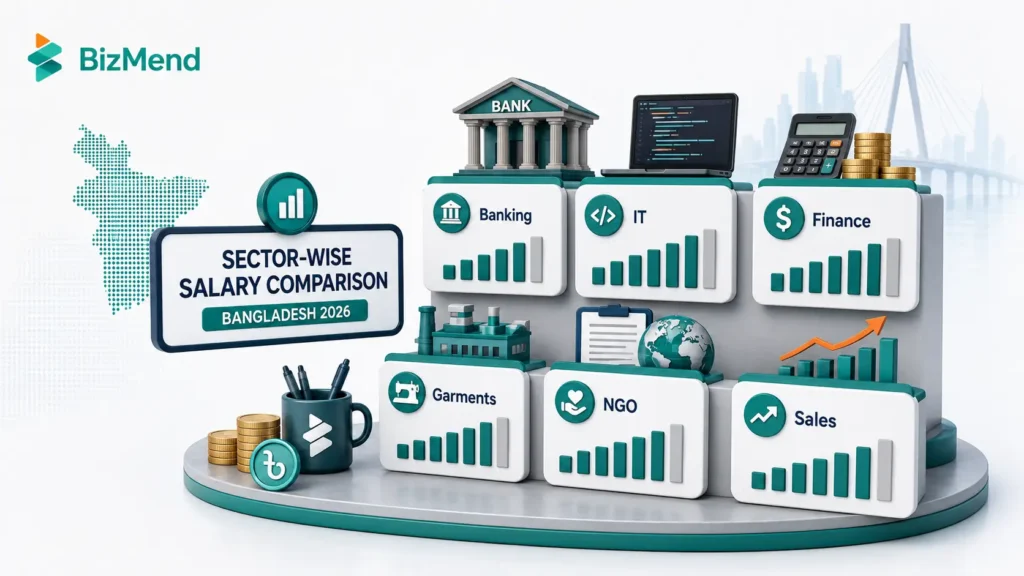
The following table is a practical gross-monthly planning guide for formal private employment. It is an editorial range based on market observation, public-sector and wage references, and selected current vacancy patterns; it is not an official BBS salary table or guaranteed offer range. It is not an official wage schedule, and individual offers can fall outside the ranges.
| Sector or role group | Entry level | Mid level | Senior or specialist | Important context |
| General administration and customer service | Tk 18,000-30,000 | Tk 30,000-55,000 | Tk 55,000-100,000+ | Employer size, English, reporting, and client handling matter. |
| Banking and financial services | Tk 28,000-50,000 | Tk 50,000-100,000 | Tk 100,000-250,000+ | Bank type, grade, targets, and professional banking qualifications affect pay. |
| IT support, QA, networks, and cybersecurity | Tk 25,000-50,000 | Tk 50,000-100,000 | Tk 100,000-220,000+ | Certifications, cloud skills, security depth, and shift work can raise pay. |
| Software engineering and product development | Tk 30,000-65,000 | Tk 65,000-130,000 | Tk 130,000-300,000+ | Product companies, remote clients, architecture, AI, and leadership create a widespread demand. |
| Accounting, audit, and finance | Tk 22,000-40,000 | Tk 40,000-90,000 | Tk 90,000-200,000+ | CA, ACCA, CMA, tax, ERP, and reporting expertise improve earning power. |
| Sales, marketing, and e-commerce | Tk 20,000-40,000 | Tk 40,000-90,000 | Tk 90,000-200,000+ | Commission and performance bonuses may materially change total income. |
| Garments and manufacturing | Tk 12,500-30,000 | Tk 30,000-70,000 | Tk 70,000-180,000+ | Worker grades, overtime, technical roles, compliance, and factory management differ. |
| NGO, development, and research | Tk 25,000-50,000 | Tk 50,000-110,000 | Tk 110,000-250,000+ | Donor funding, project term, technical specialty, and field duty affect packages. |
Note: These are planning ranges, not official national averages or guaranteed offers.
Bank employee salary cannot be reduced to one figure. Pay can vary across scheduled banks in Bangladesh, depending on bank type, grade, targets, and benefits. Entry roles may include trainee assistant officer, probationary officer, cash officer, management trainee, or junior officer.
A practical editorial 2026 range for many formal entry-level banking roles is around Tk 28,000-50,000 gross per month, but this is not an official banking sector pay scale and can vary by bank, grade, trainee status, target role, and benefits. Management trainee programs at stronger banks may offer more, while outsourced sales or collection roles may offer less. Mid-level officers, relationship managers, credit analysts, compliance professionals, and branch operations staff commonly move into the Tk 50,000-100,000 band, with senior and specialist positions rising well above it.
Candidates should compare basic salary, probation pay, confirmation increment, festival bonuses, provident fund, gratuity, medical coverage, performance incentives, transfer policy, and target pressure. Promotion may also depend on internal exams, professional banking qualifications, performance, and vacancies.
IT salary in Bangladesh has one of the widest spreads because the label covers support technicians, network engineers, QA testers, UI designers, developers, DevOps engineers, data professionals, cybersecurity specialists, and product leaders. Two people with the same job title may earn very different amounts if one maintains a local business application and the other builds a global SaaS product.
For software engineers, an editorial planning range for many formal entry roles is roughly Tk 30,000-65,000 per month, but actual offers vary sharply by company type, skill level, remote exposure, stack, portfolio, and interview performance. Mid-level engineers who can independently deliver production features often move toward Tk 65,000-130,000. Senior engineers, architects, engineering managers, AI specialists, and remote-market professionals can earn more, while some professionals working with global clients may later explore how to start a business in USA from Bangladesh instead of staying only in salary-based roles.
The strongest salary drivers are practical coding ability, system design, English communication, cloud and DevOps skills, product ownership, security awareness, portfolio quality, and evidence of business impact. A degree helps, but employers often pay more for dependable delivery than for certificates alone.
Entry-level pay rewards learning capacity and basic execution. Employers expect supervision, smaller tasks, and limited ownership. Fresh graduates should judge an offer partly by training quality, manager support, and whether the role builds transferable skills.
Mid-level pay rises when an employee can work independently, solve recurring problems, communicate with clients, and improve team output. This is often the stage where switching employers, earning a professional qualification, or developing a scarce skill creates the largest percentage increase.
Senior-level pay is linked to risk and leverage. Employers pay more when a person controls revenue, manages critical systems, leads teams, handles audits or regulators, owns strategic accounts, or makes decisions that are expensive to get wrong. Seniority by years alone does not guarantee senior-market pay.
Dhaka usually offers the largest concentration of corporate headquarters, banks, technology firms, development organizations, multinational employers, and senior roles. That creates more high-paying opportunities, but also higher rent, commuting costs, and time pressure.
Chattogram has strong opportunities in shipping, logistics, manufacturing, trading, ports, and banking. Gazipur and Narayanganj are important for manufacturing and industrial careers. Sylhet, Khulna, Rajshahi, Cumilla, and other cities may offer lower cash salaries for some office roles, but housing and commuting costs can also be lower.
Do not compare two offers using salary alone. Compare expected savings after rent, food, transport, family support, and relocation. A Tk 45,000 job near home may produce more usable income than a Tk 55,000 Dhaka job with high rent and a long commute.
Private-sector salary is market-driven. Pay can increase quickly in technology, sales, finance, pharmaceuticals, telecommunications, and multinational companies, but job security and benefits vary. Some private employers provide strong bonuses, insurance, provident fund, gratuity, meals, transport, or hybrid work; others offer only a fixed salary.
Government jobs follow grades and approved pay scales. Under the National Pay Scale 2015, government basic pay ranges from Tk 8,250 at the lowest grade to Tk 78,000 at the highest grade; Grade 9 basic pay is Tk 22,000 before applicable allowances. As of this update, do not treat any ninth pay scale proposal, demand, or media report as an implemented salary schedule unless an official Finance Division order or gazette confirms it.
Government compensation should be assessed as a package that may include house rent, medical allowance, festival allowance, pension-related benefits, and job stability. Private compensation may be higher in cash but less standardized.
Bangladesh does not use one universal minimum wage in Bangladesh for every private-sector job. The ready-made garment wage floor was reported at Tk 12,500 per month, but it should be treated as a sector-specific wage floor, not the national average salary. That figure is a sectoral wage floor, not the average salary of all Bangladeshi workers and not a benchmark for skilled office roles.
Minimum wage, average salary, median salary, and living wage are different concepts. A minimum wage is a legal floor for a covered category. An average is a statistical calculation. A median is the middle salary in a dataset. A living-wage estimate tries to reflect essential household costs and may not be legally binding.
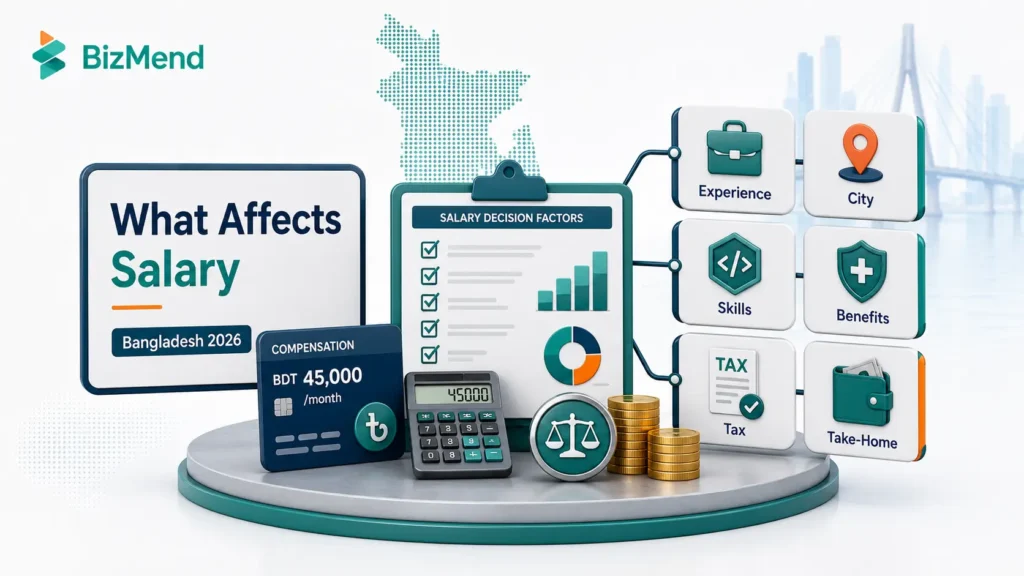
Experience increases salary only when it produces stronger output. A three-year employee who can manage clients, automate reporting, reduce errors, or lead delivery may out-earn someone with more years but limited ownership.
High-value skills in Bangladesh include professional English, spreadsheet and data analysis, ERP tools, financial reporting, credit and risk, digital marketing with measurable results, software development, cloud infrastructure, cybersecurity, product management, supply-chain planning, export documentation, and compliance.
Industry knowledge matters too. A developer who understands fintech, a finance professional who understands tax and ERP systems, or a salesperson with a proven enterprise network can command a premium because the employer buys both technical ability and context.
The best way to use an average salary in Bangladesh is as a starting point, not a verdict on your market value. Build a range from current vacancies, people doing similar work, employer type, city, and the complete compensation structure. Then adjust for your skills, measurable results, and the responsibilities you will carry.
For employers, transparent salary bands reduce mismatched expectations and improve hiring quality. For job seekers, the strongest long-term strategy is to develop skills that increase revenue, reduce cost, manage risk, or solve difficult problems. Recheck salary data before every major job move because inflation, regulation, employer budgets, and talent demand change over time.
There is no single authoritative 2026 figure covering all formal and informal workers. For many formal private jobs, entry pay commonly falls around Tk 18,000-40,000 monthly, while skilled and senior roles can be substantially higher.
Many entry-level banking roles fall around Tk 28,000-50,000 gross monthly, with mid-level roles often around Tk 50,000-100,000. Bank, grade, targets, qualifications, and benefits can change the package significantly.
A practical market guide is Tk 30,000-65,000 for entry roles, Tk 65,000-130,000 for capable mid-level engineers, and Tk 130,000-300,000 or more for senior, specialist, leadership, or remote-market roles.
Dhaka generally has more corporate and specialist roles, so cash salaries may be higher. However, rent, transport, and commuting time can reduce the advantage. Compare expected savings, not salary alone.
No. The Tk 12,500 garment minimum is a sector-specific wage floor effective from December 2023. Bangladesh has industry-specific wage structures rather than one universal private-sector minimum for every occupation.
Check gross pay, probation pay, review timing, job duties, training, manager quality, benefits, commute, stability, and the skills the role will build. The highest starting salary is not always the strongest career offer.

Learn how to become a Daraz seller in Bangladesh, register an account, list products, understand fees, manage orders, and grow…
by Sheikh Ornob
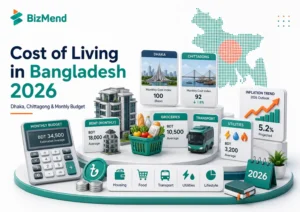
Compare the cost of living in Bangladesh in 2026, including Dhaka and Chittagong rent, food, transport, utilities, inflation, and monthly…
by Sheikh Ornob

Learn MoA and AoA requirements in Bangladesh, key clauses, drafting basics, RJSC filing steps, amendments, and common company-registration mistakes. Suggested…
by Sheikh Ornob