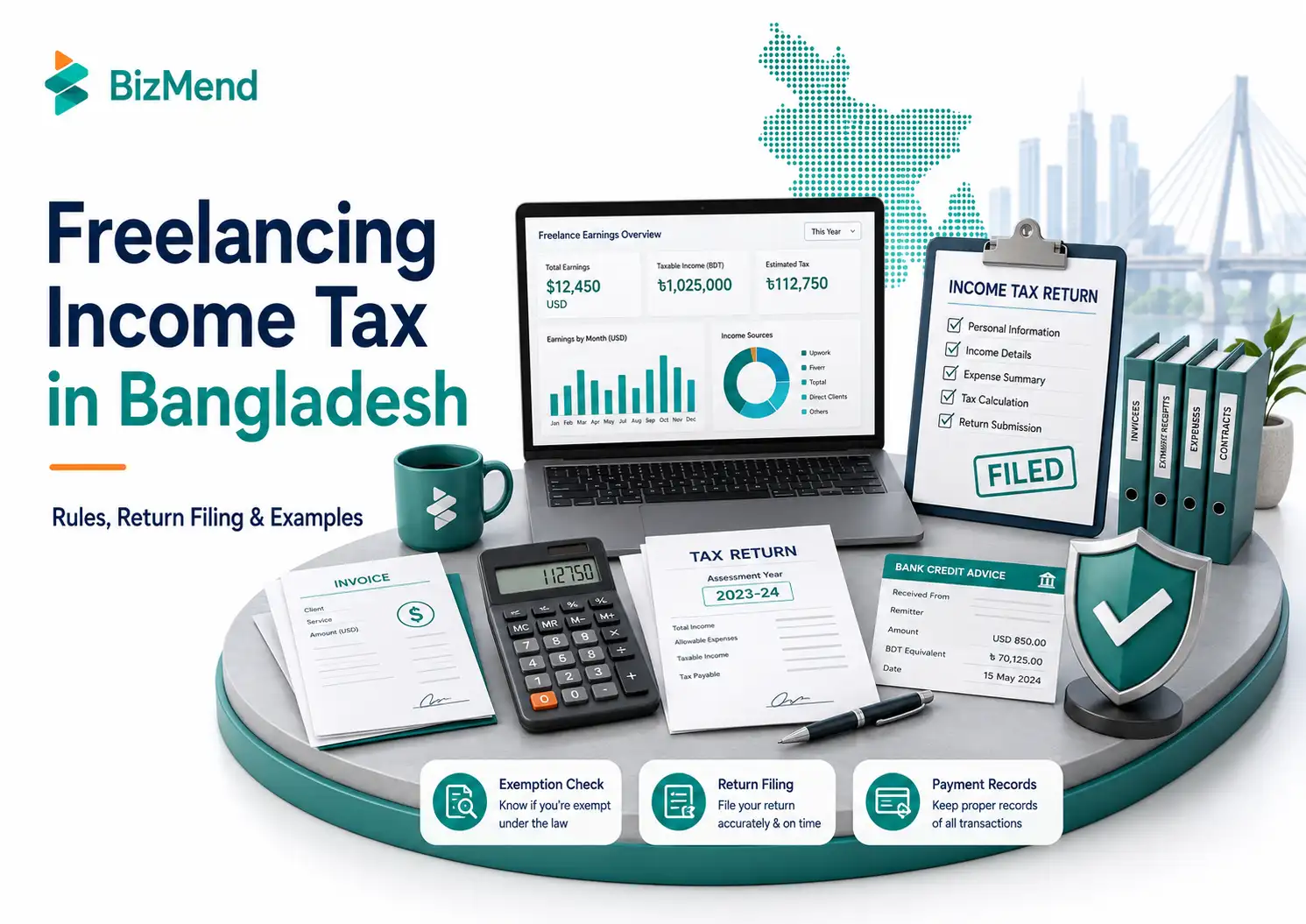

 by Sheikh Ornob
Freelance income is not something to hide or guess about.
For people doing freelancing in Bangladesh, the practical rule is this: report the income correctly, keep clean payment records, and check whether a specific exemption applies. Some freelance income may be exempt, but foreign-client payments are not automatically tax-free.
This guide explains freelancing income tax in Bangladesh in plain English, using the current NBR context available as of July 13, 2026.
Quick Answer: Freelancing income tax in Bangladesh depends on the source, legal status, payment channel, and whether a current exemption applies. Under the official English text of the Income Tax Act, 2023, income earned abroad by a Bangladeshi citizen and brought into Bangladesh according to foreign remittance law is exempt, and listed IT freelancing or IT-enabled income is exempt from July 1, 2024, to June 30, 2027, when the banking channel condition is met. “Exempt” does not mean “undocumented.” Freelancers should still keep invoices, client contracts, platform statements, bank credit advice, and Payoneer or Wise statements and file an income tax return when required.
Is it able to do Freelancing Income Tax in Bangladesh?
The safest answer is that freelance income is reportable, and it may be taxable unless it fits a valid exemption or falls below the taxable threshold. Income tax in Bangladesh does not treat every online earning situation the same way.
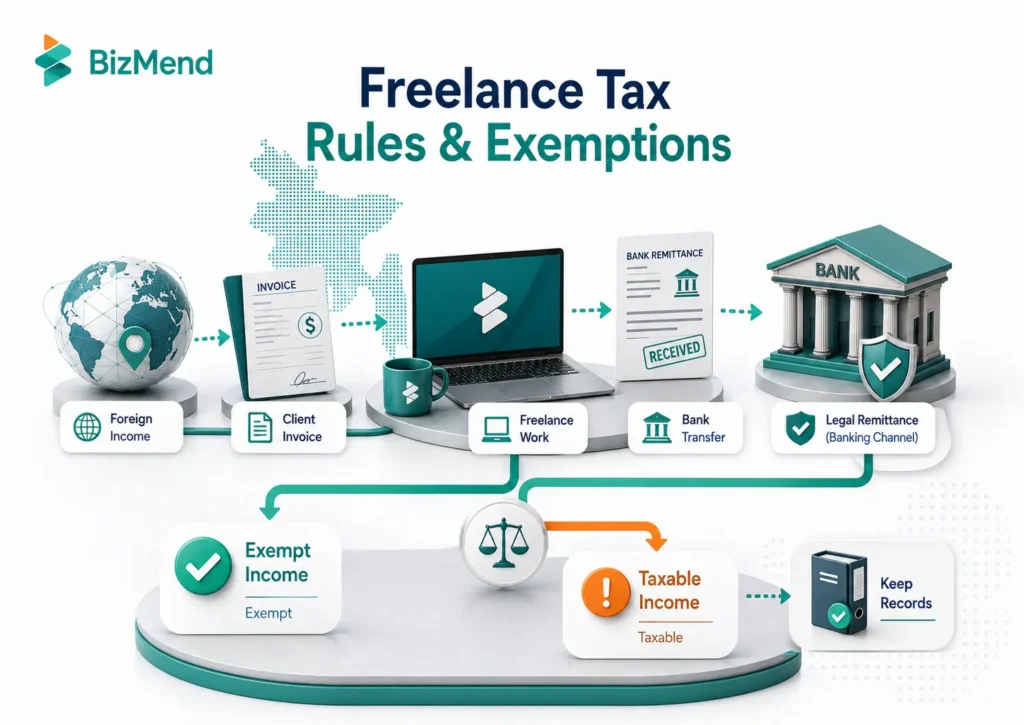
The current Income Tax Act includes two points that matter for freelancers. First, the Sixth Schedule exempts income earned abroad by an individual Bangladeshi citizen when that income is brought into Bangladesh under the existing foreign-remittance rules. Second, it exempts income from listed IT and IT-enabled businesses, including IT freelancing, for the period from July 1, 2024, to June 30, 2027, subject to the condition that the business income, expenditure, and investment are performed wholly through bank transfer from July 1, 2024.
A foreign client’s location alone does not determine whether freelance income is taxable or exempt. But they should also avoid the opposite mistake: assuming all online income is tax-free without checking the conditions.
Income may be taxable if it falls outside an exemption, uses non-bank transactions, or lacks proper records.
What NBR Rules Matter Most for Freelancers?
NBR does not publish a separate beginner-only freelancer tax code. Freelancers usually work within the general Income Tax Act, annual NBR circulars, return forms, e-Return procedures, and foreign-exchange documentation rules.
For assessment years 2026-27 and 2027-28, NBR’s 2025-26 income tax circular shows the individual tax slabs for a resident Bangladeshi citizen starting with Tk 375,000 of total income at zero tax, then progressive slabs of 10%, 15%, 20%, 25%, and 30%. These slabs matter when income is taxable after exemptions, deductions, and other adjustments are considered.
The same circular also confirms minimum tax context where total income exceeds the tax-free threshold. It states Tk 5,000 minimum tax in general, while new taxpayers have a Tk 1,000 minimum tax. Whether this applies in a particular freelancer case depends on the final taxable position and return facts.
A recent public confusion in Bangladesh was whether a 7.5% tax deduction at source applies to freelancer remittances. Dhaka Tribune reported in June 2026 that the NBR chairman said there is no provision for tax deduction on remittances of freelancers and expatriates. Treat this as a source-deduction point, not a blanket exemption from return filing or income reporting.
When Does a Freelancer Need to File an Income Tax Return?
A freelancer must file an income tax return in Bangladesh when any mandatory condition under section 166 applies.
The Income Tax Act says every person must file a return if total income during the income year exceeds the maximum amount not chargeable to tax or if other listed conditions apply. It also says an individual return contains statements of income, assets, and liabilities in Bangladesh and outside Bangladesh and living expenses where applicable.
For most individual taxpayers, Tax Day is November 30 following the end of the income year. A first-time individual assessee has a June 30 deadline following the end of the income year, and individuals residing abroad may have special timing after returning to Bangladesh. NBR can extend deadlines, so check the current e-Return portal or NBR notice before filing late.
A freelancer with exempt income may still be legally required to file a return. Filing creates a clean record, helps with loans or credit cards, and reduces confusion when bank credits, savings, assets, or lifestyle expenses do not match a blank tax profile.
Which Records Should Freelancers Keep?
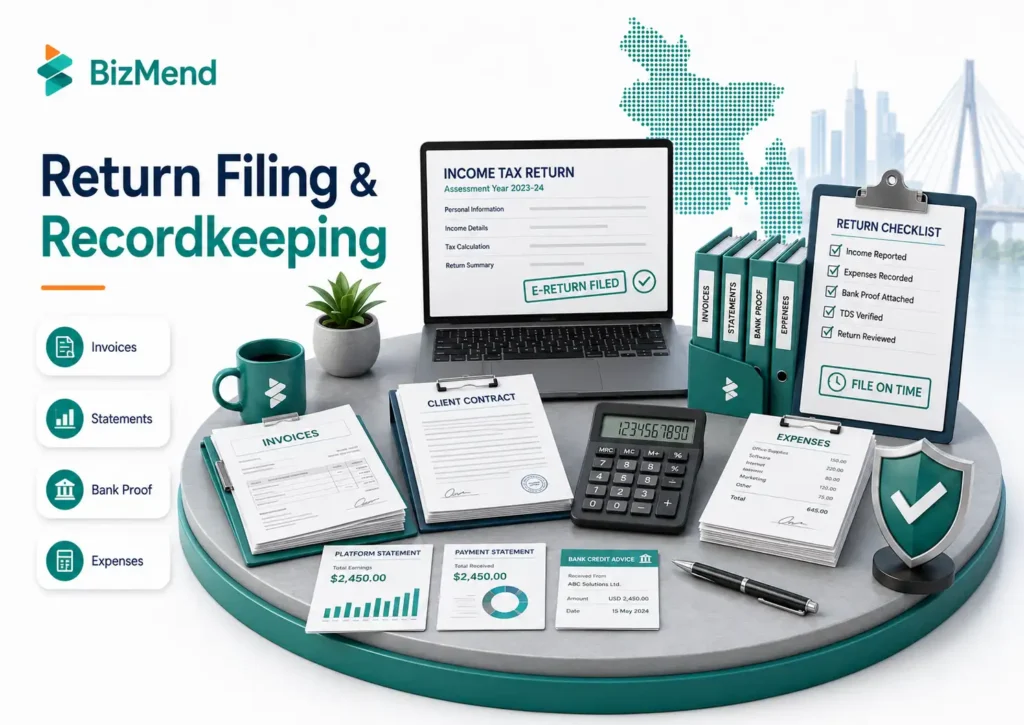
Good records are the bridge between a legitimate exemption and a stressful explanation later, especially when you receive international payments in Bangladesh from clients, platforms, or marketplaces.
- Client contracts, scopes of work, work orders, or email approvals.
- Invoices showing client name, service description, currency, amount, and date.
- Marketplace earnings reports from Upwork, Fiverr, Freelancer, Toptal, YouTube, App Store, or similar platforms.
- Payoneer, Wise, or other platform statements downloaded as PDF or CSV.
- Bank statements, encashment certificates, inward remittance certificates, or credit advices from the receiving bank.
- Exchange-rate notes or bank conversion details for USD, EUR, GBP, or other currencies.
- Expense records for software, internet, devices, subscriptions, contractors, and payment-platform fees.
Payoneer officially says its Reports and Statements area can generate monthly statements and account statements. Wise also provides downloadable statements and transfer confirmations. Use official downloadable files where possible instead of screenshots, because screenshots are easier to challenge and harder to reconcile.
How to Report Freelance Income in a Return
Start by separating income into categories. A solo freelancer doing web development, design, software, writing, consulting, or digital marketing may have business or professional income. A remote worker under an employment-style contract may need different treatment. An agency owner may have proprietorship, partnership, or company-level reporting issues.
- List every client or platform payment for the income year, which normally runs from July 1 to June 30.
- Convert foreign-currency receipts to Bangladeshi taka using the bank-credit amount or a consistent, supportable conversion basis.
- Separate exempt foreign-remitted income from taxable local or non-qualifying income.
- Deduct allowable business expenses only where the income is taxable, and the expense is genuine, documented, and connected to earning that income.
- Enter the income under the suitable head in the return or e-Return system, and keep a working paper that explains the calculation.
- Retain supporting statements even if the portal does not ask for every document during submission.
Do not net everything casually in a spreadsheet and report only what is left in the bank. Your return should be able to move from gross receipts to exemptions, allowable expenses, taxable income, tax, rebate, payment, and final payable amount.
Simple Reporting Examples
These examples are simplified for education. They are not a substitute for professional tax advice, but they show how the thinking works.
| Scenario | Likely treatment | What to keep |
| A web developer earns USD 12,000 from foreign clients and receives it through Wise into a Bangladesh bank, and all business flows use bank transfer. | May qualify for the IT freelancing exemption if the activity and banking conditions are met. | Keep invoices, platform statements, bank records, and transfer proof for all business transactions. |
| A designer earns Tk 900,000 from local companies and receives payments through bank transfer. | Likely taxable unless another specific exemption applies. Use the individual slabs after computing taxable income. | Invoices, client TDS certificates (if any), bank statements, and expense vouchers. |
| A student earns Tk 250,000 from occasional foreign microtasks and has no other income. | May be below the tax-free threshold, but any exemption must meet the relevant legal conditions. | Platform reports, bank statements, and personal notes explaining income sources. |
| An agency owner receives foreign payments but pays subcontractors in cash without proper records. | Cash payments may break the bank-transfer condition and make the IT exemption unavailable. | Bank transfer proof, contractor agreements, payment receipts, formal bookkeeping. |
Basic Tax Calculation When Income Is Taxable
For assessment year 2026-27, suppose a general individual freelancer has Tk 1,200,000 of taxable income after excluding any valid exempt income and after allowable deductions. The first Tk 375,000 is taxed at 0%. The next Tk 300,000 is taxed at 10%, the next Tk 400,000 at 15%, and the remaining Tk 125,000 at 20%.
That gives a simple pre-rebate tax of Tk 30,000 + Tk 60,000 + Tk 25,000 = Tk 115,000, before considering any eligible rebate, source tax credit, minimum tax, surcharge, late filing, or other adjustments. If the taxpayer is a woman, senior citizen, person with a disability, third-gender taxpayer, or other eligible category, the tax-free threshold may be higher under NBR’s current circular.
This example is only for taxable income. Do not apply the slab directly to income that is properly exempt. Also do not claim expenses against exempt income without professional advice, because exempt income and taxable business profit are not the same calculation.
Common Mistakes Freelancers Should Avoid
- Calling every foreign payment a remittance exemption without checking whether it was earned abroad, brought legally, and supported by records.
- Confusing no TDS on freelancer remittance with no return-filing obligation.
- Using personal screenshots instead of official statements, invoices, and bank records.
- Reporting only the final bank balance instead of gross income and clear adjustments.
- Mixing local taxable income with foreign exempt income without a working paper.
- Ignoring assets, liabilities, and living-expense statements when the return requires them.
- Filing late because the freelancer assumes small income means no compliance duty.
Compliance Tips for Bangladeshi Freelancers
Use formal payment channels whenever possible. If the exemption depends on lawful remittance or bank-transfer conditions, the payment trail is not a small detail; it is part of the tax position.
Create one folder per income year. Save invoices, platform exports, bank statements, payment-platform statements, contracts, and expense records. Keep a summary spreadsheet with columns for date, client, country, currency, gross amount, fees, net receipt, bank-credit amount, and income category.
If you run an agency, separate personal and business flows. Pay subcontractors by bank transfer, keep service agreements, and avoid undocumented cash payouts. If the business grows, ask whether you need a trade license, separate books, VAT/BIN review, or company structure advice.
File early when possible. NBR e-Return is easier when records are organized before the deadline, and early filing gives time to correct payment or classification issues.
When to Consult a Tax Professional
Consult a tax professional if you have high income, mixed local and foreign clients, agency revenue, foreign company ownership, a U.S. LLC or other foreign entity, employees, VAT questions, large assets, unexplained bank credits, late filings, prior-year mistakes, or need to apply for an ITIN for U.S. tax-related compliance.
Professional advice is also wise if you want to rely on the IT freelancing exemption but your facts are not clean. For example, a developer earning from both local clients and foreign marketplaces may need separate treatment for each income stream.
Key Takeaways
- Freelancing income tax rules in Bangladesh depend on the income source and applicable exemption.
- Foreign income earned by a Bangladeshi citizen and legally remitted to Bangladesh can be exempt under the current Income Tax Act.
- Listed IT freelancing and IT-enabled income is exempt from July 1, 2024 to June 30, 2027 when the banking-channel condition is met.
- Exempt income must be documented, and return filing may still be mandatory.
- Use official invoices, platform statements, bank records, and clear yearly summaries.
- Get professional advice when income, structure, or documentation becomes complex.
Frequently Asked Questions
Is freelancing income taxable in Bangladesh?
It can be taxable, but current law also provides important exemptions. Foreign income earned by a Bangladeshi citizen and brought into Bangladesh under remittance law can be exempt. Listed IT freelancing income may also be exempt through June 30, 2027 if the bank-transfer condition is met.
Do freelancers need to file an income tax return in Bangladesh?
Freelancers must file a return when income, registration, exemption, or proof requirements apply.
Is there NBR freelancer tax deducted from remittances?
Recent media reporting quoted the NBR chairman as saying there is no provision for tax deduction on freelancer and expatriate remittances. This concerns deduction at source; it does not remove the need to keep records or file when required.
Are Payoneer and Wise statements enough for income proof?
They help, but they are usually not enough alone. Match them with invoices, contracts or platform reports, and Bangladesh bank credit records showing the money came through a formal channel.
How should I convert USD freelance income to taka?
Use the actual taka amount credited by the bank where available. If you need a separate conversion, use a consistent and supportable basis and keep the calculation with your records.
Can I ignore small freelance income?
No. Small income may create no tax payable, but it should still be documented. Filing may be required if other legal conditions apply or if you need proof of return submission.
What if I made mistakes in past returns?
Do not invent documents or hide income. Speak with a tax professional about correction options, supporting evidence, and how to present the facts properly.
Conclusion
Freelancing income tax in Bangladesh is manageable when you separate three ideas: taxability, exemption, and filing proof. Income genuinely earned abroad may be exempt when legally remitted and properly documented. IT freelancing may also fall under a time-limited exemption when the bank-transfer condition is satisfied.
The practical habit is simple: keep official records, report income honestly, file when required, and ask for help when the facts become mixed. Clean compliance protects your bank profile, future loans, business growth, and peace of mind.