

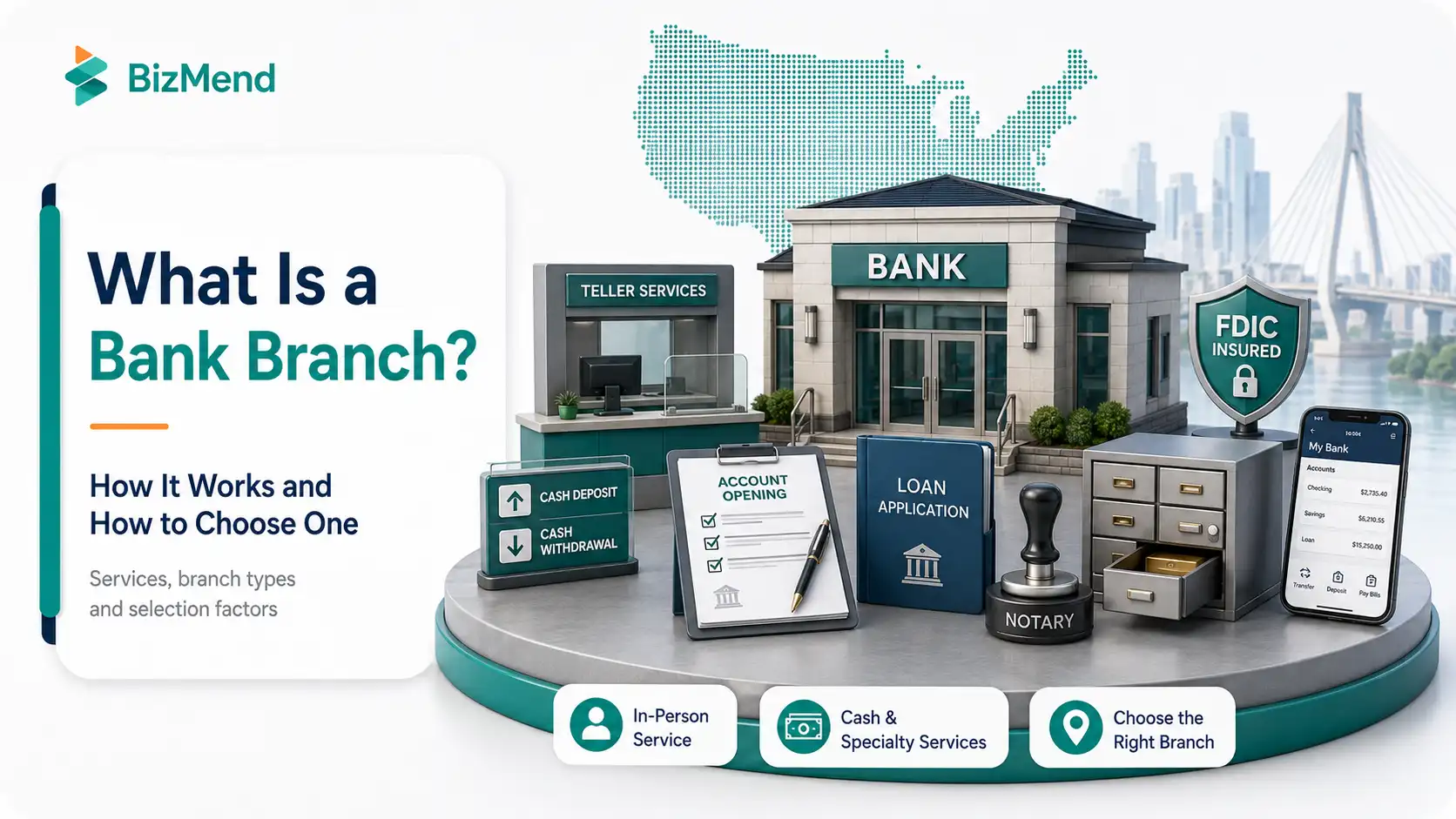
What is a bank branch? It is the physical location where a bank offers in-person services like deposits, withdrawals, loans, and notary help, standing apart from the app or website that now handles most everyday banking for many people. Newcomers to the US banking system often treat every branch as interchangeable, but the type of branch and the bank behind it both affect what you can actually get done there.
This guide covers what a bank branch is, how it actually works, the main types, requirements, and how to choose one when several sit within reach.
Quick Answer: A bank branch is a physical location, separate from a bank’s main office, where customers deposit and withdraw money, open accounts, and access services like notary work or safe deposit boxes in person. Branches operate under the same FDIC-insured charter as the rest of the bank, and federal rules require advance notice before one closes.
What Is a Bank Branch?
A bank branch is a physical location, separate from a bank’s main office, where customers deposit and withdraw money, open accounts, and access services like notary work or safe deposit boxes in person. Federal regulators define it specifically for oversight purposes as any location other than the main office where a bank receives deposits, cashes checks, or lends money.
In practice, a branch is the visible, walk-in face of a bank that otherwise operates through a much larger back-office and digital infrastructure. A teller handles routine transactions, a branch manager oversees daily operations and larger customer issues, and specialists such as loan officers or financial advisors are often based there or visit on a schedule. Every branch of a given bank operates under the same charter and the same FDIC insurance as the main office, so the protection on your deposits does not change based on which location you walk into.
The scale of branch banking remains substantial even as digital banking grows. The FDIC’s annual Summary of Deposits survey counted more than 76,000 domestic branch offices operated by over 4,400 FDIC-insured institutions as of the most recent published count, a reminder that branches remain a major part of the US banking system despite the rise of online-only alternatives.
Newcomers, small business owners handling regular cash, and anyone who wants a person to talk to for a complex issue tend to rely on branches the most, while many routine account holders now visit one only occasionally. A bank branch differs from a purely digital banking relationship in the most basic way possible: one exists as a physical address you can walk into, and the other exists only as an app or website, a distinction that shapes nearly everything else covered in this guide.
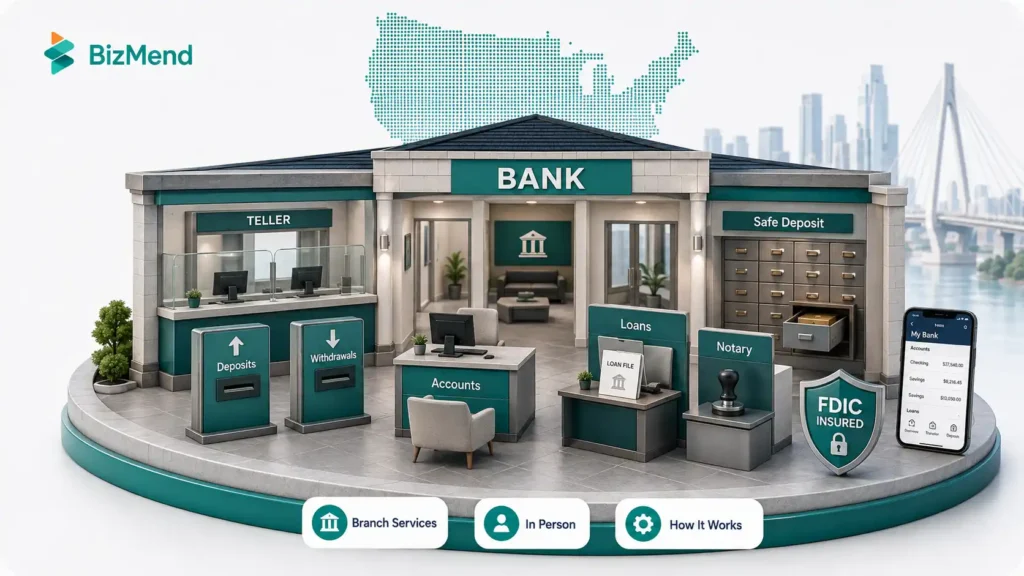
How a Bank Branch Works
A branch functions as a local extension of the bank’s full operation rather than an independent business entity of its own. Deposits taken at a branch flow into the same accounts and the same balance sheet as deposits made through the app, and the FDIC insurance covering them comes from the bank’s single charter, not from the branch location itself.
Cash handling is one of the most distinctive parts of branch operations. A teller can accept a cash deposit, cash a check, or dispense a large withdrawal in ways an app simply cannot replicate, though large cash transactions come with a federal reporting layer behind the scenes. Under the Bank Secrecy Act, a bank must file a Currency Transaction Report with FinCEN for cash transactions over $10,000 in a single business day, a routine compliance step rather than a sign of suspicion, and one that has applied at the same threshold since 1970.
Staffing at a branch typically includes tellers for routine transactions, personal bankers or platform staff who open accounts and answer product questions, and often a rotating or on-site loan officer for mortgages and business credit. Larger branches may also host a notary public and a vault with safe deposit boxes, services that remain difficult to replicate through a purely digital channel. Staffing levels and specialist availability vary significantly by branch size, so a small limited-service location may route a mortgage question to a specialist based elsewhere rather than handling it on the spot.
Branches do not last forever, and federal law treats closing one as a regulated event rather than a simple business decision. Federal law requires a bank to give its primary regulator and its branch customers at least 90 days of advance written notice before a branch closes, plus a conspicuous posted notice at the branch itself at least 30 days before closing, giving customers real time to plan around the change. Branches located in low- or moderate-income areas receive an additional layer of scrutiny, since the closing bank must also tell affected customers how to submit comments about the closure to its federal regulator.
Types of Bank Branches in the US
Not every branch offers the same services, and knowing the type helps set expectations before a visit.
A full-service branch offers the complete range of in-person banking: teller windows, account opening, loan officers, notary services, and often safe deposit boxes, making it the closest thing to a one-stop location for anything you cannot do through an app. These branches tend to sit in higher-traffic areas where the cost of full staffing is easier to justify.
A limited-service branch trims the offering, sometimes skipping loan officers, notary services, or safe deposit boxes while still handling deposits, withdrawals, and basic account questions. Banks often use this format in smaller markets where a full-service branch would not see enough traffic to justify the staffing, routing anything beyond routine transactions to a nearby full-service location or a phone specialist instead.
An in-store or retail branch operates inside a supermarket, big-box store, or similar retail location, typically with a smaller footprint and hours that match the host store rather than standard banking hours. These branches usually handle everyday transactions well but may lack a dedicated loan officer or safe deposit boxes, and their extended evening and weekend hours can matter more than their limited service range for someone who only needs routine access.
A drive-through branch adds a car-accessible teller lane or dedicated drive-up ATM alongside or instead of a walk-in lobby, built for speed rather than a full range of services, and it remains a popular option for depositing checks or picking up cash without leaving the vehicle.
Some branches now feature interactive teller machines, a hybrid between a standard ATM and a live teller who assists remotely by video, letting a bank offer extended hours or a smaller footprint while still providing a human option for more complex transactions. A national bank often runs the widest mix of these formats across its footprint. A community bank typically leans toward full-service and limited-service branches suited to a specific local market. A regional bank usually sits somewhere between the two, adjusting its branch format to match each region it actually serves.
Requirements and Eligibility to Use a Bank Branch
Opening an account at a branch generally requires the same core documents any US bank asks for, verified in person rather than through a photo upload.
A government-issued photo ID, such as a driver’s license, state ID, passport, or military ID, confirms identity, and a teller compares it to you directly rather than relying on a remote photo match the way a purely digital application typically does. A Social Security number or Individual Taxpayer Identification Number satisfies the federal customer identification rule every bank must follow regardless of channel; newcomers researching a non-resident bank account will find branch staff can often answer eligibility questions directly during the visit rather than through a support ticket. Proof of a US address, such as a lease or a recent utility bill, matters most when your ID does not already show a current one, and the state bank requirements checklist covers the equivalent document list in more detail for a branch-based state charter.
Using specific branch-only services carries its own conditions. Cashing a check at a branch where you do not hold an account is possible at many banks but often requires a valid ID and sometimes a small fee, and policies vary enough that calling ahead saves a wasted trip. Renting a safe deposit box typically requires an active account at that bank plus a signed rental agreement, and notary services sometimes require you to be an account holder, so confirming in advance avoids arriving with a document that cannot be notarized on the spot that same day.
Minimum deposits to open an account in person match whatever the specific product requires and do not differ systematically just because you applied at a branch instead of online, though a teller can sometimes waive a fee or answer a question in the moment that an app would route to a support queue instead. Business accounts opened in person often move faster too, since a banker can review formation documents and an EIN letter on the spot rather than waiting on an automated review.
Benefits and Drawbacks of a Bank Branch
Weighing branch banking against a purely digital relationship comes down to a short list of tradeoffs once FDIC coverage is confirmed either way.
Benefits
- In-person help resolves complex problems, like a disputed transaction, faster than a chat queue often can.
- Cash deposits and withdrawals happen directly at a teller window without a third-party retail network.
- Notary services, safe deposit boxes, and cashier’s checks remain difficult to fully replicate online.
- A local loan officer can sometimes move a mortgage or business loan forward with more flexibility.
- FDIC insurance applies identically whether you bank at a branch or entirely through an app.
- Building familiarity with specific staff over time can make future large transactions smoother.
Drawbacks
- Branch hours limit when you can get help, unlike an app that never technically closes.
- Overhead from rent, staff, and security often means higher fees than a comparable online account.
- A branch can close with 90 days of notice, requiring you to adjust to a new location.
- Travel time and parking add a real cost that a purely digital relationship avoids entirely.
- Smaller or limited-service branches may lack the specific service you actually need that day.
- Wait times during busy periods can turn a quick errand into a longer visit than planned.
Bank Branch vs. Other Banking Channels
A physical location, staffing, and service depth separate branch banking from the digital-first alternatives most newcomers compare it against. Understanding where a branch fits alongside these other channels helps clarify when walking into one is actually worth the trip.
An online bank skips the branch entirely, trading in-person help and cash handling for lower fees and stronger interest rates, a genuine tradeoff rather than one option being universally better. An ATM sits somewhere in between, offering cash access without staff or the full range of branch services, useful for quick transactions but not a substitute for a teller or a loan officer.
| Feature | Bank Branch | Online Bank | ATM Only |
| In-person help | Yes, staffed | No | No |
| Cash deposit and withdrawal | Yes, direct | Limited or none | Withdrawal only, some deposit |
| Notary and safe deposit box | Often available | Not available | Not available |
| Typical fees | Often higher | Often lower | Not applicable |
| FDIC coverage | Standard, up to $250,000 | Standard, up to $250,000 | Depends on the linked account |
Reviewing the national bank selection process alongside this comparison is useful for a reader deciding whether a specific bank’s branch network actually matters enough to influence the broader choice of institution.
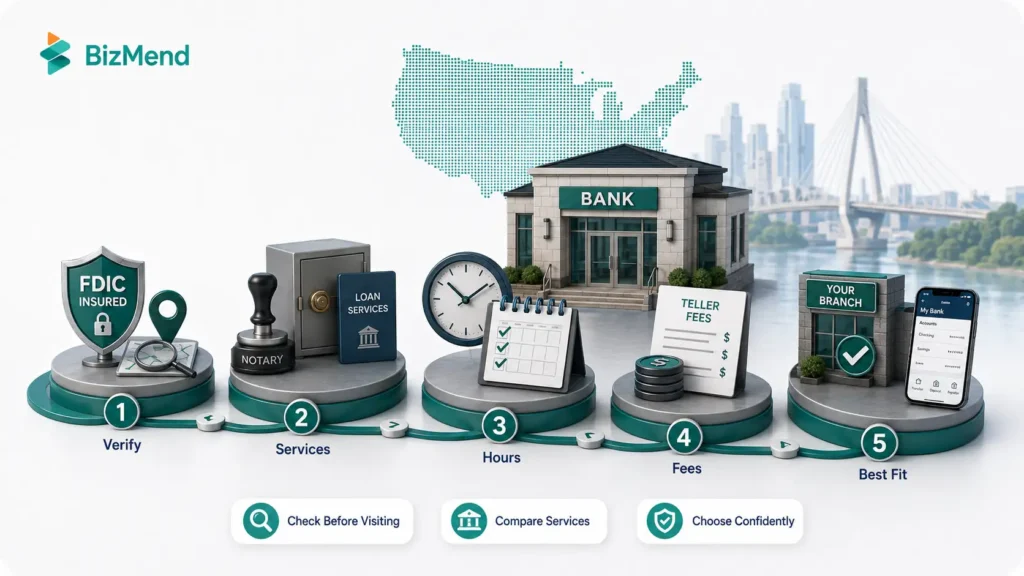
How to Choose the Right Bank Branch
Matching the branch to actual needs works better than defaulting to whichever one is physically closest.
1. Confirm the bank is FDIC-insured and the branch is still open. Search the FDIC’s BankFind tool to confirm current status, since branches close or relocate more often than most customers realize, and an outdated map listing can send you to a location that no longer exists.
2. Check the service list before visiting for something specific. Call ahead to confirm notary services, safe deposit box availability, or loan officer hours, since not every branch offers the full range, and a wasted trip costs more time than the phone call would have.
3. Compare hours against your actual schedule. A branch with hours that conflict with your work schedule provides little practical value no matter how close it sits to home, so weigh evening and weekend availability alongside the address itself.
4. Ask about fees tied to in-person service. Some banks charge more for teller-assisted transactions than for the same transaction completed through the app, so confirm the fee schedule for the services you actually plan to use before assuming branch access is free.
5. Weigh branch access against digital features. If most of your banking happens on a phone anyway, a slightly farther branch with strong hours can beat a closer one with limited service, since the branch becomes a backup rather than a daily stop.
Working through the same comparison factors used when choosing a national bank applies here too, since branch quality varies as much within a single bank’s network as it does between different banks entirely.
Key Insights
- A bank branch is a physical location separate from the main office, not a different kind of bank.
- FDIC insurance applies identically at every branch of a bank, since it covers the charter, not the location.
- Federal law requires 90 days of notice to customers and regulators before a branch closes.
- Cash transactions over $10,000 trigger a routine federal reporting requirement, not a red flag alone.
- Branch types range from full-service to limited-service, in-store, drive-through, and ITM-equipped.
- Confirm specific services like notary or safe deposit boxes before visiting for that reason.
Final Thoughts
A bank branch earns its place through in-person service, cash handling, and specialty offerings like notary work and safe deposit boxes, not through a separate charter or special protection. The same FDIC insurance and federal rules apply whether you walk into a branch or open an account entirely through an app, so the real decision comes down to which services you actually need in person.
Before relying on a specific branch, confirm it is still open and FDIC-insured through the BankFind tool, and call ahead for any specialty service like notary work or a safe deposit box rental. Comparing branch hours and services against your actual habits, rather than defaulting to the closest location, leads to a genuinely better fit.
Frequently Asked Questions
What is a bank branch?
A bank branch is a physical location, separate from a bank’s main office, where customers deposit and withdraw money, open accounts, and access services like notary work or safe deposit boxes in person, operating under the same charter and FDIC insurance as the rest of the bank.
How does a bank branch work?
A branch accepts deposits, cashes checks, and processes withdrawals through tellers, with the money flowing into the same accounts and balance sheet as digital transactions. Staff such as personal bankers and loan officers handle account opening and lending questions on site.
What does bank branch meaning actually cover, versus a main office?
A bank’s main office is its primary licensed location, while a branch is any additional location where it also receives deposits or lends money. Both operate under the identical charter and FDIC insurance, so the distinction is about location and reporting, not protection or legal status.
Can I use a bank branch if I do not have an account there?
Often yes for limited purposes, such as cashing a check drawn on that bank or asking general questions, though policies and any fees vary by institution. Services like renting a safe deposit box or full account access typically require you to already be a customer.
Is banking at a bank branch safe?
Yes. Deposits at a branch carry the same FDIC insurance as deposits made through a bank’s app, up to $250,000 per depositor, per bank, per ownership category. Physical branches also follow federal cash-reporting and closure-notice rules that add extra layers of oversight.
Who needs a bank branch?
Cash-heavy customers, people who want in-person help for a complex issue, small business owners depositing regularly, and anyone who values a notary or safe deposit box tend to rely on branches the most, while many routine account holders visit one only occasionally.
How do I find out if my bank branch is closing?
Federal law requires the bank to mail written notice to customers at least 90 days before a branch closes and to post a notice at the branch at least 30 days before closing, so a legitimate closure will never arrive without advance warning.
