How to Become a Daraz Seller in Bangladesh: Registration, Fees & Growth
Learn how to become a Daraz seller in Bangladesh, register an account, list products, understand fees, manage orders, and grow…
 by Sheikh Ornob

Complete checklist of export documents in Bangladesh. Learn what each document is, who issues it, and when you need it. Beginner-friendly guide for 2026.
One missing document can hold your entire shipment at Chittagong Port. Not for hours. Sometimes for days. And if you’re on a Letter of Credit, that delay can cost you the payment itself.
Export documents in Bangladesh aren’t just paperwork. They’re the legal proof that you shipped what you promised, from where you said, at the price agreed. Get them right and your goods move smoothly. Get them wrong and customs won’t let your container leave the yard.
This is the complete, plain-English breakdown of every export document you’ll need in 2026, including who issues each one and when.
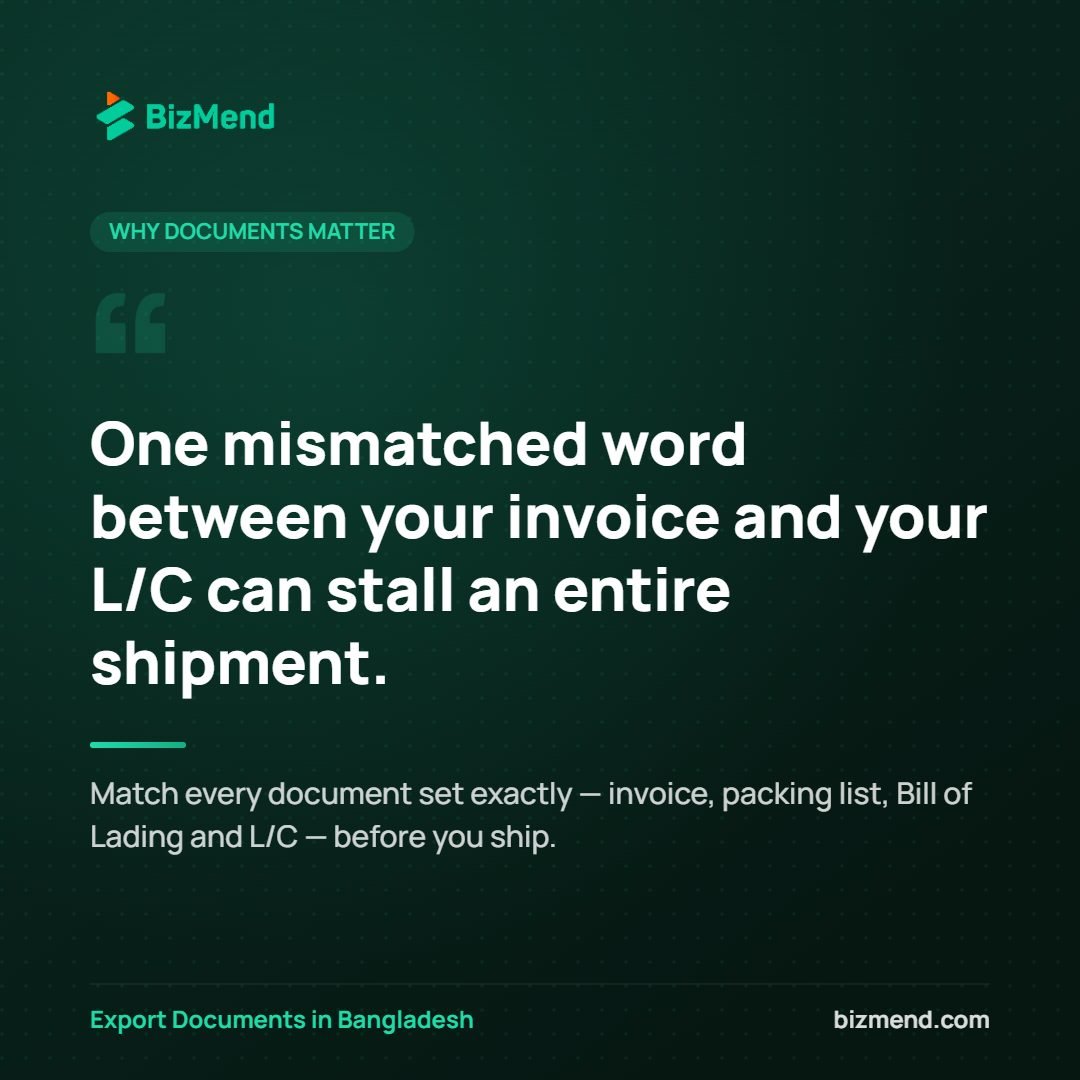
Most first-time exporters don’t realize how tightly linked all these documents are. Your commercial invoice must match the packing list. The packing list must match the Bill of Lading. If you’re on an LC, the invoice must match the LC terms exactly, down to every word and number.
One small mismatch can do it. “100% polyester shirt” on the LC versus “polyester shirt” on your invoice gives some banks grounds to reject the entire document set and refuse payment.
Bangladesh Customs now runs on the ASYCUDA World electronic system. Errors in your Bill of Export don’t just slow things down. They trigger holds, inspections, and demurrage charges you weren’t expecting.
The good news: once you understand what each document is and who provides it, the whole system starts to make sense.
These are the documents required for all commercial export shipments from Bangladesh, per the Prescribed Bill of Entry and Bill of Export Form Order, 2001 issued by the National Board of Revenue (NBR).
The ERC is your legal license to export. Every business exporting goods from Bangladesh must hold a valid one, issued by the Office of the Chief Controller of Imports and Exports (CCI&E) under the Ministry of Commerce.
You apply online through the CCI&E’s Online Licensing Module (OLM) at olm.ccie.gov.bd. The fee for a new ERC is BDT 11,500 (including 15% VAT), and annual renewal costs BDT 8,050 (including VAT).
Your ERC number must appear on every commercial invoice you issue. Customs verifies it during clearance. A lapsed or missing ERC stops your shipment at the port.
For jute, jute goods, and tea, ERC is specifically required as part of the product-level export conditions. If you haven’t applied yet, the step-by-step guide to starting an export business in Bangladesh covers the full OLM application process.
The commercial invoice is the anchor document in your entire export file. Every other document references it or must match it.
A Bangladesh commercial invoice must include:
The invoice must be signed by the exporter. If you’re on an LC, the invoice must match the LC terms exactly. Word for word, number for number.
The packing list tells customs, your freight forwarder, and your buyer exactly how the goods are packed. It should show:
A mismatch between your packing list and your invoice is one of the most common triggers for LC discrepancies and customs delays. Keep the numbers consistent across all your documents.
This is where most new exporters get confused. The EXP Form is not a customs document. It’s a Bangladesh Bank foreign exchange control document under the Foreign Exchange Regulation Act.
Your Authorized Dealer (AD) bank issues and certifies the EXP Form. By certifying it, your bank is making a commitment to Bangladesh Bank that export proceeds will be repatriated within 4 months from the date of shipment.
You submit the bank-certified EXP Form to customs along with your other shipping documents. Customs certifies it and forwards the original (exchange control copy) to Bangladesh Bank. You receive the remaining copies back through your bank.
This document has nothing to do with ASYCUDA World. It goes to customs physically with your documents, not electronically. The ASYCUDA submission is for the next document.
The Bill of Export, also called the Shipping Bill, is the customs export declaration. Your Clearing and Forwarding (C&F) agent files it electronically through the ASYCUDA World system before your goods leave the port.
Think of it as the export equivalent of a Bill of Entry for imports. It contains your shipment’s HS code, quantity, value, description, and other details. Customs uses it to verify export compliance and generate official trade statistics.
At Chittagong Port, this must be filed electronically. Your C&F agent handles the submission, but you’re responsible for giving them accurate information. Errors in the HS code or declared value here can trigger physical inspection.
For sea freight through Chittagong Port, the shipping line issues a Bill of Lading (BoL). For air freight through Hazrat Shahjalal International Airport (HSIA), the airline issues an Airway Bill (AWB).
The critical difference: the BoL is a document of title. Whoever holds the original can claim the goods. The AWB is not a document of title — it’s proof of shipment and a carrier receipt.
Under most LCs, your AD bank requires the original BoL endorsed to their order before they’ll process your payment. Plan for this step when booking your shipment.
The Certificate of Origin (CO) declares that your goods were produced in Bangladesh. Your buyer needs it to clear customs at their end, and often to claim preferential tariff rates.
Preferential CO (issued by EPB): Use this when your destination country has a trade agreement with Bangladesh:
Non-preferential CO (issued by Chambers of Commerce): Use this when no preferential trade agreement applies. Recognized chambers including DCCI, FBCCI, and MCCI issue these for standard customs certification.
Apply for your CO at the same time you’re finalizing your shipment documents. You’ll need your invoice, packing list, and Bill of Lading to apply.
According to the Prescribed Bill of Entry and Bill of Export Form Order, 2001, one of the following must be submitted with your Bill of Export:
LC is the safest payment method for first shipments. The buyer’s bank opens the LC in your favor, and your AD bank verifies and negotiates it. For more on setting up a business bank account capable of handling LC transactions, this guide to opening a bank account in Bangladesh covers what exporters specifically need. For more on how commercial banks in Bangladesh handle export transactions, that overview is also worth a read.
The insurance certificate proves your cargo is covered during transit. It’s required under CIF (Cost, Insurance, Freight) or CIP (Carriage and Insurance Paid) Incoterms, where you as the exporter are responsible for arranging insurance.
Under FOB, insurance is technically the buyer’s responsibility. But even on FOB shipments, providing evidence of insurance is good practice — it builds trust and avoids disputes if goods are damaged in transit.
These documents apply to specific product categories or destination markets. Forgetting one can result in rejection at the destination country’s port.
For exports of vegetables, fruits, plants, grains, or any plant-based agricultural products, most importing countries require a phytosanitary certificate. It certifies your goods are free from pests and plant diseases. In Bangladesh, this is issued by the Plant Protection Wing of the Department of Agricultural Extension (DAE). Requirements vary by destination, so verify what the importing country needs before applying.
For products where government quality certification is mandatory, you need a certificate from the Bangladesh Standards and Testing Institution (BSTI), based at 116/A Tejgaon Industrial Area, Dhaka-1208. BSTI issues CM (Certification Mark) licences and quality certificates for regulated goods including food products and specified manufactured items.
If your shipment uses wooden packaging materials like pallets, crates, or packing cases, many countries require proof that the wood was treated under the ISPM-15 (International Standards for Phytosanitary Measures) protocol. Approved fumigation service providers in Bangladesh issue this certificate after treatment.
For frozen shrimp, fish, and other seafood, markets including the EU and USA require a government-issued health certificate. In Bangladesh, the Department of Fisheries (DoF) issues health certificates for seafood exports. For other food products, the Bangladesh Food Safety Authority (BFSA) may be the relevant authority depending on the product and destination.
Every consignment of tea exported from Bangladesh requires a consignment-wise export permit from the Bangladesh Tea Board, in addition to the standard ERC. This permit is shipment-specific. Each consignment gets its own permit — you can’t batch-apply for multiple shipments.
For exports to the Middle East, Malaysia, and other markets where halal compliance is legally required, a Halal Certificate confirms your product was produced, processed, and handled per Islamic dietary law. Accredited halal certification bodies in Bangladesh issue this. Check which specific halal standard your destination market recognizes.
If you’re exporting Ready-Made Garments (RMG) produced under Bangladesh’s bonded warehouse facility, you must submit a Utilization Declaration to customs confirming that duty-free imported raw materials were used for the stated export. For other goods under bonded warehouse, a Utilization Permission applies. For exporters in the apparel, pharmaceutical, or agro-processing sectors, this overview of Bangladesh’s top export-oriented industries gives useful context on sector-specific documentation requirements.
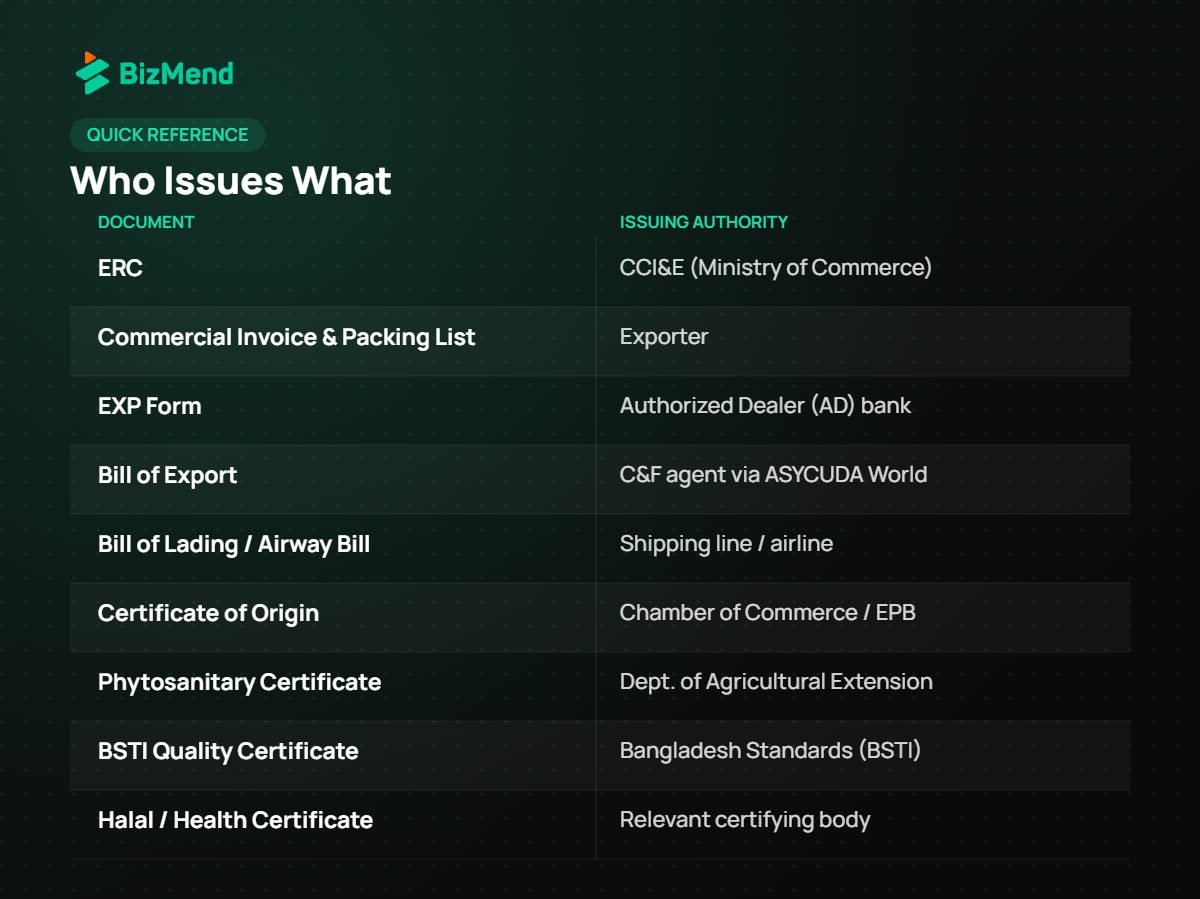
| Document | Issued By | When Required |
|---|---|---|
| Export Registration Certificate (ERC) | CCI&E via OLM (olm.ccie.gov.bd) | Before any export activity |
| Commercial Invoice | Exporter | Every shipment |
| Packing List | Exporter | Every shipment |
| EXP Form | Authorized Dealer (AD) bank | Every shipment |
| Bill of Export (Shipping Bill) | C&F agent via ASYCUDA World | Every shipment |
| Bill of Lading | Shipping line (sea freight) | Every sea shipment |
| Airway Bill | Airline (air freight) | Every air shipment |
| Preferential CO (GSP/SAFTA/APTA) | Export Promotion Bureau (EPB) | Where trade agreement applies |
| Non-preferential CO | Chamber of Commerce (DCCI, FBCCI, etc.) | Standard origin certification |
| Letter of Credit | Buyer’s bank | LC payment terms |
| Insurance Certificate | Insurance company | CIF/CIP Incoterms |
| Phytosanitary Certificate | Plant Protection Wing, Dept of Agricultural Extension | Agricultural/plant products |
| Quality Certificate | BSTI (116/A Tejgaon Industrial Area, Dhaka-1208) | Regulated product categories |
| Fumigation Certificate | Approved fumigation provider (ISPM-15) | Wooden packaging materials |
| Health Certificate (Seafood) | Department of Fisheries (DoF) | Seafood exports |
| Tea Export Permit | Bangladesh Tea Board | Per tea consignment |
| Halal Certificate | Accredited halal certifier | Halal-required markets |
| Utilization Declaration | Submitted to Customs by exporter | RMG under bonded warehouse |
Invoice terms don’t match the LC. This is the single most expensive export document error. Banks reject entire document sets over a single word difference. Match every item in your invoice to the LC description exactly.
Confusing the EXP Form with the Bill of Export. These are completely different documents. The EXP Form is a forex control document certified by your AD bank. The Bill of Export is a customs declaration filed through ASYCUDA World. Many first-time exporters submit one thinking they’ve covered both.
Wrong HS code on the invoice. The HS code affects tariffs at the destination, the CO type you need, and which product-specific documents apply. Use the correct 8-digit HS code from the Bangladesh Customs Tariff (BCT).
Getting the wrong Certificate of Origin type. If your buyer is importing into the EU and you send them a non-preferential CO from the Chamber, they cannot claim GSP duty benefits. Check which CO type the destination market requires before you apply.
Forgetting product-specific documents. A consignment of frozen shrimp without a DoF health certificate will not clear EU customs. A vegetable shipment without a phytosanitary certificate will be rejected. Always check destination country requirements for your specific product category.
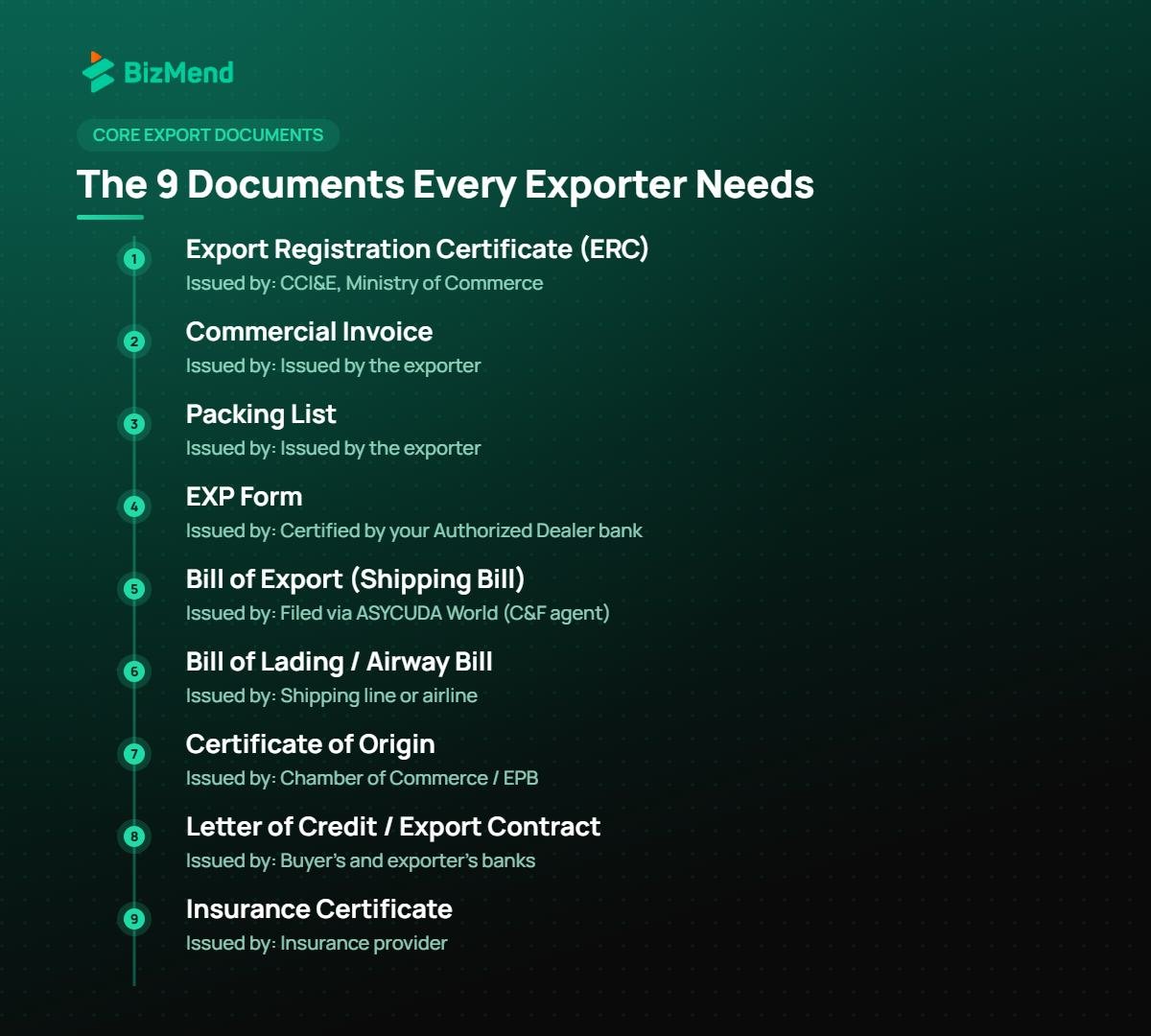
The core documents for every commercial export from Bangladesh are: Export Registration Certificate (ERC), commercial invoice (with ERC number and HS code), packing list, EXP Form certified by your AD bank, Bill of Export filed via ASYCUDA World, Bill of Lading or Airway Bill, Certificate of Origin, Letter of Credit or export contract, and insurance certificate. Product-specific documents like phytosanitary certificates, health certificates, and Tea Board permits apply based on product type and destination.
The EXP Form is issued and certified by your Authorized Dealer (AD) bank under the Foreign Exchange Regulation Act. It guarantees to Bangladesh Bank that export proceeds will be repatriated within 4 months of shipment. It is submitted to customs physically with your shipping documents. The Bill of Export (Shipping Bill) is completely separate: it is the customs export declaration your C&F agent files electronically through ASYCUDA World before your goods leave Bangladesh.
The Export Promotion Bureau (EPB) issues preferential Certificates of Origin for GSP (EU, UK, Canada, Japan, Australia, and others), SAFTA (India, Pakistan, Sri Lanka, Nepal, and other SAARC members), and APTA (China, South Korea, and others). Recognized Chambers of Commerce (DCCI, FBCCI, and MCCI) issue non-preferential (ordinary) COs for markets where no preferential trade agreement applies.
Yes. The Export Registration Certificate is mandatory for any business entity exporting goods from Bangladesh. It is issued by the CCI&E under the Ministry of Commerce. The registration fee is BDT 11,500 (including 15% VAT) for new applicants and BDT 8,050 (including VAT) for annual renewal. Apply online at olm.ccie.gov.bd. For jute, jute goods, and tea, ERC is a specific product-level export requirement.
RMG exporters need all standard export documents plus a Utilization Declaration confirming that duty-free raw materials imported under the bonded warehouse facility were used for the exported goods. For GSP benefits in the EU or UK, a preferential CO (GSP Form A) from the EPB is essential. Depending on the destination, a textile export quota certificate managed by the Bangladesh Textile Mills Association (BTMA) may also be required.
A phytosanitary certificate confirms that your agricultural goods are free from pests and plant diseases. In Bangladesh, it is issued by the Plant Protection Wing of the Department of Agricultural Extension (DAE). Most importing countries require it for plant-based products. Requirements vary by destination country, so check the destination’s regulations before applying to the DAE.
A Bill of Lading (BoL) is issued by the shipping line for sea freight through Chittagong Port. It is a document of title: the party holding the original BoL can claim the goods. An Airway Bill (AWB) is issued by the airline for air freight through Hazrat Shahjalal International Airport (HSIA). An AWB is not a document of title. Under LC payment terms, your AD bank typically requires the original BoL endorsed to their order before releasing your payment.
A health certificate is required when exporting frozen seafood, fish, shrimp, or other food products to markets including the EU and USA. The Department of Fisheries (DoF) issues health certificates for seafood exports. For other food product categories, the Bangladesh Food Safety Authority (BFSA) or BSTI may be the relevant authority. Always check the specific import requirements of your destination country for your product category.
The Bank Realization Certificate (BRC) is issued by your Authorized Dealer (AD) bank after your export payment (foreign currency) has been received and credited to your account. It certifies that export proceeds were repatriated into Bangladesh within the stipulated period. The BRC is required for claiming export cash incentives from the Bangladesh government and for income tax filing. Collect it from your AD bank after each export payment is realized.
Some destinations don’t require a CO, but most do. Without the correct CO type, your buyer cannot access preferential tariff rates under Bangladesh’s trade agreements. If you’re exporting to the EU or UK without a GSP Form A from the EPB, your buyer pays full MFN duties instead of the preferential rates. That makes your products more expensive for them and less competitive in their market.
The document list looks intimidating the first time you see it. But most exporters only deal with 6 to 7 of these on any given shipment. The core nine apply to everyone. The product-specific ones apply only to your category.
The real skill isn’t memorizing all of them. It’s knowing which ones apply to your specific product and destination market, and building the discipline to prepare them in the right sequence before your cargo reaches the port.
One practical step: bookmark the Bangladesh Trade Portal (bangladeshtradeportal.gov.bd) and the EPB website (epb.gov.bd). Both are official sources that get updated when regulations change. Requirements shift. What was acceptable for a European buyer two years ago may now require additional certification.
And if you’re looking at receiving export payments through Stripe, PayPal, or other international platforms, registering a US business entity from Bangladesh is one route many Bangladeshi exporters are now using to unlock those payment gateways.
Your documents are your export. Get them right from day one.

Learn how to become a Daraz seller in Bangladesh, register an account, list products, understand fees, manage orders, and grow…
by Sheikh Ornob
Compare the cost of living in Bangladesh in 2026, including Dhaka and Chittagong rent, food, transport, utilities, inflation, and monthly…
by Sheikh Ornob
Learn MoA and AoA requirements in Bangladesh, key clauses, drafting basics, RJSC filing steps, amendments, and common company-registration mistakes. Suggested…
by Sheikh Ornob