
 by Sheikh Ornob
Importing goods into Bangladesh without understanding your customs duty upfront is a recipe for nasty surprises at the port. I’ve seen importers budget for the product cost but completely miss the 80%+ in additional taxes sitting on top. This guide walks you through the full import duty calculation in Bangladesh, from assessable value to your final payable amount, with a real worked example you can follow.
Quick answer: To calculate import duty in Bangladesh, start with the CIF value, add 1% landing charge to get the Assessable Value, then apply CD, RD, SD, VAT, AIT, and AT based on the HS code. Bangladesh Customs uses a cumulative method, so later taxes are calculated on earlier duty-added values.
What Is Calculate Import Duty in Bangladesh?
Import duty in Bangladesh is a set of taxes and charges levied by the National Board of Revenue (NBR) on goods brought into the country. It’s not just one number. It’s a stack of six different components applied in sequence, each building on the last.
These charges are governed primarily by the Customs Act 2023 and the Value Added Tax and Supplementary Duty Act 2012. If you’re planning to start a business in Bangladesh that involves importing goods, understanding this structure is non-negotiable.
The total amount you owe is called the TTI (Total Tax Incidence). It’s the figure Bangladesh Customs shows you in their duty calculator, and it can range from as low as 10% for essential goods to well above 150% for luxury items.
Step 1: Determine Your Assessable Value
Before you can calculate any duty, you need the Assessable Value (AV). This is the base on which everything is calculated.
The CIF Method Explained
Bangladesh follows the CIF (Cost, Insurance, Freight) method for customs valuation.
CIF = Cost of Goods + Freight + Insurance
If you don’t know the actual freight or insurance:
- Freight: use 20% of the FOB (Free on Board) value
- Insurance: use 1% of the C&F value (Cost + Freight)
Once you have the CIF, you add the landing charge, which is a flat 1% of the CIF value.
Assessable Value = CIF + 1% Landing Charge
So if your CIF is Tk. 100,000, your AV is Tk. 101,000. For the worked example below, we’ll use a round AV of Tk. 100,000.
Step 2: Find Your HS Code
Every product has an HS (Harmonized System) code: an 8-digit number that classifies what you’re importing. Your HS code determines which rates of CD, SD, VAT, AIT, RD, and AT apply to you.
You can find your HS code at customs.gov.bd or through the Bangladesh Customs Tariff FY:2025-2026 published by NBR. The current tariff schedule was released in June 2025.
Getting the HS code wrong is one of the most common and expensive mistakes importers make. More on that below.
The 6 Duty Components, Explained Simply
Here’s what each tax means and how it’s applied.
Customs Duty (CD)
This is the core tariff, levied under the First Schedule of the Customs Act 2023. Bangladesh uses four primary rates: 0% for certain exempt items, 5% for basic raw materials and capital machinery, 10% for intermediate goods, and 25% for most finished consumer goods. The average MFN applied rate across all goods was approximately 14% in 2024 (WTO data).
Calculated on: Assessable Value × CD%
Regulatory Duty (RD)
RD is applied to regulate certain imports and protect local industries. It varies by product and not every HS code carries an RD. Where it applies, it’s calculated straight on the assessable value.
Calculated on: Assessable Value × RD%
Supplementary Duty (SD)
SD is applied on luxury goods, cigarettes, alcohol, cars, and certain consumer items. The rate ranges from 10% to 500% for high-luxury items. But it is NOT calculated on the AV alone.
SD Base = AV + CD + RD (the cascade effect)
Value Added Tax (VAT)
Standard VAT on imports is 15%. Like SD, VAT is NOT applied directly on the AV. VAT is applied on a higher cumulative base:
VAT Base = AV + CD + RD + SD
Advance Income Tax (AIT)
The AIT rate varies by HS code and current NBR rules. While 5% is common in many examples, importers should verify the applicable rate in the latest customs tariff.
Advance Tax (AT)
AT rate and calculation base vary under current NBR/VAT rules, so importers should verify the applicable AT rate and base for their HS code.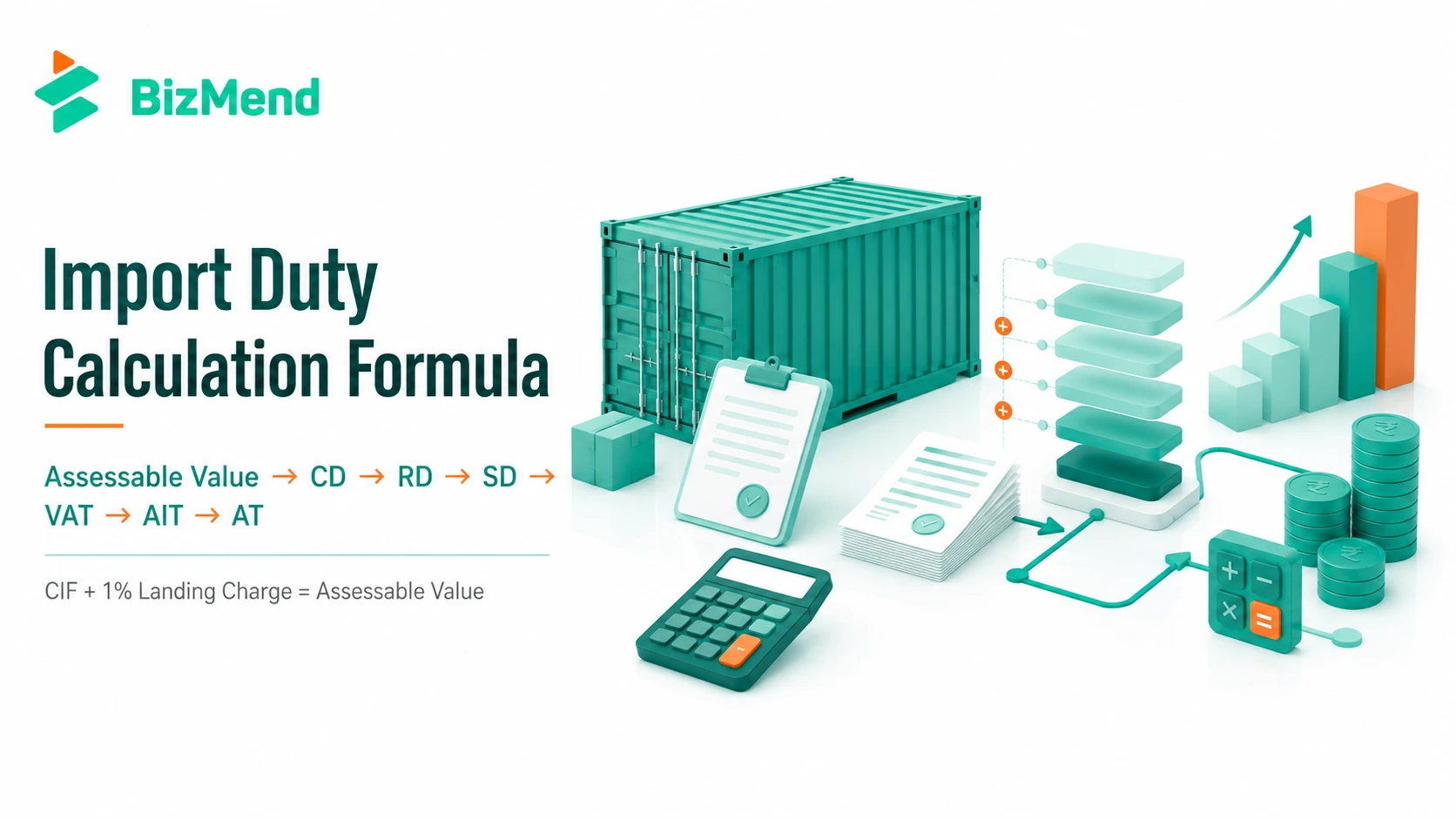
Step 3: Calculate Each Component (With a Real Example)
Let’s work through a real calculation. Assessable Value = Tk. 100,000, with CD: 25%, RD: 3%, SD: 20%, VAT: 15%, AIT: 5%, AT: 4%.
| Component | Base | Rate | Amount (Tk.) |
|---|---|---|---|
| Assessable Value (AV) | CIF + 1% | — | 100,000 |
| Customs Duty (CD) | AV | 25% | 25,000 |
| Regulatory Duty (RD) | AV | 3% | 3,000 |
| Supplementary Duty (SD) | AV + CD + RD = 128,000 | 20% | 25,600 |
| VAT | AV + CD + RD + SD = 153,600 | 15% | 23,040 |
| Advance Income Tax (AIT) | AV | 5% | 5,000 |
| Advance Tax (AT) | Verify current NBR/VAT base | 4% example rate | Amount depends on applicable AT base |
| Total Duties | 85,640 | ||
| Total Landed Cost | 185,640 |
On Tk. 100,000 worth of goods, you’d pay Tk. 85,640 in taxes and duties — an 85.6% effective duty rate. Not every import will have SD or AT. Raw materials often have CD as low as 5% and no SD at all.
Quick Reference: Typical Duty Rates by Category
This table gives you a ballpark. Always verify the exact rate against your 8-digit HS code and the current NBR tariff schedule.
| Product Category | Typical CD | Typical SD | Effective Duty Range |
|---|---|---|---|
| Capital machinery | 0–5% | 0% | ~5–15% |
| Raw materials | 5% | 0% | ~15–25% |
| Intermediate goods | 10% | 0–10% | ~30–50% |
| Consumer electronics | 25% | 10–20% | ~70–100% |
| Clothing / textiles | 25% | 0–20% | ~60–90% |
| Passenger vehicles (1000–1500cc) | 25% | 45–100% | ~130–180% |
| Alcohol / tobacco | 25% | 150–500% | 200%+ |
Common Mistakes Importers Make
- Using the wrong HS code. Misclassification is expensive. Customs officers will catch it, and penalties apply.
- Calculating VAT on CIF directly. VAT is applied to CIF + CD + RD + SD, not just CIF. The difference can be thousands of taka.
- Ignoring SD on consumer goods. For electronics, cosmetics, and consumer goods, SD can be 20–50%.
- Forgetting the landing charge. It’s just 1%, but on a Tk. 1 million shipment, that’s Tk. 10,000 added to your base.
- Not having an IRC. Commercial importers need an Import Registration Certificate from CCI&E. Without it, your shipment won’t clear customs. Make sure you have the right company structure in place before applying for your IRC.
- Using market exchange rates. Use NBR’s official customs exchange rates, not the bank’s daily rate.
The TTI Shortcut: Bangladesh Customs’ Online Calculator
The official Bangladesh Customs duty calculator at bangladeshcustoms.gov.bd/trade_info/duty_calculator shows the TTI (Total Tax Incidence) for any HS code. TTI is the combined rate of all duties as a percentage of the assessable value.
To use it:
- Go to the duty calculator on Bangladesh Customs’ website
- Enter your 8-digit HS code
- The result shows CD, SD, VAT, AIT, RD, AT, and TTI
- Multiply TTI by your assessable value to get total tax payable
The NBR’s Import Export Hub at hub.bangladeshcustoms.gov.bd provides even more detail, including document requirements and SRO exemptions that may lower your duty. When you’re ready to handle import payments and open an LC, the guide on top foreign banks in Bangladesh covers which banks are most active in import trade finance.
Key Insights
- Assessable Value includes freight, insurance, and 1% landing charge. This is the base for all duty calculations, not just the invoice price.
- SD and VAT are cascading, not flat. SD is applied on AV + CD + RD combined. VAT is then applied on that total plus SD, driving the effective rate well above 80% for consumer goods.
- Your HS code determines everything. The wrong 8-digit code can result in massively overpaying or triggering a customs dispute. Use the FY:2025-2026 tariff schedule on NBR’s site.
- AIT and AT are advance payments, not pure costs. Registered businesses can offset them against income tax returns. But you still need the cash at the port.
- TTI is your shortcut. Bangladesh Customs’ online calculator shows Total Tax Incidence per HS code instantly. Multiply by your AV to estimate total payable duties.
- Most consumer goods carry SD. Electronics, cosmetics, and finished goods often carry 20–50% SD, which can double your expected tax bill.
- Getting the IRC and company structure right is step zero. You cannot legally import commercially without a registered company, trade license, TIN, and an Import Registration Certificate.
Frequently Asked Questions
What is the assessable value in Bangladesh Customs?
The assessable value is the base on which all import duties are calculated. It equals the CIF value (Cost + Insurance + Freight) plus a 1% landing charge. If actual freight and insurance are unknown, Bangladesh Customs allows 20% of FOB for freight and 1% of C&F for insurance as estimates.
How is VAT calculated on imports in Bangladesh?
VAT at 15% is not applied on the CIF value directly. It’s applied on a cumulative base: Assessable Value + Customs Duty + Regulatory Duty + Supplementary Duty. This cascading method means the effective VAT amount is always higher than a simple 15% of the goods value.
What is the maximum import duty rate in Bangladesh?
The maximum Customs Duty (CD) rate is 25% under Bangladesh’s MFN tariff. However, when Supplementary Duty, VAT, AIT, and Regulatory Duty are stacked, total duties can exceed 150% of assessable value for luxury items. Cars with engines above 2,000cc can face duties exceeding 300%.
What is TTI in Bangladesh Customs?
TTI stands for Total Tax Incidence. It’s the combined duty and tax rate as a percentage of the assessable value. The Bangladesh Customs duty calculator at bangladeshcustoms.gov.bd shows the TTI per HS code. Multiply TTI by your assessable value to estimate total taxes payable.
Is VAT paid on imports refundable in Bangladesh?
For registered VAT taxpayers using imported goods as inputs for VATable supplies, input VAT credit can be claimed against output VAT. AIT (Advance Income Tax) can be offset against your annual income tax return. These aren’t automatic refunds but legitimate tax offsets.
What is an HS code and why does it matter?
An HS (Harmonized System) code is an 8-digit number that classifies every traded product globally. In Bangladesh, your HS code determines every duty rate applicable to your shipment: CD, RD, SD, VAT, AIT, and AT. Using the wrong HS code is one of the most expensive mistakes an importer can make.
Do I need a license to import goods into Bangladesh?
Yes. Commercial importers need an Import Registration Certificate (IRC) from the Office of the Chief Controller of Imports and Exports (CCI&E). You’ll need a company registration, trade license, TIN, bank account, and trade association membership. The IRC is valid for five years.
What is Supplementary Duty (SD) and which goods attract it?
SD is an additional tax on goods considered luxury, harmful, or competing with local production. It applies to passenger vehicles, cigarettes, alcohol, cosmetics, and many consumer electronics. The rate ranges from 10% to 500%. It’s calculated on Assessable Value + CD + RD combined, not on AV alone.
How often do Bangladesh customs duty rates change?
Duty rates are updated annually through the National Budget, usually presented in June. The current tariff is FY:2025-2026, published in June 2025 on the NBR website. Rates can also change mid-year through SROs (Statutory Regulatory Orders) issued by NBR. Always verify before finalizing import costs.
Final Thoughts
Honestly, calculate import duty in Bangladesh is more complex than it looks at first glance. The cascading calculation for SD and VAT trips up even experienced importers. But once you understand the formula and check your HS code before every shipment, the numbers stop being scary. They just become a cost you can plan for.
Your next step is to pull up the Bangladesh Customs duty calculator, enter your HS code, and cross-check the TTI against your latest supplier quote. If you’re setting up the business side for the first time, including your trade license, TIN, and bank account, get those foundations in place before your goods reach the port. If you’re also expanding your import operations internationally through a US entity, US company formation from Bangladesh can help you access global suppliers and payment gateways. Import clearance moves fast. Your paperwork should be faster.