How to Become a Daraz Seller in Bangladesh: Registration, Fees & Growth
Learn how to become a Daraz seller in Bangladesh, register an account, list products, understand fees, manage orders, and grow…
 by Sheikh Ornob

Learn how custom clearance in Bangladesh works: step-by-step port procedures, C&F agent role, required documents, duties, taxes, and Customs Act 2023 updates explained.
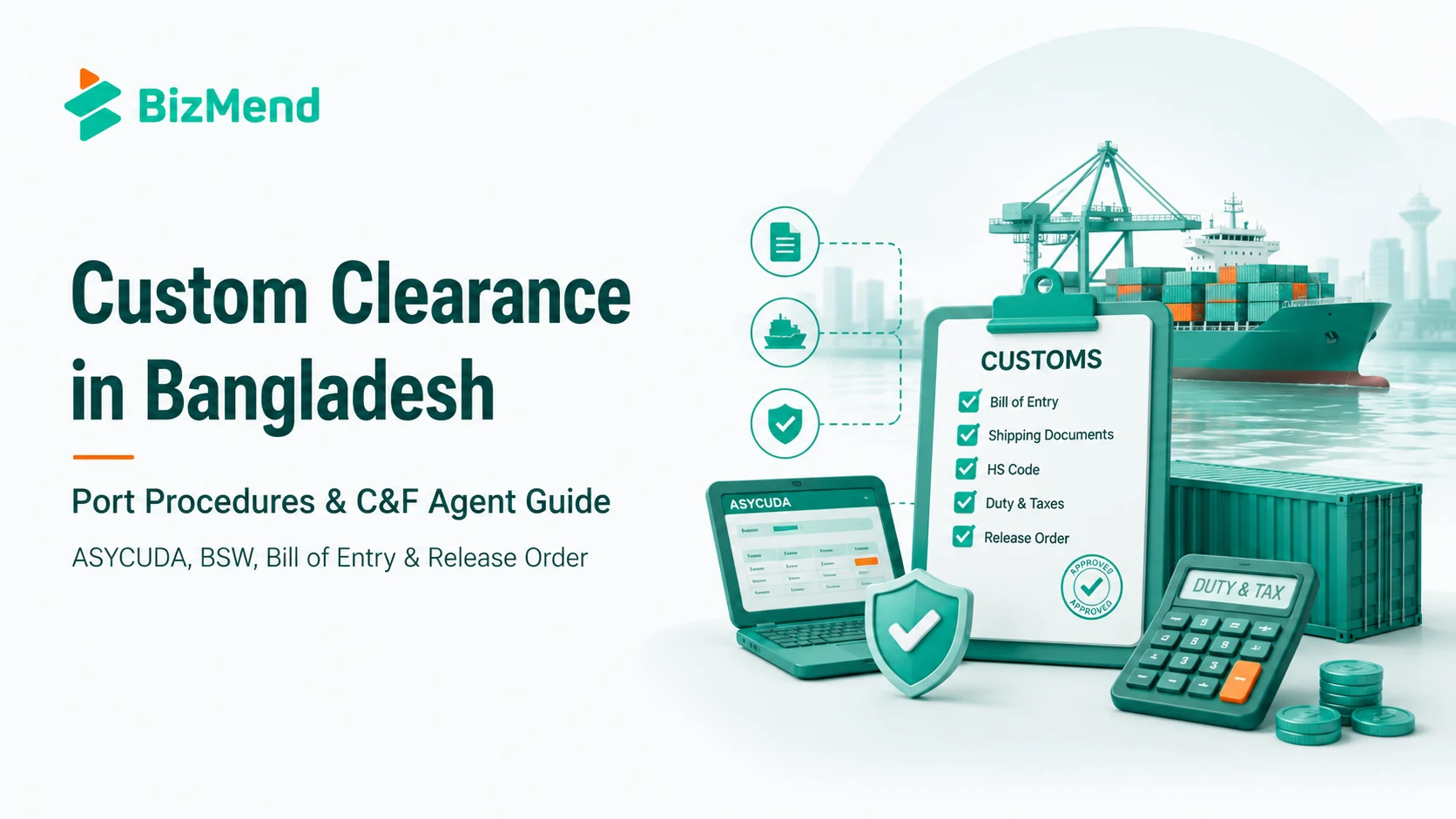
Customs House Chattogram (CCH) processes 7,000 to 8,000 bills of entry every single day. That’s the scale of what Bangladesh’s primary trade gateway handles, and it accounts for 70 to 80% of the country’s total customs revenue. If you’re importing or exporting goods, understanding how custom clearance in Bangladesh works isn’t optional. It’s the difference between your goods arriving on schedule and sitting at the port accruing demurrage. This guide covers the full step-by-step process, the documents you need, what a C&F agent actually does, how duties are calculated, and the 2025 regulatory updates you must know.
| Quick answer: Custom clearance in Bangladesh is managed by Bangladesh Customs under the National Board of Revenue (NBR), operating under the Customs Act 2023. Importers or their C&F agents submit a Bill of Entry through the ASYCUDA World system, pay assessed duties and taxes, and receive a release order. Chattogram Port handles around 80% of Bangladesh’s sea-borne trade. The Bangladesh Single Window (BSW) system is mandatory from July 1, 2025. |
Bangladesh Customs falls under the National Board of Revenue (NBR), which sits within the Ministry of Finance. The NBR is responsible for customs policy, duty collection, and trade facilitation. All customs clearance at every entry point, whether Chattogram Port, Dhaka’s Hazrat Shahjalal International Airport, Mongla Port, or land customs stations, operates under this framework.
Bangladesh operated under the Customs Act 1969 for over five decades. On October 31, 2023, the Customs Act 2023 was passed in parliament, replacing the old law entirely. The new act has 269 sections and brings Bangladesh in line with World Customs Organization (WCO) standards and the WTO Trade Facilitation Agreement.
Key changes under the Customs Act 2023:
If you’re setting up an import business in Bangladesh, understanding this new legal framework before your first shipment saves you from avoidable penalties.
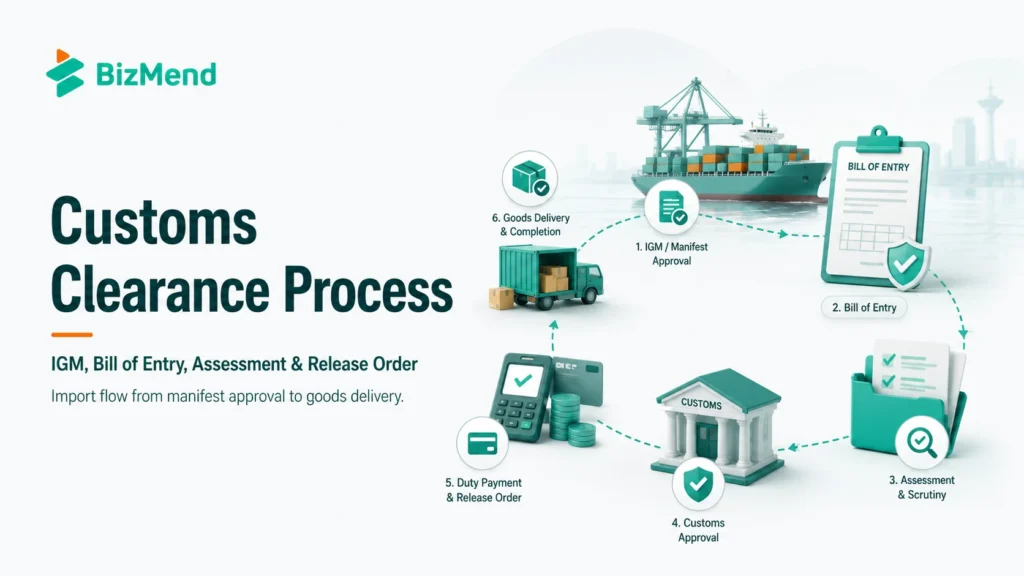
Here’s how a standard import clearance flows at Chattogram Port, from the moment the ship arrives to the moment your goods leave the port:
1. Shipping agent submits the IGM. The shipping agent (or freight forwarder, or airline for air cargo) submits the Import General Manifest (IGM) electronically into ASYCUDA World. This contains the description of all imported goods on the vessel.
2. Customs approves the manifest. Bangladesh Customs reviews and approves the IGM.
3. The C&F agent submits the Bill of Entry. The importer’s nominated C&F agent (or the importer directly) submits the Bill of Entry (B/E) through ASYCUDA World in Single Administrative Document (SAD) format.
4. Documents submitted alongside the B/E. The C&F agent submits the printed B/E along with supporting documents: commercial invoice, bill of lading, packing list, insurance certificate, LC or import permit, certificate of origin, and any product-specific documents.
5. Risk assessment. Customs uses its risk management system to decide whether the consignment needs physical examination. Not every shipment is inspected.
6. Physical inspection (if selected). If selected, customs officers inspect the goods. For plant and agricultural products, the Plant Quarantine Wing (PQW) of the Department of Agricultural Extension conducts a parallel examination.
7. Assessment notice issued. Customs calculates and assesses the applicable duties and taxes based on the HS code and CIF value. An assessment notice is issued online.
8. Importer pays duties and taxes. The importer (or C&F agent on their behalf) pays through designated banks or payment channels.
9. Customs issues the release order. Once payment is confirmed, customs issues a release order.
10. Port formalities and delivery. The C&F agent completes port authority formalities and arranges delivery of the goods to the importer’s warehouse or factory.
Before you even get to Step 3, you need a valid Import Registration Certificate (IRC) in Bangladesh, which is issued by CCI&E and is mandatory for all commercial importers.
Getting the documents wrong is the single most common cause of clearance delays. Here’s what you need for a standard import shipment:
For specific product categories, additional documents may be required: pre-shipment inspection reports, fumigation certificates for raw cotton from Western Hemisphere countries, import permits for plant and agricultural products, and clearance certificates from BSTI or DGDA depending on the goods.
If you’re dealing with a letter of credit for your import transaction, our guide on how a letter of credit in Bangladesh works covers the LC document flow in detail.
A C&F (Clearing and Forwarding) agent is a government-authorized customs broker. They’re licensed by Bangladesh Customs under the NBR and must be a member of either the Dhaka Customs Agents Association (DCAA) or the Chittagong Customs Clearing and Forwarding Agents Association, depending on the port.
Technically, an importer can handle their own customs clearance directly through ASYCUDA World. Practically, almost no commercial importer does this without a C&F agent.
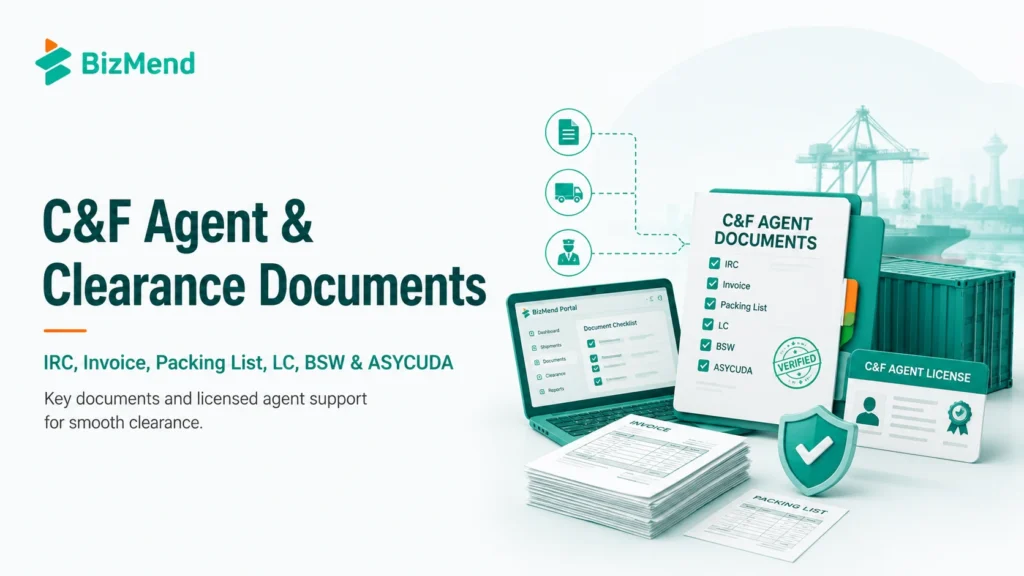
Licensed C&F agents are listed on the Bangladesh Customs Agent Management System at bdcams.bdcustoms.gov.bd. For Chattogram Port clearance, contact agents who are registered members of the Chittagong Customs Clearing and Forwarding Agents Association. For Dhaka airport clearance, use agents registered with the Dhaka Customs Agents Association.
Verify your agent’s license is current before engaging them. An expired license means their submissions will be flagged by the ASYCUDA system.
Getting a DUNS number from Dun & Bradstreet for supplier and business credibility helps establish your business identity in the trade ecosystem, which your C&F agent will need when dealing with overseas counterparts on your behalf.
Bangladesh levies six types of duties and taxes on imported goods, collectively called the Total Tax Incidence (TTI). They apply in layers on the CIF value (Cost + Insurance + Freight):
The HS code is the starting point for all of this. Bangladesh uses the 8-digit HS classification system. A wrong HS code can trigger penalties under the Customs Act 2023. Your C&F agent should verify the correct HS code before filing the B/E.
All duty and tax calculations under the Customs Act 2023 use the daily exchange rate at the time of assessment. This is a significant change from the 1969 Act. For context on which sectors drive the most import activity, our overview of top industries for foreign investment in Bangladesh is worth reading.
Export clearance is simpler than import clearance in most cases. Goods cannot be loaded onto a vessel or stuffed into containers for export until a Bill of Export (Shipping Bill) is submitted and approved through ASYCUDA World.
Standard documents for export clearance include: An Export LC or Contract or Purchase Order, Commercial Invoice, Packing List, EXP Form (certified by an Authorized Dealer bank), Certificate of Origin (issued by EPB or Chamber of Commerce), VAT Registration Certificate, and TIN certificate. The C&F agent or the exporter submits the Bill of Export electronically and customs approves before loading begins.
Two significant developments affect anyone doing customs clearance in Bangladesh from 2025.
The Bangladesh Single Window (BSW) system became mandatory from July 1, 2025. All import and export-related certificates, licences, and permits (CLPs) from 19 government bodies including CCI&E, BSTI, DGDA, and BIDA now go through the BSW portal at bswnbr.gov.bd. Importers must register their Business Identification Number (BIN) before their first shipment arrives. Without BSW registration, CLP-dependent clearances will stall.
Delay in paying assessed duties, taxes, or charges by the due date may trigger 10% interest or penal tax under the Customs Act 2023. Plan your customs clearance timeline and working capital accordingly. For commercial banks in Bangladesh with strong trade finance desks, many now help importers meet duty payments within the 10-day window.
Honestly, most customs clearance delays are preventable. Here’s what goes wrong most often:
If you’re still in the early stages of setting up your business, our guide on starting a business in Bangladesh as a foreigner covers the company registration and compliance groundwork that customs clearance depends on.
Customs clearance in Bangladesh is the process of getting imported or exported goods officially approved by Bangladesh Customs before they can be released from the port or loaded for export. It’s managed by Bangladesh Customs under the National Board of Revenue (NBR), within the Ministry of Finance. The Customs Act 2023 is the current governing law, replacing the Customs Act 1969 that had been in place for over 50 years.
ASYCUDA World is the electronic customs management system used by Bangladesh Customs for processing all import and export declarations. Every Bill of Entry (for imports) and Bill of Export (for exports) must be submitted through this system. Manual declarations are no longer accepted at Chattogram Port. C&F agents and importers access ASYCUDA World to file declarations, track clearance status, and receive assessment notices and release orders.
For a standard import, you need: Bill of Entry (SAD format via ASYCUDA World), Commercial Invoice, Bill of Lading or Airway Bill, Packing List, Insurance Certificate, LC copy or Import Contract, Certificate of Origin, IRC copy, and a signed authorization letter to your C&F agent. For specific products, additional documents such as BSTI certificates, pre-shipment inspection reports, or plant quarantine permits may also be required.
Legally, an importer can file their own customs declaration through ASYCUDA World. Practically, almost all commercial importers use a licensed C&F agent who handles technical filing, HS code verification, duty calculation, document submission, and port delivery coordination. Always verify a C&F agent’s current license at bdcams.bdcustoms.gov.bd before engaging them, as expired-license submissions are rejected by the ASYCUDA system.
Under the Customs Act 2023, a 10% penalty interest on the assessed duties and taxes is imposed if goods are not released within 10 days of the assessment notice. This was introduced to reduce port congestion from goods left uncollected at Chattogram. Plan your duty payment timeline and working capital so you can collect goods within this window. C&F agents typically coordinate this payment process on the importer’s behalf.
TTI is the combined total of all duties and taxes on an imported good: Customs Duty (CD), Regulatory Duty (RD), Supplementary Duty (SD, ranging 5% to 65.5%), VAT (15% on the duty-paid value), Advance Income Tax (AIT), and Advance Tax (AT). Each component stacks on top of the previous ones. Always calculate full TTI using the correct HS code before finalizing your import pricing. Verify current AT rates from the NBR tariff as these vary by product.
The Bangladesh Single Window (BSW) system, managed by NBR, became mandatory from July 1, 2025. It’s an integrated online portal at bswnbr.gov.bd that consolidates all certificates, licences, and permits (CLPs) from 19 government bodies including CCI&E, BSTI, DGDA, and BIDA. Importers must register their 13-digit Business Identification Number (BIN) on BSW. Without this registration, CLPs cannot be obtained and clearance stalls.
The Customs Act 2023 (passed October 31, 2023, with 269 sections) replaced the Customs Act 1969. Key changes: electronic-only declarations via ASYCUDA World, floating daily exchange rates for duty assessments, a new 10% penalty interest for delays beyond 10 days, formally incorporated risk management and post-clearance audit, and introduction of Authorized Economic Operator (AEO) status for businesses with strong compliance records.
For export, a Bill of Export (Shipping Bill) must be submitted and approved through ASYCUDA World before goods can be loaded. Key documents include: Export LC or Contract, Commercial Invoice, Packing List, EXP Form certified by an Authorized Dealer bank, Certificate of Origin, VAT Certificate, and TIN. Export clearance is generally simpler and faster than import clearance for most commercial goods.
Licensed C&F agents are listed on the Bangladesh Customs Agent Management System at bdcams.bdcustoms.gov.bd. For Chattogram Port, use agents registered with the Chittagong Customs Clearing and Forwarding Agents Association. For Dhaka airport, use agents registered with the Dhaka Customs Agents Association (DCAA). Always verify a prospective agent’s license is current before signing any service agreement.
Customs clearance in Bangladesh isn’t complicated once you understand the sequence. IGM comes in, the Bill of Entry goes out via ASYCUDA, duties get assessed, you pay, the release order comes through. What makes it go wrong is almost always the same: wrong HS code, missing documents, or an unregistered BIN on the BSW system. The Customs Act 2023 has tightened everything up, and honestly, that’s not a bad thing for serious traders.
If I were setting this up fresh today, I’d register my BIN on BSW before anything else, lock in a licensed C&F agent with a verified current license, and calculate my full TTI for every product before finalizing my import price. Those three steps alone solve most clearance problems before they start. What part of the clearance process are you tackling right now?

Learn how to become a Daraz seller in Bangladesh, register an account, list products, understand fees, manage orders, and grow…
by Sheikh Ornob

Compare the cost of living in Bangladesh in 2026, including Dhaka and Chittagong rent, food, transport, utilities, inflation, and monthly…
by Sheikh Ornob
Learn MoA and AoA requirements in Bangladesh, key clauses, drafting basics, RJSC filing steps, amendments, and common company-registration mistakes. Suggested…
by Sheikh Ornob