
How to Become a Daraz Seller in Bangladesh: Registration, Fees & Growth
Learn how to become a Daraz seller in Bangladesh, register an account, list products, understand fees, manage orders, and grow…
 by Sheikh Ornob

Updated 2026 guide to agriculture in Bangladesh: GDP data, 2024 flood losses, fisheries rankings, agro-processing incentives, climate risks, and investment
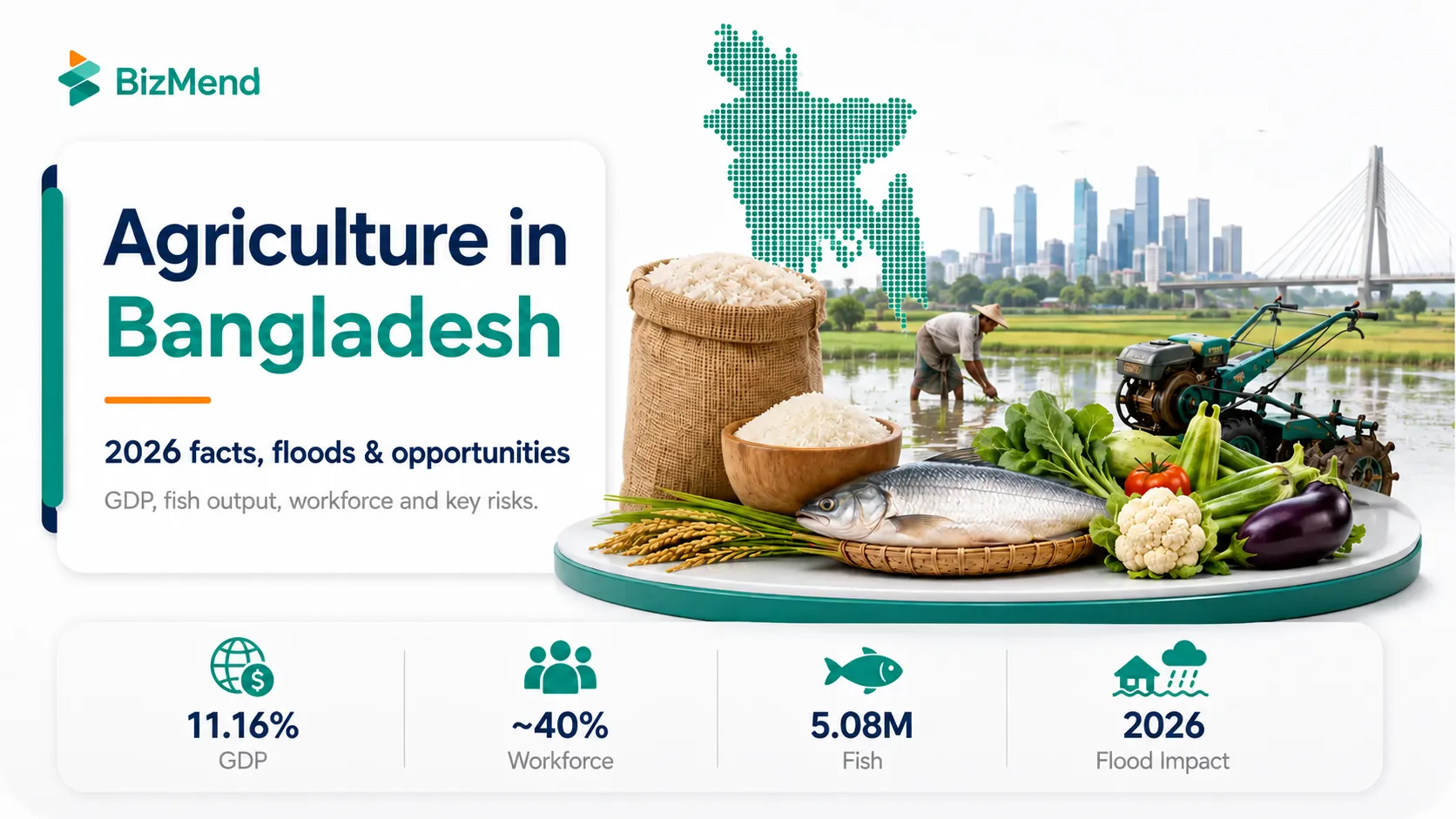
Two floods in 2024. An estimated 1.1 million metric tons of rice wiped out. Food prices jumping nearly 20% in months. And then, in the middle of all that chaos, Bangladesh still ranked second in the world for freshwater fish production.
That contradiction is agriculture in Bangladesh in a nutshell. Genuinely impressive and genuinely fragile at the same time. This article covers the current numbers, what’s actually working, what isn’t, and where the real business opportunity sits right now.
Quick answer: Agriculture, forestry, and fishing contribute about 11.2% to Bangladesh’s GDP in the latest World Bank data for 2024, while the sector still supports roughly 37–40% of the workforce. The sector covers crops, fisheries, livestock, and forestry, producing over 70 million metric tons annually. Total fish production reached 5.018 million metric tons in FY2023-24, according to the Department of Fisheries. For FY2025-26, the government set a production target of 52.55 lakh tonnes. Climate events and food inflation are the sector’s most pressing challenges heading into 2026.
Agriculture still carries the economy. The World Bank put its GDP contribution at 11.16% in 2024. The government’s FY2025-26 budget allocated Tk 39,620 crore (roughly $3.5 billion) to agriculture, food, fisheries, and livestock, a 3.6% nominal increase over FY25. That’s not nothing.
But the bigger story is employment. Depending on the source, agriculture employs somewhere between 37% and 40% of Bangladesh’s workforce. Some estimates push higher, because a large portion of rural livelihood is tied to agri-related work without being formally classified. In a country of 170 million people, this sector’s health affects almost everyone.
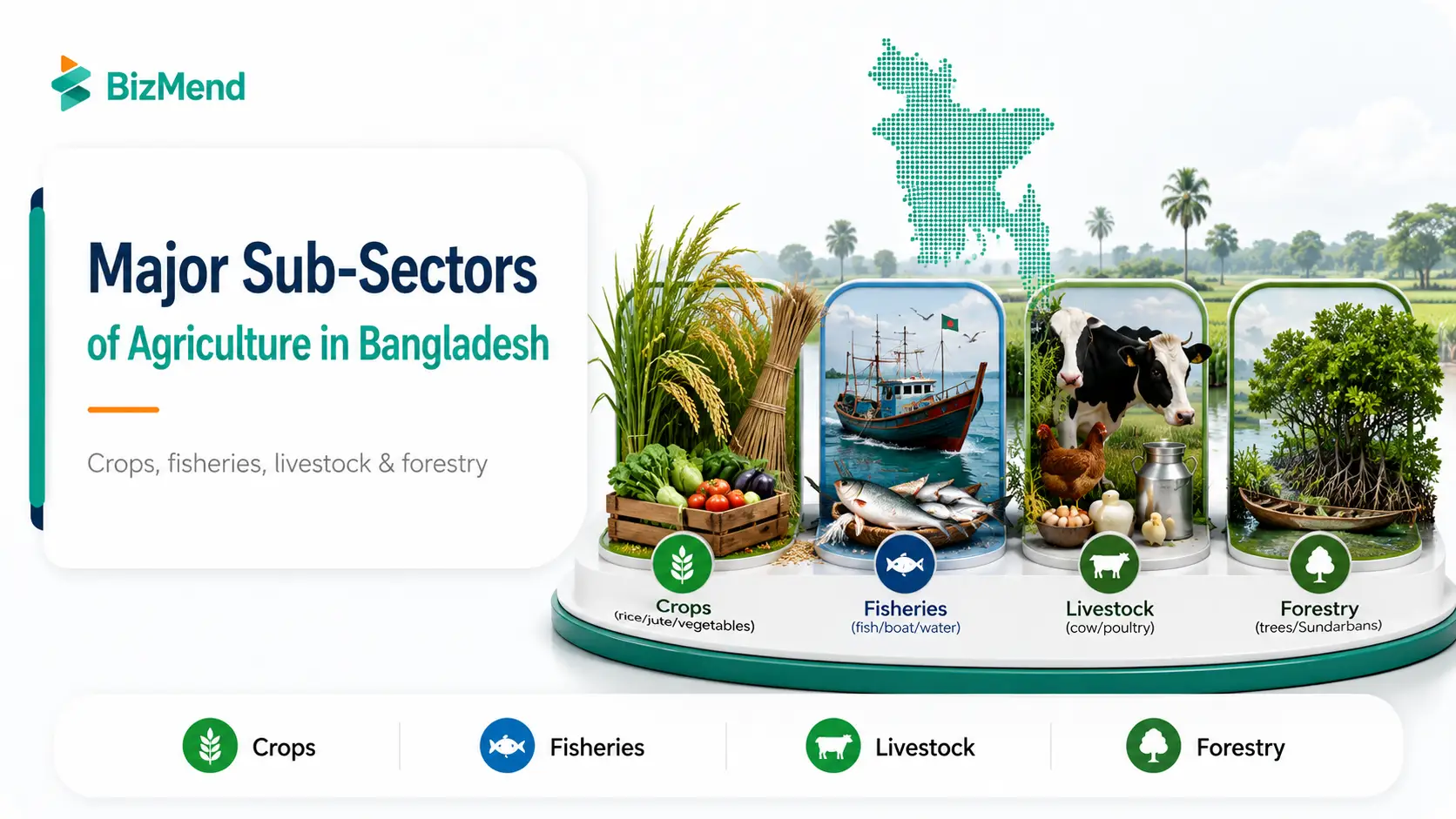
Four sub-sectors make up the whole. Crops (rice, wheat, potatoes, jute, vegetables, fruits, spices) lead by volume. Fisheries contribute 2.53% to national GDP and 22.26% to agricultural GDP, per the Department of Fisheries’ FY2023-24 data. Livestock adds another 1.80% to GDP. Forestry, mainly the Sundarbans, rounds it out.
Rice is the core crop. Bangladesh is the world’s third-largest rice producer. In FY2024-25, milled rice production was forecast at 36.8 million metric tons, down from earlier projections because of severe flooding in August and October 2024.
Beyond rice, Bangladesh holds some genuinely surprising global rankings. Second in jute. Second in jackfruit. Sixth in tropical fruit. Seventh in potato. And the country produces roughly 4 million tons of spices annually.
Bangladesh took two major flood waves in 2024: one in August, one in October. The agriculture ministry confirmed an estimated 1.1 million metric tons of rice lost. Over 200,000 tons of vegetables were also damaged. Total agricultural loss: around 45 billion taka, or roughly $380 million. At least 75 people died. Millions were displaced.
The government scrambled to authorize emergency rice imports of 500,000 tons. Food prices had already jumped nearly 20% by that point. The interim government, which took power in August after political protests forced former Prime Minister Sheikh Hasina to flee, was dealing with this on top of an already fragile economy.
This wasn’t a freak year. The Boro rice variety, Bangladesh’s most important irrigated crop, is increasingly affected by rising nighttime temperatures, per a 2025 FAO assessment. In the northwest, droughts and water scarcity have been hitting wheat and maize. In coastal Khulna and Barisal, salinity intrusion has made farming progressively harder.
The human toll shows up in food security data. Around 16 million people in Bangladesh were projected to face high levels of acute food insecurity, IPC Phase 3 or above, during May–December 2025. In a country that technically has enough food supply overall, that number tells you the problem is distribution, income, and system resilience as much as raw production.
While the crop situation is complicated, fisheries are a genuine win.
Bangladesh ranked second globally in freshwater fish production in the FAO’s State of World Fisheries and Aquaculture 2024 report. Total fish production in FY2023-24 reached 5.018 million metric tons from inland and marine sources combined. That same figure was 754,000 metric tons back in 1983-84. A sixfold increase over four decades.
Aquaculture drives it. Pond fish farming alone contributed 47.20% of total production in FY2023-24. Mymensingh and Cumilla are the country’s largest fish-producing districts, each pulling over 300,000 tons annually. Mymensingh alone has around 100,000 fish farmers raising 15 different species.
Hilsa, the national fish, brought in about 650,000 metric tons in FY2023-24, accounting for 12.21% of total production. Bangladesh ranks first globally in hilsa production among 11 producing countries and holds a geographical indication (GI) certification for “Bangladesh Ilish.” That’s a real market differentiator.
But 2024 was rough even here. Industry sources reported hilsa production fell 7% and shrimp fell 18% that year due to climate disruption, late rainfall, and extreme heat damaging farms. The aggregate numbers still showed a 2.5% overall production rise, but you can’t smooth over those sub-sector drops.
Shrimp deserves its own paragraph. It was once Bangladesh’s top agricultural export earner. It’s been struggling for years because of food safety rejections in the EU and US over antibiotic residues and compliance failures. Of 107 fish processing plants in Bangladesh, the European Commission has approved 77. Compliance investment is a genuine barrier for smaller operators, and processing plants have historically run at only a fraction of capacity.
Over 75% of agricultural produce in Bangladesh still leaves farms raw and unprocessed. That stat appears in every serious policy document about this sector. It keeps being true. And it represents either the country’s biggest problem or its biggest commercial opportunity, depending on your position.
Bangladesh’s processed or packaged food sector is estimated at around $4.8 billion and projected to reach about $5.8 billion by 2030, according to CPD/TBS-reported market estimates. Agro-processed exports have grown at 16.6% annually over the past four years. Total agro exports in FY2024 hit $1.03 billion, including $341.73 million from processed food.
Post-harvest losses are still running 30-40% for perishable produce. Bangladesh has roughly 400 cold storage facilities. Most are designed for potatoes. The gap for vegetables, seafood, and fruit is real and commercially significant.
PRAN-RFL Group, Bombay Sweets, and Square Food & Beverage have built real regional presence in the Middle East and South Asia. But they’re selling mainly to Bangladeshi diaspora communities. Western retail chains barely know these brands exist. That’s both a gap and an opportunity.
BIDA has designated agro-processing as a priority investment sector. Current incentives, active as of mid-2025:
The top industries in Bangladesh for foreign investment coverage puts agro-processing in the same priority tier as ICT and export manufacturing, which reflects the actual government policy stance.
Sea levels are rising. Coastal salinity-affected land expanded from about 0.833 million hectares in 1973 to about 1.056 million hectares by 2009, and there’s no indication it’s slowing. In the northeast, flash floods periodically destroy entire Boro rice harvests before they can be picked. The Haor region accounts for 18% of Bangladesh’s rice production and 6% of GDP, and it gets wiped out by unpredictable early floods regularly.
A 2025 FAO assessment specifically flagged Boro rice yields declining due to rising nighttime temperatures. A climate research brief from early 2025 estimated coastal and climate-related agricultural losses between 2015 and 2020 alone ran into hundreds of billions of taka.
The Bangladesh Rice Research Institute has developed over 120 stress-tolerant rice varieties. Salt-tolerant BRRI strains now grow in coastal areas that were unproductive a decade ago. Floating gardens operate in flood-prone Barisal districts. Solar-powered irrigation is spreading in dry northern regions. These are real, working adaptations at the farm level.
But The World Bank has warned that Bangladesh could lose up to one-third of its agricultural GDP by 2050 due to climate variability and extreme events if adaptation is not scaled. The FY2025-26 budget’s Tk 39,620 crore agriculture allocation sounds large until you factor in rising input costs and inflation. Analysis from August 2025 in The Daily Star concluded the real value of that budget has effectively stagnated.
Digital advisory platforms, mobile price alerts, and IoT irrigation pilots are all underway. Digital grocery and farmer-to-consumer platforms are growing, especially around Dhaka, but any exact market-size figure should be updated from a current 2026 market report before publishing. That growth is real but concentrated around Dhaka, where infrastructure actually exists.
The FoodTechBangladesh program, a five-year initiative (September 2022 to August 2027) run jointly by Larive International of the Netherlands and LightCastle Partners, is building four Centers of Excellence in Khulna, Mymensingh, Patuakhali, and Cox’s Bazar. The Khulna center is already operational. The Cox’s Bazar Centre of Excellence under FoodTechBangladesh was inaugurated in September 2025. The program aims to train 1,800 farmers in modern aquaculture practices.
Greenhouse farming is getting more serious investment attention. BIDA’s current investment materials note that setup costs in Bangladesh run EUR 90-150 per square meter, among the lowest in Asia. High-value crops like cherry tomatoes, capsicum, and exotic fruits are now being grown in climate-controlled facilities targeting export markets.
Whether precision farming and AI-based tools actually reach the smallholder farmers who dominate this sector is a different question. Most landholdings in Bangladesh are tiny. That structural reality limits how fast technology adoption can spread without subsidized delivery systems.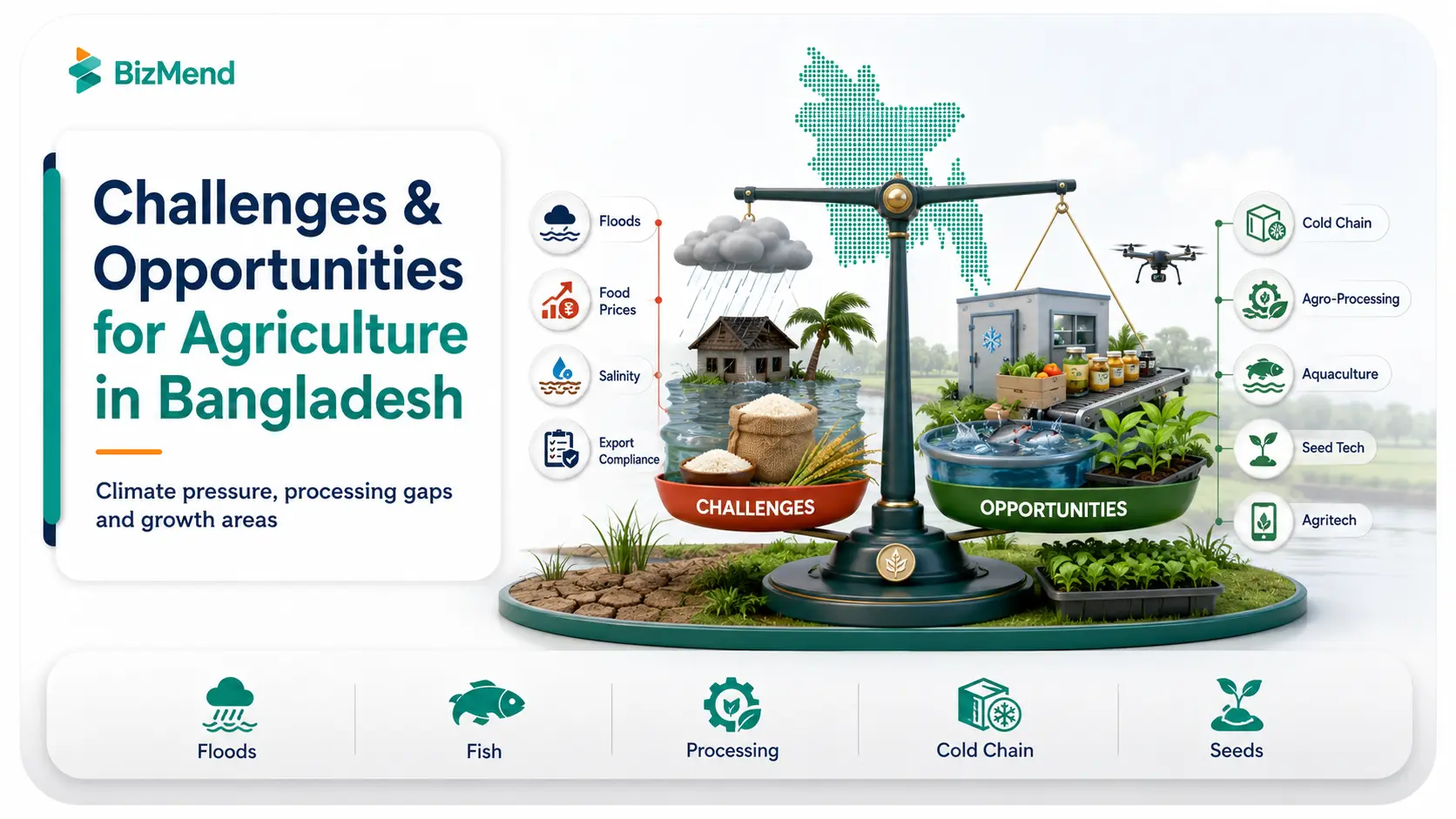
If you’re thinking about entering this sector, the legal setup matters. A guide on starting a business in Bangladesh as a foreigner covers registration and BIDA requirements. And company types and restrictions for foreigners in Bangladesh matters here because agricultural land ownership is restricted even when food processing facilities aren’t.
On financing: government banks in Bangladesh like Bangladesh Krishi Bank (established 1973) are the country’s dedicated agricultural lenders with the deepest rural reach. Non-bank financial institutions in Bangladesh are increasingly active in agritech and food processing through project financing and venture structures.
For Bangladeshi agro-entrepreneurs who want direct access to US buyers and payment processors, starting a business in the USA from Bangladesh is a path a growing number of food exporters have taken.
Agriculture, forestry, and fishing contributed 11.16% to Bangladesh’s GDP in 2024, per World Bank data. For FY2023-24 specifically, the Bangladesh Bureau of Statistics recorded 11.02%. The FY2025-26 budget allocated Tk 39,620 crore (approximately $3.5 billion) to agriculture, food, fisheries, and livestock, a 3.6% nominal increase over FY25.
Two major flood events in August and October 2024 destroyed an estimated 1.1 million metric tons of rice and over 200,000 tons of vegetables, causing approximately 45 billion taka ($380 million) in total agricultural losses. The government authorized emergency rice imports of 500,000 tons. Food prices rose nearly 20% in the aftermath, affecting millions of low-income households.
Rice is dominant, with milled production forecast at 36.8 million metric tons in FY2024-25, down from earlier estimates due to flooding. Other major crops include potatoes (7th globally), jute (2nd globally), tropical fruits (6th globally), jackfruit (2nd globally), and roughly 4 million tons of spices including chillies, onions, garlic, and ginger.
Very significant. Total fish production in FY2023-24 reached 5.08 million metric tons. The fisheries sector employs around 20 million people and contributes 2.53% to national GDP and 22.26% to agricultural GDP, per Department of Fisheries data. Bangladesh ranked 2nd globally in freshwater fish production (FAO, 2024) and is the world’s top hilsa producer.
Shrimp exports face repeated rejections in EU and US markets over antibiotic residue failures, weak traceability, and food safety non-compliance. Of 107 fish processing plants, the European Commission has approved 77. Smaller operators lack capital for compliance upgrades, and processing plants have historically operated well below capacity.
Serious and accelerating. The 2024 floods destroyed over a million tons of rice. Boro rice yields are declining due to rising nighttime temperatures (FAO, 2025). Coastal salinity has spread from 83.3 million hectares affected in 1973 to 105.6 million by 2009. The World Bank estimates Bangladesh could lose one-third of agricultural GDP to climate events by 2050 without major adaptation investment.
As of 2025: no VAT on exported goods (SRO No. 180-Ain/2025/308, June 2025), Corporate Income Tax reductions for 5-10 years depending on location, a 20% electricity rebate for agro-processing units, complete tax exemption on rice bran oil production for up to 10 years, full repatriation of profits and initial capital, and preferential or duty-free access to 52 countries including the EU and GCC.
The processed food sector is valued at approximately $4.8 billion, projected to reach $5.8 billion by 2030 per forecasts cited at the Bangladesh Investment Summit 2025. Agro-processed exports have grown at 16.6% annually over four years. Total agro exports in FY2024 reached $1.03 billion, with processed food contributing $341.73 million.
Around 1.6 crore (16 million) Bangladeshis experienced crisis-level hunger or worse during the 2025 peak stress period, according to The Business Standard analysis. This occurred despite relatively stable overall food supply, pointing to structural problems: import dependence, weak distribution infrastructure, and income gaps rather than pure production failure.
Foreigners can invest in agro-processing, aquaculture, food manufacturing, and agritech businesses in Bangladesh. Agricultural land ownership by foreigners is restricted. Processing facilities and technology-focused businesses generally don’t face the same limits. BIDA registration is required, and a Private Limited Company is the standard structure used by foreign investors in this space.
Bangladesh’s agriculture sector is both a genuine success story and a serious warning sign. The fish farming numbers are world-class. The rice self-sufficiency achievement took decades of real research and real investment. And yet one bad flood season knocks out over a million tons of grain, prices spike, and 16 million people end up in food crisis. Both of those things are true at the same time.
For anyone evaluating this sector seriously: the opportunity is real. Cold chain, processing, aquaculture compliance, agritech, seeds. The gaps are documented and the incentives are active. But the climate trajectory is real too, and that has to be part of your investment thesis, not an asterisk at the bottom. What’s your answer to that before you write the check?

Learn how to become a Daraz seller in Bangladesh, register an account, list products, understand fees, manage orders, and grow…
by Sheikh Ornob
Compare the cost of living in Bangladesh in 2026, including Dhaka and Chittagong rent, food, transport, utilities, inflation, and monthly…
by Sheikh Ornob

Learn MoA and AoA requirements in Bangladesh, key clauses, drafting basics, RJSC filing steps, amendments, and common company-registration mistakes. Suggested…
by Sheikh Ornob