
 by Sheikh Ornob
VAT in Bangladesh sounds simple until you are the one who has to charge it and file the return on time. Many businesses first hear about musak in a rushed conversation with an accountant, a bank, or an NBR officer, then realize they were already expected to know the system.
In Bangladesh, VAT sits inside a broader compliance setup run by the National Board of Revenue, or NBR. That is why people often use VAT, musak, BIN, registration, and return filing almost interchangeably, even though they are not the same things. This guide explains what VAT means, who has to register, which rates apply, how Mushak returns are filed, and where small mistakes create bigger trouble.
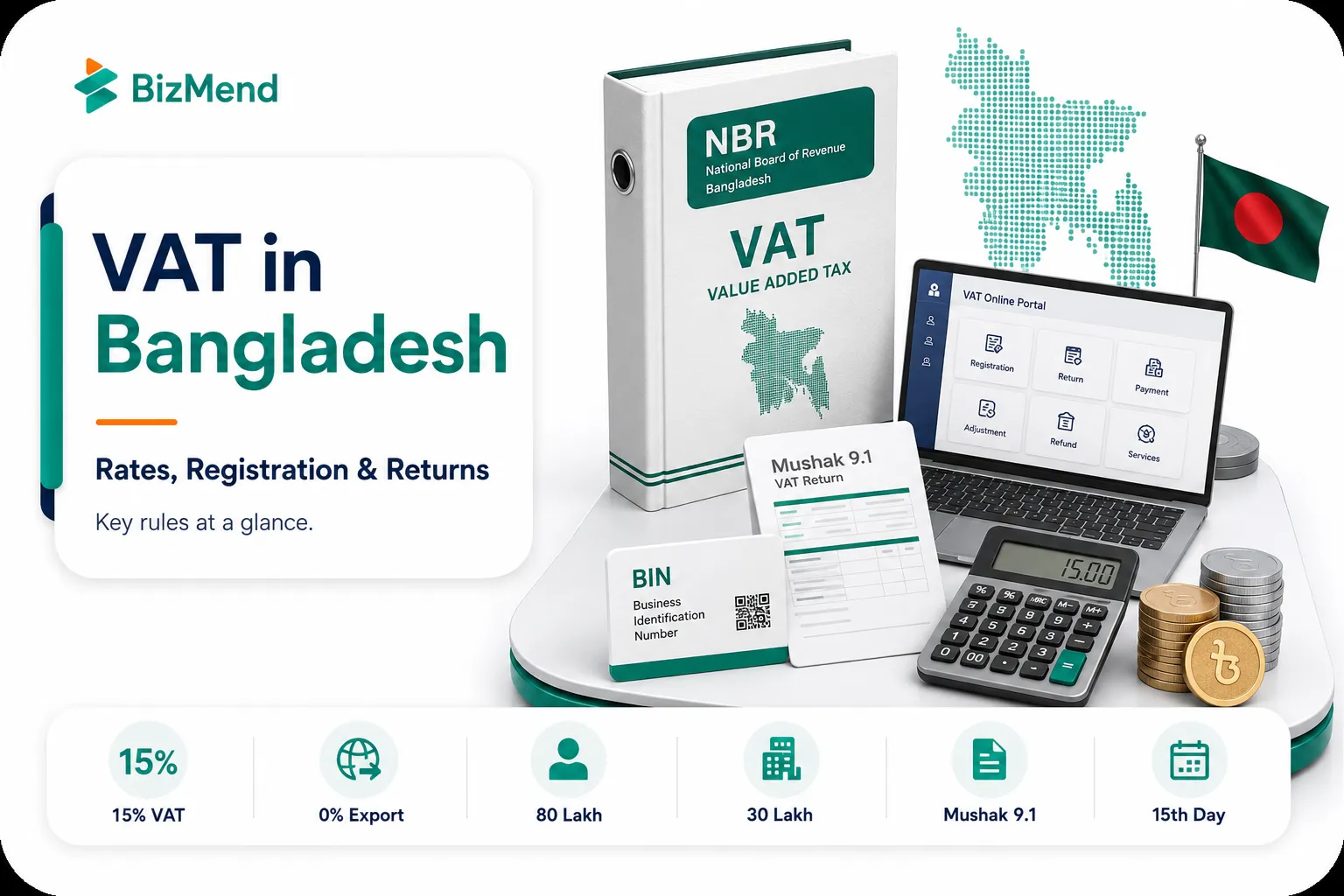
Quick answer: VAT in Bangladesh is generally charged at 15%, with export at 0%, and businesses usually need VAT registration once taxable turnover crosses BDT 80 lakh in 12 months. Smaller businesses above BDT 30 lakh may fall under 3% turnover tax instead. Monthly VAT returns are filed in Mushak 9.1 by the 15th of the following month.
Key Takeaways
- In Bangladesh, VAT is the main value-added tax system, while “musak” is the local shorthand you will see in form names, invoices, and return filing references.
- The standard VAT rate shown by NBR is 15 percent, while exports are generally zero-rated and some supplies may fall under exemptions, supplementary duty, or special SRO treatment.
- NBR guidance says turnover above BDT 80 lakh in a 12-month period triggers VAT registration, and turnover above BDT 30 lakh triggers turnover tax enlistment if the business does not cross the VAT threshold.
- Registration or enlistment should be taken within 15 days after the threshold condition arises, and online application through the NBR VAT system is the main route.
- Registered VAT taxpayers file Mushak 9.1 each month, while turnover tax taxpayers use Mushak 9.2, and the general filing deadline is the 15th day of the following month.
- A business can be required to file even in a quiet month, so no sales does not automatically mean no return obligation.
- Using the right invoice matters because VAT taxpayers issue Mushak 6.3 tax invoices, while turnover tax payers use Mushak 6.9 invoices.
- The most common compliance problems are late registration, weak invoice discipline, poor purchase and sales records, and assuming a reduced rate or exemption applies without checking the latest NBR rule or SRO.
What VAT Means in Bangladesh
In Bangladesh, VAT is a transaction tax collected through the supply chain, then settled with NBR by the business that charged it. The standard structure is input tax credit: you collect VAT on taxable sales, claim credit on eligible VAT paid on purchases, and then pay the net amount. NBR’s VAT section still describes the standard rate as 15 percent and exports as 0 percent.
The term musak is where people often get lost. Musak is not a separate tax. It is the Bengali shorthand used across the VAT system, especially in form names such as Mushak 2.1 for registration and Mushak 9.1 for the monthly return. So when someone says, ‘Have you filed your musak?’ they usually mean your VAT compliance paperwork, not a different tax category.
VAT is the tax system. Musak is the language of the forms you use to stay inside it.
For day to day business, think of four moving pieces: your BIN, your invoice, your purchase and sales records, and your return. If one of those is weak, the rest start wobbling. That matters whether you run a local trading company in Dhaka, a factory in Gazipur, or a foreign-owned company setting up under BIDA approval.
Who Needs VAT Registration, and Who Falls Under Turnover Tax
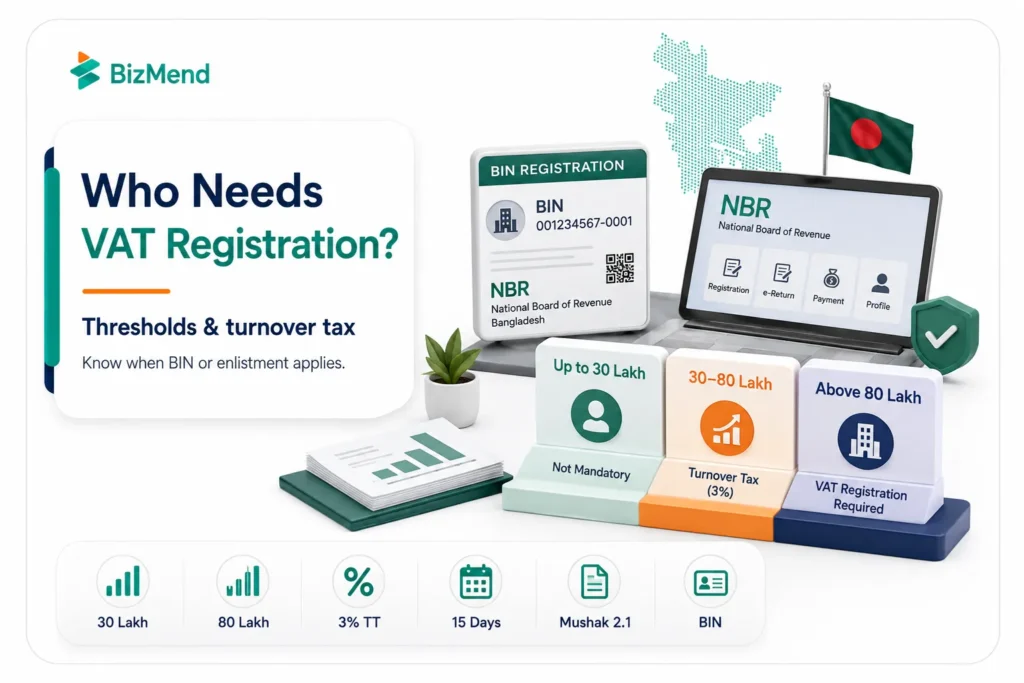
This is the question most businesses care about first, and it is also where mixed numbers online create confusion. As of May 18, 2026, NBR’s VAT FAQ still states a registration threshold of BDT 80 lakh in a 12-month period and an enlistment threshold of BDT 30 lakh. The same FAQ says registration or enlistment should be taken within 15 days after that necessity arises.
| Annual turnover in 12 months | General treatment | Typical form path |
|---|---|---|
| Up to BDT 30 lakh | Usually outside VAT and turnover tax based on the FAQ threshold | No VAT or turnover tax registration in the general case |
| Above BDT 30 lakh up to BDT 80 lakh | Usually turnover tax zone at 3 percent, subject to the nature of supply | Enlistment and Mushak 9.2 filing |
| Above BDT 80 lakh | VAT registration generally required | BIN registration and Mushak 9.1 filing |
NBR also says businesses can move from enlistment to registration if turnover grows past the VAT threshold, and in the other direction if turnover falls back within the lower band. That is useful for growing startups because registration is not a one-time label you choose for branding. It follows the turnover position and the nature of your taxable activity.
There is another practical layer here. Even businesses still reading their way through the law may need a BIN for banking, import and export activity, tender participation, land or building registration, or bank loan processing. For foreign investors, that is one reason VAT questions often show up early, right beside incorporation and BIDA paperwork.
What Rates Apply Under the Bangladesh VAT System
NBR’s current public guidance keeps the headline rate simple: the standard VAT rate is 15 percent, and exports are 0 percent. Turnover tax, which applies to enlisted businesses rather than full VAT registrants, is shown at 3 percent. That gives you the core picture, but not the whole picture.
- Standard VAT: 15 percent on taxable imports and taxable supplies in the general rule.
- Export: 0 percent under the standard guidance.
- Turnover tax: 3 percent for businesses in the turnover tax band, rather than the regular VAT chain.
- Supplementary duty: separate rates can apply to certain goods or services, especially where the law or SROs treat them differently.
Where businesses slip is assuming every service or product follows the standard line. Bangladesh’s VAT system also works through schedules, exemptions, supplementary duty treatment, and SRO-based changes. So if you are in software, telecom, restaurants, manufacturing, imports, or any regulated sector, do not assume the generic 15 percent answer is the end of the analysis. Check the latest NBR rule, SRO, or sector-specific guidance before pricing or filing.
The dangerous VAT rate is not the one you know. It is the one you assumed.
If a registered business sells goods for a VAT-inclusive price of BDT 11,500 and the supply is subject to the standard rate, the embedded VAT is not BDT 1,725 by default. Under the VAT-inclusive method shown by NBR’s calculator examples, businesses often back out the tax from the total price. That is one reason invoice discipline matters so much.
How VAT Registration Usually Works
NBR says the main route is online registration or enlistment through its VAT portal, with Mushak 2.1 used for central registration or enlistment and Mushak 2.2 used for branch registration. The authority also states that online application is the main medium and that registration can be available instantaneously in online cases, although verification can still affect the process.
Public NBR guidance also says no documents are required to be submitted with the application in the general registration or enlistment process, but the system may still validate the information you enter. In practice, businesses should keep their trade license details, TIN, NID or passport-linked information, business address, bank data, and activity description clean and consistent before they apply. A mismatched address or unclear activity code is the kind of boring error that slows everything down.
- Apply through the NBR VAT system using the correct registration form.
- Make sure your business activity, address, and identity details match across your records.
- Check whether you need central registration or branch registration.
- Display the registration or enlistment certificate once issued, because NBR says it should be visible.
If you are a foreign investor, this registration step often sits alongside company formation, BIDA approval, bank account setup, and import or operating licenses. That is why it helps to read VAT together with the wider Bangladesh tax and setup rules, not as an isolated form of exercise.
How to File VAT Returns in Bangladesh
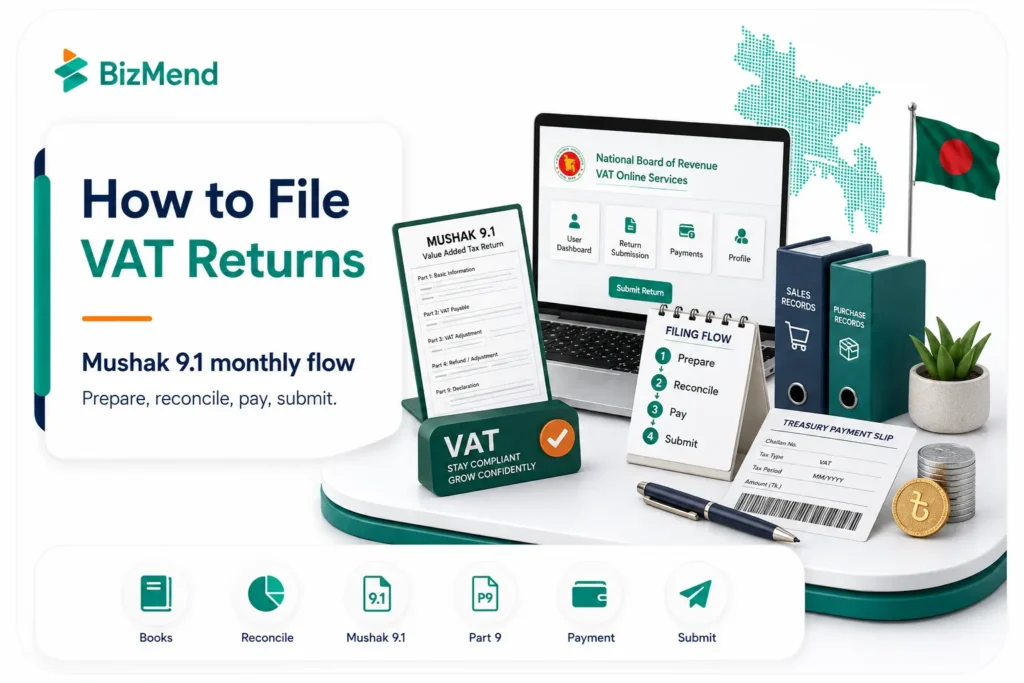
Once registered for VAT, the rhythm becomes monthly. NBR’s FAQ states that a registered person files a VAT return in Mushak 9.1 within the 15th day of the month following the tax period. For turnover tax, the return form is Mushak 9.2. NBR also notes that if the last filing date is a public holiday, the return should be submitted on the preceding working day.
- Collect your sales data for the tax period and match it against the invoices issued.
- Collect purchase data and identify input VAT that is eligible for credit.
- Reconcile output VAT, input VAT, withholding adjustments, if any, and advance payments, if they apply.
- Prepare Mushak 9.1 in the IVAS or eVAT environment and review the schedules before submission.
- Pay the net VAT due before or while filing, depending on the position shown in the return.
- Keep the submitted return, payment proof, invoices, and ledgers ready in case of review.
Invoice type matters here. NBR’s public VAT FAQ says Mushak 6.3 is the tax invoice for VAT taxpayers, while Mushak 6.9 is used for turnover tax invoices. If your invoicing is wrong all month, the return does not magically fix it at the end. The return only reports what your books and documents say happened.
NBR also warns that if a positive net tax amount is shown and the return is submitted without payment, interest may run after the 15th of the following month and a pecuniary penalty may apply. That is a good reason to treat filing and payment as one workflow, not two separate reminders.
Mistakes That Usually Create VAT Trouble
Most VAT problems are not dramatic fraud stories. They are everyday process failures. A business grows past BDT 30 lakh or BDT 80 lakh and does not react. Someone charges VAT without checking the correct treatment. The finance team files late because purchase records are still sitting in chat screenshots and paper files.
- Missing the registration or enlistment trigger and applying late.
- Using the wrong invoice form or issuing incomplete tax invoices.
- Claiming input tax credit without clean purchase support.
- Assuming an exemption or lower effective rate applies without checking the latest law, rule, or SRO.
- Treating a zero-sales month as a no-filing month.
- Letting branch data, bank data, or address updates drift away from the VAT record.
A good internal habit is to run a monthly VAT close before the 10th of the following month. That gives you a few days to catch missing invoices, supplier mistakes, or unmatched figures before the Mushak 9.1 deadline lands. For larger or foreign-owned businesses, it also makes broader tax reporting smoother.
None of this is glamorous. But VAT systems rarely punish businesses because they lack ambition. They punished businesses because nobody owned the monthly details.
Final Thoughts
VAT in Bangladesh becomes much easier once you stop treating it like one mysterious tax and start treating it like a monthly operating system. Know your threshold; use the right Mushak form, file by the 15th, and keep records clean. That is what keeps a manageable obligation from turning into a recurring compliance headache.
Frequently Asked Questions
Are VAT and Musak the same thing in Bangladesh?
Not exactly. VAT is the tax system. Musak is the label used across VAT forms, invoices, and return paperwork. In daily business conversation, people often say musak when they mean VAT filing or VAT documents.
When do I need VAT registration in Bangladesh?
Based on NBR’s public FAQ,
is generally required when taxable turnover exceeds BDT 80 lakh in a 12-month period. Businesses above BDT 30 lakh but within the lower band may instead fall under turnover tax enlistment at 3 percent.
What form is used for monthly VAT return filing?
A registered VAT taxpayer generally files Mushak 9.1 for each tax period. Turnover tax-enlisted businesses use Mushak 9.2 instead. NBR’s published guidance says the filing deadline is the 15th day of the following month.
Do I still have to file if I had no sales this month?
Many registered businesses still need to maintain filing discipline even in a slow month. The safer working assumption is to check your filing status and submit as required, rather than assuming that no sales automatically remove the return obligation.
What is the standard VAT rate in Bangladesh?
NBR’s current public guidance shows the standard VAT rate at 15 percent and export at 0 percent. Some supplies may also sit under exemption schedules, supplementary duty treatment, or sector-specific rules, so the standard rate is not the right answer for every transaction.
What is the biggest VAT mistake small businesses make?
Late threshold action is high on the list. Businesses cross the turnover trigger, delay registration or enlistment, and keep trading with weak invoice records. By the time filing starts, the cleanup work is harder than the monthly return itself.