How to Become a Daraz Seller in Bangladesh: Registration, Fees & Growth
Learn how to become a Daraz seller in Bangladesh, register an account, list products, understand fees, manage orders, and grow…
 by Sheikh Ornob

Learn how Payoneer works in Bangladesh for freelancers and small businesses, including setup, verification, withdrawals, fees, tax notes, and safety checks.
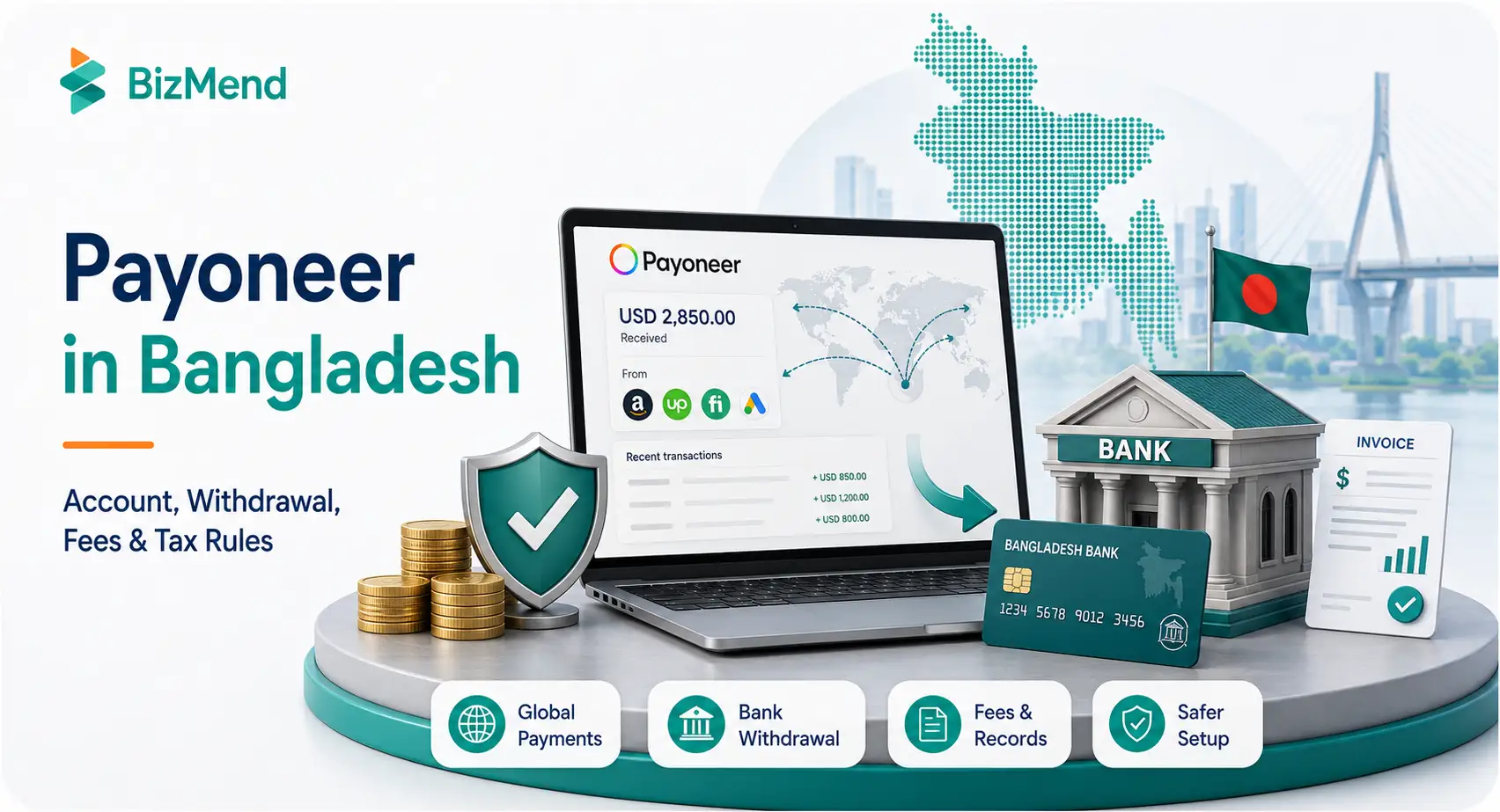
Payoneer is useful only when the setup is clean. For Bangladeshi freelancers, it can receive client or marketplace payments and withdraw them to a local bank. The risk is ignoring fees, documents, tax notes, and safety rules.
This guide explains Payoneer in Bangladesh for freelancers, remote workers, agencies, creators, and small business owners who get paid from outside the country. It focuses on account setup, verification, receiving money, bank withdrawals, fees, tax awareness, and practical safety habits.
Payoneer is not the only option for international payments. Bank wires, Wise transfers, marketplace direct payouts, and company-bank routes can all fit different cases. If you want the broader comparison first, Bizmend’s guide on receiving international payments in Bangladesh is the better starting point.
Quick Answer: Eligible users in Bangladesh can use Payoneer to receive approved payments from freelance marketplaces, online platforms, and international business clients. After verification, available funds can be withdrawn to a linked Bangladeshi bank account or bKash, subject to the fees, limits, exchange rate, and payment routes shown inside the user’s account.
Payoneer is a cross-border payment platform. For a Bangladeshi freelancer, its main value is that it can receive payments from global marketplaces or clients and let you withdraw funds to a local bank account. Payoneer also provides receiving account details in supported currencies, so a client or marketplace may be able to pay you through local-style bank details instead of a traditional international wire.
Payoneer explains that receiving accounts can provide account details for the currency you need to get paid in, and the money lands in your Payoneer balance before you withdraw or use it. That does not mean every currency, client type, or payment source is available to every user. Product access depends on eligibility, country, account type, and Payoneer’s own risk checks.
For most Bangladeshi users, the practical question is not whether Payoneer exists. It is whether Payoneer fits the exact payment route you need. Marketplace payouts are usually smoother than asking a random client to pay without understanding the supported method.
Payoneer usually fits freelancers who earn through international platforms, remote workers with repeat foreign clients, agencies that need to receive money in USD or another foreign currency, and small e-commerce in Bangladesh sellers that receive marketplace payouts. It can also help creators and service providers who want a more formal payment trail than informal wallet-to-wallet arrangements.
It may not fit every case. If your client wants to send a normal bank wire, a direct bank transfer may be cleaner. If you only receive local BDT payments, a Bangladeshi bank account or mobile financial service may be enough. If you are building a serious cross-border business with Stripe, PayPal, or U.S. banking needs, you may eventually research how founders start a business in USA from Bangladesh, but that is a different decision from simply opening Payoneer.
Think of Payoneer as one payment rail, not a full business structure. It helps you receive and move money, but it does not replace contracts, invoices, bookkeeping, tax records, or bank compliance.
Prepare your information before registration. Your legal name should match your national ID, passport, driver’s license, bank account, and tax or business records where relevant. If your name is written differently across documents, fix the mismatch before using those documents for verification.
Payoneer’s document-verification guidance says accepted government-issued identification may include a national ID, driver’s license, or passport. It may also request proof of residence or company address documents, depending on your case. The exact verification request appears inside your account, so treat YouTube shortcuts and social-media advice as secondary at best.
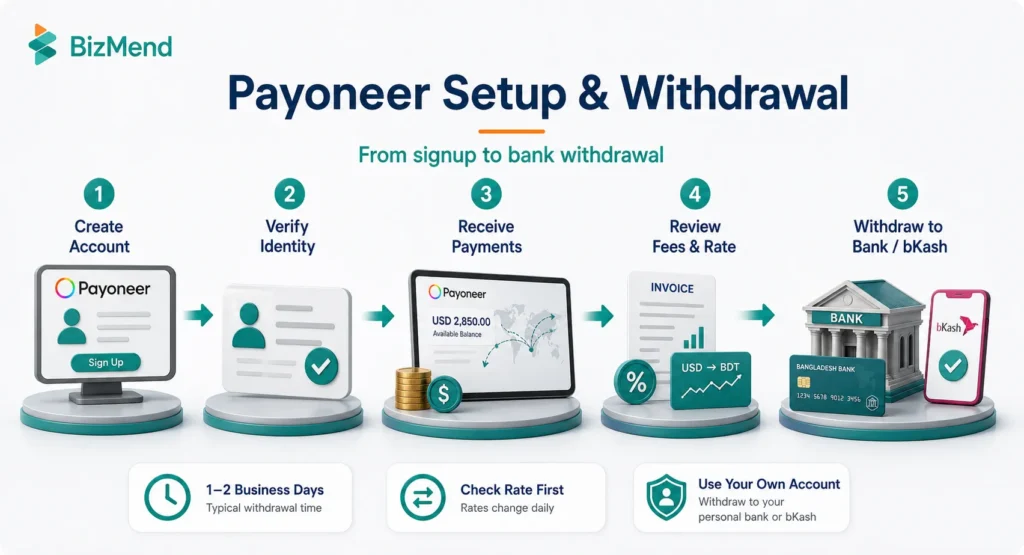
Start from Payoneer’s official website or from the payout setup page of a marketplace that supports Payoneer. Choose the account type that describes your real activity. A freelancer should not pretend to be a large company, and a registered business should not hide its business identity if the payment use case belongs to the business.
Do not rush the bank details step. A wrong account number, branch detail, routing code, or name mismatch can delay a withdrawal. If you are using a bank account that recently changed branch, name spelling, or account type, confirm the exact details with the bank before adding it.
Verification delays usually come from inconsistent information. A common pattern is simple: the Payoneer profile says one name, the bank account shows another, and the uploaded ID has a third spelling. The system then asks for more documents or blocks a step until the mismatch is explained.
Use clear, full-color scans or photos. Make sure the document is not expired, cropped, blurred, covered by fingers, or edited. If the ID has two sides, upload both sides when requested. If Payoneer asks for proof of address, submit a document that clearly shows your name, address, issuer, and date if those details are required.
For business users, the risk is mixing personal and company information. If your Payoneer account is for a business, documents may need to show business registration, business address, ownership, authorized representative details, and a bank account that fits the business profile. Do not assume an individual freelancer setup and a company setup have the same review path.
There are three common ways Bangladeshi users may receive through Payoneer: marketplace payout, payment request, and receiving account details. Marketplace payout is usually the simplest because platforms such as freelance or seller marketplaces integrate Payoneer directly. You connect Payoneer inside the marketplace and receive approved earnings after the platform releases funds.
Payment requests are different. You request payment from a client, and the available payment methods and fees depend on the client’s location, payment method, and Payoneer’s rules. This can work well for repeat clients, but you should test it before promising a deadline.
Receiving account details can feel like having a local account in another currency, but the details are not a personal bank account in the normal banking sense. Payoneer’s receiving-account guidance explains that a client or marketplace can use the provided account details to send an eligible bank transfer, after which the funds reach your Payoneer balance. Use those details only for payment types Payoneer allows.
After funds reach your Payoneer balance, you can usually withdraw to a linked bank account if your account, currency, destination, and profile are eligible. Payoneer’s official withdrawal guide explains that users select the currency and bank account, enter the amount, review the applicable fees, and then submit the withdrawal. Payoneer says most bank transfers arrive within one to two business days, although some withdrawals may take up to five business days depending on the currency, route, bank processing, weekends, holidays, and compliance reviews.
In Bangladesh, the final BDT amount depends on the withdrawal route, exchange rate, fees, bank processing, and any intermediary handling. Do not calculate your cash flow by multiplying USD by a public Google rate and assuming that exact amount will arrive. Check the amount shown before you confirm.
A practical habit is to make a small first withdrawal before routing a large client payment. That first withdrawal confirms whether your bank details, name, account type, and branch processing are working as expected.
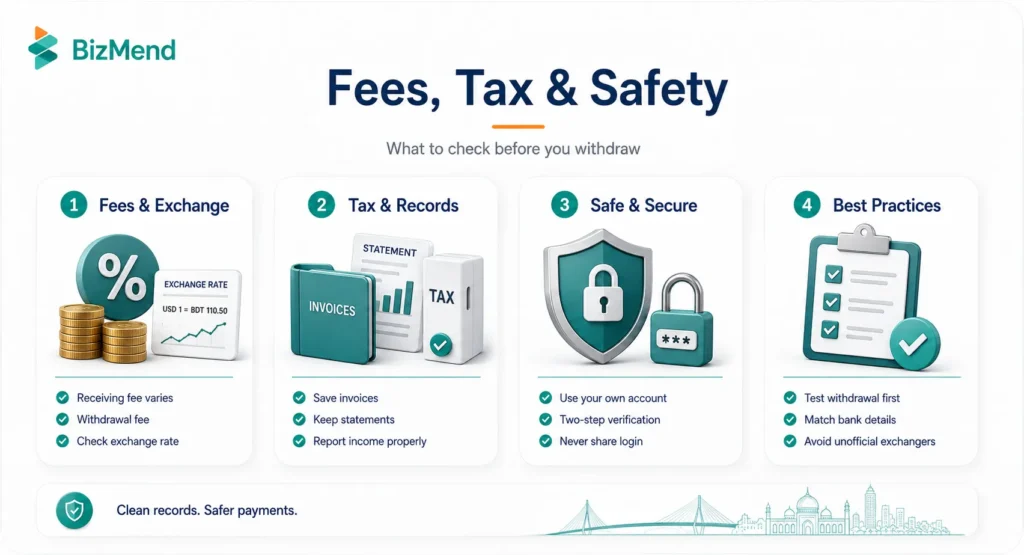
Payoneer fees are not one flat Bangladesh fee. They depend on how you receive money, how you withdraw, the currencies involved, your account type, payment source, sender location, recipient location, and Payoneer’s current pricing rules. The safest answer is always the one shown inside your Payoneer account before you confirm a transaction.
Still, the public Payoneer pricing page is useful for planning. It says receiving from another Payoneer customer’s balance can be free, marketplace fees vary by platform, some receiving-account payments can involve a 1 percent fee, card payments can cost up to 3.99 percent plus a fixed amount, and withdrawals or transfers can vary by route and corridor. It also lists an annual account fee of 29.95 USD when an account receives less than 6,000 USD or equivalent in a 12-month period, subject to the page’s conditions and regional details.
| Fee area | What it means for a Bangladeshi user |
| Receiving from marketplace | The marketplace may set its own payout cost or Payoneer arrangement. |
| Receiving through account details | May be free or may carry a fee depending on local/non-local currency and route. |
| Client card payment | Can be more expensive than bank-based routes. |
| Withdrawal to bank | Depends on destination, currency, conversion, and corridor. |
| Annual account fee | Can matter for low-volume or inactive users; check Payoneer’s current account terms. |
For freelancers, the lesson is simple: quote clients with a buffer. If your project price is 500 USD and you need exactly a certain BDT amount after fees, exchange spread, and bank processing, calculate from the net amount, not the headline invoice amount.
Payoneer to bKash Withdrawal
Eligible Bangladeshi users can also link their Payoneer account to bKash and withdraw funds directly through the bKash app. The name registered with Payoneer should match the name registered with the bKash account.
bKash currently lists a minimum withdrawal amount of BDT 1,000 and a maximum of BDT 250,000 per transaction. Payoneer charges a 3% conversion fee plus USD 1 for each withdrawal. The Bangladesh government’s 2.5% remittance incentive does not apply to Payoneer-to-bKash withdrawals.
Review the available balance, conversion rate, fee, and final BDT amount inside the bKash app before confirming because service conditions may change.
The exchange rate matters as much as the visible fee. A small fee with a weak conversion rate can cost more than a larger visible fee with a better rate. Payoneer says fees are displayed before confirmation, and the pricing page notes that currency conversion rates are based on wholesale market rates at the time of transaction and include the conversion fee where indicated.
Timing also matters. If you withdraw on a weekend, public holiday, or during a bank processing issue, the money may take longer than a normal business-day estimate. Keep operating cash in your local bank so you are not forced to withdraw at a bad time just to pay rent, salaries, or vendor bills.
For agencies and small businesses, keep a withdrawal calendar. Decide whether you withdraw after every payment, weekly, or monthly. Too many small withdrawals can create more records and possible fees; too few withdrawals can expose you to platform risk if the account gets reviewed while a large balance sits inside.
Tax is where freelancers should be careful with casual advice. Do not rely on a Facebook post, a random comment, or an old YouTube video for current tax treatment. Bangladesh’s rules can change through finance acts, SROs, annual budget measures, and NBR clarification.
Bangladesh’s Finance Act 2026 amended the relevant income-tax exemption category by replacing “IT freelancing” with the broader wording “freelancing and content creation.” However, this does not mean every payment received through Payoneer is automatically tax-free. Eligibility can depend on the taxpayer’s residency, income type, business structure, banking-channel compliance, and other statutory conditions.
Keep Payoneer statements, client invoices, marketplace earning reports, withdrawal confirmations, bank statements, and relevant tax records. Even when income qualifies for an exemption, return-filing or income-disclosure requirements may still apply based on your circumstances. Consult a qualified Bangladesh tax professional when your earnings are substantial, mixed with other income, or received through a registered business.
Bangladesh Bank circulars and bank-level processing rules affect how foreign-currency inflows are reported and handled. The Bangladesh Bank circular list is the official place to check current circulars, including export subsidy and cash incentive notices. Because these rules change, do not assume a past incentive percentage or marketplace treatment still applies.
If your bank asks for the purpose of remittance, invoice, platform statement, or client agreement, answer accurately. Calling business income a family remittance, hiding the real source, or splitting transactions to avoid questions can create problems later. The safer approach is boring: invoice, receive through a formal channel, withdraw to your own bank, and keep the paper trail.
Freelancers often focus on whether money arrives. Banks focus on why it arrived. Your records should make that answer obvious.
Most Payoneer problems are preventable. The biggest rule is to keep the account boring and truthful. Use your own identity, own devices when possible, consistent location patterns, and official support channels. Do not buy a verified account, rent someone else’s Payoneer, or let a client log in for you.
Be especially careful with local agents who promise guaranteed approval, instant verification, or lower fees through unofficial methods. They may use fake documents, shared devices, or risky routing that works for a week and fails when money is inside the account.
Payoneer is strong when the marketplace or client already supports it. Bank wire can be better for larger B2B invoices where the client’s finance team prefers direct bank transfer. Wise can be useful for certain sender-to-Bangladesh payments, but Bangladesh-based users should understand availability limits before treating it like a full multi-currency account. Bizmend’s Wise money transfer to Bangladesh guide covers that separate route.
The right choice depends on payment source, transfer size, urgency, fees, documentation needs, and whether you need foreign-currency holding. A 50 USD marketplace payout and a 5,000 USD monthly agency invoice should not be handled with the same assumptions.
| Route | Best fit | Watch out for |
| Payoneer | Marketplace payouts, repeat freelance clients, multi-currency balances. | Verification, route-specific fees, account reviews. |
| Bank wire | Larger formal invoices and direct business payments. | Sender bank charges, slower timing, documentation requests. |
| Wise transfer to Bangladesh | Personal or supported sender-side BDT payouts. | Bangladesh account availability and business-use limits. |
| Marketplace direct payout | Simple platform earnings where the marketplace manages payout rails. | Platform fees, payout schedule, limited control. |
The first mistake is opening the account with casual details and trying to fix them later. Payment accounts are not social profiles. Your name, address, date of birth, bank details, and business identity should be correct from day one.
The second mistake is treating the displayed balance as final take-home money. Your actual local cash depends on withdrawal fee, conversion, bank timing, and any tax or reporting requirement that applies to your case.
The third mistake is poor documentation. If you cannot connect a Payoneer payment to an invoice, marketplace statement, client contract, and bank deposit, you are making future tax filing and banking questions harder than they need to be.
Use this checklist before making Payoneer your main payment method. It is basic, but it prevents most painful issues.
Payoneer in Bangladesh can be a practical payment tool for freelancers, remote workers, agencies, and small online businesses. It works best when your account details, client route, bank withdrawal, and records all tell the same story.
The smart approach is not complicated. Use the official platform, keep your documents clean, check fees before confirming, withdraw to your own bank account, and save every invoice and statement. That gives you the thing every freelancer needs most: money that moves without drama and records that make sense later.
Yes, Bangladeshi freelancers and business users may be able to open Payoneer accounts if they meet Payoneer’s eligibility, verification, and product-access rules. Availability can depend on account type and intended use.
Payoneer supports withdrawals to bank accounts in many countries, and Bangladeshi users commonly use bank withdrawal routes. Always confirm inside your account because fees, eligible currencies, and available routes can vary.
Payoneer says withdrawals typically arrive within two business days, but actual timing can vary because of currency, route, bank processing, weekends, holidays, and account reviews.
Opening an account may not mean every transaction is free. Payoneer fees depend on receiving method, payment source, currency, withdrawal route, card use, account activity, and region. Review the fee shown before confirming a transaction.
Do not treat Payoneer itself as the tax answer. Tax depends on the type of income, current Bangladesh law, exemptions, records, and how the money is brought into the country. Keep documents and check current NBR guidance or a qualified tax adviser.

Learn how to become a Daraz seller in Bangladesh, register an account, list products, understand fees, manage orders, and grow…
by Sheikh Ornob
Compare the cost of living in Bangladesh in 2026, including Dhaka and Chittagong rent, food, transport, utilities, inflation, and monthly…
by Sheikh Ornob

Learn MoA and AoA requirements in Bangladesh, key clauses, drafting basics, RJSC filing steps, amendments, and common company-registration mistakes. Suggested…
by Sheikh Ornob