How to Become a Daraz Seller in Bangladesh: Registration, Fees & Growth
Learn how to become a Daraz seller in Bangladesh, register an account, list products, understand fees, manage orders, and grow…
 by Sheikh Ornob

See the Bangladesh foreign exchange reserve in 2026 with latest Bangladesh Bank data, BPM6 context, import cover, dollar pressure, and business impact.
Bangladesh’s foreign exchange reserve position improved in 2026, but it still needs close watching. The Bangladesh foreign exchange reserve is now a daily business signal. Importers, exporters, investors, and students all need the same thing: the current number and what it means.
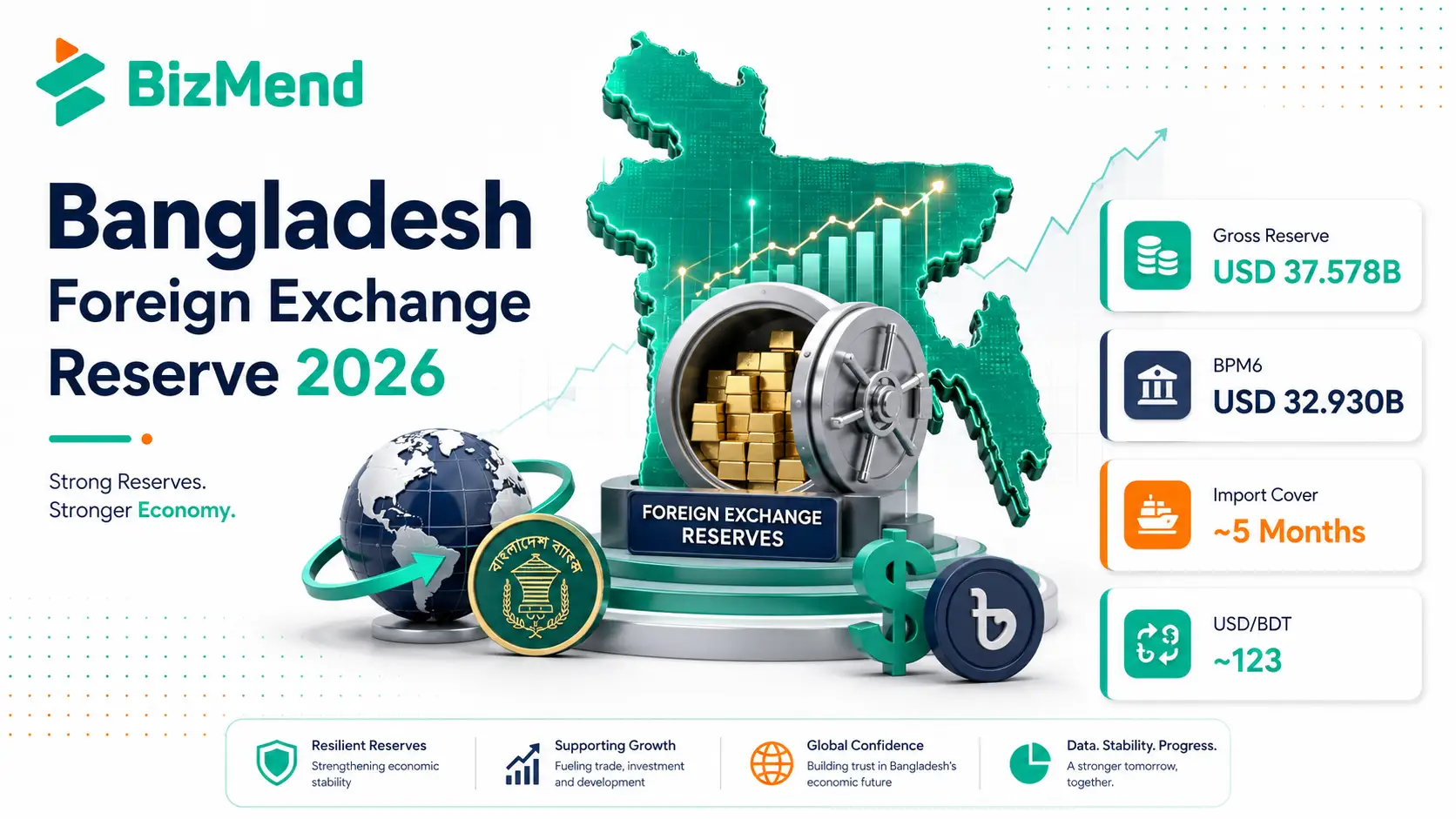
As of the Bangladesh Bank monthly reserve table accessed in mid-July 2026, the June 2026 gross reserve figure was USD 37.578 billion, while the BPM6 reserve figure was USD 32.930 billion. That headline is better than much of 2025, but it doesn’t remove dollar pressure from business decisions. The practical question is simple: can Bangladesh pay imports comfortably, keep the taka steady, and give companies enough confidence to plan ahead? This guide explains the data without turning it into a macro lecture.
Quick Answer: Bangladesh’s foreign exchange reserves improved in 2026. Bangladesh Bank’s latest monthly table shows June 2026 gross reserves at USD 37.578 billion, and BPM6 reserves at USD 32.930 billion, but daily figures can differ after ACU payments, market operations, and valuation changes. Import cover is around five months, but dollar pressure can return when import payments or ACU settlements rise.
The best baseline for current forex reserve Bangladesh is Bangladesh Bank’s monthly foreign exchange reserve table.. As of the latest table available on 13 July 2026, the June 2026 gross figure was USD 37.578 billion. The same table put foreign exchange reserves under BPM6 at USD 32.930 billion.
Those two numbers answer different questions. The gross number shows total international reserves of the country. The BPM6 number follows the IMF reporting method and is usually the cleaner signal for external payment strength, because it strips the story down to reserve assets that fit the stricter statistical test.
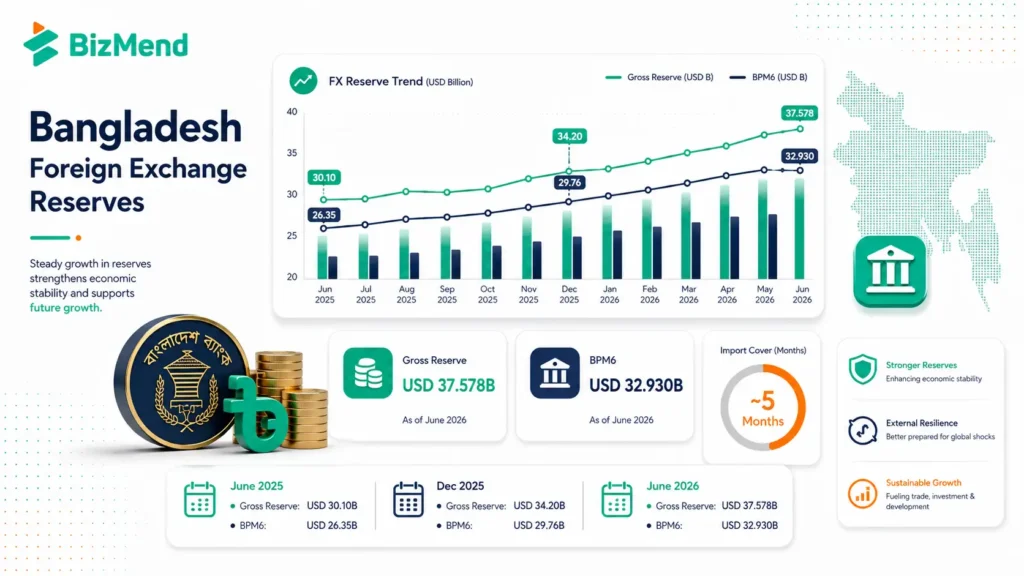
Bangladesh foreign exchange reserve trend from Bangladesh Bank monthly data
| Period | Gross reserves | BPM6 reserves | What it shows |
| June 2025 | USD 31.772 billion | USD 26.740 billion | End of FY25 baseline. |
| July 2025 | USD 29.800 billion | USD 24.779 billion | Early FY26 reserve dip. |
| December 2025 | USD 33.190 billion | USD 28.589 billion | Recovery became clearer. |
| January 2026 | USD 33.179 billion | USD 28.683 billion | Reserve level held steady. |
| April 2026 | USD 35.108 billion | USD 30.452 billion | BPM6 crossed USD 30 billion. |
| May 2026 | USD 34.477 billion | USD 29.815 billion | Monthly dip after payments. |
| June 2026 | USD 37.578 billion | USD 32.930 billion | Latest official monthly figure. |
The direction matters. From June 2025 to June 2026, the BPM6 figure rose by about USD 6.19 billion. That doesn’t mean every importer suddenly gets easy dollars, but it does mean the national buffer looks stronger than it did a year earlier.
Foreign currency reserves are the country’s working capital buffer in dollars and other hard currencies. Bangladesh needs them for import payments, external debt service, confidence in the taka, and emergency pressure moments. Think of it like a factory owner keeping enough cash to buy raw materials even when customers pay late.
Reserves don’t remove risk. They buy time, credibility, and room to make better decisions.
For a business reader, the reserve number touches more than headlines. It can shape how banks treat import LCs, how suppliers price risk, how investors read Bangladesh’s external position, and how much pressure the central bank faces in the foreign exchange market.
Import cover tells you how many months of imports a country could pay for using its reserves if fresh inflows suddenly slowed. If usable reserves were USD 30 billion and monthly import needs were USD 6 billion, the country would have about five months of import cover.
Bangladesh Bank’s BOP data shows import cover near five months, with the recent table showing 5.0 months for goods and services and 5.6 months for goods imports; the previous monthly column showed 5.1 months for goods and services. In normal business language, that means the buffer has improved, but it is not endless. Okay, let’s keep it practical: five months is comfort, not a blank check.
The BD forex reserve 2025 story was about recovery from a tight position. Bangladesh Bank data show BPM6 reserves at USD 20.521 billion in May 2025 and USD 26.740 billion in June 2025. By December 2025, the BPM6 number had climbed to USD 28.589 billion.
The BD forex reserve 2026 story is stronger, but still uneven month to month. BPM6 reserves were USD 28.683 billion in January 2026, USD 30.452 billion in April, USD 29.815 billion in May, and USD 32.930 billion in June. That is a real improvement, with normal payment dips along the way.
Bangladesh Bank BOP data shows workers’ remittance inflows of about USD 32.770 billion in the recent FY26 period shown, up about 19.1% year-on-year.
Still, the improvement has limits. Merchandise exports declined during July to May of FY26, while customs-based imports grew during July to April. That mix means the dollar market can tighten again if import demand rises before export and remittance inflows catch up.
The dollar crisis in Bangladesh conversation has cooled from its worst moments, but it has not vanished. Bangladesh Bank’s homepage showed the 13 July 2026 FX reference rate at 123.3157 BDT per USD for operations up to 5:00 PM. The previous working day’s interbank rate was shown at 123.0000.
In May 2026, Bangladesh Bank’s exchange market review said the interbank rate stayed at 122.75 BDT per USD, while the reference rate moved in a narrow band. That sounds calm. Yet bank client selling rates for import payments moved higher than the interbank rate, which is what many importers actually feel.
A stable headline rate can still feel tight if your LC opens late or your supplier demands cash faster.
This is why exchange rate impact is not only about the daily number. It is about bank access, documentation, payment timing, payment gateway in Bangladesh costs, and whether your supplier invoices in USD while your customer pays in taka.
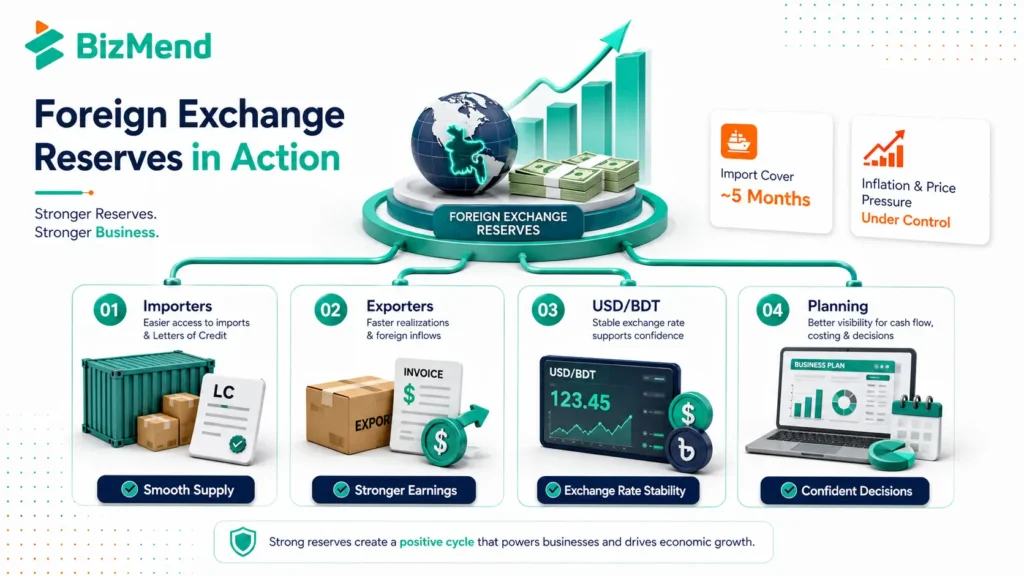
Importers feel reserve stress first because they need dollars before the goods arrive. A higher dollar rate raises landed cost. Delayed LC opening can push shipment timing. A sudden ACU payment can also make the market feel tighter for a few days, even when the monthly reserve trend looks healthy.
If you run e-commerce in Bangladesh and import electronics, packaging, accessories, or other inventory, your job is not to predict the dollar perfectly. Your job is to protect margin. That means pricing with a realistic exchange rate, leaving room for delays, and keeping bank paperwork clean before the payment clock starts.
Exporters read reserves differently. A stable or slightly weaker taka can increase BDT receipts when dollars come in, especially for businesses that receive international payments in Bangladesh. But that benefit can disappear if imported yarn, dye, packaging, freight, or finance costs rise faster.
Bangladesh Bank’s May 2026 update said merchandise exports declined 1.67 percent year-on-year during July to May of FY26. That is the warning. Dollar receipts matter, but buyer demand, shipment timing, and input costs still decide the real margin.
How reserve and exchange rate shifts can affect exporters
| Area | Potential upside | Watchpoint |
| Revenue | USD receipts may convert into more taka. | Late buyer payment can hurt working capital. |
| Costs | Local costs may be easier to cover. | Imported inputs can rise with the dollar. |
| Planning | Stable reserves can improve confidence. | Weak global demand can still slow orders. |
Foreign exchange reserves don’t set inflation alone. Food supply, energy prices, interest rates, wages, taxes, and domestic distribution all matter. Still, reserves can affect inflation through the exchange rate. When the taka weakens, imported fuel, edible oil, machinery, and raw materials can become more expensive.
Bangladesh Bank’s current inflation page, sourced from BBS, shows point-to-point inflation at 9.16% in June 2026 and twelve-month average inflation at 8.68%. That tells businesses one thing clearly: even with better reserves, pricing pressure remains part of the operating environment.
You don’t need to become a central banker to use this data well. Build a simple monthly dashboard. Track the Bangladesh forex reserve number, the BPM6 number, import cover, the USD to BDT reference rate, remittance inflows, export growth, import growth, and any large ACU payment news.
The point is not to react to every daily move. The point is to avoid being surprised. If reserves rise but imports are also rising, stay careful. If reserves fall after a scheduled payment but remittances remain strong, don’t panic from one headline.
Update note: This article was prepared on 13 July 2026 using Bangladesh Bank’s monthly foreign exchange reserve table, BOP data, FX reference rate page, current inflation page, May 2026 exchange market review, and the H1 FY27 Monetary Policy Statement for July-December 2026. The IMF context comes from the January 2026 Bangladesh Article IV report.
Reserve data can move between monthly releases. A 7 July 2026 Daily Star report citing Bangladesh Bank said BPM6 reserves stood at USD 31.72 billion that day after a USD 1.46 billion ACU payment, while gross reserves stood at USD 36.17 billion. That is why publishers and businesses should check the Bangladesh Bank source again before making a large payment decision or publishing a dated figure.
Bangladesh’s reserve position in 2026 is stronger than it looked through much of 2025, and the June BPM6 figure gives businesses more breathing room. Still, reserve comfort is not the same as zero-dollar risk. Importers need payment discipline. Exporters need margin discipline. Investors need data discipline. Watch the Bangladesh Bank table, the exchange rate, and the import cover together, because the real story lives in all three.
Bangladesh Bank’s latest official monthly table shows June 2026 gross foreign exchange reserves at USD 37.578 billion and BPM6 reserves at USD 32.930 billion. Daily figures may differ after payments, market purchases, or valuation changes, so check the Bangladesh Bank table before quoting a current number.
Bangladesh Bank publishes a gross reserve number and a BPM6 reserve number. The BPM6 figure follows IMF reporting logic and is usually lower because it uses stricter treatment for reserve assets. For business analysis, read both, but treat BPM6 as the more cautious external strength signal.
Import cover means how many months of imports the country could pay for using reserves. Bangladesh Bank’s recent BOP memo showed about 5.1 months of goods and services import cover for July to May of FY26. Higher cover usually means more breathing room for external payments.
The pressure has eased compared with the tightest period, but it is not fully gone. Import payments, ACU settlements, energy prices, remittance flows, and export demand can still move the dollar market. Businesses should plan from current data, not from comfort headlines.
Importers are affected through LC timing, dollar availability, landed cost, and pricing risk. Exporters may benefit when dollar receipts convert into more taka, but they still face imported input costs and buyer demand risk. Both sides need currency-aware cash flow planning.
Start with Bangladesh Bank’s foreign exchange reserve page for monthly gross and BPM6 figures. Then check its BOP page for import cover, its FX reference rate page for USD to BDT, and its inflation page for CPI context. For IMF methodology, use the IMF Bangladesh report and BPM6 materials.

Learn how to become a Daraz seller in Bangladesh, register an account, list products, understand fees, manage orders, and grow…
by Sheikh Ornob

Compare the cost of living in Bangladesh in 2026, including Dhaka and Chittagong rent, food, transport, utilities, inflation, and monthly…
by Sheikh Ornob

Learn MoA and AoA requirements in Bangladesh, key clauses, drafting basics, RJSC filing steps, amendments, and common company-registration mistakes. Suggested…
by Sheikh Ornob