How to Become a Daraz Seller in Bangladesh: Registration, Fees & Growth
Learn how to become a Daraz seller in Bangladesh, register an account, list products, understand fees, manage orders, and grow…
 by Sheikh Ornob

Compare corporate health insurance in Bangladesh for employees, including group coverage, claims, hospital networks, pricing factors, exclusions, providers, and HR buying tips.
Corporate health insurance in Bangladesh helps employers arrange medical coverage for employees under one negotiated group policy. Instead of each worker buying a separate plan, the company chooses benefits, eligible members, limits, claim rules, and payment terms with an insurer. The final package can range from basic hospitalization protection to broader coverage for outpatient treatment, maternity, dependents, dental, optical, or critical illness.
For HR teams, the difficult part is not finding a plan name; it is comparing policy wording, hospital access, exclusions, claim administration, and renewal costs. A low quotation can become poor value when room limits, co-payments, waiting periods, or restricted networks are overlooked. This guide explains how group plans work and how Bangladeshi employers can evaluate them safely.
Quick Answer: Corporate health insurance in Bangladesh is an employer-arranged group policy that usually starts with hospitalization coverage and may add outpatient care, maternity, dependents, dental, optical, or other benefits depending on the insurer’s quotation and policy wording. The right plan depends on policy limits, exclusions, hospital network, claim process, workforce profile, and renewal terms—not simply the lowest premium.
Corporate or group health insurance is a form of health insurance in Bangladesh purchased for a defined group, usually a company’s employees. The employer signs the master policy, submits an employee roster, agrees on benefits, and usually pays all or part of the premium. Employees receive coverage because they belong to the eligible group.
A group plan is different from an individual policy. The insurer prices and underwrites the workforce as a group, while benefit rules are standardized for the covered categories. Some employers provide one level of coverage for everyone; others create separate limits for executives, managers, and general employees.
Group medical insurance is normally an employee benefit and should not replace workplace safety, first-aid, occupational injury reporting, compensation, welfare facilities, or other duties required under labour law in Bangladesh.
The employer first gives the insurer basic workforce data, including headcount, age bands, gender mix, location, occupations, dependents, and requested benefits. The insurer then issues a quotation and proposed policy wording. After negotiation and enrollment, eligible employees receive cards, certificates, portal access, or instructions for using the policy.
Coverage generally runs for a fixed policy year. New employees may be added on a pro-rata basis, and departing employees may be removed according to the contract. At renewal, the insurer reviews claim experience, workforce changes, medical inflation, and benefit design before issuing a new quotation.
The insurer only pays eligible expenses within the policy limits and conditions. An employer should therefore treat the schedule of benefits, exclusions, claim guide, and hospital-network list as core buying documents—not marketing attachments.
A well-designed group health plan can reduce the financial shock of hospitalization and make benefits more predictable for employees. It can also strengthen recruitment, retention, attendance, and employer branding, especially where competing employers offer similar salaries.
For HR teams, a group plan creates one administrative structure for eligibility, claims support, dependents, and renewal. It may also give employees access to negotiated hospital arrangements or cashless facilities that are difficult to arrange individually.
However, insurance should not be marketed as unlimited healthcare. Employees need a plain-language benefit guide showing limits, co-payments, exclusions, network rules, and the correct claim channel.
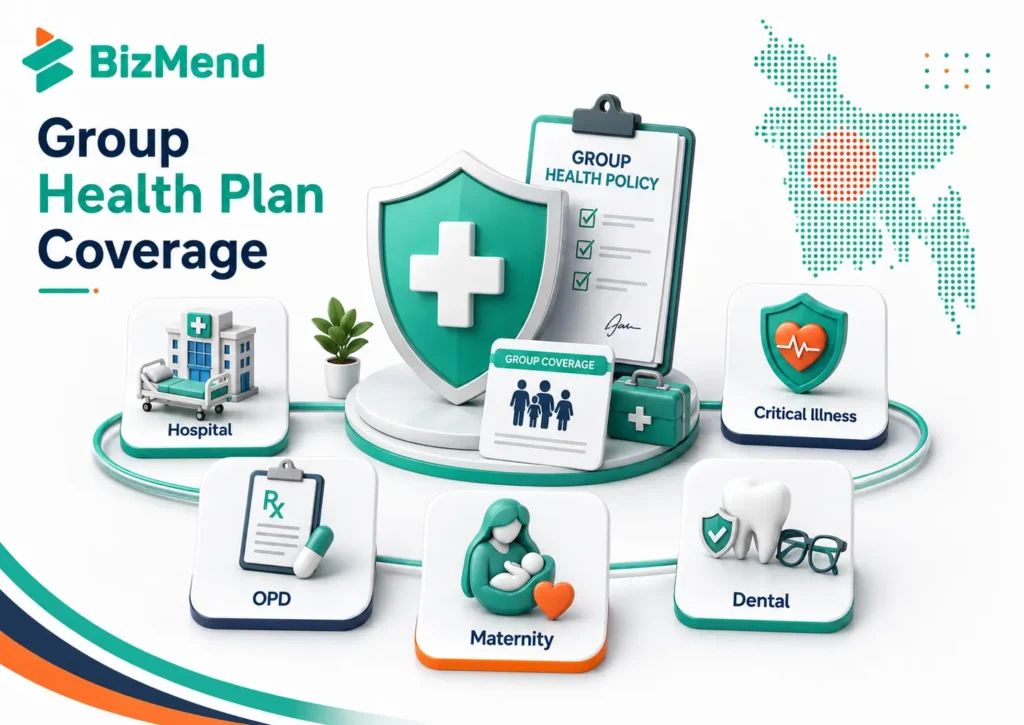
Bangladesh insurers commonly describe hospitalization as the base benefit, with optional outpatient and family benefits. The exact wording varies widely, so the table below is a comparison checklist rather than a promise that every insurer includes every item.
| Coverage area | What it may include | What HR should verify |
| In-patient hospitalization | Room, nursing, ICU, surgery, doctor visits, diagnostics, medicine and eligible hospital charges | Annual or per-disability limit, room cap, ICU limit, sub-limits and excluded items |
| Out-patient treatment | Doctor visits, diagnostics and prescribed medicine | Visit caps, medicine limits, panel requirements and original-document rules |
| Maternity | Normal delivery, C-section and specified pregnancy-related treatment | Waiting period, delivery limit, newborn cover and miscarriage wording |
| Dependents | Spouse and dependent children; sometimes parents by negotiation | Age limits, proof of relationship, enrollment rules and separate premium |
| Dental and optical | Consultation, tests, selected procedures, lenses or frames | Annual caps, excluded cosmetic work and network restrictions |
| Critical illness or accident | Lump-sum or medical benefits for named conditions or accidents | Definitions, survival period, disability scale and whether it is a rider |
| Pre- and post-hospitalization | Eligible tests and consultations before admission or after discharge | Number of days, visit limit and link to covered hospitalization |
There is no regulator-issued ranking of the best corporate medical insurer, so employers should not treat lists of the best life insurance companies in Bangladesh as a substitute for comparing the actual group-health policy wording. The practical approach is to shortlist licensed insurers regulated by IDRA, verify the product and distribution channel, obtain comparable quotations, and test each proposal against the same benefit, network, claim, exclusion, and renewal criteria.
The following comparison uses only publicly documented product information available on official insurer websites as of July 2026. Corporate terms remain quotation-based and can differ by workforce.
| Provider | Publicly documented group-health features | Practical fit to evaluate |
| MetLife Bangladesh | MetLife’s official group medical plan information describes customizable in-patient, out-patient, employee, and dependent benefits, although the employer must confirm the final limits and conditions in its quotation and policy wording. | Employers wanting broad benefit customization and a formal group-claims process |
| Pragati Life | Pragati Life publicly describes health insurance and claim information, and its site publishes a network hospital list; employers should request the current group proposal, TPA or administrator details, claim process, and full policy wording before comparing it as a corporate plan. | Companies that value local network visibility and portal/TPA administration |
| Delta Life | Delta Life publicly lists group hospitalization and group outpatient health insurance, direct payment to designated hospitals or reimbursement by BEFTN/cheque, maternity benefit options and a minimum group size of 15 members, including dependent family members. | SMEs and established employers seeking clearly described group-plan mechanics |
| Green Delta Insurance | Green Delta’s public health-insurance page confirms health-insurance offerings and benefit-schedule-style information, but the page reviewed does not provide detailed corporate group-plan terms; employers should request a current corporate quotation, group eligibility rules, network list, claim process, and full wording. | Ask specifically for current corporate customization, group eligibility, and claim administration |
| Reliance Insurance | Reliance Insurance’s public health-insurance page confirms hospitalization-focused health coverage, including hospital accommodation, consultation, investigations, surgery, medicines, ICU/CCU, and related services, but detailed corporate group-plan terms should be confirmed through a direct quotation and policy wording. | Request a corporate quotation and full wording before treating it as a group-plan alternative |
This provider table is not a ranking or endorsement. Public product pages only show part of the picture; the final decision should be based on the insurer’s current licence status, full policy wording, hospital network, claim service, quotation, exclusions, and renewal terms.
Cashless treatment means the insurer or its administrator settles eligible, pre-authorized charges directly with a network hospital. The employee may still have to pay co-payments, excesses, non-medical items, charges above sub-limits, or treatment excluded by the policy.
Reimbursement means the employee pays first and later submits a claim. This is common for non-network treatment, outpatient expenses, or costs that were not pre-authorized. Original receipts, itemized bills, prescriptions, test reports, and discharge papers are usually essential.
Cashless does not mean automatic approval. The hospital must confirm eligibility and obtain authorization, and the final payment remains subject to the policy. HR should ask who handles emergency admission, planned admission, discharge approval, and disputes outside office hours.
A typical claim process follows these steps, although the policy wording always controls:
1. Confirm that the employee or dependent was active on the policy on the treatment date.
2. Check whether the hospital is in-network and whether pre-authorization is required.
3. Notify the insurer, TPA, or HR contact within the policy deadline.
4. Collect the claim form, prescriptions, diagnostic reports, bills, receipts, and discharge summary.
5. Submit separate files for in-patient, out-patient, maternity, dental, or optical claims when required.
6. Respond quickly if the insurer requests clarification or additional medical records.
7. Review the settlement statement and explain any deduction to the employee.
MetLife’s claim resources provide group claim submission, claim forms, and required-document guidance; employers should confirm the exact claim-submission deadline from the active policy wording or current claim form before copying it into an employee handbook. Other insurers may use different deadlines, so employers should never copy one provider’s timeline into another provider’s employee handbook.
For enrollment, the insurer may request the company’s registration and tax documents, details of the authorized signatory, employee roster, dates of birth, designations, benefit categories, identity information, and dependent records. Marriage certificates or birth certificates may be needed to verify family eligibility.
Document requirements can differ by benefit and provider. HR should issue employees a current checklist instead of relying on memory or an old claim form.
Corporate plans are usually quotation-based. A public retail premium cannot be used to estimate a company’s group rate because workforce risk and benefit design are different.
Employers should compare total expected value, not premium alone. A slightly higher quote may be more useful if it removes a restrictive room cap, offers better hospital access, or gives employees faster claim support.
Every policy contains exclusions. Common areas that require close review include pre-existing conditions, waiting periods, congenital conditions, cosmetic treatment, infertility treatment, non-prescribed medicine, experimental treatment, self-inflicted injury, substance-related treatment, and non-medical hospital items.
A benefit can also be limited without being completely excluded. Room rent, maternity, consultant fees, ambulance, dental, optical, diagnostics, or post-hospital care may have separate caps. If an employee chooses a room above the entitlement, some policies may reduce related charges as well.
Ask the insurer to explain exclusions in examples. A one-page benefit schedule is not enough; HR should retain the full policy wording, endorsement, member guide, and updated hospital list.
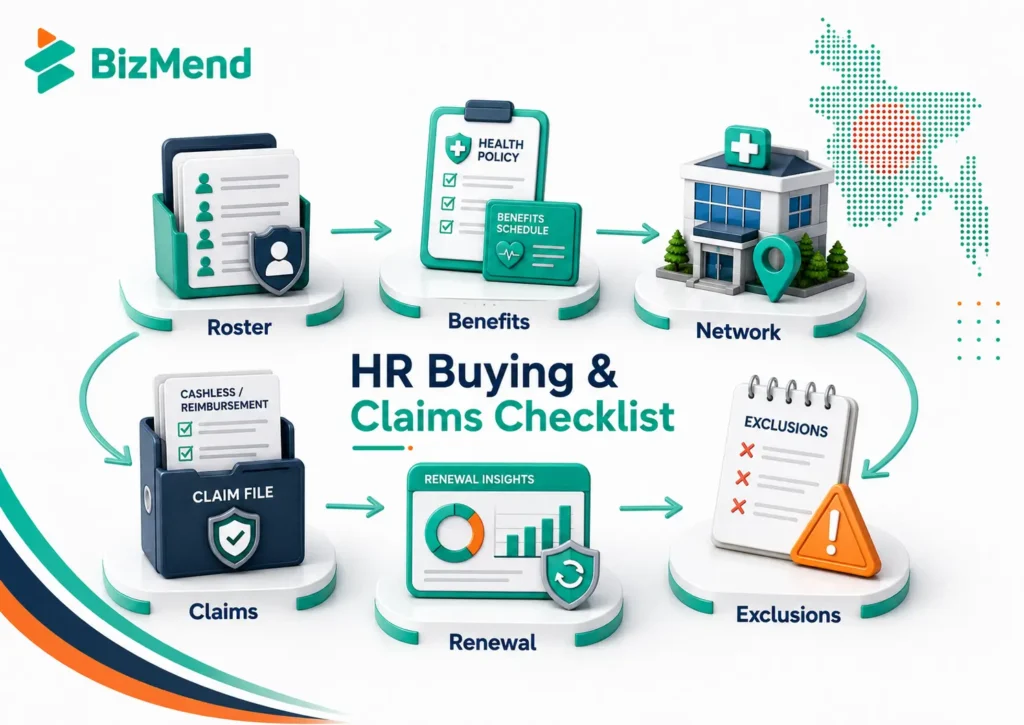
Send every shortlisted insurer the same census and benefit request. Otherwise, a cheap hospitalization-only quote may appear to beat a broader proposal that includes maternity, outpatient care, dependents, or a stronger network.
Use these selection questions:
1. Is the insurer currently licensed and regulated by IDRA for the offered product?
2. What is covered, and what is excluded or subject to waiting periods?
3. Which hospitals provide cashless service, and how often is the network updated?
4. Who gives emergency and planned admission authorization?
5. What are the average internal service targets for pre-authorization and reimbursement?
6. Can employees track claims online or through a TPA?
7. How are new hires, resignations, dependents, and category changes administered?
8. How will high claim experience affect renewal pricing?
9. What management reports will HR receive without exposing unnecessary medical data?
10. Who handles escalations, complaints, and unresolved claims?
Good administration begins after the policy is issued. HR should reconcile the active employee list regularly, add new hires promptly, remove leavers, verify dependent status, and keep proof of all insurer instructions.
Before renewal, review claim utilization by benefit category, common deduction reasons, network complaints, service delays, and employee feedback. Do not wait for the expiry week. Starting early gives the employer time to redesign benefits, obtain alternative quotes, and communicate changes.
Renewal changes should be explained before the new policy year. Employees need to know whether limits, hospitals, co-payments, maternity terms, or claim channels have changed.
Corporate health insurance can be a strong employee benefit when the policy is designed around real workforce needs and explained honestly. The most useful plan is not automatically the one with the largest headline limit or the lowest quotation. Employers should compare hospital access, sub-limits, dependents, maternity, exclusions, claim support, administration, and renewal risk together.
Before signing, request the full wording, benefit schedule, hospital list, claim guide, service contacts, and a clear quotation showing taxes and optional benefits. For complex workforces or major benefit changes, speak with an IDRA-regulated insurer, licensed insurance intermediary, benefits adviser, and qualified HR or legal professional.
A group medical policy is generally arranged as an employee benefit rather than a universal requirement for every employer. Separate labour, workplace-safety, medical-facility, injury, and compensation duties may apply depending on the establishment and worker category. Obtain professional advice for your sector.
Yes, many group plans allow spouse and dependent-child coverage. Eligibility ages, relationship evidence, enrollment rules, and premium treatment vary. Some providers require consistent enrollment of an entire dependent category rather than optional selection by individual employees.
Maternity is often optional. The policy may set a waiting period, delivery limit, C-section limit, miscarriage terms, and newborn conditions. Employers should request the exact maternity wording instead of relying on a sales summary.
Cashless claims are settled directly with an eligible network hospital after authorization. Reimbursement claims require the employee to pay first and submit documents later. Both remain subject to policy limits, exclusions, and documentation rules.
The minimum group size depends on the insurer and product. Delta Life’s public page currently states a minimum of 15 members including dependent family members for its group health coverage. Other providers may use different participation rules.
Renewal pricing may rise because of higher claim frequency, expensive claims, medical inflation, older workforce demographics, broader benefits, more dependents, or changes in insurer pricing. Reviewing utilization early can help the employer redesign the plan before renewal.
There is no single best insurer for every company. The better choice is the provider whose policy wording, hospital network, benefit limits, claim administration, data reporting, and renewal terms match the employer’s workforce and budget. Compare equivalent quotations before deciding.

Learn how to become a Daraz seller in Bangladesh, register an account, list products, understand fees, manage orders, and grow…
by Sheikh Ornob

Compare the cost of living in Bangladesh in 2026, including Dhaka and Chittagong rent, food, transport, utilities, inflation, and monthly…
by Sheikh Ornob
Learn MoA and AoA requirements in Bangladesh, key clauses, drafting basics, RJSC filing steps, amendments, and common company-registration mistakes. Suggested…
by Sheikh Ornob