How to Become a Daraz Seller in Bangladesh: Registration, Fees & Growth
Learn how to become a Daraz seller in Bangladesh, register an account, list products, understand fees, manage orders, and grow…
 by Sheikh Ornob

Learn how the Chittagong Stock Exchange works, CSE indices, listed securities, trading steps, BO accounts, brokers, and key differences from DSE.
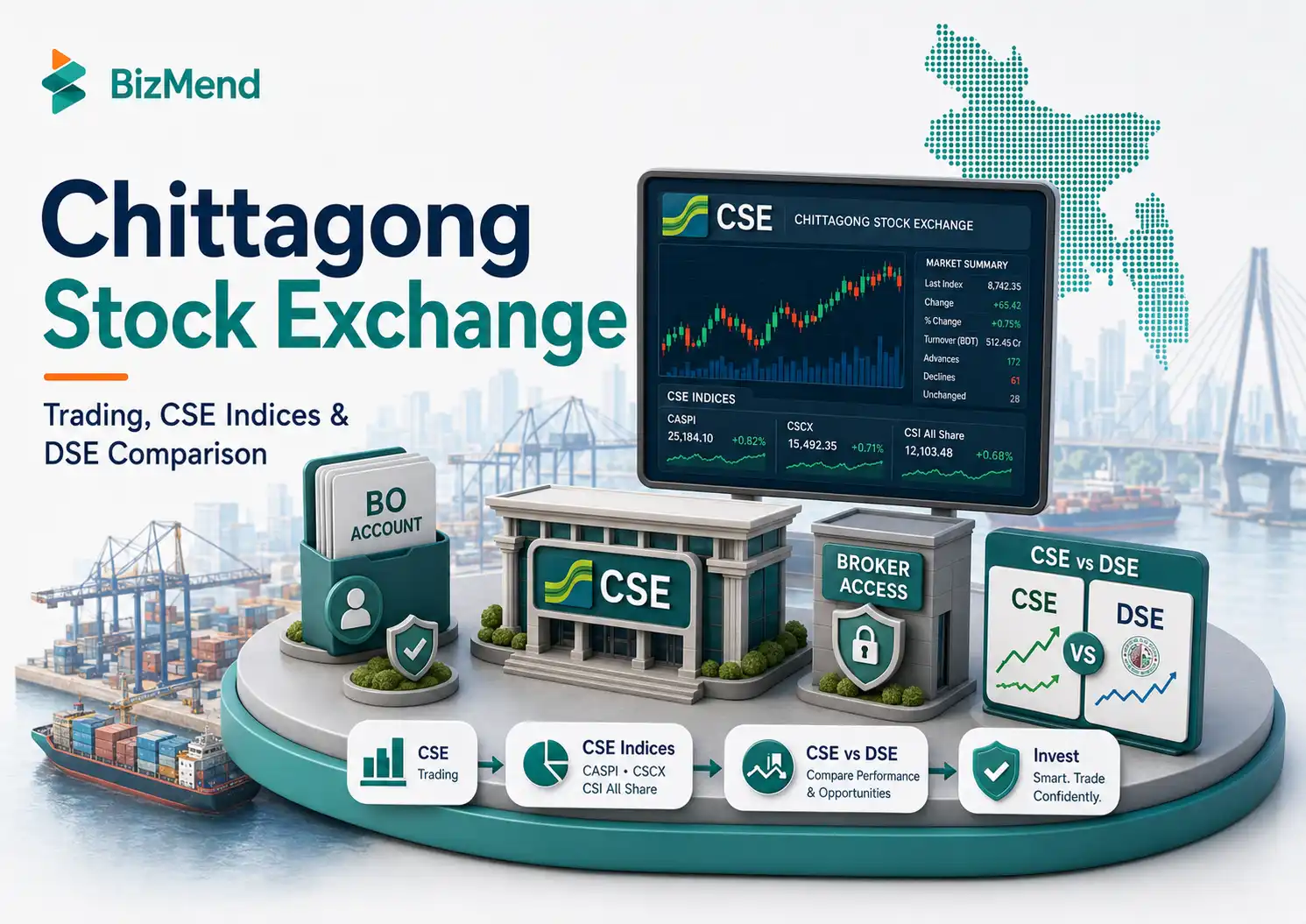
The Chittagong Stock Exchange, or CSE, is one of Bangladesh’s two regulated stock exchanges and a marketplace for buying and selling listed securities through approved brokers or TREC holders. CSE says it began its journey on 10 October 1995 from Chattogram through the cry-out trading system and became the first Bangladeshi bourse to introduce online trading. For beginners, CSE is not a separate investment product; it is an exchange where orders are matched, and market prices are published.
Investors access CSE through a broker or TREC holder, hold shares in a CDBL Beneficiary Owner account, and place orders through a branch, web platform, or mobile service. This guide explains the CSE trading system, listed securities, major indices, CSE vs DSE differences, investor access, limitations, and safety checks using official sources reviewed for 2026.
Quick Answer: The Chittagong Stock Exchange is a BSEC-regulated marketplace where investors trade listed shares and other securities through approved brokers. To invest, you generally need a CDBL BO account, a brokerage account, verified funds, and a suitable order. CSE and DSE serve the same national market but operate separate trading systems, indices, and broker networks.
The Chittagong Stock Exchange, commonly called CSE Bangladesh, is one of the country’s two regulated stock exchanges. It provides the infrastructure for securities trading, market-price publication, company listing, broker participation, and investor services. The role of BSEC Bangladesh includes supervising stock exchanges, intermediaries, public issues, market conduct, and investor-protection requirements.
CSE began floor trading on 10 October 1995 in Chattogram. Its official history says it introduced automated online trading in June 1998, becoming the first Bangladeshi exchange to do so. In 2011, it launched a next-generation trading system with a real-time matching engine. TCSE says it became a demutualized exchange on 21 November 2013, separating ownership and trading-right structures under the demutualized-exchange framework.
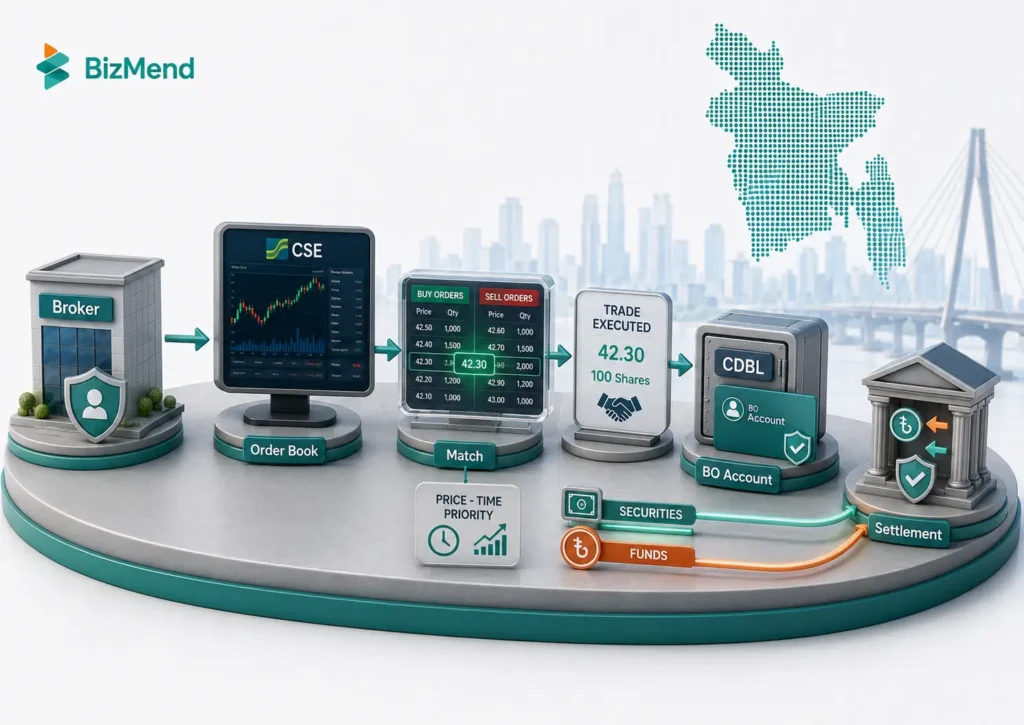
CSE uses an electronic order-driven system. Buyers submit their maximum prices and sellers submit their minimum prices. The matching engine pairs compatible orders under exchange rules. CSE describes the core logic as price-time priority: better prices normally come first, followed by earlier orders at the same price.
The process is not a direct payment between two investors. Your broker checks your cash, shares, account status, exposure, and risk limits before sending the order to CSE. After a trade is executed, the broker confirms the transaction, clearing and settlement processes follow the applicable rules, and the securities are reflected through the central depository system.
Suppose a share has sellers offering at Tk 52 and buyers bidding at Tk 51.50. A new investor places a limit buy order for 100 shares at Tk 52. If enough shares are available at that price and the order passes broker checks, it may execute fully or partially. If the investor instead places a limit order at Tk 51, it will remain unmatched unless a seller accepts that price before the order expires or is cancelled.
CSE’s official trading-hours page should be treated as the source for current sessions, but investors should recheck the live CSE notice before time-sensitive trades because schedules may change for holidays, Ramadan, operational events, or regulatory directions.
Trading schedules can change for Ramadan, public holidays, operational events, or regulatory directions. Investors should therefore confirm the day’s official notice instead of relying on a saved screenshot. CSE also supports spot and auction sessions, which may run alongside normal trading or in a separate session.
The most common CSE order is a limit order, which lets an investor choose a specific buy or sell price. This is usually easier for beginners to control because it prevents an order from executing above the chosen buy price or below the chosen sell price.
Not every retail platform exposes every order type, and broker policies may add practical restrictions. Beginners should ask what the order will do, how long it remains active, whether partial execution is possible, and what charges apply before confirming it.
The exchange publishes separate information for its main market, SME platform, bonds, qualified-investor offers, and each initial public offering in Bangladesh connected with the CSE listing process. Main-market companies cover banking, pharmaceuticals, engineering, insurance, telecommunications, textiles, energy, consumer goods, and other sectors.
An eligible public limited company in Bangladesh may seek a CSE or DSE listing after completing the applicable corporate, disclosure, BSEC, and public-offer requirements. For that reason, this guide does not freeze a single number as a permanent 2026 total. Buyers should use the live CSE company directory to confirm whether a security is currently listed, tradable, suspended, or placed on a separate board.
A stock index summarizes the price movement of a defined group of securities. It does not show whether every company increased or decreased, and it is not a guaranteed forecast. CSE’s official index page identifies CASPI, CSCX, CSE30, CSE50, CSI and sector indices; avoid overgeneralizing the methodology unless citing the specific methodology section for each index.
| CSE index | What it broadly represents |
| CASPI | CSE All Share Price Index, designed to represent the broad share market. |
| CSCX | Selective Categories Index covering eligible non-Z-category companies while excluding specified instruments or inactive securities. |
| CSE30 | A selective index of 30 companies chosen using eligibility, liquidity, market-capitalization, governance, and financial criteria. |
| CSE50 | A benchmark index built from selected securities. |
| CSI | CSE Shariah Index for securities included under its Shariah-screening methodology. |
| Sector indices | Track price movement within individual sectors rather than the full market. |
CSE states that CSE30 constituents must satisfy rules involving listing history, market capitalization, free-float, trading frequency, retained earnings, dividend record, and other qualitative and quantitative factors. Investors should still study the underlying companies; membership in an index is not a recommendation to buy.
1. Choose a licensed broker or CSE TREC holder: The first step in learning how to invest in the Bangladesh stock market is choosing a licensed broker or CSE TREC holder with suitable exchange access, fees, security, and withdrawal support.
2. Open a BO account: A Beneficial Owner account records securities electronically, so beginners should understand how to open a BO account in Bangladesh before applying through a broker or depository participant. Applicants should review the official CDBL online BO account-opening instructions before preparing their identity information, bank evidence, photograph, signature, contact details, and NRB documents.
3. Complete brokerage KYC: Provide identity, address, bank, nominee, tax, source-of-funds, and other documents requested under current rules.
4. Fund the brokerage account: Use traceable banking channels accepted by the broker. Never send investment money to a salesperson’s personal account.
5. Select the security and order type: Review company disclosures, market depth, price limits, liquidity, and total transaction cost before placing the order.
6. Confirm execution and settlement: Check the contract note, quantity, price, commission, tax or levy deductions, and BO-account movement.
7. Monitor disclosures, not rumors: Follow official company announcements, CSE notices, BSEC directions, and audited financial statements.
CSE also publishes an Internet Trading Service application route linked to participating TREC holders. However, opening an internet-trading profile does not replace the BO account, brokerage KYC, bank connection, or broker approval required for actual trading.
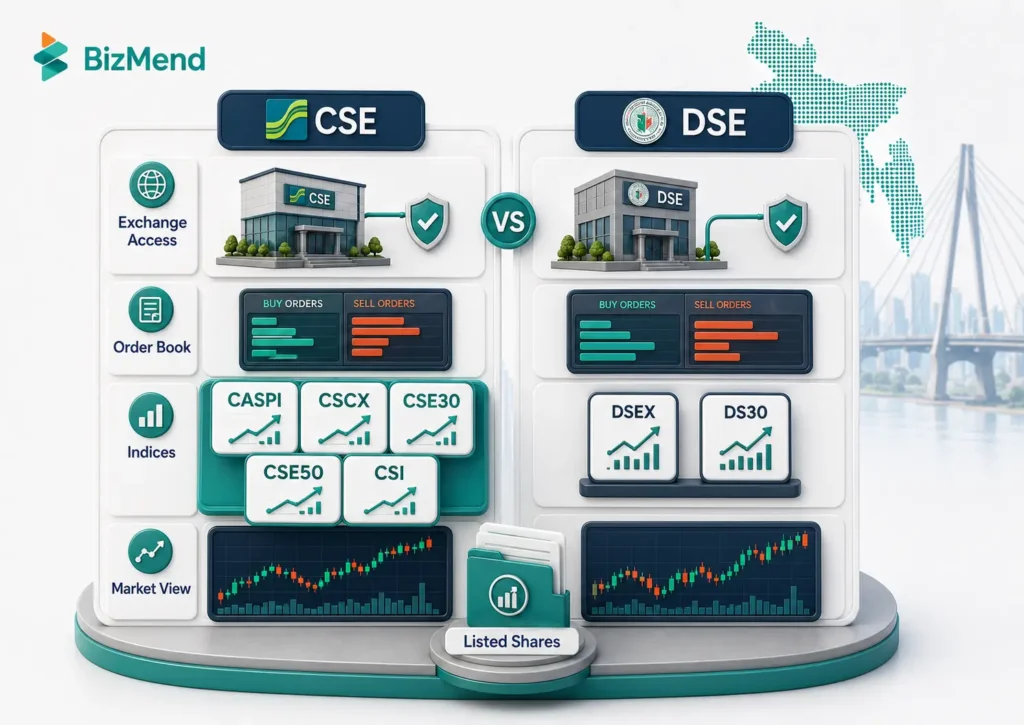
CSE and Dhaka Stock Exchange are separate trading venues operating within the broader Bangladesh stock market. BSEC regulates both, relies on brokers for investor access, and connects dematerialized securities to CDBL. Securities may trade on both exchanges, but each exchange maintains its own order book.
| Comparison point | Chittagong Stock Exchange | Dhaka Stock Exchange |
| Primary base | Chattogram, with regional operations including Dhaka | Dhaka |
| History | Trading started in 1995 | Older exchange with a longer operating history |
| Trading system | CSE’s own electronic order-matching and market-data system | DSE’s separate electronic trading infrastructure |
| Main indices | CASPI, CSCX, CSE30, CSE50, CSI, sector indices | DSEX, DS30, DSES and other published measures |
| Broker access | Requires a broker/TREC holder supporting CSE | Requires a broker/TREC holder supporting DSE |
| Order book | Orders compete inside CSE | Orders compete inside DSE |
| Practical choice | Depends on broker access, liquidity, platform support, charges, and the security | Depends on the same factors; neither exchange removes investment risk |
The same share can show different quantities, spreads, or execution conditions across the two order books. A lower displayed price is not automatically better after liquidity, partial fills, settlement, and charges are considered. Do not assume a broker automatically routes an order to the better exchange unless that service is clearly offered.
Stock investing can produce gains, losses, or long periods of weak performance. CSE membership, an index position, or a famous company name does not guarantee liquidity, dividends, or capital appreciation. A licensed broker can explain execution and account procedures, while a qualified financial adviser can help assess suitability without promising returns.
The Chittagong Stock Exchange gives local and eligible overseas investors regulated access to listed securities through approved intermediaries. It does not guarantee better returns than DSE; it provides a separate exchange, broker network, order book, platform, and set of indices.
A beginner should start with the account structure: verify the broker, open the correct BO account, connect a personal bank account, learn limit orders, and read official disclosures. Before every trade, check the security’s current status and liquidity on the live CSE platform. For account disputes or rule questions, contact the broker, CSE, CDBL, BSEC, or a qualified professional rather than relying on social media advice.
CSE is a demutualized public limited company and a regulated securities exchange, although its public-company structure should not be confused with the structure of a private limited company. Its activities are subject to BSEC rules, approved regulations, and securities laws; being regulated does not mean the government guarantees investor returns.
For normal dematerialized share investment, you generally need a CDBL BO account together with a brokerage account. Special instruments or market segments may have additional eligibility conditions.
The BO account holds securities at CDBL, while exchange access comes through the broker. Whether you can trade on both exchanges through one brokerage relationship depends on the broker’s memberships, platform setup, and account arrangements.
Both are regulated exchanges, but neither removes market, company, liquidity, fraud, or operational risk. Safety depends heavily on the security, broker, account controls, documentation, and investor behavior.
CASPI is the broad CSE All Share Price Index. CSE also maintains selective, benchmark, Shariah, and sector indices, including CSCX, CSE30, CSE50, and CSI.
No. A company may be listed but trade infrequently, be suspended, or appear on a different platform or category. Check live price, volume, status, and official notices before placing an order.
Use the official CSE website for market data, listed securities, brokers, indices, trading hours, and notices; CDBL for BO-account services; and BSEC for regulatory rules and investor guidance.

Learn how to become a Daraz seller in Bangladesh, register an account, list products, understand fees, manage orders, and grow…
by Sheikh Ornob

Compare the cost of living in Bangladesh in 2026, including Dhaka and Chittagong rent, food, transport, utilities, inflation, and monthly…
by Sheikh Ornob

Learn MoA and AoA requirements in Bangladesh, key clauses, drafting basics, RJSC filing steps, amendments, and common company-registration mistakes. Suggested…
by Sheikh Ornob