How to Become a Daraz Seller in Bangladesh: Registration, Fees & Growth
Learn how to become a Daraz seller in Bangladesh, register an account, list products, understand fees, manage orders, and grow…
 by Sheikh Ornob

Learn how the Bangladesh stock market works, including DSE trading, BO accounts, brokers, orders, settlement, indices, IPOs, dividends, and risks.
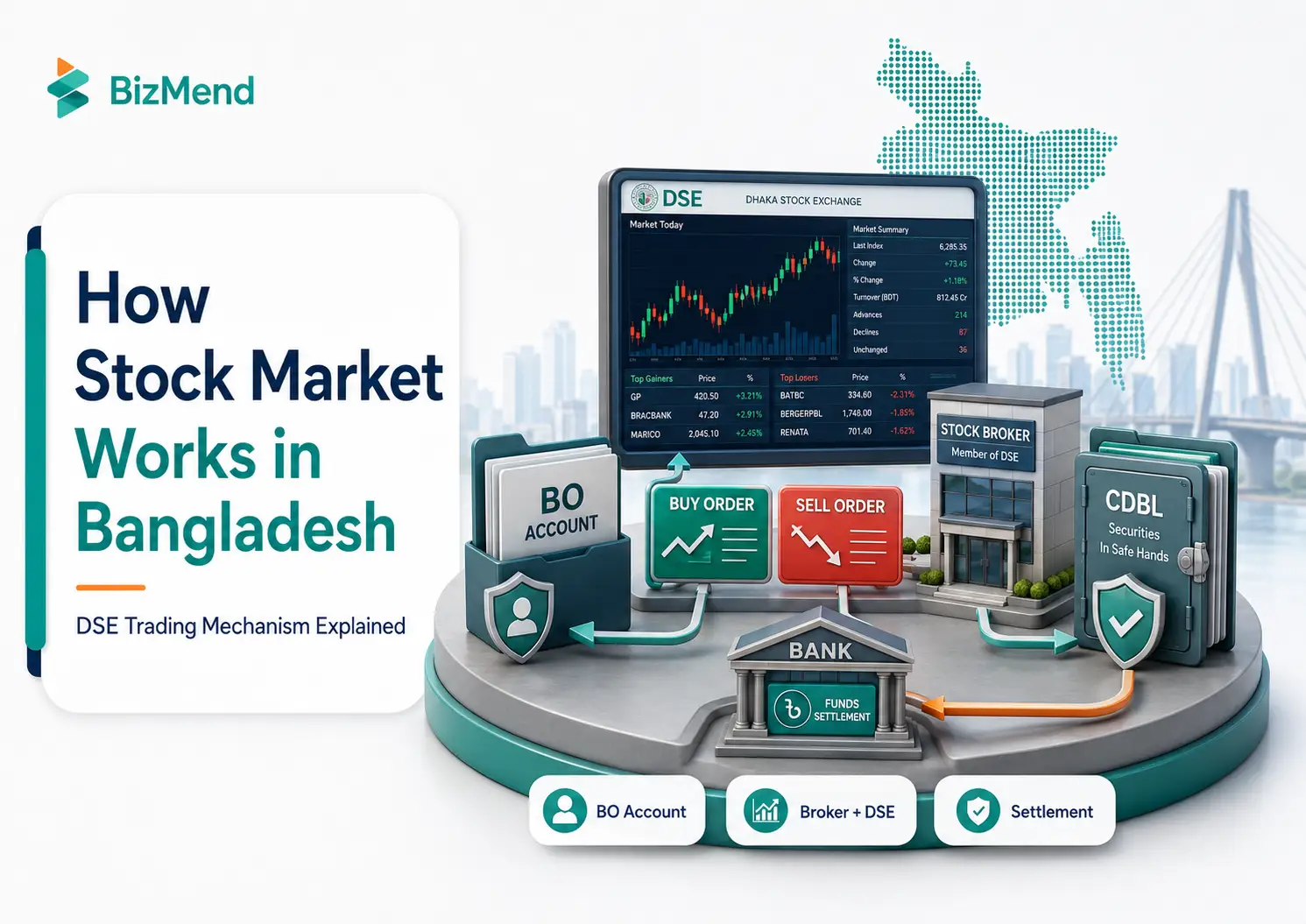
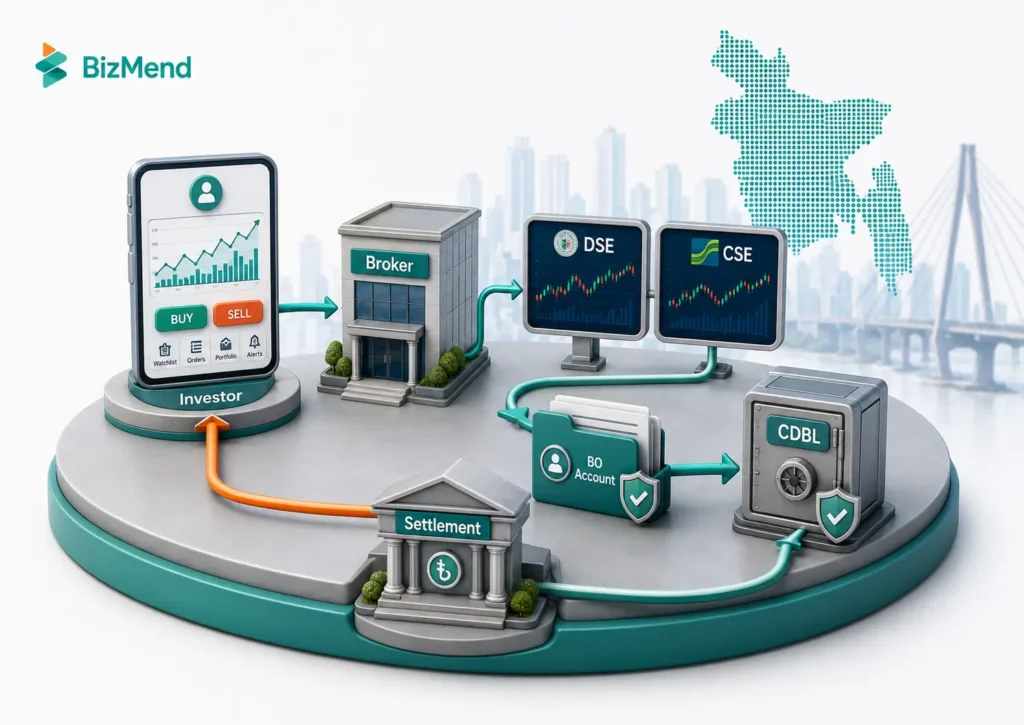
Understanding how the Bangladesh stock market works starts with four connected parts. : the stock exchange, a licensed broker, a beneficiary owner or BO account, and the banking channel used to fund trades. Investors normally trade through a broker or TREC holder; even when using tools such as DSE-Mobile, trading access depends on broker/TREC permission and the connected order-management system.
After a buy or sell order is matched, the trade still has to be cleared and settled. Cash moves through the broker and banking system, while securities are recorded electronically through Central Depository Bangladesh Limited. DSE and CSE provide the marketplaces, BSEC regulates the capital market, and CDBL maintains the depository records that show who owns dematerialized shares.
Quick Answer: Bangladesh’s stock market works through licensed brokers connected to DSE or CSE. Investors open a BO account, deposit funds with a broker, submit buy or sell orders, and receive shares electronically through CDBL after settlement. Prices change as eligible orders match in the exchange’s automated order book.
Bangladesh has two stock exchanges: the Dhaka Stock Exchange (DSE) and the Chittagong Stock Exchange (CSE). Both provide organized marketplaces where listed shares and other approved securities can be traded. DSE is the larger market by activity and public visibility, while CSE offers a second regulated trading venue.
The role of BSEC Bangladesh includes regulating stock exchanges, licensing intermediaries, supervising issuers, and protecting investors under applicable securities rules. It supervises exchanges, intermediaries, issuers, and market conduct under applicable securities laws and rules. Central Depository Bangladesh Limited (CDBL) is the electronic depository that records securities ownership through BO accounts.
Together, these institutions form the Bangladesh stock market, where exchanges match orders, brokers serve investors, CDBL records securities ownership, and BSEC regulates market activity.
The trading mechanism used by the Dhaka Stock Exchange is an electronic, order-driven system that matches compatible buy and sell orders. A buyer states the security, quantity, and acceptable price. A seller does the same. The exchange compares compatible orders and creates a trade when the buying and selling conditions meet.
Order matching generally follows price priority first and time priority second. A buyer offering a higher price is normally ahead of a lower-priced buyer. When two orders have the same price, the order entered earlier usually receives priority.
A matched trade can be fully filled or partially filled. For example, an investor may submit an order for 500 shares, but only 200 shares may be available at the selected price. The remaining quantity can stay pending, expire, or be cancelled depending on the order conditions and the broker platform.
Suppose Company ABC has a best sell offer of Tk 42.50 for 300 shares. You place a limit buy order for 200 shares at Tk 42.50. If your order reaches the market while that sell quantity remains available, the system can match 200 shares at Tk 42.50. If another buyer reaches the order book first, your order may remain unfilled even though you saw that price on the screen.
A BO account is the electronic account used to hold securities in an investor’s name, so beginners should understand how to open a BO account in Bangladesh before choosing a broker or funding trades. It functions like a digital vault for listed shares, bonds, eligible securities, and units of mutual funds in Bangladesh that are held electronically through the depository. A trading account and a BO account are connected but not identical: the trading account is used to place orders and manage broker balances, while the BO account records securities ownership.
According to CDBL’s official online BO account-opening instructions, applicants should prepare their identity information, bank evidence, photograph, signature, contact details, and applicable NRB documents before starting the application. A broker or depository participant may request additional KYC documents.
Never open a BO account using another person’s phone, email, bank account, or identity documents. Mismatched information can delay withdrawals, dividends, account updates, or future compliance checks.
Retail investors normally access DSE or CSE through a licensed stock broker or brokerage house. The broker opens and maintains the trading relationship, receives funds, provides an order-entry channel, issues trade confirmations or contract notes, charges brokerage and related fees, and supports withdrawals and account servicing.
Broker platforms may include web trading, mobile apps, dealer-assisted orders, portfolio statements, market data, and research. Features differ, so compare licensing status, account security, service quality, fee disclosure, withdrawal processing, complaint handling, and platform reliability before choosing one.
A broker is an intermediary, not a guarantor of profit. Research calls, dealer comments, social-media groups, and informal tips should not replace your own review of company disclosures, financial statements, risks, and valuation.
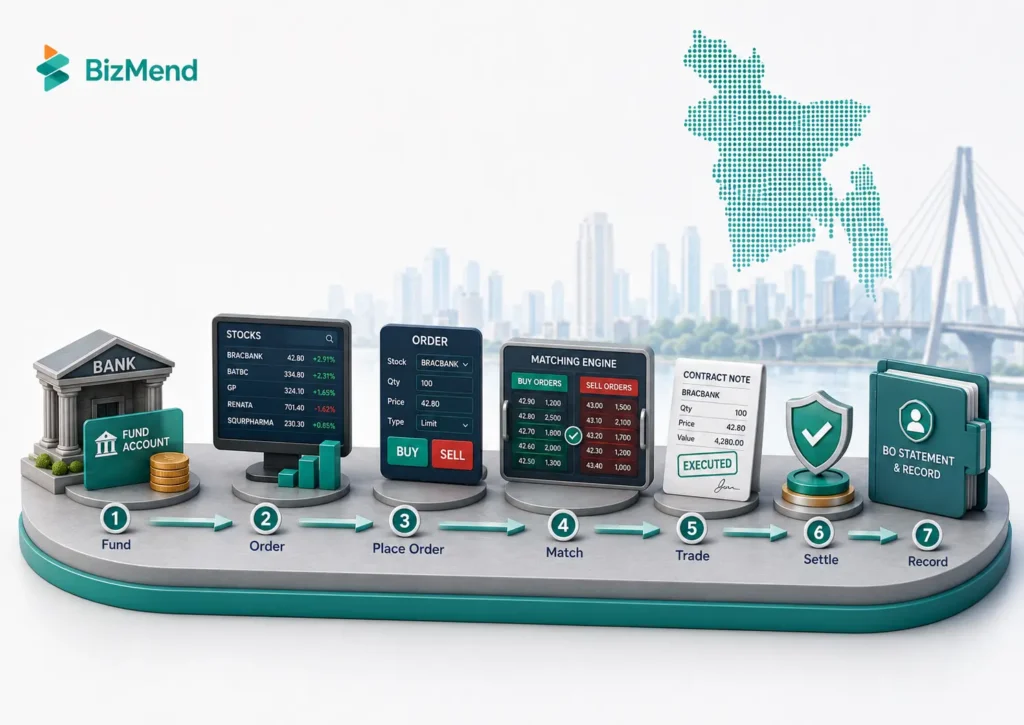
The first step in learning how to invest in the Bangladesh stock market is choosing a licensed broker, completing KYC, and opening a BO account with a connected trading account. Confirm all account names, bank details, mobile numbers, and email addresses before activation.
Transfer money using the broker’s approved banking channel. Avoid sending investment funds to a salesperson’s personal account or using an unverified mobile wallet. Keep deposit receipts and confirm that the amount appears in your official ledger.
Review the company’s disclosures, financial performance, governance, business risks, dividend history, and market liquidity. A low share price does not automatically mean the company is cheap or safe.
Specify the trading code, buy or sell direction, quantity, and price condition. Check the estimated cost, including brokerage and other applicable charges, before submitting.
An order is not a trade until it matches. It may execute fully, execute partially, or remain pending. Review the final execution price and quantity rather than relying on the price visible before submission.
After execution, check the contract note, broker ledger, and BO statement. Shares and sale proceeds become available according to the applicable settlement schedule, which can vary by instrument category, exchange rules, and official notices; beginners should confirm sellable balance and withdrawable cash from the broker ledger before acting.
A limit order tells the system the highest price you will pay when buying or the lowest price you will accept when selling. It gives price control, but execution is not guaranteed. If the market never reaches your price, the order can remain unfilled.
A market-style instruction, where supported by the broker or exchange system, prioritizes faster execution at available prices, but beginners should confirm whether their Bangladesh broker actually supports that order type and what price-band or validity rules apply. The risk is price slippage: the final price may differ from the last traded price, especially when a stock has low liquidity or a thin order book.
Bangladesh broker interfaces do not all present order instructions in the same way. Some may focus on priced limit orders and validity choices rather than displaying a simple named market-order button. Confirm the exact DSE order types, order-validity options, cancellation rules, and price-band restrictions supported by your broker before trading.
| Order instruction | Main purpose | Main advantage | Main risk |
| Limit buy | Buy at a chosen maximum price or lower | Better price control | May not execute |
| Limit sell | Sell at a chosen minimum price or higher | Better price control | May not execute |
| Market-style instruction | Seek faster execution at available prices | Higher execution probability | Final price may move |
| Cancel or modify | Change a pending order before execution | Correct quantity or price | Already executed quantity cannot be reversed |
Bangladesh exchanges normally operate on business days from Sunday through Thursday, excluding exchange holidays. DSE trading hours can change through official notices, Ramadan schedules, holidays, or special market decisions, so investors should verify the current trading session from DSE or their broker before placing a time-sensitive order. Ramadan schedules, technical changes, special circumstances, and holiday calendars may shorten or shift sessions.
Do not rely on an old timetable or screenshot; check the official Dhaka Stock Exchange notices or your broker’s daily update before placing a time-sensitive order. Pre-open, continuous trading, closing, or post-closing phases may also have different rules from the main matching session.
Trade execution and settlement are different events. Execution means the exchange matched a buyer and seller. Settlement is the later process in which securities are delivered to the buyer’s BO account and funds are finalized for the seller through the clearing and brokerage system.
Settlement schedules are often described as T+n, where T is the trade date and n is the number of business days after the trade. Different securities or categories can follow different schedules, and rules can change. Your broker should tell you when purchased shares become sellable and when sale proceeds become withdrawable.
A common beginner mistake is trying to withdraw sale proceeds or resell recently purchased shares before the applicable settlement is complete. Always read the broker ledger and settlement status instead of assuming that an executed trade is immediately final.
A stock index summarizes the price movement of a selected group of securities. It is a market indicator, not a bank balance and not a guarantee that every listed share moved in the same direction.
DSEX is the broad benchmark commonly used to describe overall DSE market movement. DS30 tracks a selected group of larger and more liquid companies under its methodology. DSES is designed around Shariah-compliant securities. CSE also publishes its own broad and selected indices, including CASPI and other index families.
If DSEX rises by 1%, that does not mean every investor made 1%. Your result depends on the companies you own, your purchase price, trading costs, dividends, and the timing of your trades.
An initial public offering in Bangladesh is the regulated process through which an eligible company first offers approved securities to public investors. Investors apply during the offer process, and allotment depends on the rules and demand. After listing, the company’s eligible securities become publicly traded shares that investors can buy and sell in the secondary market through DSE or CSE.
The secondary market is where existing investors buy and sell listed securities from one another. The issuing company does not receive money every time its shares trade in this market. Prices are determined by supply, demand, disclosures, expectations, liquidity, and trading rules.
IPO approval or listing is not a promise of profit. A newly listed share can rise, fall, or remain illiquid. Read the prospectus and risk disclosures rather than treating an IPO as guaranteed income.
Share investors generally look for capital gains, cash dividends, stock dividends where permitted, or a combination of these. A capital gain occurs when shares are sold above the total purchase cost. A loss occurs when the selling value is lower after accounting for fees and charges.
A dividend is a distribution approved under the company’s process; it is not automatic. A profitable company may retain earnings, while a company with weak fundamentals may declare a dividend that does not solve its underlying risks. Investors should check record dates, entitlement rules, tax treatment, and the company’s official disclosure.
Market prices can fall because of company-specific problems, sector weakness, interest rates, liquidity, regulatory decisions, economic conditions, or investor sentiment. Diversification can reduce concentration risk, but it cannot remove market risk.
The largest beginner risk is often not volatility alone; it is investing without understanding what was purchased. Rumours, coordinated social-media promotion, thinly traded shares, weak governance, and emotional buying can produce losses that are difficult to recover.
Liquidity risk matters because a displayed market price does not guarantee that a large quantity can be sold at that price. Operational risk also matters: weak passwords, shared OTPs, fake brokerage pages, and unauthorized dealer instructions can expose an account.
Regulatory categories, price bands, trading suspensions, corporate actions, and settlement rules can affect when or how a security trades. Read exchange notices and company disclosures, and use official complaint channels when records do not match.
Buying because a share looks numerically cheap; investing emergency funds; taking loans to speculate; concentrating all money in one company; following unlicensed tip providers; ignoring brokerage costs; failing to review BO statements; sharing passwords or OTPs; and assuming past dividends guarantee future returns.
Confirm that the broker is properly licensed and that the BO account is opened in your own name. Read the fee schedule and withdrawal policy. Learn how to view the order book, contract note, cash ledger, and BO balance.
Choose a small learning amount that you can afford to keep invested and potentially lose. Review at least the company’s audited reports, recent price-sensitive disclosures, sponsor/director information, sector risks, and trading liquidity. Decide your acceptable price before entering the order.
After every trade, verify the executed price, quantity, fees, settlement status, and BO movement. Keep records. Contact the broker’s compliance team promptly if an order, withdrawal, or statement looks wrong.
Learning how the stock market works in Bangladesh is mainly about understanding the chain from investor to broker, exchange, clearing system, and CDBL. The visible buy button is only one part of the process. Order matching, settlement, fees, ownership records, and regulatory notices all affect the final result.
Beginners should focus first on account security, official disclosures, realistic risk, and disciplined order placement. Use a licensed broker for operational questions and consult a qualified financial adviser when a decision depends on your income, debt, tax position, time horizon, or ability to absorb losses. No exchange mechanism can turn speculative trading into guaranteed income.
No. A retail investor normally opens a BO account and trading account through a licensed broker or depository participant. The broker routes eligible orders to the exchange.
The BO account records electronic ownership of securities through CDBL. The trading account is the broker-side account used for orders, cash balances, fees, and transaction records.
No. The order must match an eligible sell order. It may be fully filled, partially filled, or remain unexecuted depending on price, quantity, priority, and liquidity.
No order type is automatically safe. A limit order offers price control but may not execute. Market-style execution, where supported, may fill faster but can produce an unexpected price.
That depends on the current settlement cycle and security category. Check your broker’s settlement status and exchange rules before submitting a sell order.
No. Dividends depend on company performance, board recommendations, shareholder approval where applicable, and regulatory requirements. Past dividends do not guarantee future payments.
Use BSEC, DSE, CSE, CDBL, and your licensed broker’s official notices. Trading hours, settlement, security categories, and operational rules can change.

Learn how to become a Daraz seller in Bangladesh, register an account, list products, understand fees, manage orders, and grow…
by Sheikh Ornob

Compare the cost of living in Bangladesh in 2026, including Dhaka and Chittagong rent, food, transport, utilities, inflation, and monthly…
by Sheikh Ornob

Learn MoA and AoA requirements in Bangladesh, key clauses, drafting basics, RJSC filing steps, amendments, and common company-registration mistakes. Suggested…
by Sheikh Ornob