
 by Sheikh Ornob
Loan quotes in Bangladesh can look simple until the fine print hits. Two banks can both say yes and still leave you paying very different monthly costs. That changes your borrowing math fast.
If you are checking the business loan interest rate in Bangladesh, 2026 is not a year to rely on old rate caps or vague branch talk. Bangladesh Bank now lets banks price loans more freely, so the spread between SME, trade, and working capital facilities matters more. This guide compares the latest public rates and special verified schemes, so you can narrow your shortlist before you sit down with a relationship manager.
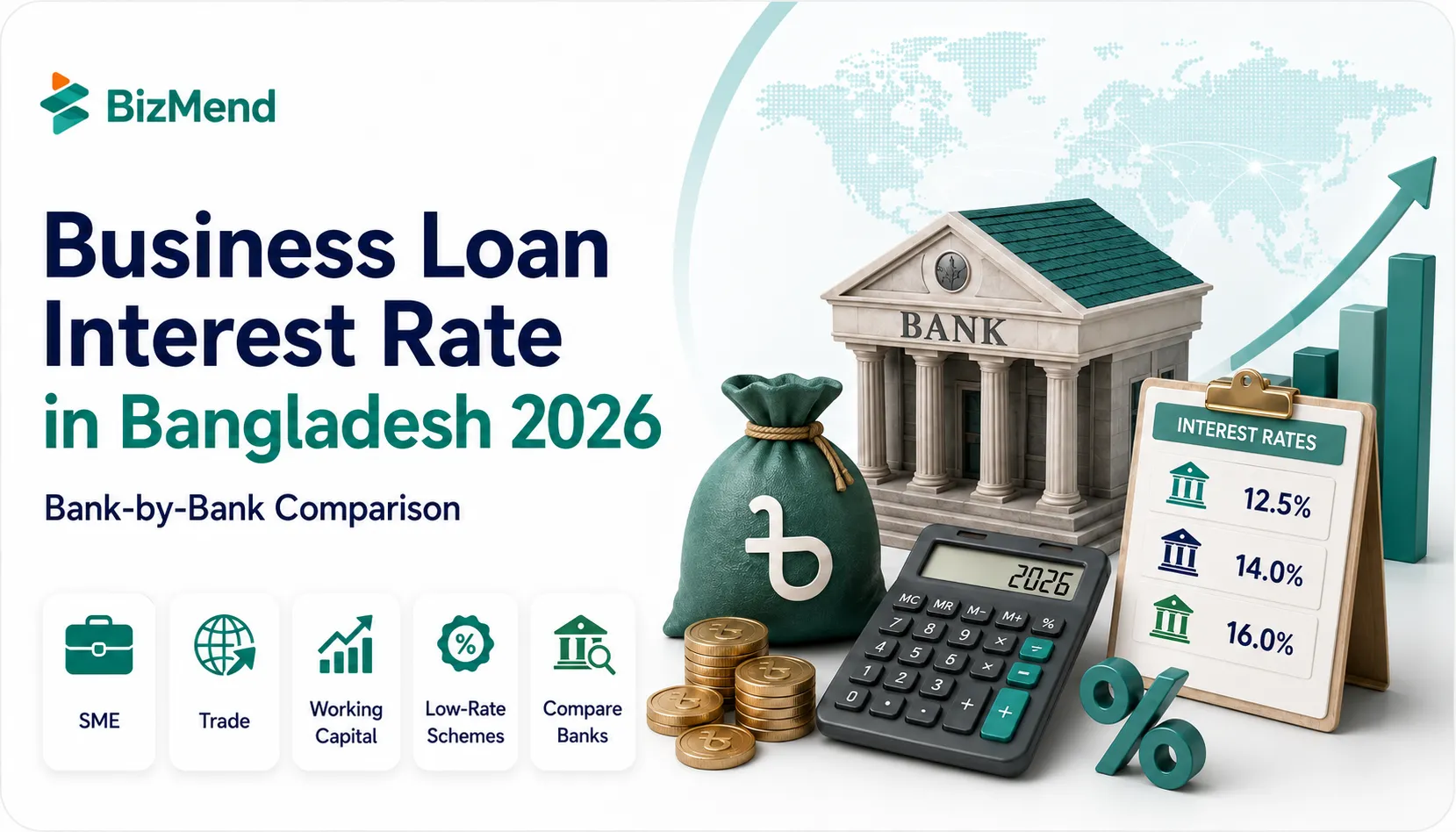
Quick answer: In Bangladesh in 2026, publicly posted business loan rates mostly cluster between 12.5% and 16% a year, depending on the bank, facility, and borrower profile. Prime Bank, UCB, and MTB publish mainstream business ranges near 12.5% to 14.5%, while special startup or women entrepreneur schemes can drop to 4% to 8%.
Key Takeaways
- Bangladesh Bank withdrew the SMART-based lending cap in May 2024, so banks now price business loans more directly through their own risk and relationship models.
- Across the public rate sheets I verified, mainstream business lending in May 2026 usually sits between 12.5% and 16.0% a year.
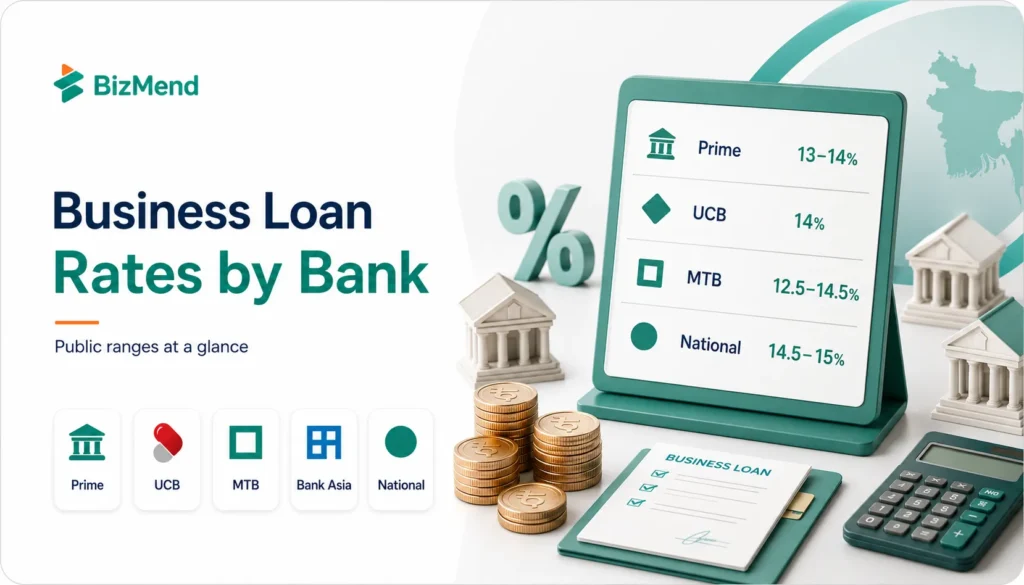
- Prime Bank, UCB, and Mutual Trust Bank publish some of the cleaner mainstream business ranges for readers who want a fast first comparison.
- Special programs can look far cheaper than standard loans, but they usually target startups, women entrepreneurs, or borrowers under Bangladesh Bank or SME Foundation-backed windows.
- A low headline rate is not enough on its own because collateral, repricing rules, tenor, and processing speed can change the real cost.
- Some banks publish full sector-wise lending sheets, while others show only product pages, so public comparisons in Bangladesh still need a bit of detective work.
- If your business needs trade finance, working capital, and term lending together, the best bank for you may not be the one with the lowest single number on its website.
- Before you negotiate, collect your bank statements, turnover proof, trade license, tax documents, and collateral details because pricing often shifts once your file looks stronger.
What Business Loan Rates Look Like in Bangladesh in 2026
The first thing to know is that Bangladesh no longer runs business lending off the old SMART ceiling formula. Bangladesh Bank’s BRPD Circular No. 10, dated 08 May 2024, withdrew that system and shifted pricing toward a banker-customer relationship. Plain English version: the same business can now hear meaningfully different offers from different banks, even for similar facilities.
That does not mean rates are random. Public sheets still show a pattern. Standard commercial, SME, and working capital facilities now tend to sit in three broad buckets: around 12.5% to 13.0% for some trade or stronger corporate-style exposures; around 14.0% to 14.5% for many mainstream SME and business products; and around 15.0% to 16.0% where risk, product type, or bank pricing is tighter. Special funds can fall well below that.
- Mainstream trade and commercial lending: often about 12.5% to 14.0%.
- Mainstream SME term and working capital lending: often about 14.0% to 14.5%.
- Narrow subsidized windows: sometimes 4.0% to 8.0%, but only for specific borrowers.
Funding cost still matters in the background. BRAC Bank’s retail base rate communication for April 2026 put its base rate at 9.47%, based on Bangladesh Bank data on top six-month FDR rates. So even though the formal cap is gone, the market is still anchored by what banks are paying for deposits and what kind of risk they think your business brings.
Bank by Bank Comparison of Publicly Posted Rates
Yeah, this is the part most readers actually came for. The table below focuses on the latest public business lending numbers I could verify from bank pages, rate sheets, or official announcements. It is a shortlist tool, not a sanction letter, because your final rate can still move once the bank sees your statements, collateral, and turnover.
| Bank | Publicly posted business rate | Effective date | What to watch |
|---|---|---|---|
| Prime Bank | 14.00% SME term and working capital, 13.00% trade and other commercial lending, 10.00% export financing | 01 Apr 2026 | It also lists a startup SME rate of 4.00% under the Bangladesh Bank startup policy. |
| Bank Asia | 14.50% on most listed CMSME products, 13.00% other commercial lending for large enterprises | 12 May 2024 SME page, 05 Nov 2025 loan page | The Subarno women’s entrepreneur term loan is listed separately at 5.00% fixed. |
| United Commercial Bank | 14.00% small and medium industries, 14.00% wholesale and retail trade, 13.00% export financing | 01 Feb 2026 | One of the clearest sector sheets for standard commercial borrowing. |
| Mutual Trust Bank | 14.50% SME term and working capital, 12.50% wholesale and retail trade, 12.50% other commercial lending | 11 May 2026 | Among the lower mainstream public trade rates I could verify. |
| National Bank | 15.00% NBL Small Business Loan, 14.50% corporate loans | 01 May 2026 | Good reminder that product labels and sector sheets do not always sit at the same level. |
| Bengal Commercial Bank | 14.00% small and other industry term loans, 14.50% working capital for SME and others | 01 Jan 2025 | The separate 2026 SME Foundation-backed window is priced at 8.00%. |
| BRAC Bank | No single public all-purpose SME rate sheet was easy to verify, but TARA Uddokta SME Loan is listed at 5.00% up to BDT 50 lac | Active 2026 product page | BRAC also published a retail base rate of 9.47% for April 2026, which is useful context on funding costs. |
The headline rate matters, but the real fight is often over spread, collateral, and how often the bank can reprice you.
If you only compare one line from each bank, you can fool yourself fast. A 13.00% trade line is not the same thing as a 14.00% SME term loan, and neither is directly comparable to a women’s entrepreneur refinance window at 5.00%. You have to compare like with like, or the table becomes trivia instead of a decision tool.
What the Published Numbers Actually Mean
Most bank sheets in Bangladesh do not simply say, “Here is your business loan rate.” They often show a declared rate, a lowest rate, and a highest rate by economic sector. That tells you the bank has internal room to move. Your actual number can depend on collateral, debt load, repayment history, cash flow volatility, relationship depth, and how badly the bank wants your account.
- Declared rate: the bank’s standard posted number for that sector or product.
- Lowest rate: usually the best end of the range for stronger or specially approved borrowers.
- Highest rate: the upper end the bank is willing to charge within that category.
- Product page rates: often linked to a specific scheme, not the whole SME book.
Let’s not sugarcoat it, websites can also be messy. One page may carry a 2026 sector sheet while another still shows a 2025 effective date. That does not always mean the rate is wrong, but it does mean you should ask the branch for the current sanction framework and repricing terms before you celebrate a low number.
Where the Lowest Published Rates Sit in 2026
If your goal is the cheapest number on paper, the winners are not the ordinary all-purpose business loans. They are the targeted schemes. These rates can be excellent, but the borrower profile is narrower, the paperwork can be tighter, and the use of funds may be more closely defined.
| Scheme | Published rate | Who it fits | Reality check |
|---|---|---|---|
| Prime Bank Startup SME | 4.00% | Bangladesh Bank startup financing policy | Best for eligible startups, not for ordinary trading businesses that just want quick working capital. |
| Bank Asia Subarno | 5.00% fixed | Women’s entrepreneur term loan | Narrow borrower profile, but the published number is strong if you qualify. |
| BRAC Bank TARA Uddokta | 5.00% up to BDT 50 lac | Women-owned business under SME | Useful if you need an unsecured or semi-structured women-focused option. |
| Bengal Commercial Bank via SME Foundation | 8.00% | SME Foundation revolving fund credit wholesaling program | Loan sizes on the public announcement run from BDT 1 lac to BDT 25 lac. |
| Bank Asia via SME Foundation | 8.00% | SME Foundation refinance fund through credit wholesaling program | Good example of how subsidized windows sit below ordinary posted CMSME rates. |
A cheap scheme you cannot qualify for is not a cheap option. It is just a nice number on somebody else’s brochure.
This is why many businesses end up comparing two shortlists instead of one. Shortlist one is the subsidized or policy-backed group, where rates might land at 4.0% to 8.0%. Shortlist two is the mainstream business lending group, where you should plan closer to 12.5% to 16.0%. Mixing those two buckets without context will make every normal bank look overpriced, even when the products are not meant for the same borrower.
How to Compare Banks Without Getting Distracted by One Number
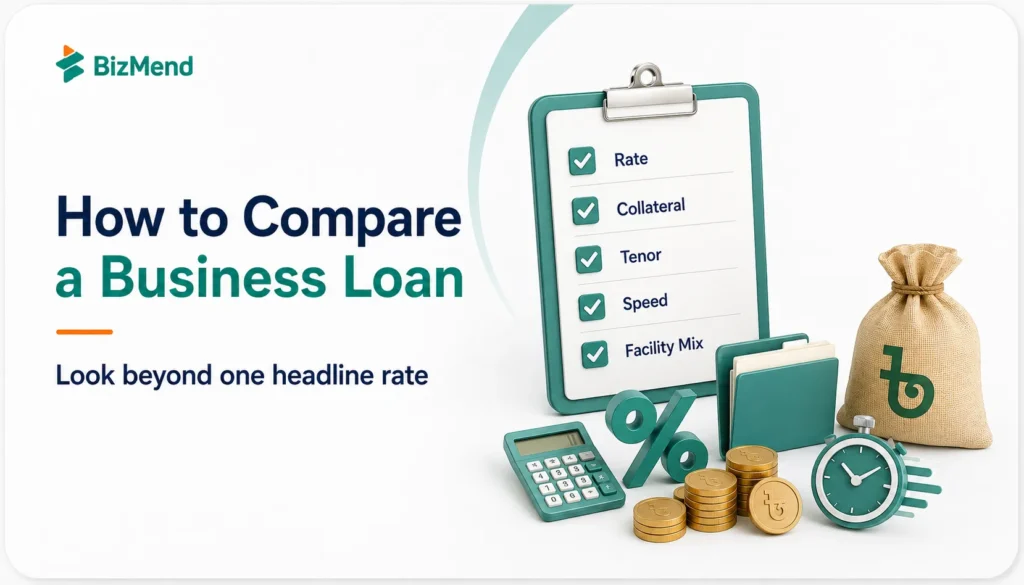
A finance manager usually cares about more than rate, and for good reason. A slower 12.50% line with heavy collateral and weak limits can be worse for the business than a 14.00% facility that actually matches your cash cycle. If you are building a shortlist this week, use this simple filter before you call any branch.
- Match the product to the need: compare working capital with working capital, trade lines with trade lines, and term loans with term loans.
- Check repricing rules: ask how often the bank can revise the rate and what event triggers the change.
- Price the collateral burden: a lower rate can hide a heavier mortgage, cash margin, or personal guarantee demand.
- Look at total usable limit: a bank that gives you LC, OD, and term finance together may be worth more than one cheap single product.
- Ask about turnaround time: many businesses lose more from delay than from fifty or seventy-five basis points.
- Stress test repayment: run your monthly debt service at the current rate and at one percentage point above it.
Okay, let’s not make this sound fancier than it is. You are trying to buy flexibility at a tolerable cost. The right bank is the one that gives you money on terms your business can actually live with, not the one that wins a spreadsheet beauty contest for five minutes.
When a Higher Rate Can Still Be the Better Deal
This sounds annoying, but it is true. A 14.50% facility can beat a 13.00% facility if the higher-rate bank gives you a cleaner sanction, longer tenor, lower collateral pressure, or faster renewal. That matters most for importers, distributors, seasonal traders, and manufacturers who get hurt by timing problems more than by a small spread gap.
- Better cash flow fit: installment timing matches your sales cycle.
- Lower operational friction: fewer approvals, faster document handling, and smoother renewals.
- Broader facility mix: term loan, overdraft, LC, and guarantee under one relationship.
- Less collateral drag: smaller mortgage ask, lower cash margin, or more realistic guarantor demands.
So yes, rate matters a lot. But your borrowing cost is really a bundle of price, speed, structure, and access. If a bank quotes low and then stalls your disbursement or boxes you into the wrong facility, you did not save money. You just paid for the problem in a different way.
Final Thoughts
The cleanest way to read the 2026 market is this: ordinary business loans in Bangladesh usually live in the low to mid-teens, while targeted schemes can fall much lower for the right borrower. Start with the public sheet, but make your final choice only after you compare repricing, collateral, and speed.
Frequently Asked Questions
What is the average business loan interest rate in Bangladesh in 2026?
For publicly posted mainstream business facilities, a practical planning range is about 12.5% to 16.0% a year. The exact number still depends on the bank, your sector, collateral, cash flow, and whether you are taking term finance, working capital, or trade facilities.
Which bank shows the lowest published business loan rate right now?
Among the special schemes I verified, Prime Bank publishes a 4.00% startup SME rate tied to Bangladesh Bank policy. Among broader mainstream public business rates, Mutual Trust Bank shows 12.50% for wholesale, retail, and other commercial lending on its May 2026 sheet.
Are business loan rates fixed in Bangladesh?
Not always. Since Bangladesh Bank moved away from the SMART-based cap in May 2024, banks can price more flexibly. Many sanction letters now spell out how often repricing can happen, so you should ask whether your rate is fixed for a period or subject to review.
Do all banks publish their SME rates clearly on their websites?
No, and that is part of the problem. Some banks publish full sector sheets, some publish only product pages, and some leave readers with partial or older circulars. That is why a public comparison should be treated as a shortlist tool, not the last step in your decision.
What documents help me negotiate a better loan rate?
Strong recent bank statements, clean repayment history, tax records, audited or management accounts, a valid trade license, collateral details, and a clear use of funds story all help. Banks price risk, so the cleaner your file looks, the more room you usually have to negotiate.