
 by Sheikh Ornob
Banks rarely fund a raw idea. That catches many founders late. If you’re searching for a startup loan in Bangladesh, you need to know which doors are actually open.
Startup loans in Bangladesh generally sit across three lanes: Bangladesh Bank-backed startup lending, standard SME bank products, and government-backed capital that isn’t really a loan at all. Some routes can finance as much as Tk 8 crore, while others start as low as Tk 2 lakh, but the rules change fast based on your stage, revenue, guarantees, and paperwork. This guide sorts the real options, shows where banks still hesitate, and helps you match your business to the right route.
Quick answer: A startup loan in Bangladesh usually comes through three routes: Bangladesh Bank-backed startup products, SME Foundation partner programs, or bank-run SME loans such as Bank Asia Somvabona, EBL Startup, and BRAC Bank Startup Builder. Limits can start around Tk 50,000 and reach Tk 1 crore or more, depending on stage, collateral, sector, and lender policy.
Key Takeaways
- Bangladesh does not have one universal startup loan product, so your best option depends on whether you are pre-revenue, early-revenue, or already scaling.
- Bangladesh Bank’s revised startup financing policy set a maximum customer rate of 4% and expanded financing limits to between Tk 2 crore and Tk 8 crore, depending on the startup’s stage.
- The Bangladesh Bank startup route is designed for eligible Bangladeshi founders and still works through participating banks and financial institutions, not through a direct walk-in loan counter at the central bank.
- Older CMSME refinance routes for new entrepreneurs still matter, especially if your business is smaller, formal, and needs a more traditional enterprise loan profile.
- Startup Bangladesh Limited is a government-backed capital route for high-growth startups, but it is equity or quasi-equity support, not a standard monthly installment loan.
- Bank products marketed as startup friendly often still require revenue evidence, guarantors, or a repayment story that looks stronger than the word “startup” suggests.
- Current product pages show a wide spread: EBL Startup starts at Tk 2 lakh, BRAC Startup Builder starts at Tk 5 lakh, and Prime Startup advertises financing up to Tk 8 crore.
- If your venture is still an idea on slides, debt is usually the wrong first tool. Registration, early sales, or equity readiness will matter more than the application form.
What Startup Financing Really Means in Bangladesh
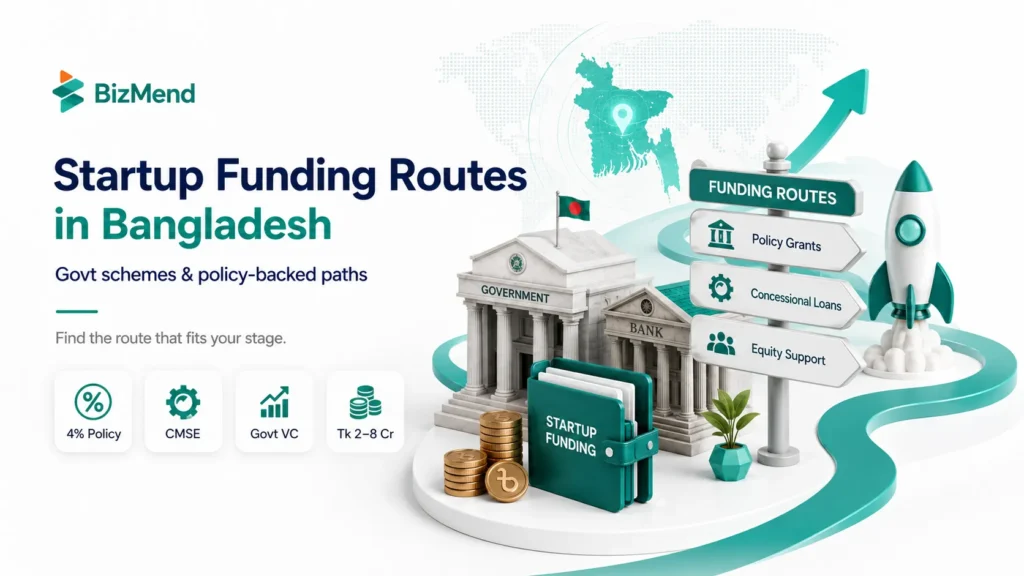
A lot of founders picture a startup loan as one neat product for brand new businesses. That isn’t how the market works. In Bangladesh, the label usually covers three different things: a central bank-backed startup policy, standard SME loans from commercial banks, and government-backed equity-style capital for tech ventures.
That distinction matters because each lane asks a different question. Bangladesh Bank-backed startup financing asks whether your company fits the policy and stage rules. An SME bank product asks whether you can repay on schedule. A venture capital route asks whether your company could grow fast enough to justify investor risk.
| Route | What it really is | Best fit |
|---|---|---|
| Bangladesh Bank startup financing | Policy-backed startup loan or investments through participating banks and financial institutions | Growth-minded startups that can document traction and policy eligibility |
| Regular SME bank loan | Commercial debt for working capital or business expansion | Registered businesses with cash flow, guarantees, or usable security |
| Government-backed venture capital | Equity, convertible debt, or grant-style support | Tech or innovation-led ventures that are too early for normal debt |
If you start with the wrong lane, you lose weeks. Worse, you may get told no for the wrong reason. So before you compare rates, first decide whether you need repayable debt, refinance-backed enterprise credit, or investor-style capital.
Government-Backed Routes to Check First
Bangladesh Bank Startup Financing Policy
This is the headline route most founders mean today. On July 9, 2025, Bangladesh Bank revised its startup financing policy so eligible Bangladeshi citizens aged 21 or older could access startup financing at a maximum 4% customer rate. Reporting on the policy also says financing limits now range from Tk 2 crore to Tk 8 crore based on the venture’s stage, and the central bank opened a Tk 500 crore refinance window for participating lenders.
That sounds generous, and it is. But let’s keep our feet on the ground. This is not automatic money for anyone with a pitch deck. The route still depends on a participating bank or financial institution agreeing that your startup fits the policy, the risk, and the documentation standards. In plain English, the central bank made the lane wider, but lenders still control the gate.
The policy got friendlier. The approval test is still stubbornly practical.
Bangladesh Bank Refinance for New Entrepreneurs in CMSE
Bangladesh Bank also has a longer-running refinance route for new entrepreneurs in the cottage, micro, and small enterprise sectors. Its published cumulative information page showed Tk 214.403 crore refinanced to 3,078 beneficiaries as of June 30, 2023. This matters if your business is smaller, more local, and easier to frame as a formal CMSE than as a classic high-growth startup.
Think of this as the quieter route. It may not sound flashy, but for trading, service, light manufacturing, or modest production businesses, it can fit better than chasing a startup label that your branch manager does not really know how to process.
Startup Bangladesh Limited
Startup Bangladesh Limited is the ICT Division’s flagship venture capital fund. On its official site, it says it started in March 2020 with an allocated capital of BDT 500 crore and can invest through equity, convertible debt, and grants. That means it is government-backed startup capital, yes, but not a standard bank loan with equal monthly installments.
| Government-backed route | Typical size signal | Repayment style | Best when |
|---|---|---|---|
| Bangladesh Bank startup financing | Tk 2 crore to Tk 8 crore under the 2025 policy | Debt or investment through participating lenders | You have traction and can meet formal startup policy criteria |
| New entrepreneurs refinance in CMSE | Usually smaller enterprise borrowing | Regular enterprise repayment through participating lenders | You run a formal small business and need practical operating finance |
| Startup Bangladesh Limited | Case-by-case investment capital | Not a normal installment loan | You are too early or too innovation-led for plain bank debt |
Bank Options for Founders Who Need Debt Now
If you need money for stock, equipment, rollout, or a working capital gap, bank products usually matter more than policy headlines. The good news is that several lenders now publish startup or startup-adjacent products on their own sites. The less cheerful truth is that these products still lean hard on proof that your business can survive the repayment schedule.
| Bank product | What the page currently shows | What it tells you |
|---|---|---|
| EBL Startup | Tk 2 lakh to Tk 1 crore, 24 to 60 months, no minimum business length, no bank transaction requirement, 2 personal guarantees | Useful for very early formal businesses, but guarantees still matter |
| BRAC Startup Builder | Tk 5 lakh to Tk 5 crore, founder age 21 to 45, Bangladeshi by birth, proven business model, revenue flow, up to Tk 1 crore without mortgage | Better fit for startups that already show traction |
| Prime Startup | Financing up to Tk 8 crore as per Bangladesh Bank startup financing policy | A route worth checking if you qualify for the revised policy |
| BRAC Druti | Up to Tk 15 lakh, unsecured, built for smaller business needs | Good for founders whose funding need is practical and still modest |
| BRAC TARA Uddokta | Starts at Tk 5 lakh, 5% up to Tk 1 crore, unsecured up to Tk 2 crore | A strong route for women entrepreneurs who fit the bank profile |
| EBL Mukti | Up to Tk 1 crore, women-led businesses, SME-focused | Useful when refinance support drops pricing |
| MTB Ava | Women led CMSMEs with operating history, 7% under refinance, 9% without | Pricing changes meaningfully if refinance is unavailable |
Notice the pattern. Even products with the word “startup” usually stop short of pure idea-stage risk. EBL may not require prior bank transactions or a minimum business length for its startup product, but it still asks for two personal guarantees. BRAC Startup Builder asks for a proven business model and established revenue flow. That’s the real market signal.
Startup loan in Bangladesh usually begins where a lender can already see sales, cash flow, or a fallback guarantee.
So if you are deciding between banks, do not compare brand names first. Compare entry filters. A smaller, unsecured SME loan that actually matches your current stage may be far more realistic than chasing a larger policy limit that looks impressive on paper but fails at credit review.
What Banks Usually Want Before They Say Yes
Banks care about repayment visibility, not founder excitement. If your company is registered, trading, and already moving money through a bank account, your file immediately looks more real. If you are still informal, still pre-revenue, or still explaining future demand instead of current demand, approval gets much harder.
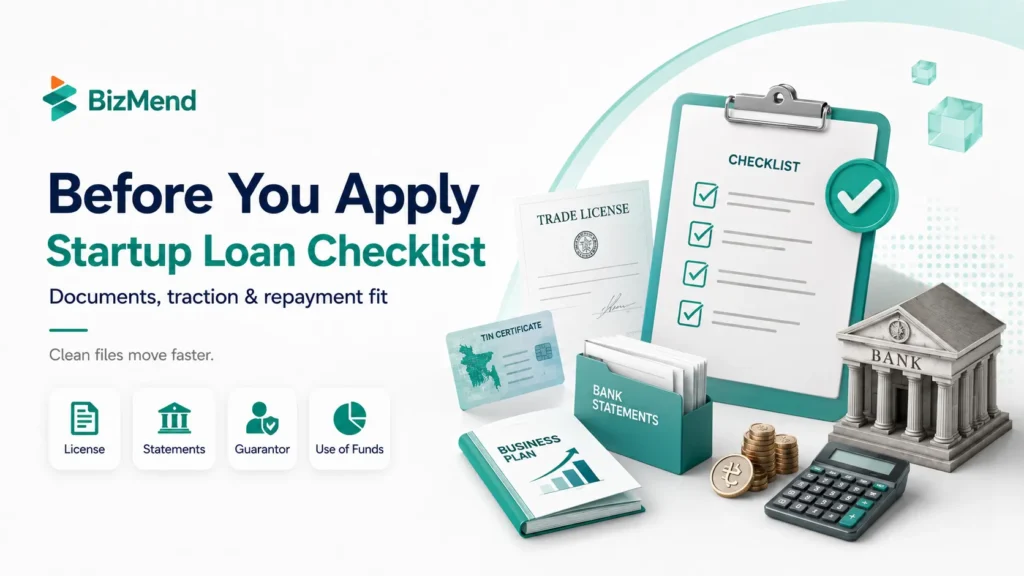
You should expect some combination of registration documents, tax identity, ownership proof, statements, guarantors, and a use of funds explanation. Product pages do not always list every document, but they tell you the direction. EBL points to borrower and guarantor papers. BRAC Startup Builder points to a proven model and revenue flow. City Bank’s women entrepreneur page still requires at least 2 years of business experience.
- Company registration or trade license, depending on your legal structure.
- TIN, NID, and KYC documents for owners and key signatories.
- Business bank statements, even if the product says earlier-stage businesses may apply.
- Proof of address and operating location.
- Quotations or invoices if the loan is for machinery, inventory, or a fit-out.
- Personal guarantees or family-backed support for products that waive mortgage.
- Basic financials that show turnover, margin, and repayment capacity.
If that list feels painfully ordinary, that’s because it is. Most lending decisions are. The founders who move fastest are rarely the ones with the most exciting idea. They are the ones who can hand over a clean file in one sitting.
Which Route Fits Which Founder
| Founder situation | Most realistic first route | Why |
|---|---|---|
| You have an idea but no revenue yet | Startup Bangladesh Limited or grant and equity hunting | Pure debt is usually too early unless you have strong collateral or guarantors |
| You launched recently and need a smaller practical loan | EBL startups or smaller SME products like BRAC Druti | These products are closer to early operating reality than giant policy headlines |
| You already have revenue and a stronger repayment story | BRAC Startup Builder or Prime Startup | You can better match startup policy or traction-based credit review |
| You run a formal small enterprise, not a classic tech startup | New entrepreneurs or CMSE-refinanced linked lending | The structure may fit your business better than a startup label |
| You are a woman founder with an operating business | BRAC TARA or a women’s entrepreneur product from banks like City Bank | Segment-specific products may offer better pricing or unsecured room |
This is where many applications go wrong. Founders often chase the largest number they see online, not the route that matches their current shape. Match your stage first, then your amount, then your lender. That order saves time and protects your credibility with the branch.
Mistakes to Avoid Before You Apply
A weak application does not just get rejected. It can also make the next conversation harder because the lender already thinks your paperwork is messy or your expectations are unrealistic. So before you apply, clean up the basics.
- Do not apply for a startup product when your business is really a standard small trade or service enterprise. You may fit a CMSE route better.
- Do not hide thin revenue. Banks usually discover the gap anyway through statements, site visits, or transaction history.
- Do not ask for Tk 2 crore when your current business activity supports Tk 10 lakh. Oversized requests weaken the whole file.
- Do not confuse equity with debt. Startup Bangladesh may fit some ventures better than a bank loan, but it is a different kind of money.
- Do not wait until cash is already tight. Founders get better terms when the business still looks stable, not desperate.
One last thing: always recheck the latest product terms on the lender or agency site before you submit. Startup policy in Bangladesh is moving, and branch-level execution can lag behind the headline announcement.
Final Thoughts
The best startup loan in Bangladesh is usually the one that matches your current stage, not the one with the biggest headline limit. If you separate policy buzz from real credit filters, the financing picture gets much easier to handle.
Frequently Asked Questions
Can I get a startup loan in Bangladesh with no business history at all?
Sometimes, but it is rare through plain bank debt. A few products, such as EBL Startup, say no minimum business length is required, yet they still ask for guarantees and documents. If you are truly pre-revenue, equity, grants, or founder capital are usually more realistic first steps.
Is there a government startup loan in Bangladesh?
Yes, in the broad sense. Bangladesh Bank has a startup financing policy and a refinance window that works through participating lenders. There are also refinance routes for new entrepreneurs in the CMSE sector. But the government does not usually hand you the money directly at a central desk.
What interest rate applies to Bangladesh Bank startup financing?
Recent reporting on the revised July 9, 2025 policy says the customer-level interest or profit rate is capped at 4 percent. You should still confirm the current branch-level terms and any related fees before signing.
Do I need collateral for a startup loan?
Not always. Some products are explicitly unsecured up to certain limits. EBL Startup says no collateral is required, and BRAC Startup Builder says up to Tk 1 crore can be offered without mortgage. Still, many products replace hard collateral with guarantees, stronger statements, or tighter eligibility.
Should I choose a bank loan or government-backed equity support?
Choose debt when you have predictable repayment capacity and a clear use of funds. Choose equity-style support when your company is still too early, too risky, or too innovation-led for normal installments. The wrong money can strain a young business faster than no money at all.