How to Become a Daraz Seller in Bangladesh: Registration, Fees & Growth
Learn how to become a Daraz seller in Bangladesh, register an account, list products, understand fees, manage orders, and grow…
 by Sheikh Ornob

NRB stock market investment in Bangladesh is allowed, but the process is more structured than opening a normal resident trading account. An overseas Bangladeshi typically needs a CDBL BO account,...
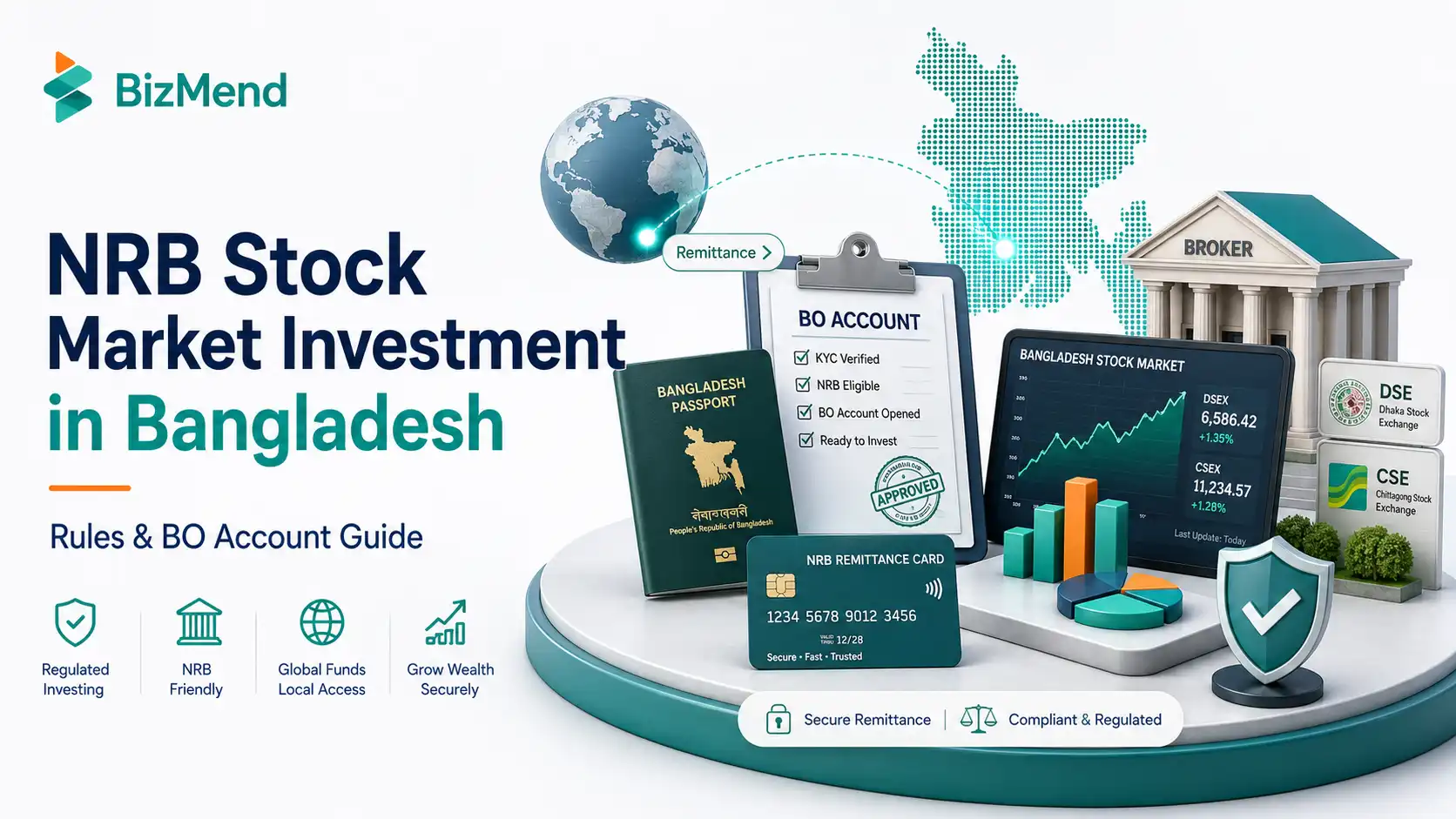
NRB stock market investment in Bangladesh is allowed, but the process is more structured than opening a normal resident trading account. An overseas Bangladeshi typically needs a CDBL BO account, a brokerage or trading account, and a Bangladesh Bank arrangement, often a NITA or another ADB-bank-approved NRB investment route, before sending funds for stock investments.
The practical challenge is connecting those three parts correctly. Passport and NRB proof, identity records, bank details, and broker compliance checks must all match. This guide explains the current BO account process, DSE and CSE access, remittance flow, dividend and tax cautions, common mistakes, and the questions to ask a licensed broker before sending money.
Quick Answer: Yes. NRBs can invest in shares listed on Bangladesh’s stock exchanges through a licensed broker and a CDBL BO account. They should remit funds through official banking channels using the route confirmed by the broker and authorized dealer bank, keep full remittance evidence, complete NRB KYC, and confirm tax and repatriation requirements before trading. 
Yes. A non-resident Bangladeshi can generally buy and sell eligible securities listed on the Dhaka Stock Exchange (DSE) or Chittagong Stock Exchange (CSE), although understanding how the broader Bangladesh stock market works can help investors choose the right exchange and broker. The investment must be handled through regulated market infrastructure rather than through an informal person-to-person arrangement.
Bangladesh Securities and Exchange Commission (BSEC) regulates the capital market, while Central Depository Bangladesh PLC (CDBL) maintains the electronic securities depository. A licensed broker executes trades, while a CDBL participant opens and services the BO account; understanding how to invest in the Bangladesh stock market can also help NRBs connect the broker, BO account, and funding process correctly.
Being an NRB does not guarantee account approval. The broker, bank, and DP must complete identity verification, anti-money-laundering checks, source-of-funds review, and document validation. Requirements may differ slightly between institutions, especially when the applicant does not have an up-to-date Bangladesh NID or wants future repatriation of sale proceeds.
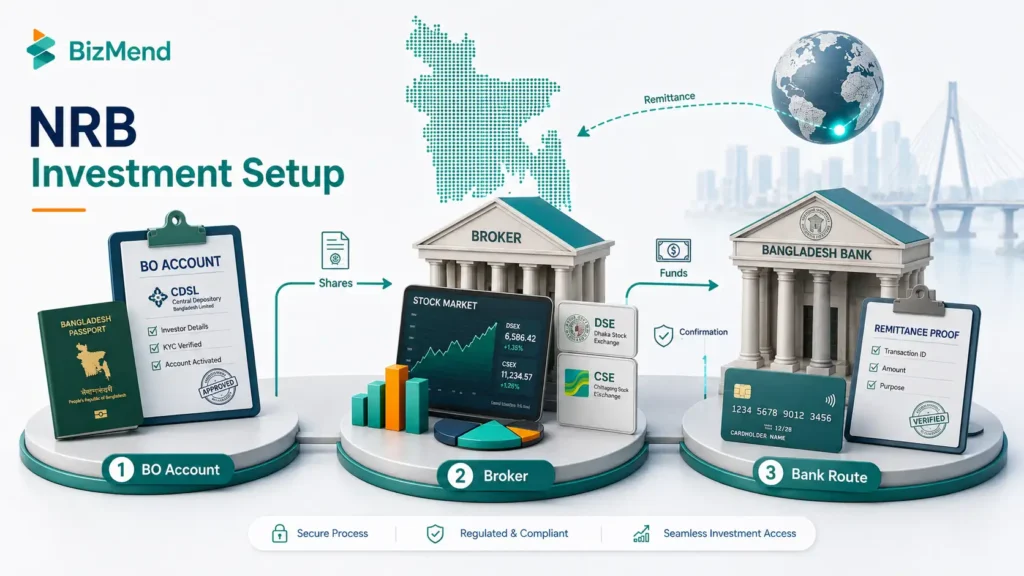
An NRB investment setup usually has three connected accounts or relationships. Confusing them is one of the most common reasons for delays.
| Component | Main purpose | Who provides it |
| BO account | Holds shares and other eligible securities electronically | CDBL through a depository participant |
| Trading or brokerage account | Places buy and sell orders on DSE or CSE | A BSEC-regulated broker or TREC holder |
| Bank account or approved NRB investment arrangement | Receives inward remittances and settles trades, dividends, and withdrawals | A Bangladesh bank, usually through an Authorized Dealer branch when foreign exchange is involved |
A BO account by itself does not place trades. A brokerage account by itself does not hold securities. The bank relationship supplies and receives money, and NRBs who do not already have a suitable local account should first review how to open a bank account in Bangladesh and what verification documents may be required. For NRBs, all three should use the same verified name and consistent identity details.
A BO account is the electronic account in which shares are credited after purchase and debited after sale, so investors should understand how to open a BO account in Bangladesh before submitting their documents. CDBL states that investors may open an account with a CDBL participant, and the standard BO form includes passport details, bank details, nominee or POA options, and DSE/CSE trading-ID fields; NRB-specific requirements should still be confirmed with the selected DP.
CDBL also operates an online BO account-opening system. CDBL’s visible online BO portal asks applicants to keep bank-certificate or cheque-book information for routing and account numbers, a scanned photo and signature, and up-to-date NID information; NRB applicants should confirm passport-proof and additional document requirements with the selected DP before submission.
The online route currently relies on NID data. An NRB whose NID is missing, outdated, or mismatched should not enter false information or use another person’s identity. Ask the selected DP whether an assisted or document-based process is available and what additional verification is required.
The exact checklist varies by broker, DP, bank, country of residence, and account type. Prepare the following before starting:
Some institutions may ask for notarization, embassy attestation, certified copies, video verification, or a local correspondence address. Do not assume one broker’s checklist applies to every broker.
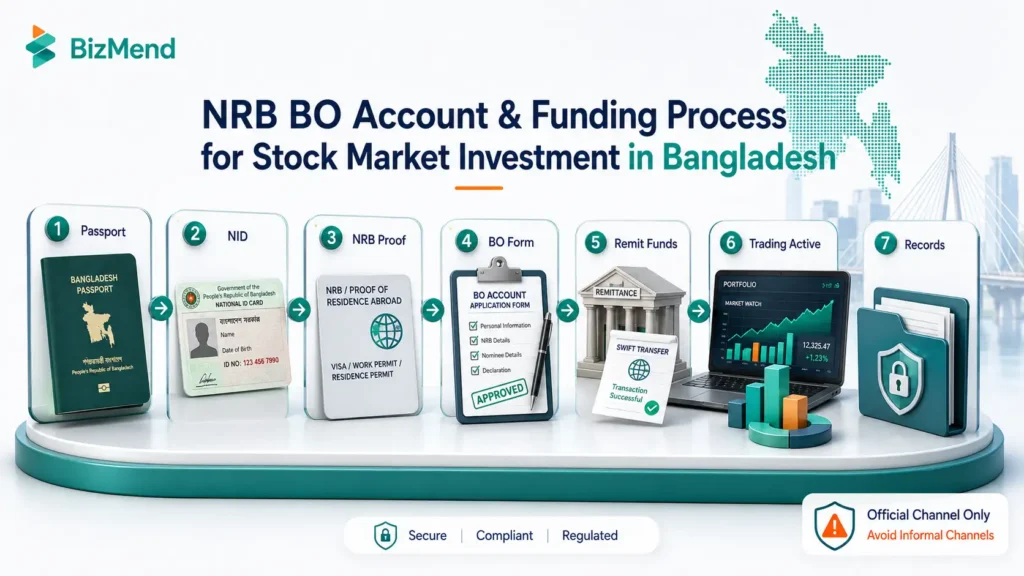
1. Choose a regulated broker and DP. Check and verify the intermediary through the Bangladesh Securities and Exchange Commission before submitting documents, transferring funds, or sharing account credentials. Compare NRB onboarding support, online trading access, settlement arrangements, research quality, and complaint handling, not only commission.
2. Confirm the bank and remittance structure. Ask which Bangladesh bank account or approved NRB investment account should be linked, because the available types of bank accounts in Bangladesh serve different savings, transaction, remittance, and NRB purposes. If you want to remit profits or sale proceeds abroad later, discuss the documentation path with an authorized dealer bank before funding the account.
3. Complete BO and brokerage applications. Submit the BO form, client agreement, KYC, nominee form, where applicable, tax details, and the broker’s trading-account forms. Read the rights, fees, and account-operation clauses before signing.
4. Complete identity and source-of-funds checks. Provide clear, consistent documents. The broker or bank may ask why you are investing, where the money came from, and how you expect to transact.
5. Remit money through an official channel. Send money through a bank or exchange house with an approved drawing arrangement. Use the exact beneficiary and reference information supplied by the bank or broker.
6. Wait for cleared funds and trading activation. Do not place orders until the broker confirms that funds are cleared, the BO account is active, and the trading ID is connected correctly.
7. Use the broker’s approved trading channel. Place orders through the broker’s platform, dealer, or supported online system. Review contract notes, settlement entries, and CDBL notifications after transactions.
CDBL’s online account system can simplify submission, but the DP still performs review and activation. There is no universal guaranteed approval time for every NRB case.
Use official inward-remittance channels. Bangladesh Bank states that Bangladeshi nationals living abroad can send foreign exchange to their own Bangladesh Bank accounts or nominated accounts through foreign banks and exchange houses that maintain drawing arrangements with Bangladeshi banks.
For stock market funding, follow the bank and broker’s exact route. Depending on the structure and repatriation objective, the bank may use a Non-Resident Investor’s Taka Account (NITA) or another approved NRB account arrangement. Do not assume an ordinary resident savings account or an overseas account opened through a non-resident banking process provides the same foreign-exchange record, investment eligibility, or repatriation treatment as a Bangladesh bank arrangement approved for NRB stock investment.
Avoid cash handovers, hundi, third-party wallets, unrelated personal accounts, or informal fund pooling. Weak documentation can create bank, tax, AML, and repatriation problems even when the investment itself is legitimate.
NRBs may access listed securities through brokers or TREC holders connected to DSE, CSE, or both, but investors using the Dhaka Stock Exchange should first understand its indices, trading structure, hours, and execution process. The standard CDBL BO form contains fields for both DSE and CSE trading IDs, showing that one depository relationship can be linked to exchange trading arrangements.
However, a company listed on both exchanges may have different order-book liquidity, bid-ask spreads, and execution conditions at a given time. Your broker’s platform may route or support only certain markets. Confirm exchange access, online-order facilities, settlement cycles, and any separate fees before opening the account.
Do not open multiple accounts merely to chase IPO access or bypass controls. CDBL and brokers require unique and consistent identity, mobile, bank, and account information.
CDBL’s fee schedule includes a 2025 amendment showing an annual BO-account maintenance fee of Tk 150; brokers or DPs may still charge additional opening, service, platform, brokerage, bank-transfer, or document-verification fees. A broker or DP may charge additional opening, service, communication, platform, or administrative fees, and brokerage commission applies to trades.
Ask for a written schedule covering account opening, annual maintenance, brokerage commission, settlement charges, taxes or levies, bank transfer costs, inactive-account rules, and any foreign-document verification fee. Promotional “free BO account” wording may refer only to the opening charge, not the full annual cost.
Account timing depends on document quality, NID matching, bank verification, source-of-funds review, overseas attestation requirements, and DP workload. Treat any timeline as an estimate until the broker confirms activation.
Cash dividends are normally processed through the investor’s recorded bank details after applicable deductions. Bonus shares are credited to the BO account. Keep bank information current, and check CDBL alerts and issuer notices around record dates.
Do not rely on a single fixed online tax rate. Dividend withholding, capital-gains treatment, tax-return obligations, e-TIN status, treaty relief, and documentation can vary by investor status and annual finance legislation; confirm the current treatment with a broker, tax adviser, and AD bank. A missing or incorrect e-TIN may also affect withholding treatment.
Repatriation is a banking and foreign-exchange process, not an automatic feature of the BO account; confirm the approved investment route, inward-remittance evidence, sale proceeds, tax documents, and AD-bank checklist before investing. The Authorized Dealer bank may require original inward-remittance evidence, broker statements, contract notes, tax certificates, dividend statements, and proof that the proceeds came from an approved investment route. Confirm the current checklist before investing, not only when you want to send money abroad.
BSEC’s role is to protect investors and regulate the market, but regulation does not remove investment loss. Use official exchange disclosures, audited financial statements, price-sensitive information, and licensed intermediaries. Never give your password, OTP, or unrestricted account control to an informal portfolio manager.
NRB stock market investment in Bangladesh is practical when the account structure is set up correctly from the beginning. The safest sequence is to verify a licensed broker and CDBL participant, confirm the bank and remittance route, prepare consistent NRB documents, and keep a complete record of every transfer and trade.
The market can provide long-term investment exposure, but it does not provide guaranteed returns. Before sending funds, ask the broker and Authorized Dealer bank to confirm the latest BO, tax, settlement, and repatriation requirements in writing. For portfolio recommendations or complex tax treatment, use appropriately licensed and qualified professionals.
Yes, CDBL provides an online BO account-opening system. Its current instructions require NID information and ask for a scanned passport copy as NRB proof, along with bank evidence, photo, signature, email, and mobile details. The selected DP still reviews and approves the application.
Yes, provided the chosen broker supports the relevant exchange. Confirm whether the broker is connected to DSE, CSE, or both and whether its online platform gives access to both markets.
Bank details are required in the standard BO process, and CDBL’s online instructions ask for a cheque or bank certificate copy. For overseas funding and possible repatriation, confirm the appropriate NRB investment account structure with an Authorized Dealer bank.
That can create source-of-funds, ownership, tax, and repatriation problems. Use the approved route supplied by the bank and broker, with the investor’s identity and remittance record clearly documented.
No automatic guarantee should be assumed. Repatriation depends on the approved banking route, supporting remittance and trade records, tax compliance, and the current foreign-exchange rules applied by the Authorized Dealer bank.
CDBL’s published 2025 amendment states a Tk 150 annual depository-level BO maintenance fee. The DP or broker may add opening, service, platform, brokerage, bank, or document-verification charges, so request the complete current schedule.
Consult a licensed broker before opening or funding the account when documents, exchange access, or settlement are unclear. Use an authorized dealer bank for foreign exchange and repatriation questions and a qualified tax professional for personal tax treatment.

Learn how to become a Daraz seller in Bangladesh, register an account, list products, understand fees, manage orders, and grow…
by Sheikh Ornob

Compare the cost of living in Bangladesh in 2026, including Dhaka and Chittagong rent, food, transport, utilities, inflation, and monthly…
by Sheikh Ornob
Learn MoA and AoA requirements in Bangladesh, key clauses, drafting basics, RJSC filing steps, amendments, and common company-registration mistakes. Suggested…
by Sheikh Ornob