
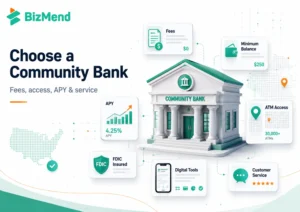
How to Choose a Community Bank in the US: 2026 Guide
To choose a community bank, compare monthly fees, minimum balance rules, interest rates, ATM access, FDIC insurance, digital features, and…

Learn what is a state bank is, how it differs from a national bank, who typically uses one, and whether deposits are FDIC insured.
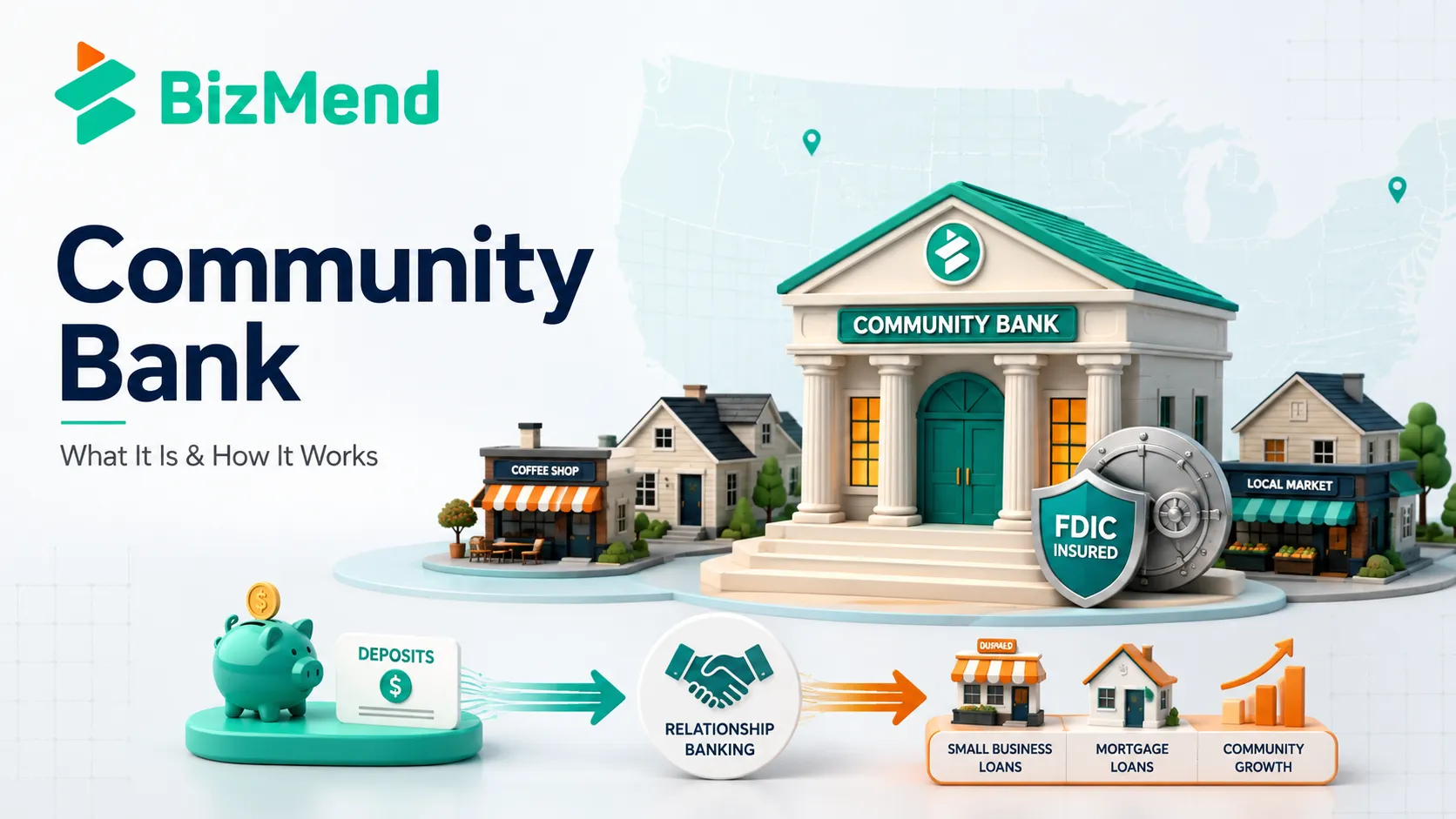
A community bank operates on relationships instead of algorithms, gathering most of its deposits and making most of its loans within the town or region it calls home. Newcomers comparing US banks often assume the term means a small building on Main Street, but regulators define a community bank by its business model, not by a size cutoff alone.
That distinction matters because a community bank can hold a state or national charter, manage billions in assets, and qualify as community-focused under federal criteria. This guide covers what a community bank is, the main types, and how to choose one.
Quick Answer: A community bank is a state or nationally chartered bank that gathers most of its deposits locally and bases lending decisions on relationships rather than automated formulas. Regulators generally treat banks and bank holding companies with less than $10 billion in total assets as community banking organizations for supervision purposes.
The Federal Deposit Insurance Corporation defines a community bank by business model rather than by a single asset line. Its research definition, set out in the 2012 Community Banking Study and reaffirmed in 2020, scores each bank on relationship lending, local deposit gathering, and limited geographic reach instead of relying only on total assets, since size alone excludes some genuinely community-focused banks and includes some that are not.
The Federal Reserve applies a related but separate size test for its own supervisory purposes. Under its community banking program, state member banks, bank holding companies, and savings and loan holding companies with less than $10 billion in total assets fall into the Federal Reserve’s largest supervisory portfolio by number of institutions.
These two definitions overlap in practice but serve different purposes. The FDIC’s research definition explains why a bank counts as community-focused; the Federal Reserve’s asset threshold explains how closely and how often a bank gets examined. Community banks make up roughly 90 percent of all FDIC-insured institutions by count, according to the FDIC’s fourth-quarter 2025 Quarterly Banking Profile, even though they hold a much smaller share of total industry assets than that figure might suggest.
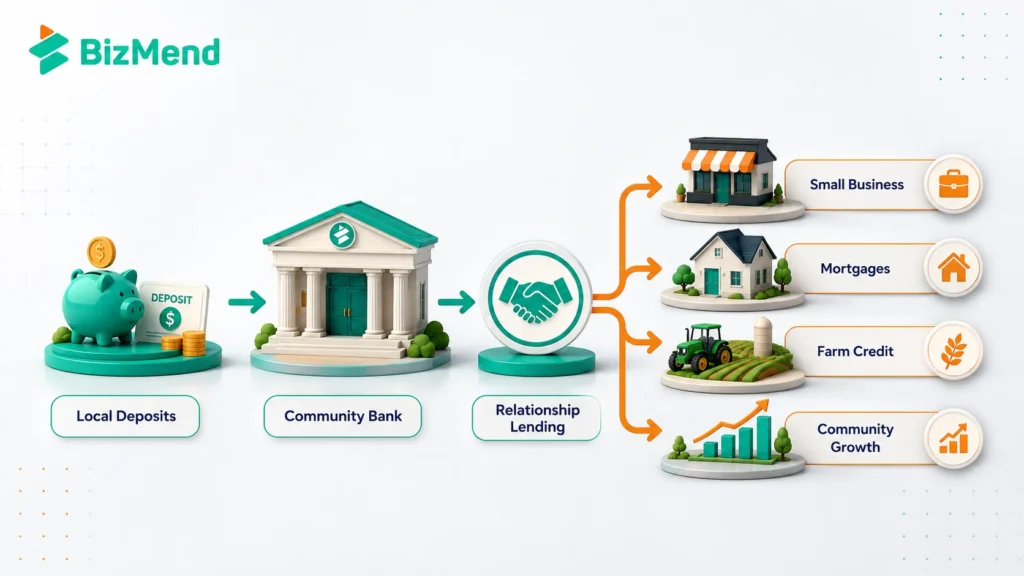
Relationship banking sits at the center of the FDIC’s definition. Community banks tend to gather most of their core deposits from the local area and lend heavily to businesses and households they know directly, often using judgment and long-term history alongside standard underwriting rather than relying on credit-score formulas alone.
The FDIC’s scoring approach excludes certain specialty institutions even when they are small, including credit card banks, industrial loan companies, trust companies, and bankers’ banks, because their business model does not resemble traditional community banking. It also excludes any bank with no loans, no core deposits, or foreign assets making up 10 percent or more of total assets, on the reasoning that these institutions are not primarily engaged in local relationship banking regardless of their size.
Charter type plays no role in this classification. A community bank can hold a national bank charter from the Office of the Comptroller of the Currency, or a state charter supervised by a state banking department plus the Federal Reserve or FDIC. This state bank guide covers those charter options in more depth. What matters for the community bank label is how the bank actually does business, not which regulator issued its charter.
Community banks vary by charter, ownership, and specialty even though they share a local, relationship-driven business model.
State-chartered community banks hold a charter from a state banking department and add either the Federal Reserve or the FDIC as a federal regulator, depending on Federal Reserve membership. Most community banks fall into this category, since state charters historically offered more flexibility and a lower startup cost for smaller institutions entering the market.
Nationally chartered community banks hold a charter from the OCC and can still be small, locally focused institutions despite sharing a federal chartering track with the largest banks in the country. Reviewing national bank requirements alongside a specific community bank’s own account rules helps separate charter-level requirements from bank-specific policy.
Mutual community banks are owned by their depositors rather than by outside shareholders, so profits generally support lower fees or better rates instead of dividends. Stock community banks issue shares like any corporation, though those shares often trade thinly or not at all on major exchanges, and control frequently stays concentrated among founding families or local investors.
Minority depository institutions are community banks where a majority of ownership, or of the board in some structures, belongs to minority individuals, and they frequently focus lending on historically underserved neighborhoods that larger banks have sometimes underserved. Agricultural and rural community banks concentrate on farm and small-town lending and often carry a higher share of agricultural credit on their books than the industry average, reflecting deep ties to a single local economy.
Day to day, a community bank funds itself the same way any bank does: it accepts checking, savings, and CD deposits, then lends that money out through mortgages, small business loans, and consumer credit. The spread between what it pays depositors and what it earns on loans funds its operations, staff, and branch network.
What sets the structure apart is decision-making. Community bank loan officers frequently have real discretion to approve a loan based on local knowledge of a borrower’s business or history, rather than routing every application through a centralized, algorithm-driven process at a distant headquarters. Boards and senior management are often based in the same community the bank serves, which shortens the distance between a customer’s request and an actual decision.
Community banks also tend to hold a larger share of their balance sheet in loans relative to securities and trading assets compared with the largest banks, reflecting their focus on direct relationship lending over capital-markets activity. Many reinvest a significant share of local deposits back into the same community through mortgages, farm credit, and small business lines, which is part of why policymakers and community groups often track community bank lending separately from the broader industry.
Two different sets of requirements apply depending on whether the question is about the bank itself or about a customer opening an account.
For the bank, qualifying for simplified capital treatment under the community bank leverage ratio framework requires less than $10 billion in total consolidated assets, limited off-balance-sheet exposure, limited trading activity, and a leverage ratio above the regulatory minimum. A 2026 final rule from the OCC, Federal Reserve, and FDIC lowered that minimum leverage ratio from 9 percent to 8 percent effective July 1, 2026, and extended the grace period for banks that temporarily fall short from two consecutive quarters to four, making the framework easier for more community banks to use without losing simplified treatment.
For a customer, opening a personal account at a community bank generally requires a government-issued photo ID, a US mailing address, and a Social Security number or Individual Taxpayer Identification Number. Newcomers exploring a non-resident bank account before finishing a visa or company formation process typically face the same basic document checklist that any US bank would require. Comparing that checklist against the general state bank requirements published for state-chartered institutions helps confirm what a specific community bank will likely ask for.
Business accounts add formation documents and, in most cases, an Employer Identification Number before a community bank will open the account, along with any state-specific licensing documents relevant to the business and its industry.
Weighing a community bank against a larger alternative comes down to a short list of practical tradeoffs once FDIC insurance is confirmed on both sides.
Benefits
Drawbacks
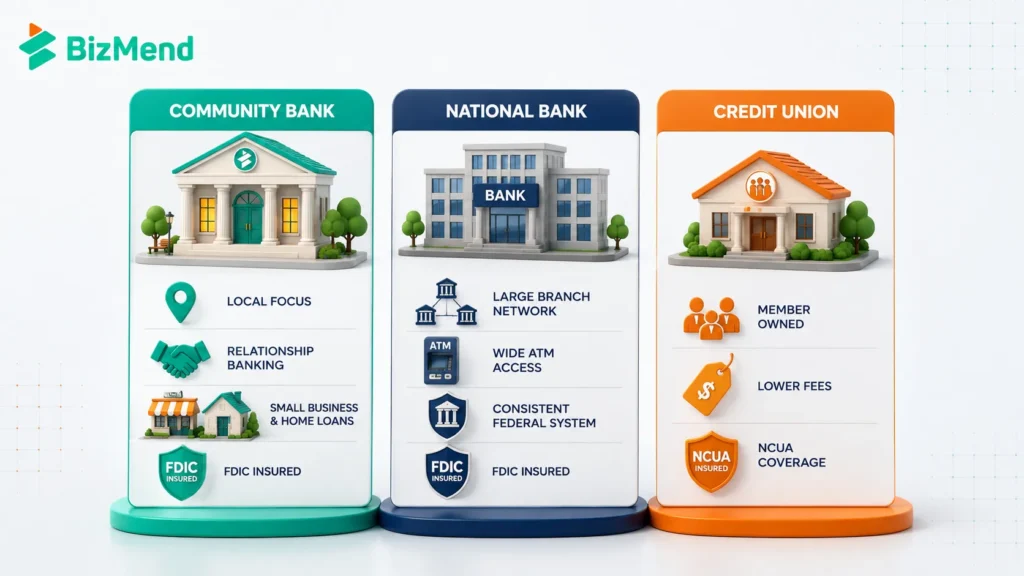
Charter type, size, and business model together separate a community bank from the alternatives a reader is likely to compare it against.
A regional or national bank operates at a larger scale, often across many states, and typically routes credit decisions through centralized underwriting rather than a local loan officer’s judgment. The national bank guide covers how that federal charter track works in more detail.
A credit union differs on ownership rather than charter type or size, since members technically own the institution and profits return as lower fees or better rates instead of shareholder dividends, a structure credit unions share with mutual community banks but not with stock-owned ones.
An online-only bank usually holds a state or national charter too, so it can still meet the FDIC’s community bank criteria in theory, though most online banks fail the local geographic scope test because their deposit base and lending are not concentrated in one physical community.
| Feature | Community Bank | Regional or National Bank | Credit Union |
| Primary basis for classification | Business model: local deposits and relationship lending | Charter and scale, often multi-state | Ownership: member-owned, not-for-profit |
| Typical lending decision | Local loan officer discretion | Centralized underwriting | Local or regional committee |
| FDIC or NCUA coverage | FDIC, up to $250,000 | FDIC, up to $250,000 | NCUA, up to $250,000 |
| Geographic footprint | Concentrated in one region | Often multi-state or national | Concentrated, membership-based |
| Typical strength | Relationship lending, local knowledge | Branch and product breadth | Lower fees, member focus |
Matching the bank to the actual need works better than choosing by branch count or brand recognition alone.
1. Confirm FDIC insurance and charter type. Search the FDIC’s BankFind tool to confirm the bank is currently insured and check whether it holds a state or national charter before applying.
2. Compare local relationship value against digital features. A community bank often wins on personal service and faster small business decisions, so weigh that against how much online and mobile banking actually matters for daily use.
3. Ask about lending philosophy. Request specifics on how the bank underwrites small business or agricultural loans, since relationship-based lending is the main advantage a community bank usually offers over a larger competitor.
4. Compare fees and minimum balances directly. Community bank fee schedules vary widely, so pull the current schedule from the bank rather than assuming it is lower simply because the bank is smaller.
5. Check branch and ATM coverage against where you actually live, work, and travel, since community banks concentrate their footprint in one region rather than nationwide.
Working through the same process used when choosing a state bank applies here too. The steps for choosing a national bank cover similar comparison factors from the federal charter side. Fees, branch access, digital tools, and lending style stay the consistent considerations across every charter type.
A community bank earns that label through relationship lending, local deposit gathering, and limited geographic reach, not through a fixed size cutoff or a special charter. Both state and nationally chartered banks can qualify, and FDIC insurance protects deposits the same way at a community bank as it does at the largest national brand, so safety is rarely the deciding factor in a comparison.
Before opening an account, confirm the specific bank’s current FDIC-insured status and charter type through the FDIC BankFind tool, then compare lending philosophy, fees, and digital features against what daily banking actually requires. Business owners weighing a large loan should also ask directly about single-borrower lending limits and current capital position before committing to a relationship.
A community bank is a state or nationally chartered bank that gathers most of its deposits locally and bases lending decisions on relationships and local knowledge rather than automated underwriting alone. The FDIC identifies community banks using a business-model definition rather than a single asset threshold.
A community bank accepts deposits and makes loans like any bank, funding itself on the spread between deposit costs and loan income. Local loan officers often have real discretion to approve small business and consumer credit based on relationship history rather than routing every decision through a centralized formula.
Yes, in most cases. Non-citizens can generally open an account with a valid passport and an Individual Taxpayer Identification Number in place of a Social Security number, and community banks typically apply the same identity documentation rules as larger banks.
Yes, within FDIC limits. Nearly all community banks carry FDIC deposit insurance covering up to $250,000 per depositor, per bank, per ownership category, identical to the protection at the largest national banks. Confirm any specific bank’s status through the FDIC’s BankFind tool.
The difference is business model and scale rather than legal status alone. A national bank holds a federal OCC charter and often operates across many states with centralized underwriting, while a community bank, which can hold either a state or national charter, focuses on local deposits and relationship-based lending.
No. The FDIC excludes certain small institutions from its community bank definition, including credit card specialists, industrial loan companies, trust companies, and banks with no core deposits or significant foreign assets, even when their total assets are small.
Use the FDIC’s BankFind tool to search by location and confirm current FDIC-insured status and charter type, then compare a shortlist directly on fees, lending philosophy, and branch or digital access before applying, since these details vary even among community banks in the same city.

To choose a community bank, compare monthly fees, minimum balance rules, interest rates, ATM access, FDIC insurance, digital features, and…
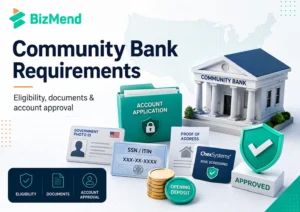
Check the community bank requirements at a glance, follow the exact steps to apply, and see why applications get rejected…
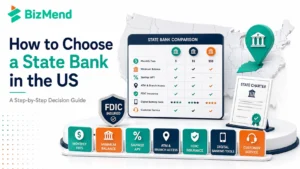
Compare fees, APY, FDIC insurance, and digital tools for how to choose a state bank in the US, plus a…