

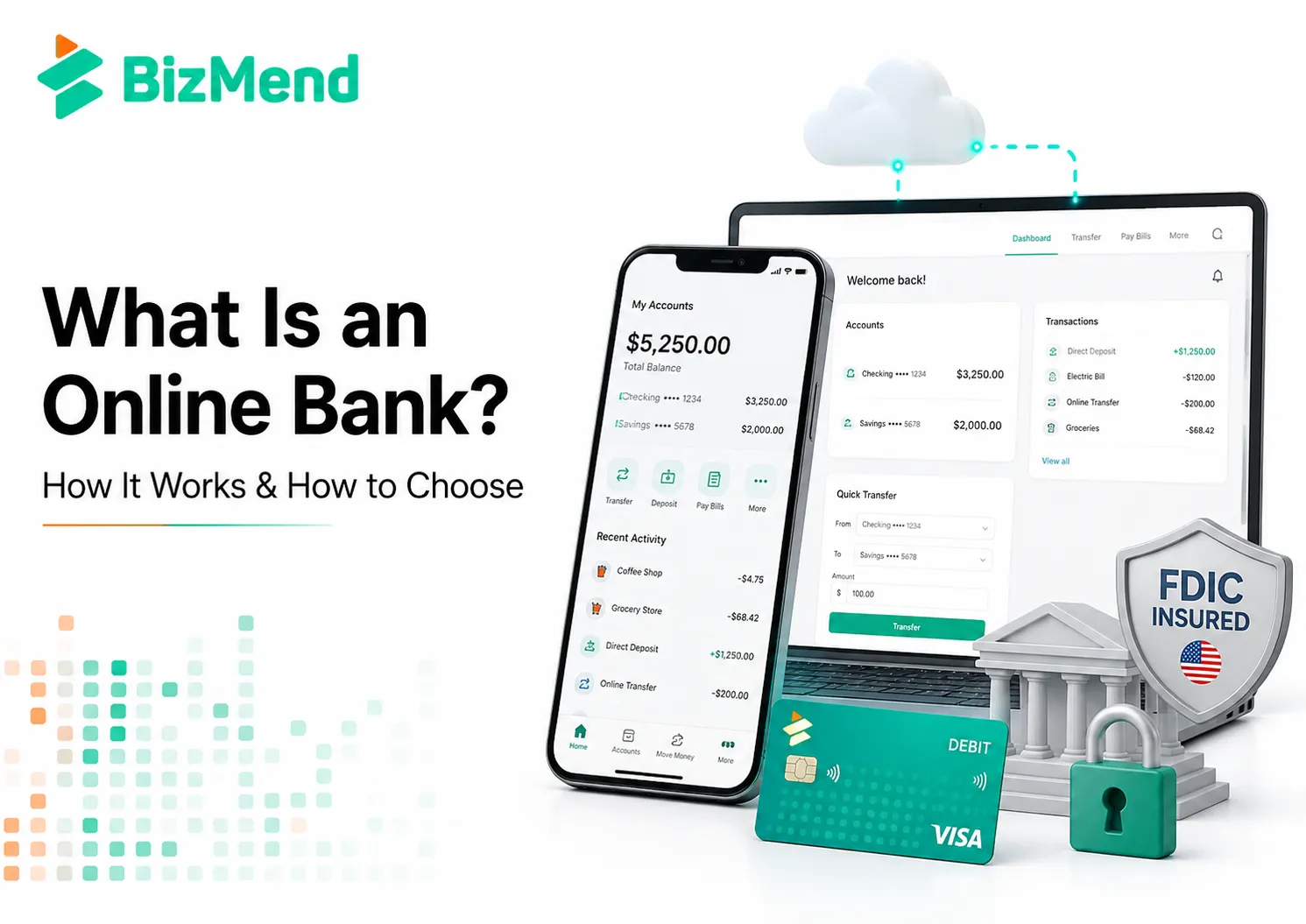
What is online bank? It runs entirely through a website or app instead of a branch lobby, and that single difference reshapes almost everything else about the account, from fees to customer service to how fast a deposit clears. Newcomers to the US banking system often assume every app with a bank-sounding name is the same kind of institution, but the differences underneath the interface matter more.
This guide covers what an online bank is, how it actually works, the main types, requirements, and how to choose one without getting confused by branding alone.
Quick Answer: An online bank is a financial institution that operates primarily or entirely through a website or mobile app instead of physical branches, while still holding a state or national bank charter and FDIC deposit insurance. It offers most of the same core services as a traditional bank, often with lower fees and stronger digital tools.
What Is Online Bank?
An online bank is a financial institution that operates primarily or entirely through a website or mobile app instead of physical branches, while still holding a state or national bank charter and FDIC deposit insurance, according to the FDIC’s own consumer guidance on internet-based banks.
In practice, an online bank works the same way a branch-based bank does behind the scenes: it accepts deposits, pays interest, issues debit cards, and makes loans, all while examiners from the same federal and state regulators supervise it. The visible difference is the delivery channel. Instead of visiting a teller, a customer opens an account, deposits checks, pays bills, and contacts support entirely through digital channels, sometimes backed by phone support and rarely by any physical location at all.
Newcomers, remote workers, and anyone comfortable managing money without a branch tend to gravitate toward online banks, often chasing lower fees and stronger interest rates that lower overhead can make possible. Rate-sensitive savers and people who travel often also favor an online bank, since a strong app usually beats a branch for round-the-clock account access no matter where the customer happens to be.
The term gets confused most often with a neobank or fintech app, which may look identical on a phone screen but does not always hold its own bank charter, a distinction covered in more depth below. Traditional banks with strong mobile apps add a third layer of confusion, since a full-service branch bank can offer digital tools just as polished as a true online-only competitor, which is why the underlying charter and branch footprint matter more than the app’s appearance alone.
How an Online Bank Works
An online bank funds itself the same way any bank does, paying interest or offering low fees on deposits and then lending that money out or investing it, with the spread covering operations and profit. Without branch rent, teller staff, and vault security to fund, an online bank can often afford to pass some of those savings back to customers as higher savings rates or fewer monthly fees.
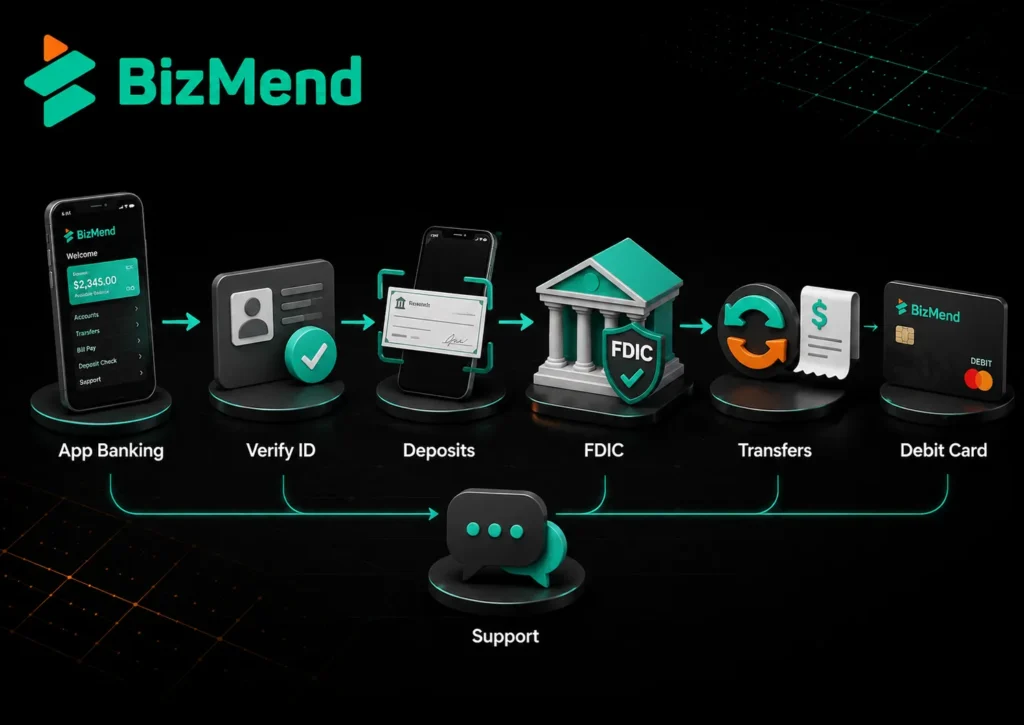
Account opening, identity verification, deposits, and customer service all happen through a mobile app or website, generally using the same document requirements a branch-based bank would ask for. Mobile check deposit replaces handing a check to a teller, electronic transfers replace mailing a check, and a support chat or phone line replaces a face-to-face conversation with a bank employee. Most online banks also participate in a large surcharge-free ATM network to make up for not having branch ATMs of their own.
The regulatory backbone matters most here. A bank offering accounts online must still hold a state or national charter and FDIC insurance just like any brick-and-mortar institution, and the FDIC confirms deposit insurance protects online-only bank customers exactly the same way it protects branch customers, provided the money sits in an account at the FDIC-insured bank itself rather than with a middleman that merely promises to deposit it there eventually.
That middleman distinction is where online banking gets genuinely more complicated than a branch visit. Many popular banking apps are not banks at all; they are financial technology companies that partner with a separate, FDIC-insured bank behind the scenes and route customer deposits into that bank’s accounts. Coverage in that arrangement depends on how the funds are recorded, not just on which brand name is on the app.
Interest calculation, statement delivery, and dispute handling all work through the same underlying systems a branch bank uses, just presented through a cleaner interface. When something goes wrong, such as a delayed deposit or a suspicious charge, the process typically starts with an in-app chat or a phone call rather than a branch visit, and the timeline for resolution follows the same federal consumer protection rules that apply to any bank regardless of channel.
Types of Online Banks in the US
Online banks fall into a few structurally different categories, and knowing which one a specific app belongs to affects both the product lineup and the deposit-insurance picture.
Self-chartered online banks hold their own state or national bank charter directly, which means the FDIC insures deposits at that institution the same way it would at any community or national bank. These banks answer to the same examiners, capital rules, and consumer protection laws as any other chartered bank, online-only or not.
Online divisions of traditional banks let an existing brick-and-mortar bank offer a separate, often fee-light online brand alongside its regular branch network. The charter, regulator, and FDIC coverage are identical to the parent bank; only the product packaging and pricing differ.
Fintech apps partnered with a sponsor bank, often called neobanks or challenger banks, make up a large share of what people casually call online banks. These companies are not banks themselves and hold no charter; instead, they build the app and customer experience while an FDIC-insured partner bank actually holds the deposits behind the scenes. FDIC insurance can still apply through pass-through coverage, but only when the fintech’s recordkeeping accurately tracks each customer’s share of the pooled account, which is exactly the gap federal regulators moved to address after a major banking-technology middleware provider collapsed in 2024 and temporarily locked customers out of their own funds.
Industrial loan company charters offer a fourth route, mostly used by financial technology and commercial companies that want direct FDIC-insured deposit-taking authority without becoming a full bank holding company. These state-chartered, FDIC-insured institutions can issue accounts and loans much like a self-chartered online bank, subject to their own state regulator plus the FDIC. Utah has historically issued the largest share of these charters, and interest in the structure has grown again recently as more companies outside traditional finance pursue direct deposit-taking authority rather than relying on a partner bank.
Comparing these categories against the community bank classification helps clarify the difference. The regional bank classification works the same way: both describe a business model or asset size, not a delivery channel, so “online” describes something genuinely different from either one. What matters for online banking specifically is whether the entity you are trusting with a deposit holds its own charter, not a size tier or a marketing label.
Requirements and Eligibility for an Online Bank
Opening an account at an online bank generally asks for the same core documents any US bank requires, just collected through a screen instead of a counter.
A government-issued photo ID, such as a driver’s license, state ID, or passport, confirms identity, often verified through a photo upload and a live selfie check rather than an in-person look. A Social Security number or Individual Taxpayer Identification Number satisfies the federal customer identification rule every bank must follow; newcomers researching a non-resident bank account will find online banks apply the same taxpayer-number rule as any branch-based bank. A US mailing address is required even for an online-only relationship, since the bank still needs a verifiable address for statements, cards, and legal notices, and a small number of online banks decline applicants with certain visa statuses or without a US address entirely.
Most online banks also review a ChexSystems report, the same specialty consumer file a branch-based bank checks, so past banking problems can affect an online application exactly as they would at a physical branch. Age requirements mirror the rest of the industry too: an applicant generally needs to be 18, or have a joint adult owner if younger, since a deposit account is a contract that a minor cannot enter into alone. The general state bank requirements checklist covers the equivalent document list for a branch-based charter, useful for comparing what actually changes between an online-only relationship and a traditional one.
Minimum opening deposits at online banks are often lower than the industry average, and several waive the requirement entirely, since a lower-overhead operation does not need the deposit to offset branch costs the way a traditional bank sometimes does. Confirming the current figure directly with the specific bank is still worthwhile, since policies vary and change.
Benefits and Drawbacks of an Online Bank
Weighing an online bank against a branch-based alternative comes down to a short list of tradeoffs once FDIC insurance is confirmed on both sides.
Benefits
- Lower overhead often translates into fewer monthly fees and more competitive savings rates.
- Mobile-first design tends to produce a smoother app experience than a legacy branch-based bank.
- Nationwide surcharge-free ATM networks often substitute for a lack of branch ATMs.
- Account opening and everyday service happen entirely on your schedule, without branch hours.
- FDIC insurance applies identically to online banks and the largest brick-and-mortar brands, up to the standard $250,000 limit.
- Fewer legacy systems sometimes mean faster rollout of new features like early direct deposit.
Drawbacks
- No branch access removes the option of in-person help for a complex problem or a large cash deposit.
- Some online banks limit cash deposit options to third-party retail networks that can charge a fee.
- Confusing a fintech app for a chartered bank can create real uncertainty about deposit protection.
- Customer service depends entirely on phone, chat, or email, which can feel slower during a dispute.
- Product range is sometimes narrower than a full-service branch-based bank offers.
- Building a personal relationship with a loan officer is harder without a consistent local point of contact.
Online Bank vs. Other Bank Types
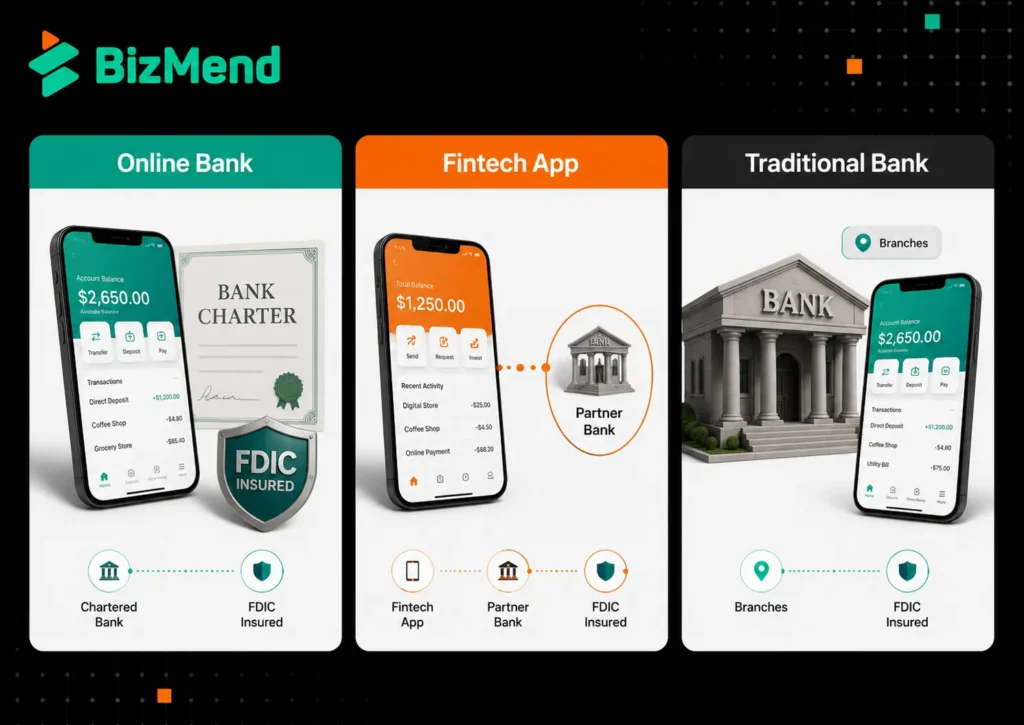
Delivery channel, charter status, and corporate structure together separate an online bank from the alternatives a reader is likely to compare it against. Understanding all three matters more here than with most other bank comparisons, since two apps that look nearly identical on a phone screen can sit on completely different regulatory foundations.
A state bank or national bank can also offer a full online banking experience while still operating branches, so “online” alone does not tell you whether a bank has a physical footprint; the distinguishing factor for a true online bank is that it operates with few or no branches by design. A neobank or fintech app often looks identical to a self-chartered online bank on a phone screen, but the underlying charter and deposit-insurance path differ in ways that matter if the arrangement ever runs into trouble, particularly if the fintech itself, rather than its banking partner, experiences financial difficulty.
| Feature | Self-Chartered Online Bank | Fintech or Neobank App | Traditional Bank with Online Access |
| Holds its own bank charter | Yes | Usually no | Yes |
| FDIC insurance path | Direct | Pass-through via partner bank | Direct |
| Branch access | Rare to none | None | Available |
| Typical fee level | Low | Low | Varies, often higher |
| Product range | Moderate to full | Often narrow | Often broad |
Reviewing the national bank selection process alongside this comparison is useful for a reader who ultimately decides a hybrid, branch-plus-app relationship fits better than an online-only one.
How to Choose the Right Online Bank
Matching the account to actual habits works better than choosing by app-store rating or advertised rate alone.
1. Confirm the underlying charter and FDIC status. Search the FDIC’s BankFind tool for the actual bank behind the app, not just the brand name, since a fintech interface often hides a separate chartered bank underneath and the app store listing rarely spells this out clearly.
2. Compare fees and rates against your real balance pattern. A headline rate or a fee-free pitch means little if it only applies above a balance you rarely carry, so pull the fine print before assuming the advertised number applies to you.
3. Check ATM and cash deposit access. Confirm the surcharge-free network actually reaches where you live and work, and find out how the bank handles cash deposits if you ever need one, since some online banks route cash deposits through a retail partner that charges its own fee.
4. Test customer support before you need it. Contact support with a simple question before funding the account, and judge the response time and clarity rather than assuming a chat bubble means real help is available whenever you actually need it.
5. Read the deposit-insurance disclosure carefully. Confirm in writing which FDIC-insured bank actually holds your money and under what account structure, especially for a fintech app rather than a self-chartered bank, since this single detail matters more than any other factor if something goes wrong later.
Working through the same comparison factors used when choosing a national bank applies here too, since fees, ATM access, and service quality matter regardless of whether the bank operates from a branch or a browser tab.
Key Insights
- An online bank still needs a state or national charter and FDIC insurance to be a real bank.
- Many popular banking apps are fintechs partnering with a separate chartered bank, not banks themselves.
- FDIC insurance covers online banks identically to branch banks, up to $250,000 per depositor.
- Confirm the actual FDIC-insured bank behind any app before trusting it with a paycheck.
- Lower overhead often means better rates and fewer fees than a traditional branch-based bank.
- No branch access is the main tradeoff, especially for cash deposits or complex in-person help.
Final Thoughts
An online bank is defined by its delivery channel, not by a special charter or a lack of regulation. The safest online banks hold their own state or national charter and carry FDIC insurance exactly like any branch-based bank, while many popular banking apps are technology companies that route deposits to a partner bank behind the scenes rather than holding a charter themselves.
Before trusting any online bank with a paycheck, confirm the FDIC-insured institution behind the app through the FDIC’s BankFind tool, read the deposit-insurance disclosure closely, and compare fees, rates, and ATM access against how you bank day to day and week to week. A lower fee only matters if the underlying protection is real and clearly documented.
Frequently Asked Questions
What is an online bank?
An online bank is a financial institution that operates primarily or entirely through a website or app instead of physical branches, while still holding a state or national bank charter and FDIC deposit insurance like any other bank.
How does an online bank work?
An online bank accepts deposits and makes loans like any bank, funding itself on the spread between what it pays depositors and what it earns on loans. Lower overhead from not running branches often lets it offer better rates and fewer fees than a traditional bank.
What does online bank meaning actually cover, versus a neobank?
An online bank in the strict sense holds its own bank charter and FDIC insurance directly. A neobank, sometimes marketed the same way, is usually a technology company that partners with a separate chartered bank to hold deposits rather than being a bank itself.
Can I open an online bank account as a non-citizen?
Yes, in most cases. Non-citizens can generally open an account with a valid passport and an Individual Taxpayer Identification Number in place of a Social Security number, since online banks apply the same federal identification rules as any other US bank.
Is an online bank FDIC insured and safe?
A self-chartered online bank carries FDIC insurance directly, identical to a branch-based bank. A fintech app without its own charter can still offer FDIC protection through a partner bank, but only if the pass-through recordkeeping is accurate, so confirming which bank actually holds the money matters.
Who needs an online bank?
Anyone comfortable managing money without a branch, including remote workers, frequent travelers, and rate-sensitive savers, tends to benefit most, while someone who regularly deposits cash or wants in-person help for complex banking needs may prefer a branch-based alternative instead.
How do I verify which bank actually holds my online bank deposits?
Check the account agreement or the app’s own disclosures for the FDIC-insured bank’s name, then confirm that bank’s current status through the FDIC’s BankFind tool rather than assuming the app’s brand name is the insured institution itself. This single check protects against a surprisingly common source of confusion.
