
 by Sheikh Ornob
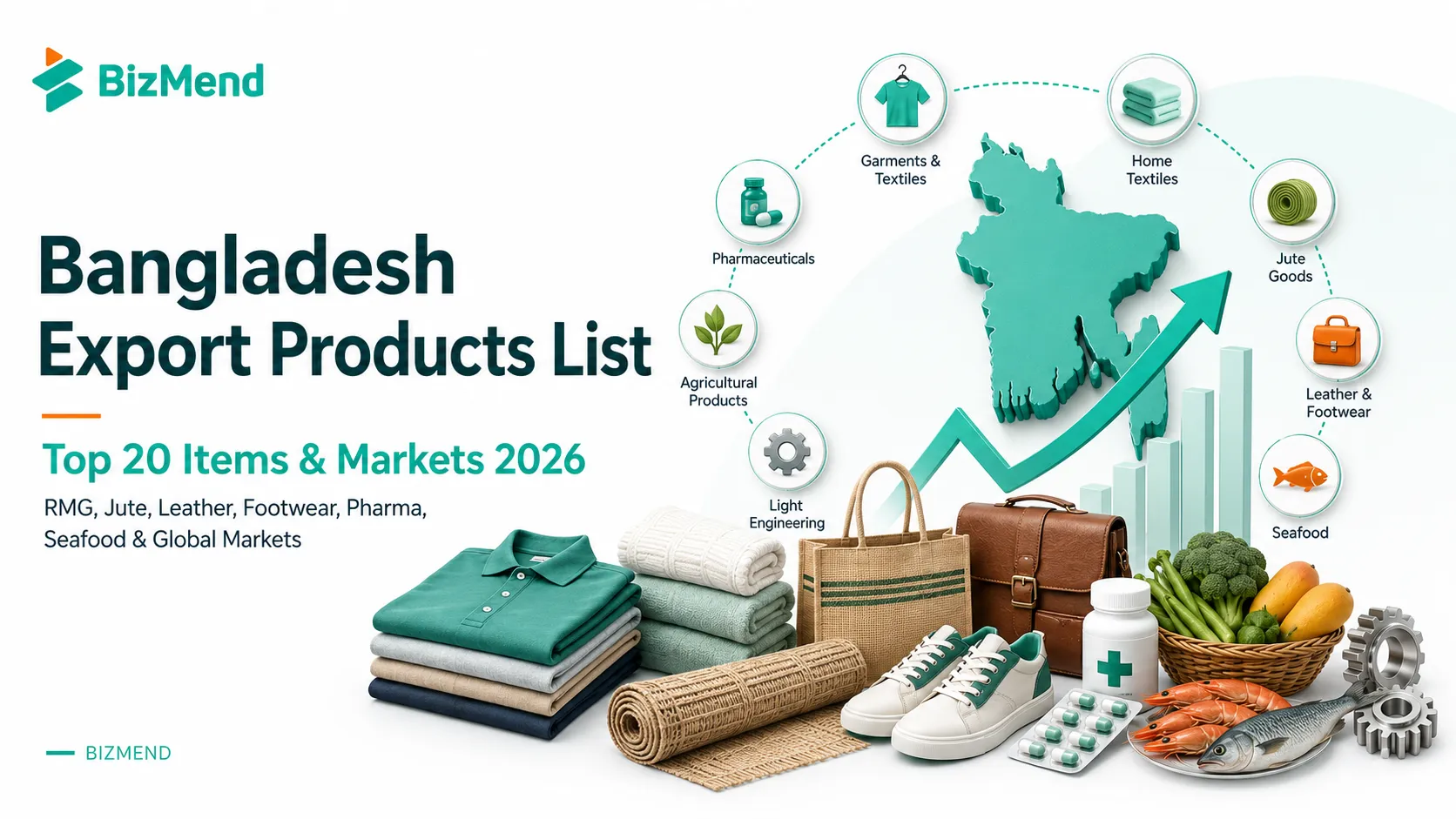
Bangladesh shipped $48.28 billion worth of goods in fiscal year 2024-25. That’s a record. And it didn’t happen on garments alone. The Bangladesh export products list is wider than most people realize. Yes, ready-made garments dominate. But pharmaceutical products now go to 150 countries. Non-leather footwear grew 34% in a single year. And agricultural exports were around $1 billion.
Here’s the full picture. All 20 major export items, real numbers from the Export Promotion Bureau (EPB), and the destination markets driving those numbers.
Quick Answer: Bangladesh’s top export products include knitwear ($21.16B), woven garments ($18.19B), home textiles ($871.57M), jute and jute goods ($820M), leather and leather goods (~$1.14B), non-leather footwear ($414M, Jul–Mar), frozen seafood, agricultural products (around $1B), light engineering ($535.56M), and pharmaceuticals ($213M). In FY2024-25, total exports reached $48.28 billion, with the USA, EU countries, Germany, and the UK as primary destination markets.
Bangladesh’s Export Basket: Why It’s Bigger Than You Think
Most people hear “Bangladesh exports” and think garments. And they’re not wrong. RMG accounts for over 81% of total export earnings. But the other 19% is roughly $9 billion worth of goods, and several of those sectors are growing fast.
FY2024-25 was a strong year overall. Total exports hit $48.28 billion, up 8.58% from $44.47 billion in FY2023-24, according to EPB data released on July 2, 2025. Bangladesh retained its position as the world’s second-largest apparel exporter after China, confirmed by BGMEA.
If you’re setting up an export business, the complete guide to starting an export business in Bangladesh covers the ERC, OLM portal, and full setup process.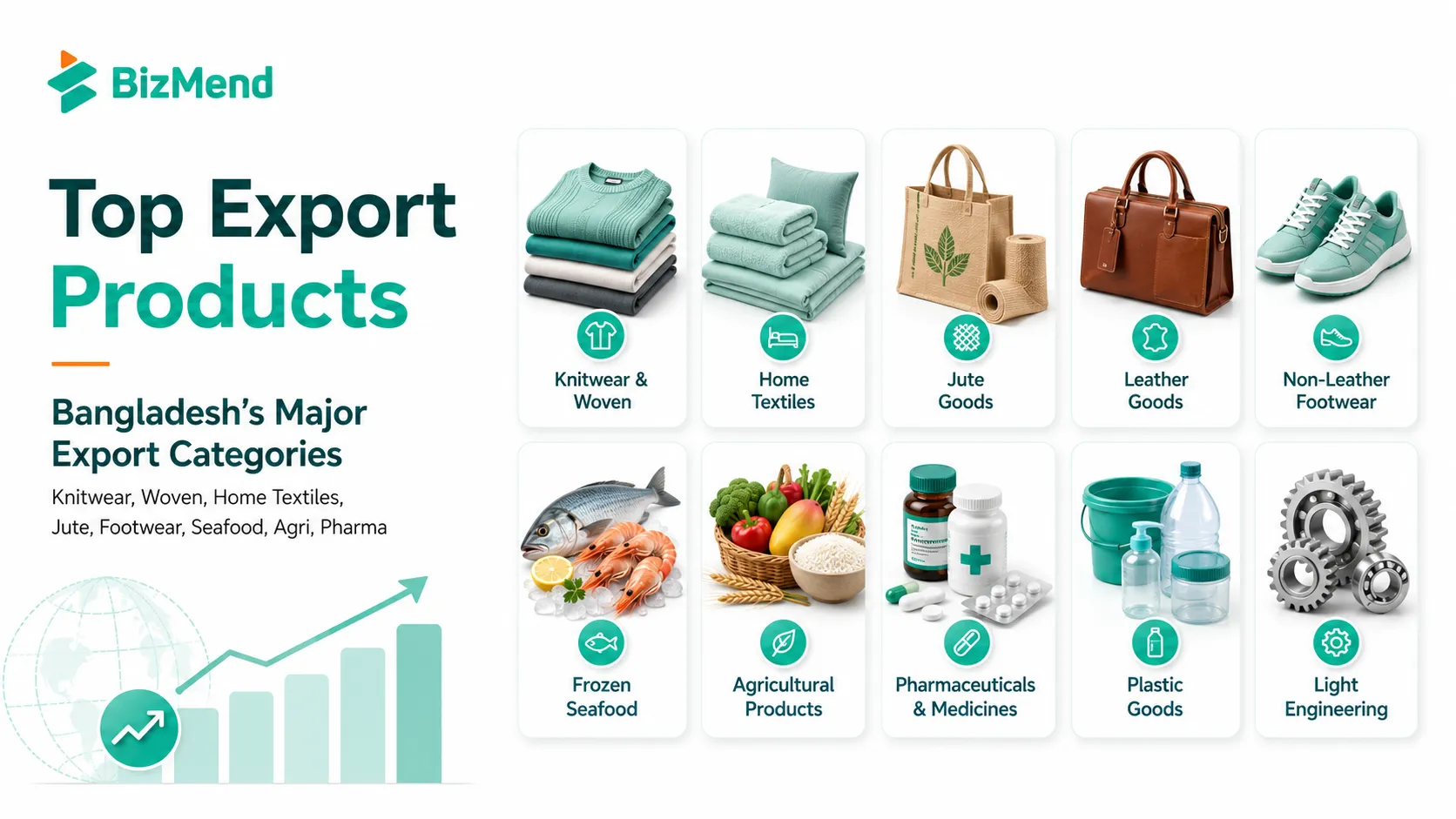
The Bangladesh Export Products List: Top 20 Items
1. Knitwear
FY2024-25 export value: $21.16 billion
Knitwear is Bangladesh’s single largest export category. This includes t-shirts, polo shirts, sweaters, jerseys, cardigans, and knitted underwear. Bangladesh is the world’s largest exporter of men’s shirts, and knitwear makes up more than half of total RMG earnings. The EU, USA, and UK are the primary buyers. RMG sector growth in FY2024-25: 8.84%.
2. Woven Garments
FY2024-25 export value: $18.19 billion
Woven garments cover trousers, formal shirts, jackets, blouses, coats, and similar cut-and-sew products. Germany, Spain, France, and the USA are major buyers of Bangladeshi woven garments. Both knitwear and woven together make RMG a $39.35 billion sector.
3. Home Textiles
FY2024-25 export value: $871.57 million
Bed sheets, pillowcases, duvet covers, towels, and curtains. Home textiles have a quieter profile but consistent demand. The USA is the biggest buyer of Bangladeshi home textiles, importing $149.49 million in FY2024-25. Exports grew 7.85% in the first half of FY2024-25.
4. Jute and Jute Products
FY2024-25 export value: $820.16 million
Jute is Bangladesh’s oldest export earner, though the sector declined 4.10% in FY2024-25. This category includes raw jute, hessian cloth, sacking bags, jute yarn and twine, and diversified jute products like geo-textiles and jute bags. Bangladesh is the world’s largest exporter of jute yarn and textile fiber. India, China, Europe, and the Middle East are key buyers. The diversified jute products segment attracts a 10% government cash incentive under current Bangladesh Bank FE Circular guidelines.
5. Finished Leather and Leather Goods
FY2024-25 export value: about $1.14 billion
Finished leather, handbags, wallets, belts, and other leather goods make up Bangladesh’s second-largest non-garment export category. The Tannery Park at Savar in Dhaka houses the main manufacturing base. Italy, Germany, and Japan are strong buyers. Leather and leather goods receive a 10% cash incentive under the active Bangladesh Bank FE circular.
6. Non-Leather Footwear
FY2024-25 export value: approximately $414 million (Jul–Mar), 34.15% growth
This is one of the fastest-growing items on the Bangladesh export products list. Non-leather footwear (canvas shoes, sports shoes, sandals, synthetic footwear) grew 34.15% in July–March FY2024-25. The EU is the main destination. This sector is increasingly competitive against Vietnamese and Chinese alternatives.
7. Frozen Shrimp and Seafood
FY2024-25 export value: approximately $316 million (Jul–Feb), 14.45% growth
Frozen shrimp, hilsa fish, dried fish, and other seafood products are traditional exports with growing demand. The EU, USA, Japan, and Southeast Asia are major buyers. Frozen shrimp gets tiered cash incentives (8% for shrimp with up to 20% ice content, decreasing as ice percentage rises). Bangladesh’s Department of Fisheries (DoF) issues health certificates required by EU and US importers.
8. Agricultural Products and Processed Food
FY2024-25 export value: around $1 billion
Vegetables, potatoes, mangoes, spices, paan (betel leaf), processed foods, and frozen vegetables. Agricultural exports were around $1 billion in FY2024-25, driven partly by diaspora demand in the UK, Middle East, and Southeast Asia. Processed agricultural products and potatoes each receive a 10% cash incentive. A phytosanitary certificate from the Plant Protection Wing of the Department of Agricultural Extension is required for all plant-based exports.
9. Light Engineering Products
FY2024-25 export value: $535.56 million
Auto parts, hand tools, bicycle parts, small machinery components, and metal products. India, the EU, and the Middle East are buyers. Light engineering qualifies for a 10% export cash incentive. This sector has high backward linkage potential since many inputs can be sourced locally.
10. Pharmaceutical Products
FY2024-25 export value: $213 million, exported to 150+ countries
Bangladesh’s pharma industry produces 97% of its domestic drug needs and exports generics to over 150 countries including the USA, UK, EU, Canada, and Australia. In FY2024-25, pharmaceutical exports reached $213 million, up 4% from $205 million in FY2023-24 (The Business Standard, October 2025). As an LDC, Bangladesh benefits from TRIPS pharmaceutical flexibilities available to LDCs until 2033, but Bangladesh’s LDC graduation may affect how long local pharma exporters can rely on that waiver.
For exporters needing to understand documentation and compliance requirements, the complete guide to export documents in Bangladesh covers sector-specific certificates including health certificates and quality certification requirements.
11. Specialized Textiles
FY2024-25 export value: $382 million, 13.37% growth
Terry towels, technical textiles, and specialty fabrics. This category grew 13.37% in FY2024-25. Japan and Germany are significant buyers of Bangladeshi terry towels.
12. Plastic Goods
FY2024-25 export value: $284 million, 16.21% growth
Plastic household products, packaging materials, industrial plastic components. Exports grew 16.21% in FY2024-25 and more than doubled over the past decade. According to the Bangladesh Plastic Goods Manufacturers and Exporters Association (BPGMEA), if deemed exports (plastic accessories in RMG shipments) are included, the actual figure is far higher.
13. Ceramics
Bangladesh produces tiles, tableware, sanitary ware, and crockery for export. According to the Bangladesh Ceramic Manufacturers and Exporters Association (BCMEA), the industry is expanding both in capacity and market reach. Ceramics receive a 6% export cash incentive under current Bangladesh Bank guidelines.
14. Bicycles
Germany, the Netherlands, and France are the primary buyers of Bangladeshi bicycles. In FY2024-25, bicycle exports to Germany alone reached $37.34 million. The sector receives a 3% export incentive.
15. Furniture
Wooden furniture, readymade furniture, and office furniture. The furniture sector receives an 8% export cash incentive, one of the higher rates for non-traditional sectors. Growing demand exists in the Middle East, USA, and EU.
16. IT Software and IT-Enabled Services (ITES)
Bangladesh’s IT export sector earns a 6% cash incentive and 2.50% for individual freelancers. The sector exports software development, BPO, data processing, and digital services globally. BASIS (Bangladesh Association of Software and Information Services) facilitates the cash incentive certification process for IT exporters.
17. Shipbuilding
Bangladesh builds and exports ocean-going vessels, river vessels, and specialty boats to European and global buyers. Ship exports receive a 6% cash incentive. Bangladesh’s competitive labor cost and growing technical capacity make this a viable long-term export industry.
18. Headgear and Caps
FY2024-25 USA export value alone: $258.74 million
Baseball caps, beanies, sun hats, and other headgear. The USA is the dominant buyer, importing $258.74 million worth from Bangladesh in FY2024-25. This is technically part of the textile accessories export category but significant enough in value to stand alone.
19. Handicrafts
Bamboo goods, coir products, rattan furniture, silk products, handloom textiles, and clay pottery. Handicrafts export mainly through fair trade channels to Europe, North America, and Japan. Organizations like Aarong have helped build international brand recognition for Bangladeshi crafts.
20. Frozen Vegetables
Frozen okra, bitter gourd, drumsticks, and other vegetables for the diaspora market in the UK, Middle East, and Southeast Asia. This has a distinct supply chain and buyer profile driven by the Bangladeshi and South Asian diaspora community abroad.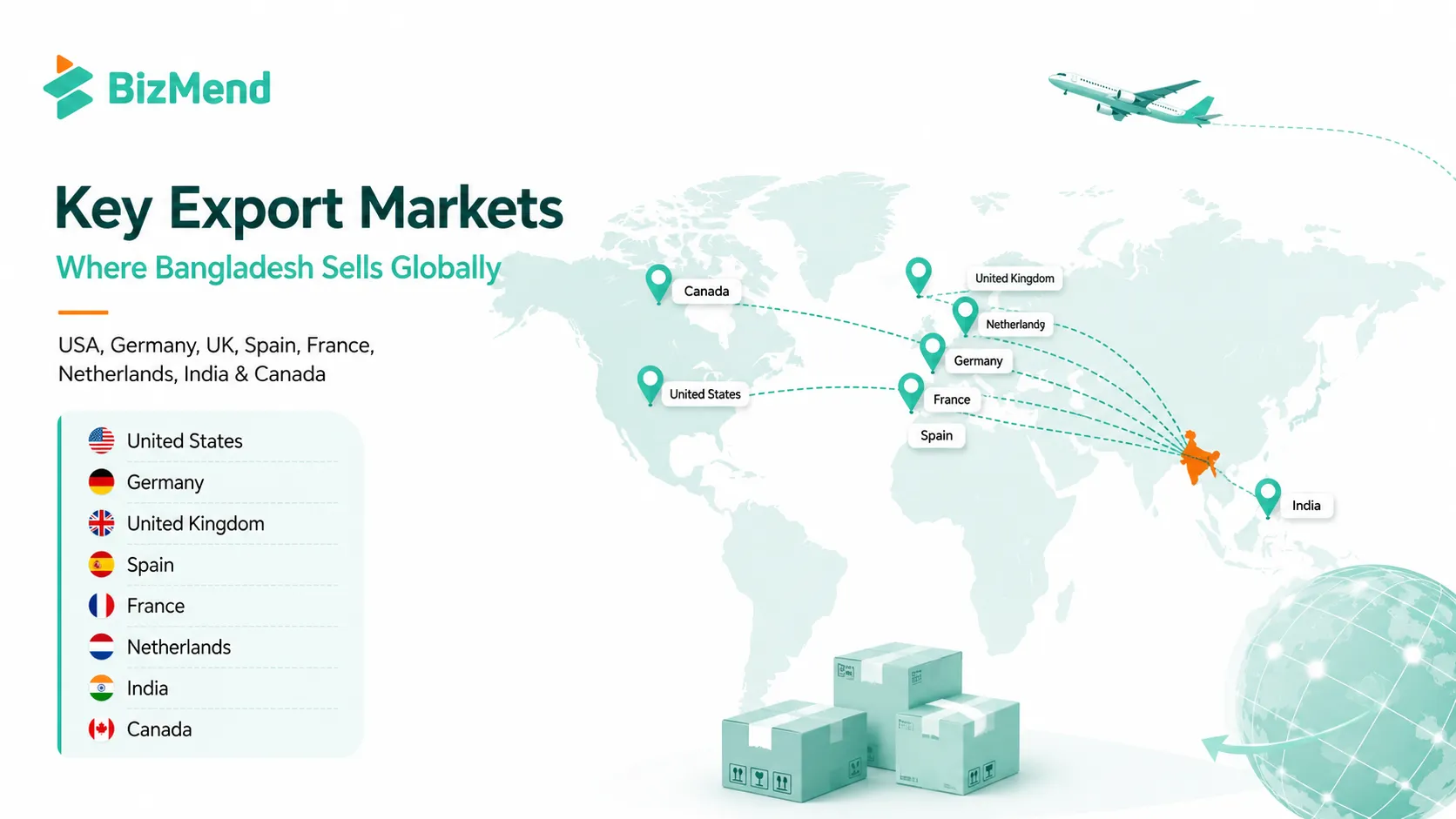
Where Bangladesh Sells: Key Destination Countries
Bangladesh exported to over 180 countries in FY2024-25. The table below shows individual country destinations based on EPB data released in July 2025.
| Country | FY2024-25 Export Value | Notes |
|---|---|---|
| United States | $8.69 billion | ~18.00% of total; 14.38% growth |
| Germany | $5.29 billion | ~10.96%; EU member |
| United Kingdom | $4.62 billion | ~9.57% |
| Spain | $3.55 billion | ~7.36%; EU member |
| France | $2.42 billion | ~5.01%; EU member |
| Netherlands | $2.35 billion | ~4.87%; EU member; 21.72% growth |
| India | $1.76 billion | ~3.65%; 12.43% growth |
| Canada | $1.30 billion | ~2.69%; 11.26% growth |
| Other markets (outside top 20) | $7.18 billion | ~14.88%; growing 8.30% YoY |
Note: EU member states collectively (Germany, Spain, France, Netherlands, Italy, and others) account for approximately $21.38 billion, or 44.29% of Bangladesh’s total FY2024-25 exports. The individual EU country values shown above are components of that collective total, not separate from it.
The “other markets” bloc grew 8.30% to $7.18 billion in FY2024-25, signaling Bangladesh’s early-stage market diversification into Africa, Latin America, Southeast Asia, and the Middle East. The Netherlands grew 21.72%. Sweden grew 15.66%. Mexico grew 15.45%.
For exporters thinking about reaching international buyers, this overview of top export-oriented industries in Bangladesh helps identify which sectors are attracting the most buyer interest right now.
Which Export Items Are Growing Fastest?
Looking at FY2024-25 data, here’s where the momentum is:
- Non-leather footwear: 34.15% growth (Jul–Mar FY2024-25). No other major sector comes close.
- Plastic goods: 16.21% growth.
- Specialized textiles: 13.37% growth.
- Frozen seafood: 14.45% growth (Jul–Feb).
- Light engineering: Strong momentum, reaching $535.56 million for the full year.
- Pharmaceuticals: 4% growth, expanding into regulated markets (EU, USA).
- Knitwear and woven garments: 8.84% combined growth. Steady and large.
And the one sector going backwards: jute and jute goods fell 4.10% in FY2024-25. The diversified jute products segment is holding better than raw jute, but the overall sector faces structural headwinds from synthetic alternatives.
For exporters looking to understand the export incentives attached to these sectors, the guide to export incentives in Bangladesh covers current rates from Bangladesh Bank FE Circular No. 28 (July 2025).
If you’re considering your company structure before entering an export sector, this guide on company types and restrictions in Bangladesh explains what structure suits different export models.
And for Bangladeshi exporters looking to access international payment gateways, this guide on starting a US business from Bangladesh explains how an overseas entity can help receive payments through Stripe, PayPal, and similar platforms.
Key Insights
- RMG is $39.35 billion but two separate items. Knitwear ($21.16B) and woven garments ($18.19B) are distinct export categories. Bangladesh is the world’s second-largest apparel exporter after China, per BGMEA data for FY2024-25.
- Non-leather footwear is the fastest-growing major category. It grew 34.15% in July–March FY2024-25, making it one of the most significant opportunities for new exporters outside the garment sector.
- Agricultural exports were around $1 billion in FY2024-25. Vegetables, fruits, spices, and processed foods are gaining ground in diaspora markets and beyond.
- Pharmaceutical exports reached $213 million and go to 150+ countries. As an LDC, Bangladesh benefits from TRIPS pharmaceutical flexibilities until 2033, though LDC graduation may affect how long pharma exporters can rely on that waiver.
- Jute exports declined 4.10% to $820 million. Despite government cash incentives, the overall sector faces pressure from synthetic alternatives. Diversified jute products show more resilience than raw jute.
- The USA is Bangladesh’s single largest export destination at $8.69 billion. EU member states collectively account for $21.38 billion (44.29%). Germany alone takes $5.29 billion. Non-traditional markets like the Netherlands (+21.72%), Sweden, and Mexico are growing rapidly.
- Export documentation requirements differ by product. Garments bound for the EU require a REX/statement on origin for EU GSP/EBA access. Agricultural products need phytosanitary certificates. Seafood requires health certificates from the Department of Fisheries. Other markets may require different preferential origin documents.
Frequently Asked Questions
What are the top export products of Bangladesh?
Bangladesh’s top export products by value in FY2024-25 are knitwear ($21.16 billion), woven garments ($18.19 billion), home textiles ($871.57 million), jute and jute goods ($820 million), leather and leather goods (~$1.14 billion), non-leather footwear ($414 million, Jul–Mar), agricultural products (around $1 billion), light engineering ($535.56 million), pharmaceuticals ($213 million), and plastic goods ($284 million). Total exports in FY2024-25 reached $48.28 billion.
What is Bangladesh’s biggest export product?
Bangladesh’s biggest export product is knitwear, with FY2024-25 earnings of $21.16 billion. Knitwear includes t-shirts, polo shirts, sweaters, jerseys, and knitted underwear. Combined with woven garments ($18.19 billion), the ready-made garment (RMG) sector earned $39.35 billion in FY2024-25, accounting for over 81% of Bangladesh’s total merchandise export earnings.
Which countries buy the most from Bangladesh?
In FY2024-25, the United States was the single largest buyer at $8.69 billion (approximately 18% of total exports). Germany was the second-largest single-country market at $5.29 billion, followed by the UK at $4.62 billion, Spain at $3.55 billion, France at $2.42 billion, and the Netherlands at $2.35 billion. EU member states collectively account for approximately $21.38 billion (44.29%) of total exports.
How much does Bangladesh export per year?
Bangladesh’s total merchandise export earnings in FY2024-25 (July 2024 to June 2025) were $48.28 billion, representing an 8.58% year-on-year growth from $44.47 billion in FY2023-24. This data comes from the Export Promotion Bureau (EPB), released on July 2, 2025.
Is Bangladesh the largest garment exporter in the world?
No. Bangladesh is the world’s second-largest apparel exporter, after China. But Bangladesh is the world’s largest exporter of men’s shirts, jute yarn, textile fiber, and textile scrap, according to the Observatory of Economic Complexity and trade data.
What are Bangladesh’s fastest-growing exports right now?
Based on FY2024-25 data, non-leather footwear grew 34.15% (July–March), making it the fastest-growing major export category. Plastic goods grew 16.21%, specialized textiles 13.37%, frozen seafood 14.45%, and light engineering reached $535.56 million for the full year. Among destination markets, the Netherlands (21.72%), Sweden (15.66%), and Mexico (15.45%) are growing fastest.
Does Bangladesh export pharmaceutical products?
Yes. In FY2024-25, Bangladesh’s pharmaceutical exports reached $213 million, exported to more than 150 countries including the USA, UK, EU, Canada, and Australia. The country has 213 active pharmaceutical companies. As an LDC, Bangladesh benefits from TRIPS pharmaceutical flexibilities available to LDCs until 2033, but Bangladesh’s LDC graduation may affect how long local pharma exporters can rely on that waiver.
What documents are needed to export from Bangladesh?
Core export documents include the Export Registration Certificate (ERC), commercial invoice with ERC number and HS code, packing list, EXP Form certified by the Authorized Dealer (AD) bank, Bill of Export filed through ASYCUDA World, and Bill of Lading or Airway Bill. For EU-bound garments, a REX/statement on origin is required for EU GSP/EBA access. Agricultural goods need phytosanitary certificates, seafood needs health certificates from the Department of Fisheries, and other markets may require different preferential origin documents.
What is the export registration requirement in Bangladesh?
All businesses exporting from Bangladesh must hold a valid Export Registration Certificate (ERC) issued by the CCI&E under the Ministry of Commerce. The ERC is applied for online through the OLM portal at olm.ccie.gov.bd. New ERC costs BDT 11,500 (including 15% VAT) and must be renewed annually.
How can I start exporting from Bangladesh?
To start exporting from Bangladesh, register your business, get a trade license, TIN, and VAT registration, then apply for an ERC via olm.ccie.gov.bd. Once the ERC is in hand, identify your product, find international buyers through EPB, B2B platforms, or LinkedIn outreach, prepare the necessary export documents, and process payments through your Authorized Dealer (AD) bank using a Letter of Credit for early shipments.
Final Thoughts
If you’ve been looking at this list wondering which product to start exporting, my honest take: don’t start with garments unless you already have a factory or long-term supplier relationship. The margins are tight, the compliance requirements are high, and the competition is brutal.
But non-leather footwear at 34% growth? Light engineering at $535 million with a 10% cash incentive? Pharmaceuticals going to 150 countries? Those are real windows. The sectors outside RMG are where new exporters can actually find room.
The data is clear. Bangladesh’s export story is getting broader every year. The question is whether you’re positioned to be part of the next chapter.
If you’re ready to take the first step, start by getting your Export Registration Certificate in order. That’s the non-negotiable starting point for any legal export from Bangladesh.