How to Become a Daraz Seller in Bangladesh: Registration, Fees & Growth
Learn how to become a Daraz seller in Bangladesh, register an account, list products, understand fees, manage orders, and grow…
 by Sheikh Ornob

Complete Bangladesh stock market guide 2026: how DSE and CSE work, how to open a BO account, what to invest in, and key risks every beginner should know.
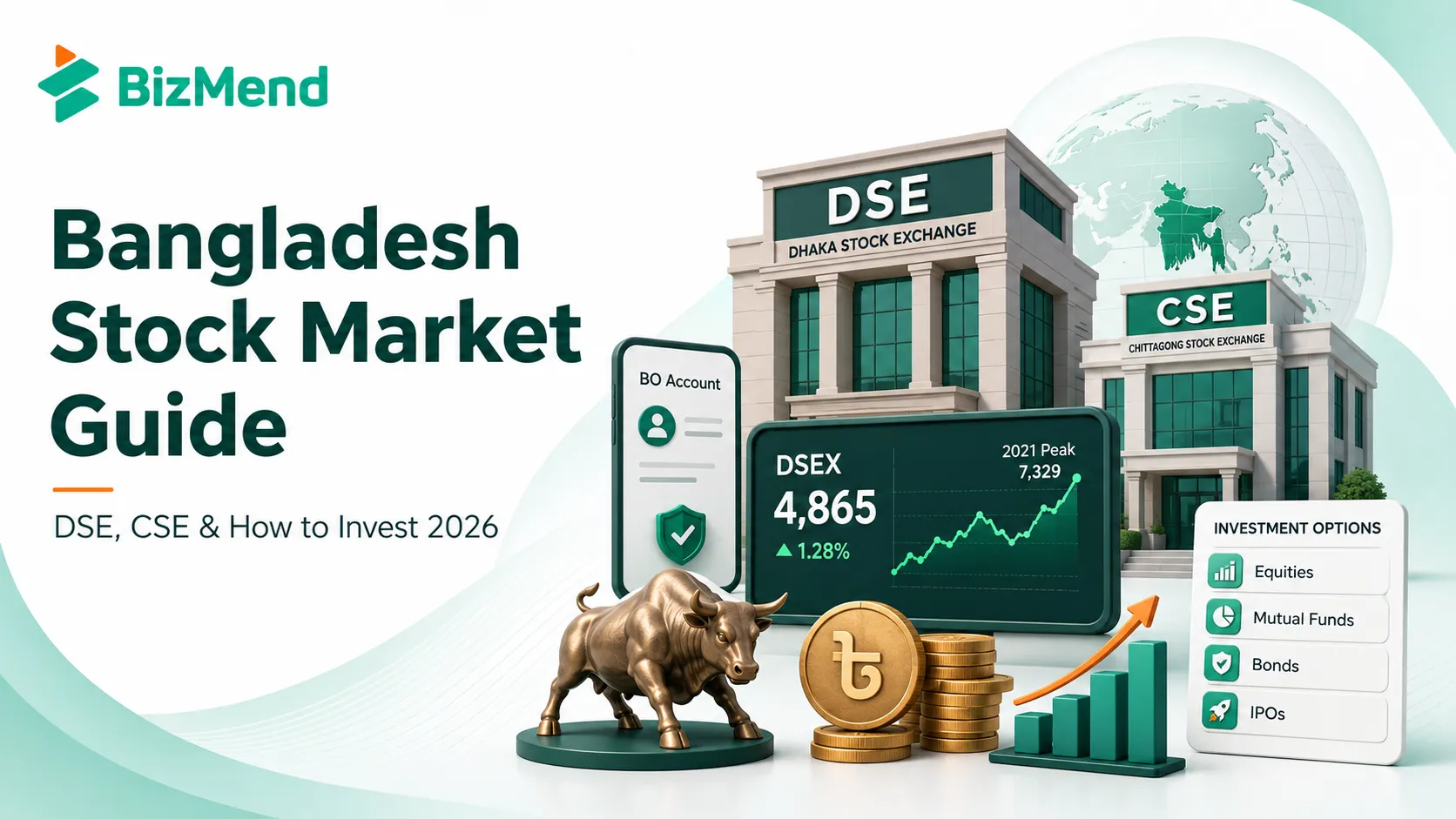
Most people in Bangladesh have heard of the share market. Very few actually understand how it works. The benchmark DSEX index hit an all-time high of 7,329 points in September 2021 and then fell to around 4,865 points by December 2025. That’s the kind of swing that wipes out unprepared investors fast.
This guide gives you the real picture: how the Bangladesh stock market works, how to open an account, what you can invest in, and what risks to take seriously before putting any money in.
Quick answer: The Bangladesh stock market has two exchanges: the Dhaka Stock Exchange (DSE) and the Chittagong Stock Exchange (CSE), both regulated by the Bangladesh Securities and Exchange Commission (BSEC). To invest, you need a Beneficiary Owner (BO) account through a CDBL-registered broker. The main benchmark index is the DSEX, which closed at approximately 4,865 points in December 2025. Instruments available include equities, mutual funds, corporate bonds, and IPOs.
The Bangladesh stock market is where companies list their shares for public trading, and where investors buy and sell those shares to grow their wealth. It’s part of Bangladesh’s broader capital market, which also includes government securities, corporate bonds, and mutual funds.
Two exchanges handle all the formal trading: the Dhaka Stock Exchange (DSE) and the Chittagong Stock Exchange (CSE). Both operate under the regulation of the Bangladesh Securities and Exchange Commission (BSEC). Share settlement and custody run through CDBL, the Central Depository Bangladesh Limited, which is the country’s only securities depository.
Bangladesh’s DSE market capitalization was approximately BDT 6.62 trillion in 2024; the USD equivalent should be recalculated using the relevant 2024 exchange rate before publishing. For investors who also want to understand the banking ecosystem supporting market activity, the guide on commercial banks in Bangladesh gives useful context.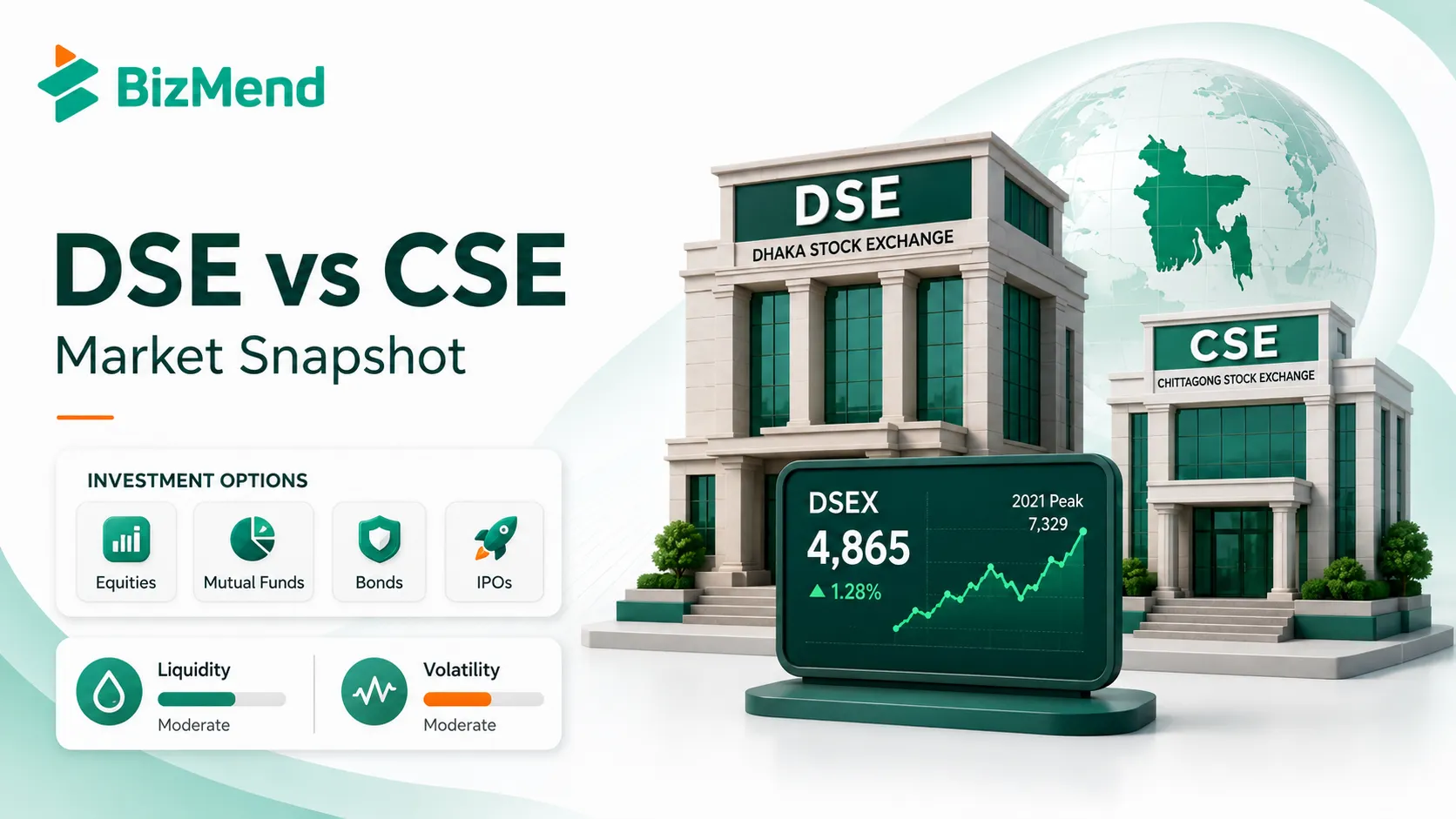
The DSE is Bangladesh’s primary stock exchange. It was incorporated on April 28, 1954, making it one of the oldest exchanges in South Asia. Today the DSE operates from its tower at Plot 46, Road 21, Nikunja-2, Dhaka-1229.
Trading runs Sunday through Thursday, 10:00 AM to 2:30 PM Bangladesh Standard Time (BST). The market is closed on Fridays, Saturdays, and official public holidays. During Ramadan, hours are typically reduced to 10:00 AM to 2:00 PM.
In January 2023, DSE and Nasdaq announced a partnership on trading technology, a notable milestone for market modernization.
| Index | What It Tracks |
|---|---|
| DSEX (Broad Index) | All listed companies — the main benchmark |
| DS30 | Top 30 companies by size and liquidity |
| DSES (Shariah Index) | Shariah-compliant companies only |
| CDSET | Companies listed on the SME platform |
| Metric | Data | Source |
|---|---|---|
| DSEX (December 2025) | ~4,865 points | CEIC / DSE |
| DSEX all-time high | 7,329 points (September 2021) | CEIC |
| Market capitalization (2024) | BDT 6.62 trillion | DSE / CEIC |
| P/E ratio (October 2025) | 9.9 | CEIC / DSE |
| Industrial sectors | 22 | DSE |
The P/E of 9.9 makes Bangladesh one of the cheaper emerging markets by valuation. But low valuations don’t automatically mean safe or profitable investments, especially in a market where liquidity is a real concern.
The CSE was incorporated on April 1, 1995, and received authorization on February 12, 1995. It was formally inaugurated on November 4, 1995. Trading started with open-outcry before switching to automated online trading in June 1998.
As of April 2025, CSE had approximately 640 listed securities including around 330 companies, 37 mutual funds, 16 bonds, and 235 treasury bonds (CEIC data).
Here’s the reality most guides won’t tell you: as of October 2025, CSE’s average daily trading volume was only around BDT 150 million, compared to DSE’s BDT 5.16 billion (Bonikbarta, November 2025). CSE contributes roughly 3% of total Bangladesh stock market activity, down from 15-16% two decades ago. There’s a live debate about merging it with the DSE.
For most beginners, the DSE is where you’ll be investing. If browsing CSE-listed stocks, always check liquidity before placing an order.
The Bangladesh Securities and Exchange Commission (BSEC) was established on June 8, 1993 under the Bangladesh Securities and Exchange Commission Act 1993. It’s attached to the Ministry of Finance and became an ‘A’ category member of IOSCO on December 22, 2013. Website: sec.gov.bd.
The Central Depository Bangladesh Limited (CDBL) is the country’s only depository. It handles electronic share custody, settlement, BO account management, and SMS alerts for investors. Website: cdbl.com.bd.
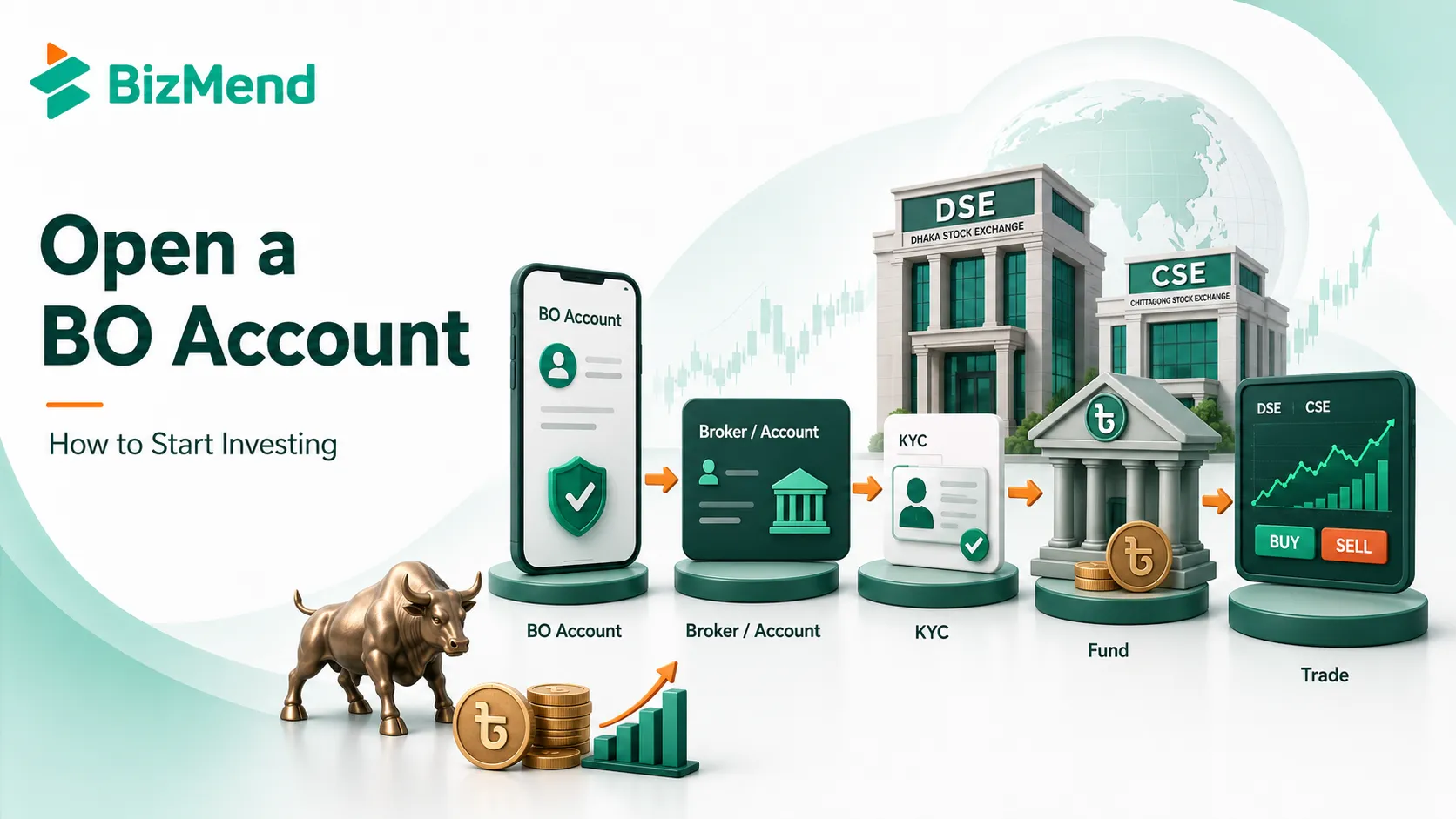
BO stands for Beneficiary Owner’s Account. It holds your shares electronically, the same way a bank account holds money. Every investor in Bangladesh needs a BO account to buy or sell listed securities. It’s registered with CDBL and linked to your chosen broker.
There are two main types:
For a Single or Joint BO Account:
For an NRB BO Account, you’ll also need:
BSEC launched a digital BO account opening system through CDBL. You can open your account entirely online at cdbl.com.bd/bo by selecting a licensed broker, filling in your NID and banking details, and completing verification. No in-person visit required.
Fees vary by broker. Verify current charges with your chosen licensed broker before applying. Once confirmed, your broker issues a 16-digit BO account number.
You’ll need a linked bank account to fund your trades. The guide on how to open a business bank account in Bangladesh is useful here, especially for new investors or NRBs setting up their financial infrastructure.
Always verify your broker is licensed at sec.gov.bd before signing up. For a bank with strong digital payments capability for funding trades, the best private banks in Bangladesh guide covers the top options.
Bangladesh’s capital market offers more than just stocks. Per BSEC’s official investment guide, instruments traded on DSE and CSE include:
If you’re a Non-Resident Bangladeshi, you can invest through an NRB BO account. You’ll need a Foreign Currency (FC) account in Bangladesh for remittance. Non-resident shareholders can transfer their shares to other non-residents freely. The 10% IPO reservation for NRBs is a meaningful provision if the IPO market picks back up.
If you’re an NRB managing investment income through an international entity, US company formation from Bangladesh is an option some diaspora investors use alongside their domestic market activity.
For NRBs needing banking support with international transfer capabilities, the guide on top foreign banks in Bangladesh covers which banks handle cross-border remittances most efficiently.
For investors building broader financial foundations, the guide on non-bank financial institutions in Bangladesh covers alternative investment products outside the stock market. And if you’re also setting up a business, the full guide on how to start a business in Bangladesh covers the legal and financial setup you’ll need.
The Bangladesh stock market consists of two exchanges: the Dhaka Stock Exchange (DSE), based at Plot 46, Road 21, Nikunja-2, Dhaka, and the Chittagong Stock Exchange (CSE), based in Chittagong. Both are regulated by BSEC and operate Sunday through Thursday, 10:00 AM to 2:30 PM BST. The DSE handles the vast majority of trading volume.
DSEX is the Dhaka Stock Exchange Broad Index, the main benchmark for Bangladesh’s stock market. It tracks the performance of all companies listed on the DSE using a market-capitalization-weighted methodology. The DSEX hit its all-time high of 7,329 points in September 2021 and closed at approximately 4,865 points in December 2025 (CEIC data).
A BO (Beneficiary Owner) account holds your shares electronically, the same way a bank account holds money. Every investor in Bangladesh needs one. You open a BO account through a BSEC-licensed broker, either online via CDBL’s portal at cdbl.com.bd/bo or in person. You’ll need your NID or passport, passport photos, bank account details, and nominee information.
Yes. NRBs can open an NRB BO account through a licensed broker and invest in DSE and CSE-listed securities. NRBs need a foreign currency (FC) account in Bangladesh for remittance. Additionally, 10% of IPO shares in each listing are reserved specifically for NRB investors.
Instruments available include equity shares, mutual funds (open-end and closed-end), IPOs, corporate debentures, and treasury bonds. These are traded on both DSE and CSE. Mutual funds are managed by professional asset managers and are a lower-risk entry point compared to individual stock selection.
The Bangladesh stock market carries meaningful risks: the DSEX fell roughly 34% from its 2021 peak to late 2025, daily liquidity has declined over 60% since 2021, and foreign equity investment dropped approximately 70% over five years to $914.58 million by December 2025 (Bangladesh Bank). The market is not inherently unsafe, but it is volatile and relatively illiquid compared to larger emerging markets.
You can verify licensed brokers on BSEC’s official website at sec.gov.bd. Always confirm a broker is registered before opening an account or transferring funds. Most major brokers offer online trading platforms and mobile apps. You can also open a BO account directly through the CDBL portal at cdbl.com.bd/bo and select from listed depository participants.
The DSE (Dhaka Stock Exchange) is Bangladesh’s primary exchange, handling approximately 97% of the country’s daily stock trading volume as of 2025. The CSE (Chittagong Stock Exchange), established in 1995, contributes around 3% of daily trading activity. Both list similar instruments and are regulated by BSEC, but DSE offers significantly higher liquidity for most investors.
Yes. DSE operates the DSES (DSE Shariah Index), which tracks companies meeting Shariah compliance criteria. Investors seeking Shariah-compliant investments can focus on DSES-indexed companies. Some mutual funds also operate under Shariah principles. Verify Shariah compliance status with the relevant fund or company before investing.
The Bangladesh stock market is genuinely interesting for long-term investors willing to do their homework. The P/E ratio is low. The country’s demographics and economic trajectory are strong. But the near-term reality, including a multi-year market downturn, declining liquidity, and a frozen IPO pipeline, means jumping in without preparation is a real risk.
For beginners, a cautious approach could be to open a BO account, start with a small amount, consider diversified mutual funds, and observe the market before buying individual stocks. What sector of Bangladesh’s economy do you think is most undervalued right now?

Learn how to become a Daraz seller in Bangladesh, register an account, list products, understand fees, manage orders, and grow…
by Sheikh Ornob
Compare the cost of living in Bangladesh in 2026, including Dhaka and Chittagong rent, food, transport, utilities, inflation, and monthly…
by Sheikh Ornob
Learn MoA and AoA requirements in Bangladesh, key clauses, drafting basics, RJSC filing steps, amendments, and common company-registration mistakes. Suggested…
by Sheikh Ornob