How to Become a Daraz Seller in Bangladesh: Registration, Fees & Growth
Learn how to become a Daraz seller in Bangladesh, register an account, list products, understand fees, manage orders, and grow…
 by Sheikh Ornob

A data-backed guide to investment opportunities in Bangladesh in 2026. Covers FDI trends, top sectors, LDC graduation risks, and entry rules for local and foreign investors.
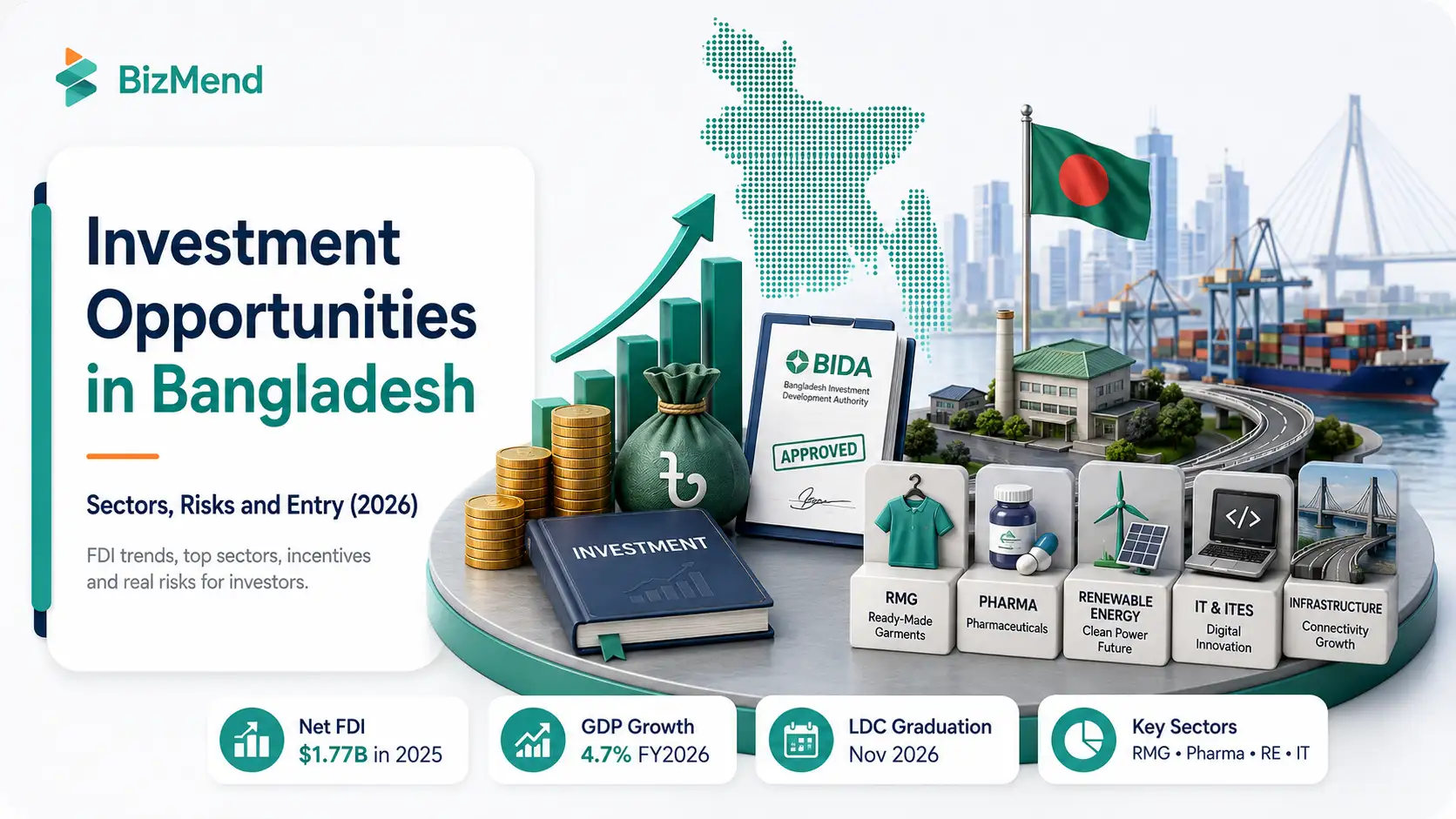
Bangladesh doesn’t make the front page of most investor newsletters. But quietly, it’s been reshaping its economic base for years. Net FDI hit $1.77 billion in 2025. Pharmaceutical exports now reach 151 countries. And a massive renewable energy buildout is underway, backed by ambitious government targets. This guide breaks down the real investment opportunities in Bangladesh sector by sector, including the risks most promotional material conveniently skips.
Quick Answer: Investment opportunities in Bangladesh span ready-made garments, pharmaceuticals, renewable energy, and IT. Net FDI reached $1.77 billion in 2025, per Bangladesh Bank data. The IMF projects GDP growth of 4.7% for FY2026. Bangladesh is scheduled to graduate from LDC status on 24 November 2026, but the government requested an extension of the preparatory period in February 2026. This makes LDC graduation a live policy factor for export-oriented sectors and trade preferences.
Bangladesh’s inward FDI stock has held broadly stable at around $18 billion since 2021, concentrated mainly in textiles, finance, and power, according to UNCTAD’s 2025 Investment Policy Review implementation report. The digital economy, pharmaceuticals, and telecommunications are emerging as diversification areas.
But here’s the real picture: FDI currently accounts for less than 1% of Bangladesh’s GDP. For comparison, Vietnam sits at 4.2%. That gap reflects both untapped potential and real structural barriers.
The IMF completed its 2025 Article IV Consultation for Bangladesh in January 2026, projecting GDP growth to rebound to 4.7% in FY2026 after decelerating to 3.7% in FY2025. Inflation remained elevated at 8.2% year-on-year in October 2025, with the IMF projecting 8.9% for FY2026.
Bangladesh’s top FDI source countries by stock are the UK (17%), Singapore (9.9%), South Korea (8.9%), China (7.9%), the Netherlands (7.3%), Hong Kong (7.2%), and the USA (5.8%), per Bangladesh Bank data.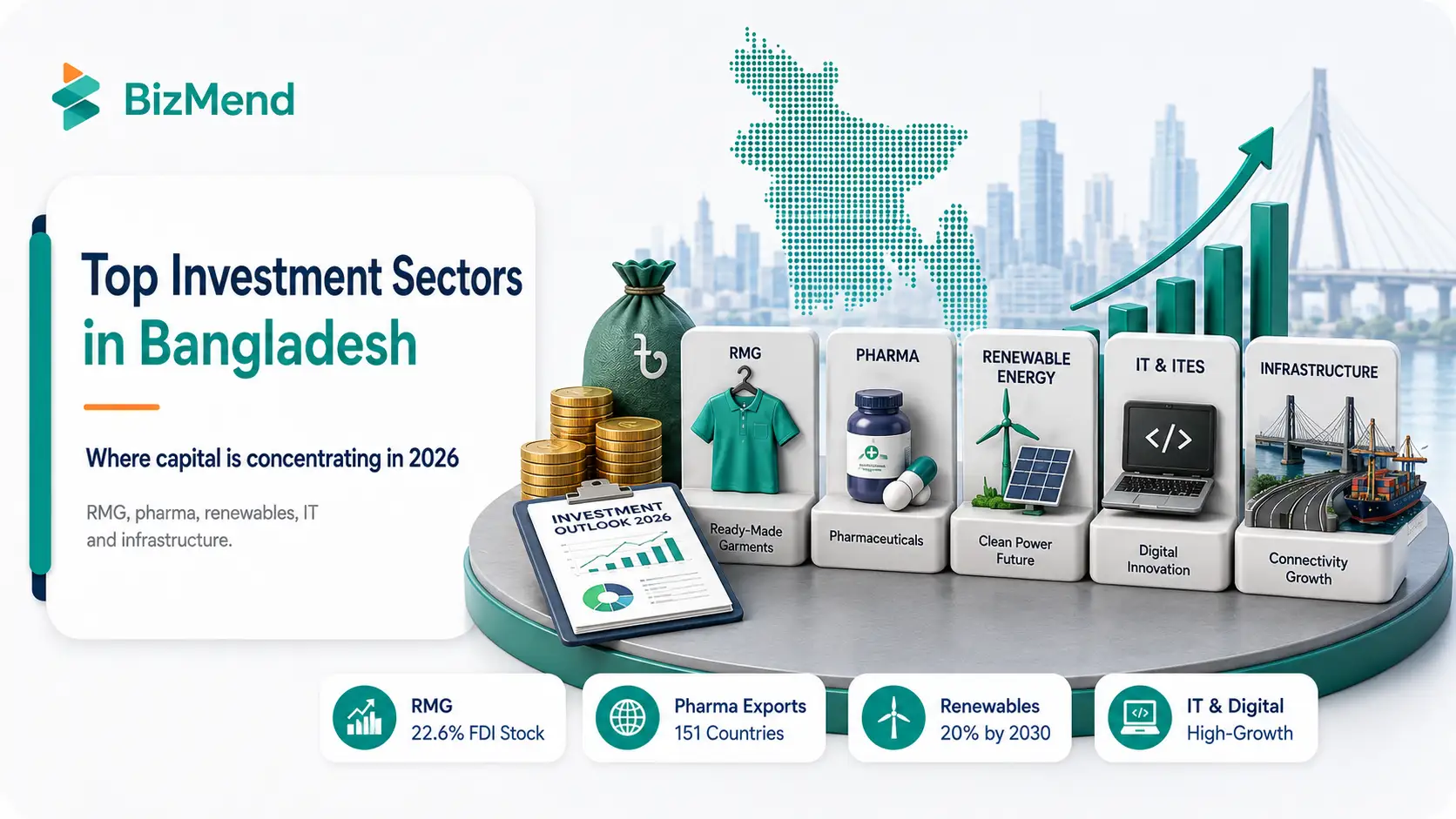
Net FDI rose 39% in 2025 to $1.77 billion. That sounds strong until you look at the composition. Per Bangladesh Bank data and analysis by The Daily Star, this growth came almost entirely from reinvested earnings ($781.67 million) and intracompany loans ($434.11 million). Net equity inflows barely moved: from $544.63 million to $554.63 million.
In other words, existing investors are doubling down. New investors are largely waiting. That’s an honest reading you need going in. Not a reason to walk away, but a signal about what phase Bangladesh is at in its investment cycle.
The ready-made garment (RMG) sector dominates Bangladesh’s export economy, accounting for over 80% of total merchandise exports. It also commands the largest share of Bangladesh’s FDI stock. Textiles and wearing apparel hold 22.6% of total inward FDI stock, per end-June 2024 Bangladesh Bank data.
The specific opportunity: sustainable manufacturing, advanced textile technologies, and supply chain integration. Bangladesh’s RMG sector already hosts over 200 LEED-certified factories, the largest such cluster in the world.
Bangladesh is scheduled to graduate from Least Developed Country (LDC) status on 24 November 2026, but the government requested an extension of the preparatory period in February 2026. The EU’s Everything But Arms (EBA) scheme currently gives Bangladesh zero-duty access to European markets. Post-graduation, without GSP+ qualification, exports could face EU tariffs of 9-12%. WTO analysis estimates Bangladesh could lose up to $8 billion in annual export earnings once LDC trade preferences lapse.
Negotiations for GSP+ status are ongoing with the EU as of late 2025. For RMG investors, the post-LDC environment means sustainability compliance, buyer diversification beyond the EU, and technology upgrades that reduce labor cost dependency.
Bangladesh’s pharmaceutical sector meets 98% of domestic medicinal demand and exports to at least 151 countries, including the US, EU, UK, Canada, and Australia. BIDA projects the domestic pharma market alone to exceed $6 billion by 2025, with a CAGR of over 12%.
Pharmaceutical exports reached $177.42 million in the first ten months of FY2024-25, a 3.46% year-on-year increase, per BIDA data. The sector is home to 213 active companies, ranging from generic manufacturers to companies advancing into insulin, hormones, anti-cancer drugs, and biosimilars.
The strategic investment case: Bangladesh currently imports 85-95% of its Active Pharmaceutical Ingredients (APIs) at an annual cost of $1.3 billion. A 200-acre API Industrial Park in Munshiganj is being developed, with companies beginning to set up API manufacturing plants. Asia’s API market is projected to grow at 9% CAGR until 2027. An investor entering API manufacturing in Bangladesh now is positioning for both domestic import substitution and regional export.
The TRIPS waiver allows Bangladeshi companies to produce patented drugs without royalty payments. The LDC pharmaceutical transition period under TRIPS runs until 2033, but Bangladesh may lose that benefit after LDC graduation unless a transition, extension, or deferment applies. But with LDC graduation in November 2026, companies need to plan around that timeline now.
Bangladesh has committed to generating 20% of its electricity from renewables by 2030 and 30% by 2040, under its Draft Renewable Energy Policy 2025. Power demand is growing at 7% annually, with peak demand projected to surpass 25,000 MW by 2030.
Current renewable energy capacity stands at approximately 1,690 MW as of December 2025, per IEEFA data. Solar leads at around 80% of that mix. To hit the 2030 target, Bangladesh needs to deploy roughly 760 MW of renewable capacity per year from January 2026 through December 2030, per IEEFA analysis.
The investment requirement is significant. IEEFA estimates Bangladesh needs up to $980 million per year in renewable energy investment through 2030, rising to $1.46 billion per year through 2040.
Real barriers: Moody’s downgraded Bangladesh’s sovereign credit rating to B2 in November 2024, raising borrowing costs for international capital. Solar panels and inverters for rooftop projects currently face a 28.73% import duty. The Bangladesh Power Development Board (BPDB) had a payment backlog to Independent Power Producers exceeding BDT 270 billion ($2.21 billion) by November 2025.
Eligible renewable energy producers may receive tax-holiday benefits, but solar equipment duties vary by product and policy update. Bangladesh has proposed duty and VAT exemptions for renewable-energy components under the Draft Renewable Energy Policy 2025, while some solar items still face separate duty changes. For project financing context, non-bank financial institutions in Bangladesh play a meaningful role in long-term project financing alongside commercial banks.
Bangladesh’s digital economy is getting real institutional attention. UNCTAD’s 2025 IPR Implementation Report specifically flagged ICT and the digital economy as a growing area of FDI interest. A new patents law has been introduced to bring IP rules closer to international standards, offering more legal certainty for technology investors.
The Income Tax Act 2023 includes simplified procedures and expanded digital filing, which directly benefits tech-sector investors. BIDA offers Hi-Tech Parks with fiscal incentives for software development and IT-enabled services (ITES).
IT-sector stocks on the Dhaka Stock Exchange trade above their 3-year average PE ratio, suggesting investors are pricing in strong future earnings growth. Entry points include software development, fintech, e-commerce infrastructure, and IT-enabled services.
Bangladesh has been investing heavily in infrastructure. The Padma Bridge opened in 2022. Metro rail systems are expanding in Dhaka. Matarbari deep-sea port is under development, which matters because port congestion currently adds to logistics costs running at around 16% of GDP.
Bangladesh has approved/planned many economic zones under BEZA, but not all are operational. Economic Zones and Hi-Tech Parks should be discussed separately because they fall under different authorities. Foreign investors operating in designated EZs receive tax holidays, duty-free capital machinery imports, and streamlined approvals. Government banks in Bangladesh outlines how development finance flows through the public banking system for infrastructure investment.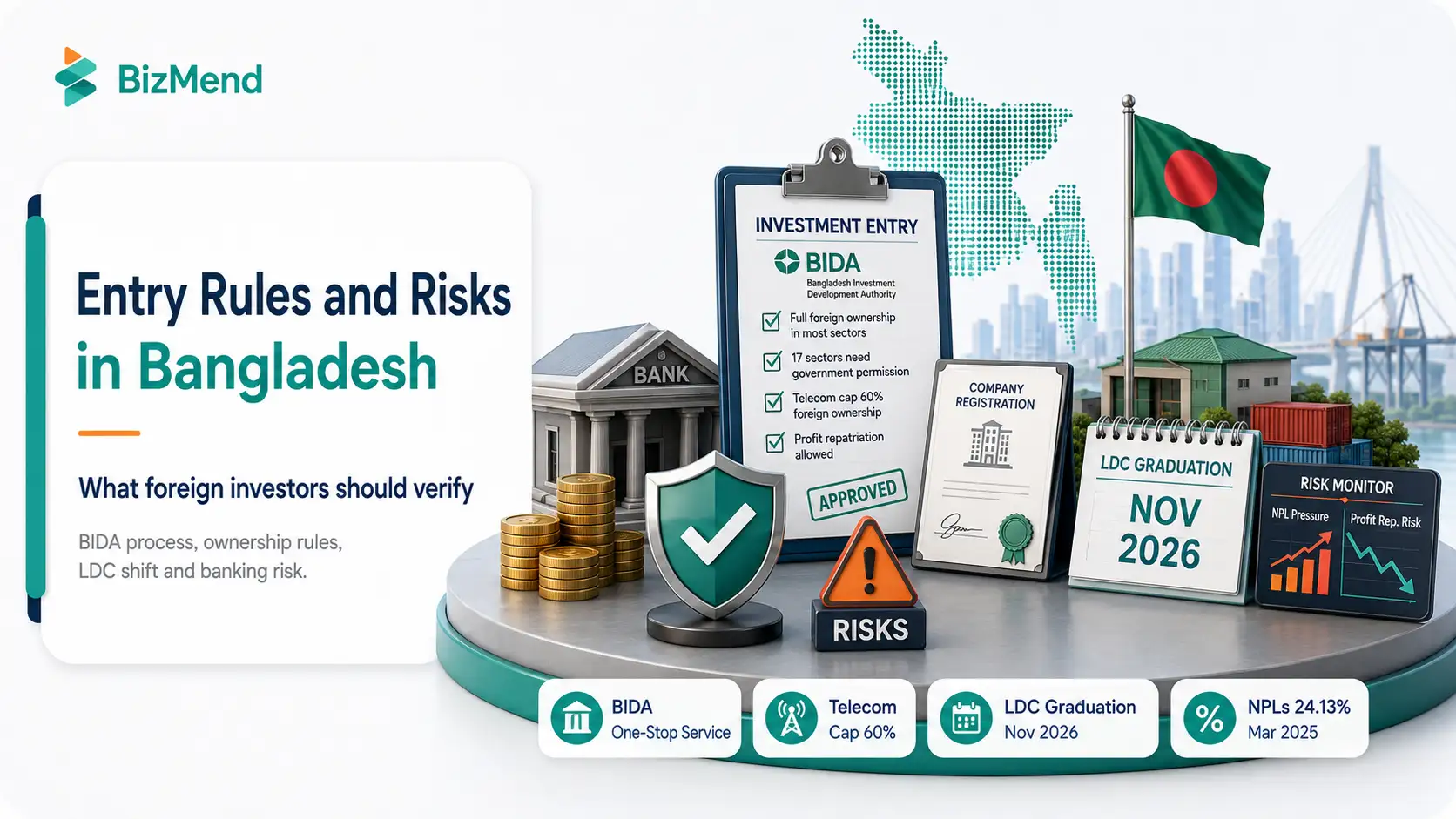
Every investment promotion highlights the upside. Few go into structural risks with any rigor. Here are two you need to understand before committing capital.
Bangladesh’s banking sector is under serious stress. Non-performing loans reached Tk 4.20 trillion, representing 24.13% of total outstanding loans, by March 2025. Some reports using different methodologies placed the figure as high as 34.6% by September 2025. A stressed banking system limits domestic credit availability, raises borrowing costs, and creates systemic uncertainty for any business relying on local financing.
Understanding which banks are financially sound before selecting a financial partner matters. The red, yellow, and green zone bank classifications maintained by Bangladesh Bank are a useful starting filter. For capital markets and merchant banking structures, investment banking in Bangladesh covers the regulatory and institutional landscape.
The Dhaka Stock Exchange (DSE) has documented structural problems. Net foreign investment in listed stocks stood at negative $66 million during July to October of FY2025-26, per data cited by The Business Standard. The DSE faces challenges from manipulation, insider trading, and regulatory enforcement gaps.
A passive public equity strategy carries higher risk than comparable markets. Sector-focused direct investment or joint ventures with established local partners generally offer more control than listed stock exposure for most foreign investors.
The Bangladesh Investment Development Authority (BIDA) is the primary government agency for facilitating foreign investment. UNCTAD’s 2025 report noted that BIDA’s digital one-stop service platform has reduced approval times and improved transparency, though implementation gaps persist.
Foreign investors can register through BIDA’s online portal. For formal business registration steps, how to register a company in Bangladesh via Business Globalizer covers incorporation, tax ID, and banking setup. For understanding which commercial banks handle foreign investor accounts effectively, the top private banks in Bangladesh guide is a practical reference.
The sectors with the strongest combination of growth trajectory and policy support include pharmaceuticals, renewable energy, IT and digital services, and ready-made garments. Each carries sector-specific risks, particularly LDC graduation’s impact on garments and pharma, and banking sector NPLs affecting credit availability across the economy.
Bangladesh received net FDI of $1.77 billion in 2025, per Bangladesh Bank data, a 39% increase over 2024’s $1.27 billion. Growth was driven by reinvested earnings ($781 million) and intracompany loans ($434 million), not fresh equity from new investors entering the market.
Yes, but modestly. Bangladesh’s GDP growth decelerated to 3.7% in FY2025, per IMF data. The IMF projects a rebound to 4.7% in FY2026 and FY2027, contingent on fiscal and financial sector reforms. The World Bank forecast 4.8% and the ADB projected 5% for the same period.
BIDA (Bangladesh Investment Development Authority) is the primary government body for facilitating foreign investment. It offers a digital one-stop service for registrations and approvals, coordinates investor facilitation across ministries, and administers incentives including tax holidays and customs exemptions for priority sectors.
Yes, in most sectors. Bangladesh permits full foreign ownership in the majority of industries. However, 17 sectors require specific government permission, four sectors are fully reserved for state investment, and telecommunications caps foreign ownership at 60%. Always verify the specific sector rules through BIDA before structuring an investment.
The TRIPS pharmaceutical transition period allows LDCs to avoid enforcing certain pharmaceutical patent protections until 2033. Bangladesh benefits from this as an LDC, but the benefit may change after LDC graduation unless a transition, extension, or deferment applies. With LDC graduation scheduled for November 2026, this waiver’s future is a material planning factor for pharmaceutical investors producing patented generics.
Bangladesh needs approximately $980 million in annual renewable energy investment through 2030 to meet its target of 20% of electricity from renewables, per IEEFA. Current installed renewable capacity is around 1,690 MW as of December 2025, dominated by solar at 80% of the mix. Challenges include a B2 sovereign rating, a 28.73% solar component import duty, and a $2.21 billion BPDB payment backlog.
Non-performing loans reached Tk 4.20 trillion (24.13% of total outstanding loans) by March 2025. Some analyses placed the figure as high as 34.6% by September 2025. This is one of the highest NPL ratios in the region and directly affects credit availability, borrowing costs, and the overall investment climate.
Bangladesh is scheduled to graduate from Least Developed Country status on 24 November 2026, but the government requested an extension of the preparatory period in February 2026. LDC graduation means the potential loss of zero-duty trade preferences including the EU’s EBA scheme. WTO analysis estimates the potential loss at up to $8 billion in annual export earnings. Negotiations for GSP+ status with the EU are ongoing as of late 2025.
Bangladesh is a genuinely interesting place to put capital, but it’s not a simple opportunity. The fundamentals are real: a working-age population of 170 million, a proven industrial base, government sector incentives through BIDA, and sector stories in pharma and renewable energy that hold up to scrutiny. So does the risk picture: a banking sector under real stress, a sovereign credit downgrade, and an LDC graduation that resets the rules for export-dependent sectors.
My honest recommendation: pick one sector, dig into the specific BIDA incentives for it, and model what LDC graduation means for your revenue assumptions. Don’t rely on general narratives. What sector are you most seriously considering, and what’s your biggest open question about it?

Learn how to become a Daraz seller in Bangladesh, register an account, list products, understand fees, manage orders, and grow…
by Sheikh Ornob
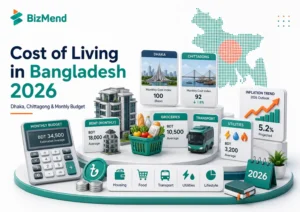
Compare the cost of living in Bangladesh in 2026, including Dhaka and Chittagong rent, food, transport, utilities, inflation, and monthly…
by Sheikh Ornob

Learn MoA and AoA requirements in Bangladesh, key clauses, drafting basics, RJSC filing steps, amendments, and common company-registration mistakes. Suggested…
by Sheikh Ornob