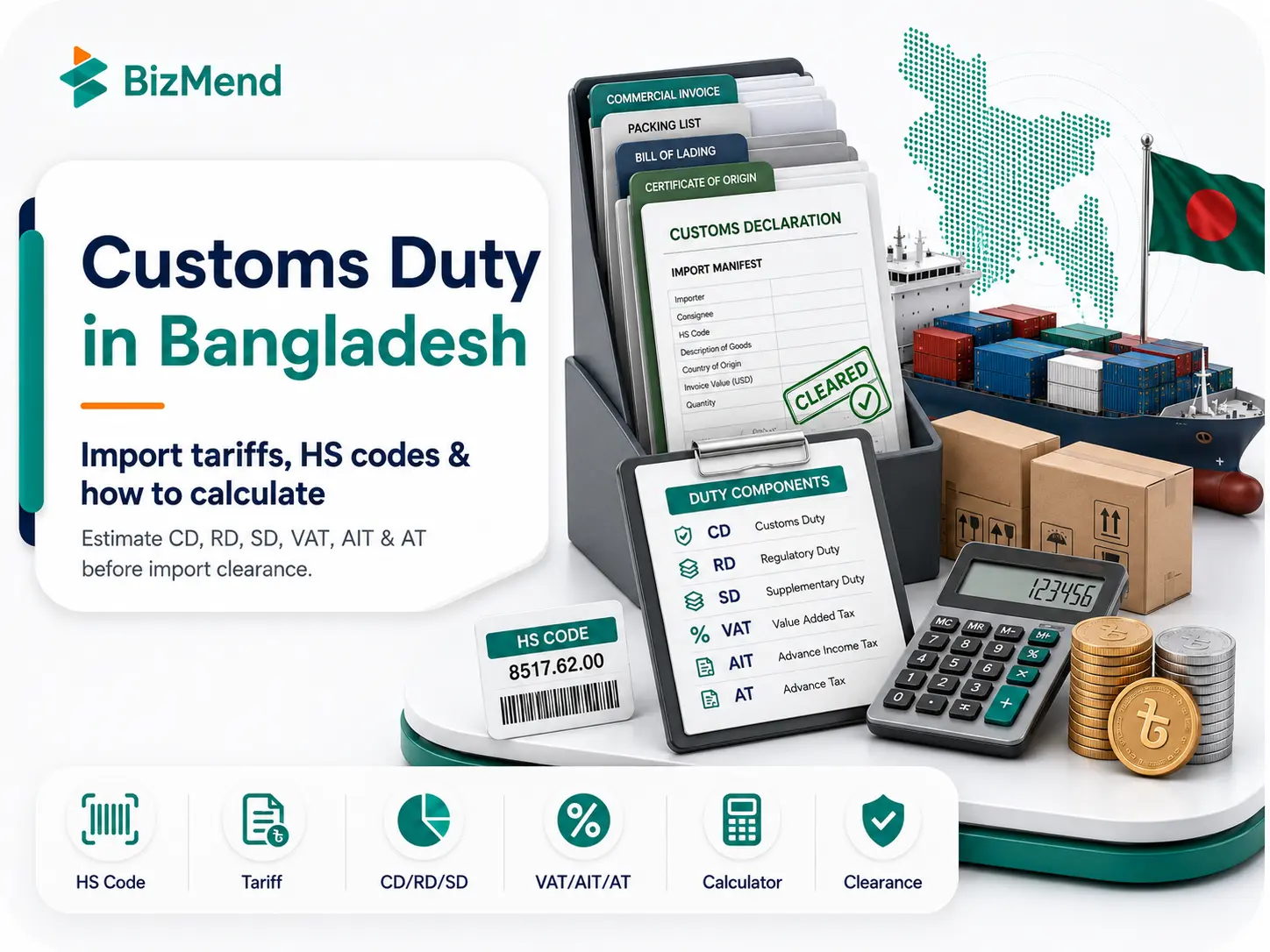

 by Sheikh Ornob
If you’re importing into Bangladesh, a textbook definition of customs duty isn’t really what you’re looking for. What you really want to know is how much the shipment will cost before it clears Customs and reaches your warehouse. Because that number shapes pricing, cash flow, and profit.
The hard part is that there isn’t one flat import charge. Bangladesh uses HS code-based classification and then stacks different taxes on different bases. So if the code is wrong, the math is wrong. This guide breaks down customs duty in Bangladesh, shows you where HS codes fit in, and walks through a practical calculation flow you can use before goods arrive.
Quick answer: In Bangladesh, you estimate import taxes by finding the correct HS Code in the NBR or Bangladesh Customs tariff, then applying the listed CD, RD, SD, VAT, AIT, and AT rates to the right assessable and cumulative values. The common 15 percent VAT is only one part of the bill.
Key Takeaways
- Customs duty in Bangladesh usually means the CD line in the tariff, but your actual import tax bill can also include RD, SD, VAT, AIT, and AT.
- The correct HS code is the starting point because small differences in description, packaging, or end use can change the total tax incidence.
- Bangladesh Customs and NBR both publish tariff tools that let you search the live rate by HS code or product description before you price a shipment.
- The assessable value is not always just your invoice value, because customs valuation works from the customs value and can include freight, insurance, and landing charges.
- CD and RD are usually applied on the assessable value, while SD, VAT, AT, and AIT can use different bases, so one flat percentage won’t give you a reliable estimate.
- The official tariff line can show AT as 0, 5, or 7.5, which means broad assumptions can badly underprice a commercial import.
- If classification is unclear, Bangladesh Customs has an advance ruling process for HS classification, and that can save you from an expensive dispute later.
- A usable landed cost estimate needs both the right HS code and the latest tariff line, not just a supplier quote or an old spreadsheet.
What customs duty in Bangladesh actually includes:
People lump everything together and call it import duty. That’s understandable, but not precise. In practice, you need to separate the basic customs duty rate from the full import stage tax stack. The tariff row is where that becomes visible, because it shows the individual columns that affect your costing, not just one headline number. If you are quoting a supplier, a buyer, or your own management team, that distinction matters a lot.
Okay, let’s keep this practical. If you are estimating cost, think in layers: the tariff schedule tells you what category the product falls into, the HS code tells you which line applies, and the row then tells you which taxes are active for that line. Some products carry a fairly plain structure. Others stack multiple taxes and create a much heavier import bill than first-time importers expect.
| Term | What it usually means | Why it matters for costing |
|---|---|---|
| Customs duty or import duty | Usually the basic CD rate on the tariff line | Treat this as the first layer, not always the full import stage burden |
| Tariff or customs tariff | The official schedule of HS codes and rate columns | Use this to find the live legal rate for your product |
| HS Code | The classification code that determines the tariff line | If the code shifts, your estimate can shift with it |
| TTI | Total tax incidence is shown in customs tools | Helpful for a quick sense check, but still confirm the individual rate bases |
That last point matters. TTI is handy for a quick sense check, but you still want the individual rate columns when you are pricing a shipment, planning cash, or explaining a duty estimate to finance. TTI tells you the burden feels high or low. The separate columns tell you where that burden comes from, which is what you need when a number gets challenged.
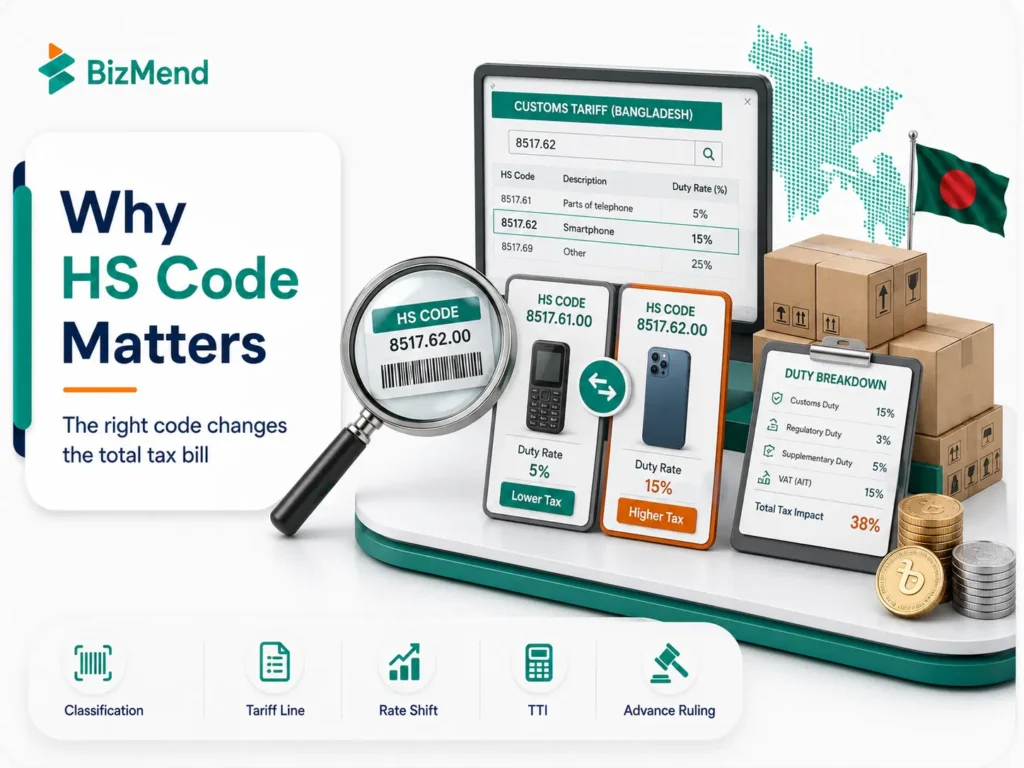
Why the HS code controls your estimate
Bangladesh uses the Harmonized System for classifying goods, and that classification drives the tariff row. So the product description isn’t a side note. It decides which rate columns show up and whether the item is treated more like a finished consumer product, an industrial input, or something with extra duty layers. A vague description can leave too much room for the wrong code.
The fastest way to see why this matters is to compare similar lines side by side. Same broad chapter, very different tax result. That is why classification work feels slow at first. You are not only naming the product. You are choosing the tax lane it will travel through.
| HS Code | Example line | CD | SD | VAT | AIT | AT | RD | TTI |
|---|---|---|---|---|---|---|---|---|
| 07102910 | Frozen leguminous vegetables, wrapped or canned up to 2.5 kg | 25 | 0 | 15 | 5 | 5 | 3 | 58.40 |
| 07102990 | Frozen leguminous vegetables, not wrapped or canned up to 2.5 kg | 25 | 0 | 0 | 5 | 0 | 3 | 33.75 |
| 84186110 | Industrial refrigeration or freezing equipment | 1 | 0 | 15 | 5 | 5 | 0 | 26.90 |
| 84186190 | Other refrigeration or freezing equipment, non-industrial line | 25 | 30 | 15 | 5 | 5 | 3 | 104.42 |
In Bangladeshi customs, a near miss on an HS code is not a small typo. It’s a different tax result.
That’s why copying the supplier’s code blindly can go bad fast. Suppliers classify their export system. Bangladesh Customs classifies it for Bangladesh clearance. If your goods sit near two headings, it is worth checking the wording, the supporting notes, and, if needed, an advance ruling before the shipment leaves. Let’s not sugarcoat it: the time to find a classification problem is before the shipment arrives, not while you are trying to clear it.
Where to check the current rate before you quote a price
You have four official checkpoints, and each solves a slightly different problem. Good import planning usually uses more than one of them. One tool helps you find the rate. Another helps you compare annual changes. Another helps you settle a classification question before it becomes a clearance fight.
- Use the NBR tariff schedule when you want the full annual schedule, the budget-linked changes, and the official rate columns for the current fiscal year.
- Use the Bangladesh Customs operative tariff search when you know the HS code or product description and want the current row with CD, SD, VAT, AIT, RD, and AT.
- Use the duty calculator when you want a quick TTI view for a specific HS code and need a fast sense check before deeper costing.
- Use the advance ruling pages and database when the code itself is the risky part of the estimate and you need more certainty before import.
If trade finance is part of the same planning exercise, pair this with Bizmend’s Foreign Banks for Export Import Business. Duty is only one part of an import’s cash story.
Also, do not assume last year’s spreadsheet is still safe. Budget changes, SRO changes, and line-level updates can move a rate even when the product itself has not changed. Pull the latest row before you lock in a price.
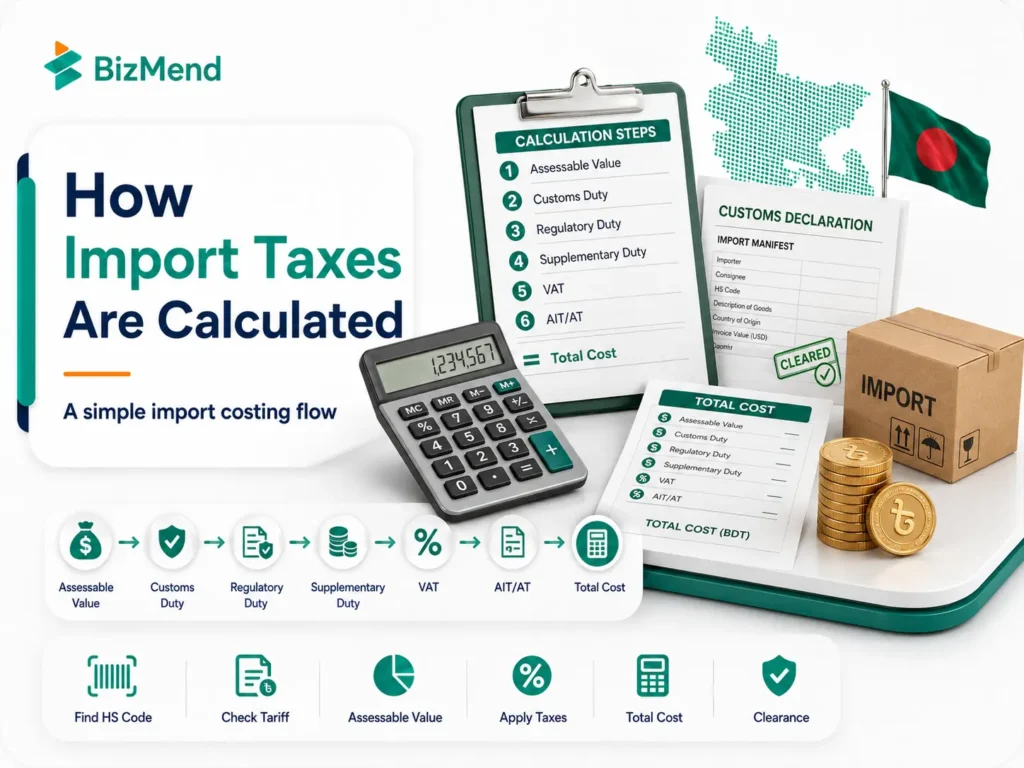
How to calculate import taxes in Bangladesh
Step 1: Find the assessable value
Customs value is the base that starts the chain. In the classic customs guidance example, you begin with cost, freight, and insurance to get CIF, then add landing charge. That is the number from which customs duty starts. If you skip this step and just use the supplier’s invoice amount, your estimate can already be off before you touch a single tax rate.
Step 2: Apply Customs Duty and Regulatory Duty
CD and RD are generally calculated on the assessable or dutiable value shown for the goods. So before you do anything fancy, get those two rates from the correct tariff row. This is the cleanest part of the calculation, and it gives you the first real picture of how heavy the import may become.
Step 3: Apply Supplementary Duty if the line has it
SD is a cumulative tax. In the customs examples, it is calculated on assessable value plus CD plus RD. That means SD doesn’t sit on a clean base like CD does. It sits on a growing base, which is one reason the final import tax can climb faster than new importers expect.
Step 4: Apply VAT and Advance Tax on the proper cumulative base
Bangladesh’s import VAT is not a simple copy of the customs duty base. The import stage examples show VAT and AT being calculated after the earlier duty layers are added in. So when someone says, “The VAT is only 15 percent,” the honest answer is, “15 percent of what?” The base matters as much as the rate.
Step 5: Apply Advanced Income Tax on the relevant import base
AIT appears as its own tariff column, and the official example calculates it on the dutiable value. So keep it separate instead of burying it inside VAT or CD. This sounds fussy, but it is the difference between a reusable costing sheet and a messy estimate no one trusts twice.
Here is the official style of worked example importers often use to understand the flow. The dutiable value is Tk 50,000, and the example rates are CD 25 percent, RD 3 percent, SD 20 percent, VAT 15 percent, AT 3 percent, and AIT 5 percent. This is an illustration of the sequence, not a promise that your product will carry those exact rates.
| Tax | Base used | Base value | Rate | Amount |
|---|---|---|---|---|
| Customs Duty | Dutiable value | 50,000 | 25% | 12,500 |
| Regulatory Duty | Dutiable value | 50,000 | 3% | 1,500 |
| Supplementary Duty | DV + CD + RD | 64,000 | 20% | 12,800 |
| VAT | DV + CD + SD + RD | 76,800 | 15% | 11,520 |
| Advance Tax | DV + CD + SD + RD | 76,800 | 3% | 2,304 |
| Advance Income Tax | Dutiable value | 50,000 | 5% | 2,500 |
Total import stage duties and taxes in that example: Tk 40,624.
One warning before you reuse any sample formula: the current tariff can show different AT outcomes by line. Some rows show 0, some 5, and some 7.5. So treat worked examples as a map, not as a shortcut around the live tariff row. The right sequence plus the wrong line item still gives you the wrong answer.
Common mistakes that make your estimate wrong
- Using the supplier invoice value as the final tax base, without adjusting for the customs valuation method, freight, insurance, and landing charge assumptions where relevant.
- Treating customs duty as the only import charge and ignoring RD, SD, VAT, AIT, or AT, which can make the estimate look far cheaper than the real landed cost.
- Using a broad chapter-level HS guess instead of the exact product line that reflects the real material, presentation, and use of the goods.
- Missing product details that affect classification, such as material, pack size, consumer packaging, industrial use, or whether the item is a part or a finished product.
- Relying on an old spreadsheet instead of the current operative tariff and current budget year rates, even though line items and tax treatment can change.
- Skipping advance ruling when the product could reasonably fit more than one heading and leaving the biggest pricing variable unresolved until the clearance day.
What to verify before shipment leaves the supplier
If you want a better duty estimate before arrival, check these before the goods are on the water. This is the quiet work that saves you from loud problems later.
- The final commercial description, material composition, technical specification, and end use of the product, because vague descriptions create vague classifications.
- The proposed HS code, plus one fallback code if the item sits close to another heading and the classification is not completely settled.
- The current tariff row, including CD, RD, SD, VAT, AIT, and AT, so your estimate uses live rates instead of memory.
- Whether origin-based concessions, exemptions, or project-linked privileges may apply, especially for machinery, raw materials, or approved investment projects.
- The supporting import documents, such as the LC, invoice, bill of lading or airway bill, packing list, and country of origin certificate.
- Any item specific approvals, such as BSTI, quarantine, or sector regulator clearance, because customs planning is not just a rate lookup exercise.
If the code is still uncertain after all of that, pause and resolve the classification issue before shipment. That short delay is usually much cheaper than a clearance delay, a surprise assessment, or a pricing mistake you only notice after the goods are already sold.
Final Thoughts
Customs duty in Bangladesh isn’t impossible to estimate. It just punishes lazy inputs. Start with the right HS code, pull the live tariff row, and apply each tax to the right base. Do that, and your landed cost estimate becomes far more usable.
Frequently Asked Questions
Is customs duty the same as total import tax in Bangladesh?
No. Customs duty often refers to the basic CD rate, but many imports can also attract RD, SD, VAT, AIT, and AT. If you only quote the CD line, you can end up with a very low estimate. For some goods, that gap is small. For others, it is the difference between a workable selling price and a loss making import.
How do I find the correct HS Code in Bangladesh?
Start with the Bangladesh Customs or NBR tariff search, compare the product’s material, technical specification, pack size, and end use, then narrow to the exact tariff wording. Don’t stop at the chapter level. Read the line description closely. If the classification is still fuzzy, apply for an advance ruling before import.
Can I rely on the supplier’s HS code?
Use it as a clue, not as the final answer. Your supplier may classify the item for export in another country, while Bangladesh Customs will assess it under the Bangladesh tariff and local classification practice. If the product has multiple uses or sits close to another heading, the supplier’s code can be a very shaky shortcut.
Does every import pay 15 percent VAT and 5 percent AIT?
Not always. Some tariff lines show VAT at 0, some show 15, and the current operative tariff can show AT at 0, 5, or 7.5 depending on the line and importer context. AIT and SD can also differ by item. Always check the current row for your exact product instead of assuming every import follows one standard pattern.
What happens if Customs uses a different classification from yours?
Your duty estimate can change, sometimes by a lot. That is exactly why the advance ruling system exists. If the product sits close to multiple headings, getting a ruling before shipment is often cheaper than arguing after arrival. It protects your costing, your paperwork, and your timeline.