
 by Sheikh Ornob
Business finance gets confusing fast. A business loan in Bangladesh can fund stock, machinery, or trade. Picking the right option is where most owners stall.
That’s normal, especially when every lender uses different labels, asks for different papers, and talks about obvious risks. This guide breaks down the main loan types, who usually qualifies, what documents banks and NBFIs ask for, and how the application process works in Bangladesh. We’ll also separate local business loans from foreign borrowing rules, because those are not the same thing. At the end, you’ll leave with a shortlist, not a headache. That matters when cash is tight.
Quick answer: Most established businesses in Bangladesh can apply for working capital, term, trade, startup, or women entrepreneur loans through banks and NBFIs if they show legal registration, tax records, bank activity, and repayment capacity. Foreign currency borrowing follows a separate BIDA and Bangladesh Bank route.
Key Takeaways
- Business loans in Bangladesh usually fall into five practical buckets: working capital, term finance, trade finance, women entrepreneur finance, and startup or sector-specific facilities.
- Your legal setup matters early, because sole proprietorships, partnerships, and private limited companies do not submit the same documents.
- Most lenders want to see a valid trade license, TIN or e-TIN, bank statements, proof of business premises, and a cash flow story that makes repayment believable.
- Business age is a common filter. For example, BRAC Bank lists at least 2 years of operation for some ANONNO facilities and longer history for larger exposures.
- Collateral is not always mandatory, but unsecured loans usually come with lower limits, tighter eligibility, and heavier focus on turnover and repayment behavior.
- If your company is a private limited company, expect extra paperwork such as RJSC records, board resolutions, audited accounts, and charge creation documents.
- Women entrepreneur products can come with better access conditions, but many schemes require majority female ownership or follow Bangladesh Bank refinance rules.
- Foreign borrowing is its own lane. BIDA approval, Bangladesh Bank rules, and reporting through an authorized dealer bank may apply depending on the structure.
What counts as a business loan in Bangladesh?
In plain English, it’s any credit facility taken for business use, not personal spending. That includes money for inventory, machinery, shop renovation, import bills, tax and duty payments, contractor work orders, delivery vehicles, or a bigger factory floor.
Lenders in Bangladesh do not present these products in one neat family tree. A bank may call it an SME loan, a term loan, a revolving loan, a work order facility, or trade finance. An NBFI like IDLC may package similar needs under SME financing. Same business problem, different product label.
| Loan type | What it usually funds | What lenders care about |
|---|---|---|
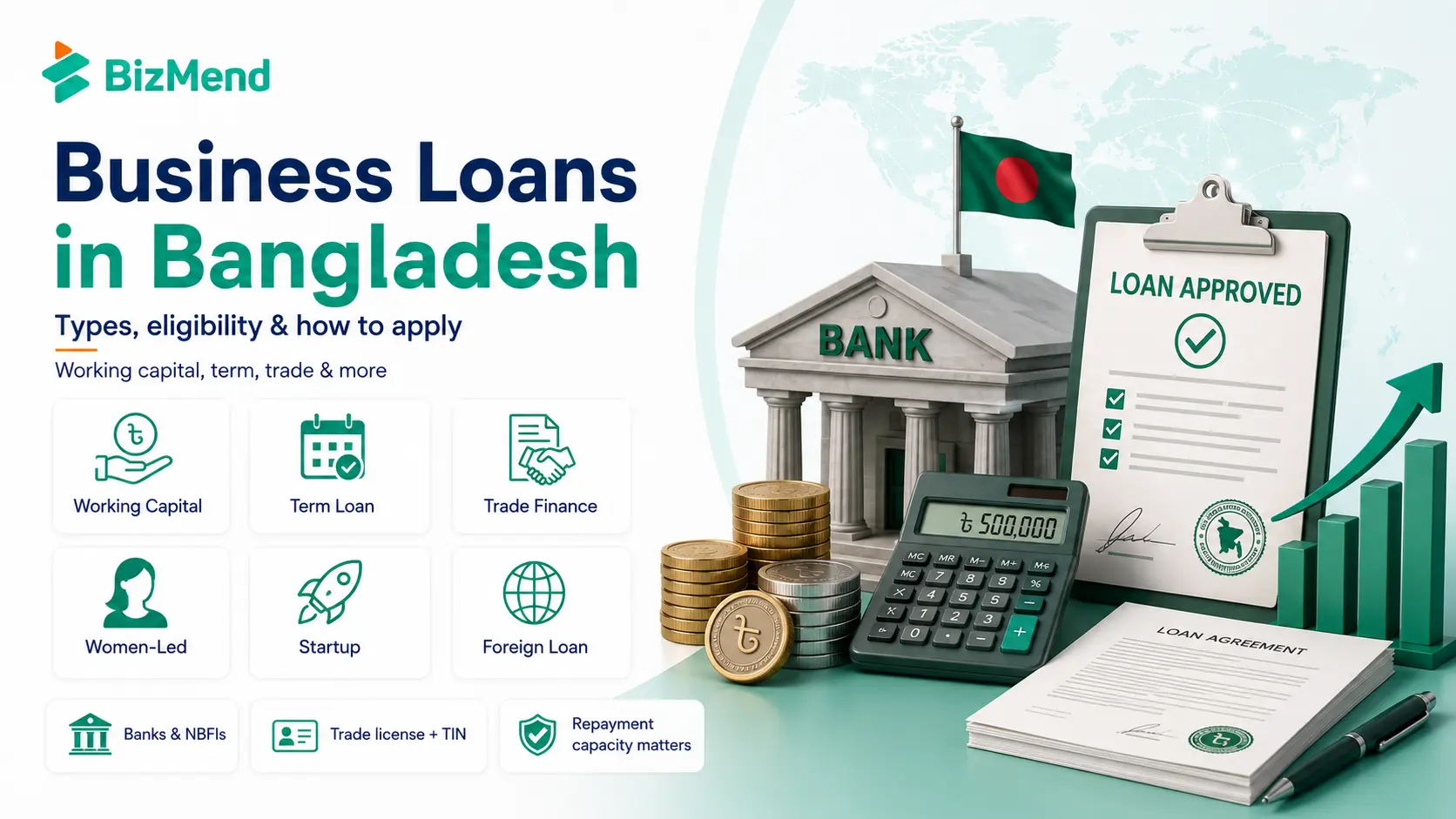
| Working capital | Stock purchases, supplier payments, payroll support, daily operations | Turnover pattern, bank statement movement, repayment cycle |
| Term loan | Machinery, fit-out, expansion, vehicles, major equipment | Business track record, asset use, longer cash flow visibility |
| Trade finance | LC, LATR, import costs, inland bill purchase, duty and VAT-related needs | Trade documents, supplier cycle, transaction history |
| Women entrepreneur loan | Expansion, fixed assets, working capital for women-led firms | Ownership structure, trade license, eligibility under scheme rules |
| Startup or special program loan | New business models, platform sellers, sector-specific growth | Business model clarity, data trail, scheme availability |
The right loan solves a business problem. The wrong one creates a repayment problem.
Current lender pages make that variety obvious. BRAC Bank lists unsecured ANONNO loans, larger SME term facilities, women-focused TARA loans, and trade-linked products such as SHOMRIDDHI. City Bank’s SME schedule of charges from October 2024 shows separate small business, agriculture, startup, distributor, women, and Islamic asset-backed products.
The main types you will actually see
Working capital loans
These are for keeping the business moving. Think inventory, short supplier cycles, wages, rent, utility pressure, or receivables gaps. If cash gets stuck in sales but bills keep arriving, this is usually the first category to check.
Banks may offer this as an overdraft, revolving finance, work order finance, or a short-tenor installment product. BRAC Bank’s corporate and SME materials specifically mention procurement, local purchases, duty and VAT payments, advances against receivables, and work order financing.
Term loans
Term loans fit slower, bigger purchases: machinery, office fit-out, expansion, commercial space, or a delivery vehicle. You repay over a fixed period, often in monthly installments. This is the product that makes sense when the asset will earn over time, not in one quick sales cycle.
Let’s not sugarcoat it. Lenders study repayment ability much harder here because the ticket size is often larger and the tenor is longer. That is why audited numbers, stable sales, and collateral become more important as the amount goes up.
Trade finance
If your business imports, supplies, or moves goods on credit, trade facilities matter more than a generic SME loan. Products such as LC, LATR, inland bill purchase, bank guarantees, and import-linked working capital sit in this bucket.
BRAC Bank’s SHOMRIDDHI page is a useful example. It lists LC, LATR, revolving loan, overdraft, inland bill purchase, term loan, and bank guarantee under one umbrella, with loan sizes starting from BDT 5 lac depending on facility type.
Women entrepreneur loans
This is one of the more structured lanes in Bangladesh. Bangladesh Bank has long pushed dedicated desks and refinance support for women-led enterprises, and current Bangladesh Bank publications still show a policy target for women within the CMSME portfolio.
On the lender side, BRAC Bank’s TARA Uddokta page says businesses with at least 51 percent female ownership can apply, and it advertises 5 percent pricing up to BDT 50 lac under the stated policy window. City Bank also lists a women entrepreneur SME product with unsecured and secured ranges on its current product page.
Startup and digital business loans
This is where founders often get overexcited. Yes, some lenders now market startup or digital business products. No, that does not mean a fresh idea with zero records automatically gets funded.
City Bank’s October 2024 SME schedule shows a startup loan category that is subject to fund availability and framed for innovative, scalable, high-growth businesses. BRAC Bank also markets PRABARTAN for digital platform businesses such as e-commerce and f-commerce, with at least 1 year in the same line of business.
Foreign loans for foreign-owned businesses
This is a separate route, and mixing it up with local SME lending causes a lot of confusion. BIDA says prior approval is required for foreign currency borrowing used to import capital goods for new projects, replacement, or expansion, and it also says no permission is granted for foreign loans used as working capital in that long-term route.
BIDA also says certain short-term overseas parent or affiliate loans are possible for foreign-owned manufacturing businesses, and after Bangladesh Bank’s Foreign Exchange Circular No. 4, dated 19 January 2021, some service companies except trading businesses can also access that route. The same FAQ notes a maximum 3 percent annual interest cap for those short-term foreign borrowings and says the borrowing must still be reported through the banking system.
Foreign borrowing is not just a bigger SME loan. It’s a different rulebook.
Who is usually eligible?
Eligibility is not one national checklist. Each bank and NBFI sets its own product rules, but the same patterns show up again and again. You need a legally running business, basic tax compliance, visible cash flow, and a reason the lender believes this facility matches the way your business earns.
A few current examples make that concrete. BRAC Bank says ANONNO applicants need a valid trade license and at least 2 years of operation for some lower-ticket loans, while City Bank’s women entrepreneur page lists 2 years of business experience and owner age from 21 to 65. For larger or secured loans, lenders commonly ask for stronger financials, guarantors, and property-backed security.
In practice, lenders usually check these points:
- Business type: sole proprietorship, partnership, private limited company, or another acceptable legal form.
- Business age: often at least 1 to 3 years depending on product size and risk.
- Cash flow strength: sales should be strong enough to cover installments without drama every month.
- Credit behavior: lenders may ask for a CIB undertaking and pull your credit information through the banking system.
- Sector fit: some products are built for trading, manufacturing, agriculture, contractors, women-led enterprises, or digital sellers.
- Security support: unsecured is possible, but collateral, guarantees, or a charge over assets can widen your options.
Okay, let’s not make this sound fancier than it is. Banks want proof that your business exists, earns, and can repay. If one of those three looks shaky, approval gets slower or smaller.
What documents do lenders usually ask for?
This is where many good businesses lose time. The business may be fine, but the file is messy. A missing trade license renewal, a weak bank statement trail, or the wrong company paper for a limited company can stall everything.
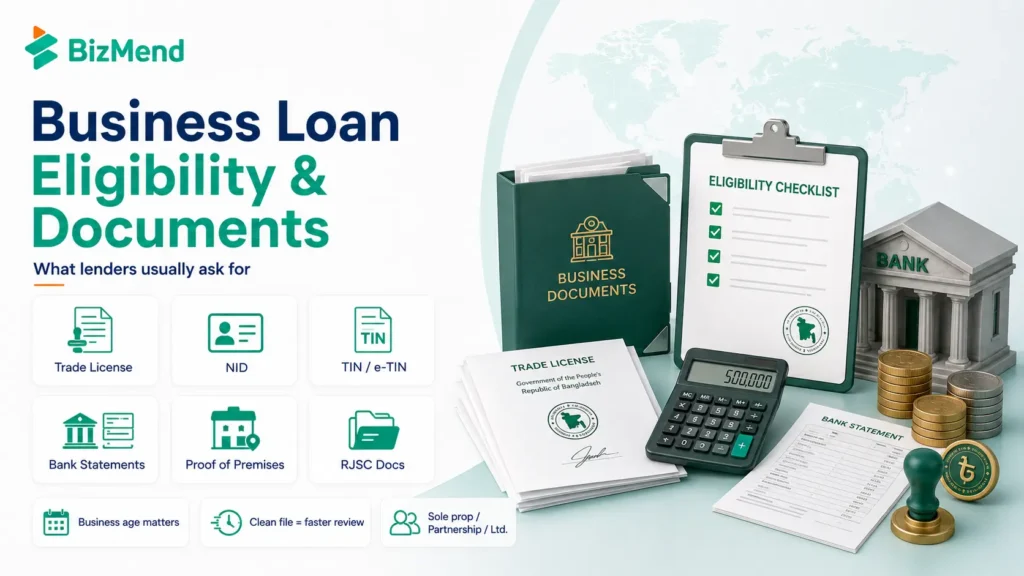
IDLC’s current SME document list is a good baseline. It asks for NID, trade license, personal net worth statement, bank statement, rental deed, sales information for the last 12 months, TIN, and a CIB undertaking. City Bank’s SME schedule adds the heavier company papers limited companies usually need.
| Business form | Common core documents | Extra documents you may need |
|---|---|---|
| Sole proprietorship | NID, updated trade license, e-TIN or tax return proof, bank statements, proof of premises | Sales records, guarantor details, security papers if secured |
| Partnership | All core papers above plus partnership deed | Partner profiles, partner guarantees, business resolutions |
| Private limited company | Trade license, TIN, certificate of incorporation, RJSC director records, bank statements | MOA and AOA, audited financials, board resolution, charge creation papers, director net worth statements |
| Joint venture or foreign-linked business | Core company papers plus ownership and registration documents | BIDA registration, joint venture agreement, foreign borrowing papers if relevant |
Banks don’t reject only weak businesses. They reject weak files.
For private limited companies, City Bank’s schedule specifically lists memorandum and articles of association, certificate of incorporation, Form XII and Schedule X certified by RJSC, board resolution, directors’ guarantees, and audited financials. That tells you something important: company loans are not just bigger, they are document-heavier.
How to apply without wasting weeks
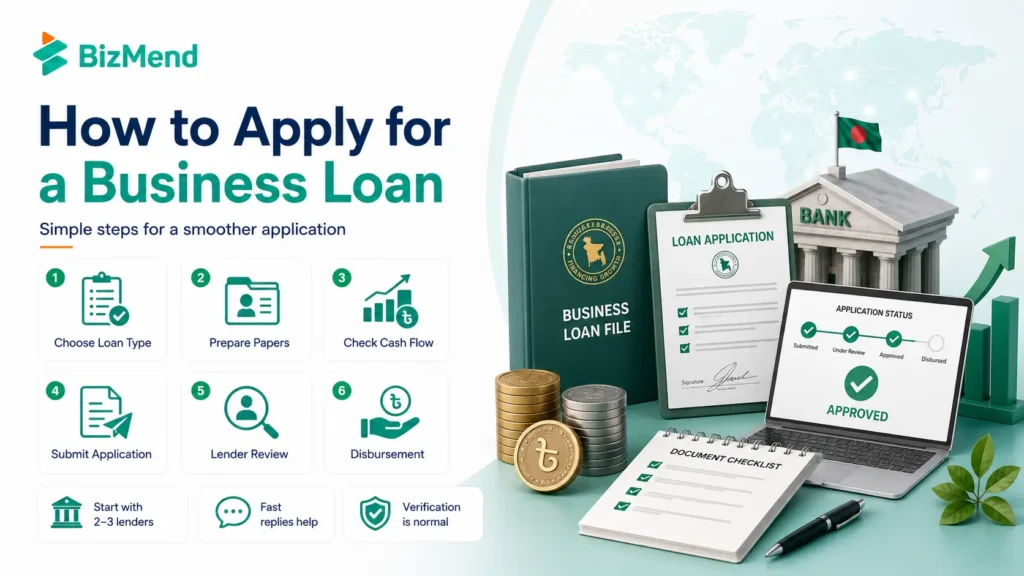
The cleanest applications usually follow the same sequence. First, match the loan type to the business problem. Second, prepare the papers in the legal name of the exact borrowing entity. Third, speak to the lender with numbers, not vibes.
- Define the purpose clearly. Say whether the money is for stock, a machine, duty payment, a shop fit-out, a vehicle, or order execution. Lenders underwrite clearer purposes faster.
- Choose the right lane. A working capital gap should not be dressed up as a machinery loan, and a foreign currency borrowing request should not be treated like a local SME product.
- Organize the file. Put your trade license, TIN, bank statements, business address proof, sales records, and company papers in one complete set before the first serious meeting.
- Clean up the banking trail. If your account activity is thin, cash-heavy, or mixed with personal transactions, fix that first. Lenders read bank statements like a story.
- Submit the application and respond fast. Most delays happen after submission, when the lender asks follow-up questions and the business answers three days later with half the documents.
- Prepare for verification. Site visits, guarantor checks, valuation, legal review, and CIB review are normal. For foreign borrowing cases, BIDA and Bangladesh Bank rules may add another review layer.
If you are a foreign-owned company dealing with external financing, note one current procedural change. Bangladesh Bank announced the official launch of its Foreign Investment and Financing Web Portal on 6 February 2025, and BIDA says foreign loan applications are handled through its OSS process. So yes, the digital route exists, but the supporting paperwork still matters.
Mistakes that slow approval or shrink the offer
- Applying for the biggest amount first instead of the amount your cash flow can genuinely carry.
- Using personal transactions and business transactions through the same account, then wondering why the lender cannot read your numbers.
- Assuming a startup label removes the need for records, guarantors, or business proof.
- Turning up with expired trade licenses, missing tax papers, or old RJSC forms.
- Calling every facility an SME loan when the real need is trade finance or a term loan.
- Expecting a local bank to treat foreign borrowing like a normal domestic business loan.
- Ignoring pricing disclosures, security documents, valuation costs, and small charges that add up around the facility.
One more thing. Do not shop your file to ten lenders in a panic. Start with two or three realistic matches. A cleaner, better targeted approach usually gets better feedback and saves your team a lot of back and forth.
Final Thoughts
A business loan in Bangladesh is not one product. It’s a menu, and the smartest move is matching the facility to the job. Get your paperwork clean, know your numbers, and choose a lender lane that fits your business stage. That alone can save you weeks.
Frequently Asked Questions
Can a new business get a business loan in Bangladesh?
Sometimes, yes, but brand new businesses usually have fewer choices. Many mainstream products want at least 1 to 3 years of operating history, especially for unsecured or larger loans. If you’re early, look for startup-specific products, smaller-ticket facilities, or lenders that care more about transaction data and sponsor strength.
Do I always need collateral?
No. Unsecured business loans exist in Bangladesh, especially in SME banking. But unsecured usually means lower loan caps, tighter screening, and stronger focus on turnover, business age, and repayment behavior. Once the amount rises, collateral, guarantees, or a registered charge over assets become much more common.
Which documents matter most in a first screening?
The basics usually decide whether the conversation keeps moving: updated trade license, NID, tax record, bank statements, proof of premises, and business sales evidence. For private limited companies, certificate of incorporation, RJSC records, board resolution, and audited accounts quickly become central.
Can a foreign-owned company borrow from a local lender?
It can, but the path depends on the product. A locally registered foreign-owned company may still apply for domestic facilities if it meets the bank’s risk rules. External or foreign currency borrowing follows a separate BIDA and Bangladesh Bank framework, and some uses, such as long-term foreign working capital borrowing, are restricted.
How long does approval usually take?
There is no single national timeline. Simple digital or small ticket products can move much faster than secured company loans. Once valuation, legal checks, site visits, RJSC documents, or foreign borrowing approvals enter the picture, the process gets longer. The fastest way to avoid delay is a complete file and quick responses to follow-up questions.