
 by Sheikh Ornob
Global expansion rewards preparation, not shortcuts.
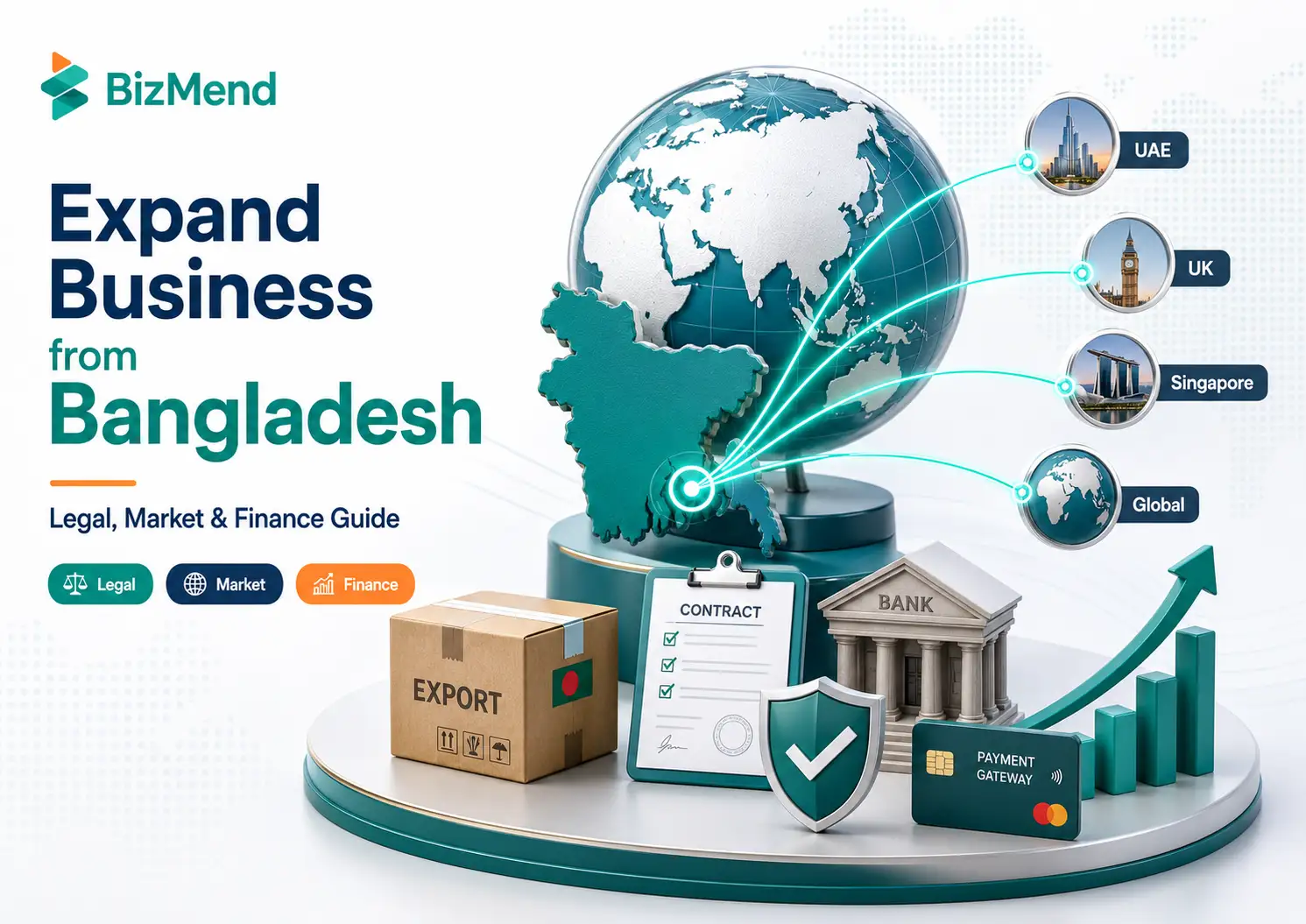
For a Bangladeshi company, going global can mean exporting products, selling digital services, opening an overseas entity, hiring abroad, or building payment access in another market. The right route depends on customers, compliance, banking, tax exposure, and the founder’s ability to operate across borders without losing control at home.
This guide explains how to expand business from Bangladesh in a practical way: choose the right market, select a legal structure, plan banking and payments, manage documentation, and avoid common compliance mistakes.
Quick Answer: To expand business from Bangladesh, start by proving demand in one target market, then choose the lowest-risk entry model: export from Bangladesh, appoint a distributor, sell through a marketplace, or register a foreign company where you need banking, local contracts, tax registration, or payment gateway access.
UAE, UK, and Singapore routes can work for different goals, but formation is only one part of the plan. You still need Bangladesh-side export, foreign exchange, tax, contract, and banking compliance before moving money or signing long-term obligations.
Why Bangladeshi businesses expand globally
Bangladeshi businesses expand overseas for several practical reasons: larger customer bases, stronger currencies, access to better payment infrastructure, brand credibility, diversified revenue, and closer proximity to buyers. Exporters may need a foreign presence to handle distributors. Software agencies and e-commerce sellers may need international payment gateway access, while local sellers should also understand payment gateway in Bangladesh options before expanding. Manufacturers may need warehouses, agents, or local certifications.
Global expansion is not the same as simply registering a company abroad. A foreign entity can help with contracts, banking, payment processing, or local hiring, but it also creates tax filings, accounting duties, beneficial ownership checks, and ongoing governance. The goal is to match the structure to the business model, not chase a fashionable jurisdiction.
When is a Bangladeshi business ready for overseas expansion?
A business is usually ready when it has repeatable demand, clean records, documented ownership, reliable delivery capacity, and a clear reason for entering a specific country. A founder who only wants a Stripe or PayPal account may need a different path from a manufacturer targeting distributors in the Gulf.
- You already have paying foreign customers or qualified leads.
- Your product can meet the target market’s legal, quality, labeling, tax, and data requirements.
- Your Bangladesh accounting, trade license, tax identification, and ownership records are organized.
- You can explain how money will move from customer to company to Bangladesh, especially if you need to receive international payments in Bangladesh or repatriate income.
- You have a budget for setup, renewal, bookkeeping, registered address, tax filings, banking reviews, and professional advice.
If these basics are weak, expansion may create more friction than growth. Fix documentation, contracts, pricing, and cash flow first, then choose the foreign route.
Choose the market before choosing the company
Market selection should come before UAE, UK, or Singapore formation. The best jurisdiction is the one that supports your customers, payment channels, bank account options, tax position, and operational needs.
| Factor | What to check | Why it matters |
| Customer access | Where buyers are located, how they buy, language, sales cycle | Prevents registering in a country that does not improve revenue |
| Legal fit | Licensing, sector restrictions, import rules, consumer protection | Reduces regulatory surprises |
| Payment fit | Gateway support, bank account options, settlement currency | Improves collection and reduces failed onboarding |
| Tax and reporting | Corporate tax, VAT/GST, withholding tax, transfer pricing risk | Avoids hidden annual costs |
| Operations | Hiring, warehousing, local partner needs, time zone | Keeps the structure useful after registration |
For many Bangladeshi companies, the first overseas move should be a market test: paid pilot projects, distributor discussions, marketplace validation, trade fair conversations, or small compliant export shipments. Entity formation becomes easier to justify once demand is visible.
Legal setup options for global expansion
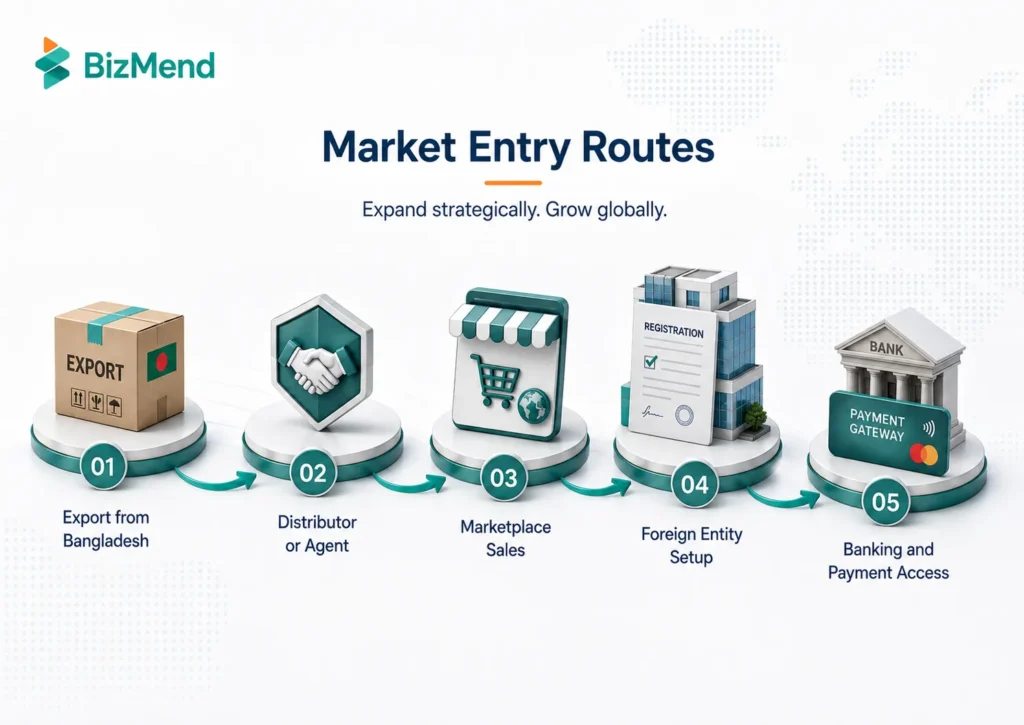
There is no single setup model for every international business from Bangladesh. A company can start light and become more formal as revenue, risk, and local obligations increase.
| Route | Best for | Main caution |
| Export from Bangladesh | Manufacturers, traders, service exporters with direct buyers | Requires proper export, foreign exchange, invoice, and banking documentation |
| Distributor or local agent | Physical products, B2B sales, regulated channels | Needs strong contracts, territory limits, payment terms, and termination clauses |
| Marketplace or platform sales | Ecommerce, SaaS, digital products | Platform payment and tax rules may change |
| Foreign subsidiary or LTD/LLC | Payment gateway access, local contracts, hiring, credibility | Creates ongoing filing, accounting, tax, and beneficial ownership duties |
| Branch or representative office | Physical presence tied to the Bangladeshi parent | Parent company exposure and local registration rules can be heavier |
The safest structure is usually the simplest structure that solves the real business problem. Do not register abroad only because competitors did it. Register when there is a clear business case.
UAE, UK, and Singapore routes: practical comparison
UAE, UK, and Singapore are common choices for Bangladeshi founders, but each serves a different purpose. The table below is a planning view, not legal or tax advice.
| Route | Common use case | Key official point |
| UAE | Gulf-facing trade, consulting, ecommerce, regional presence | The UAE Ministry of Economy describes Basher as a unified online platform for setting up a UAE business and obtaining a trade license digitally. |
| UK | Global credibility, UK/EU-facing clients, company contracts, payment onboarding | GOV.UK says online private limited company registration costs GBP100 and is usually completed within 24 hours; an overseas company must register with Companies House if it sets up a place of business in the UK. |
| Singapore | Asia-facing holding, trading, tech, investor-friendly operations | ACRA says all foreign businesses must engage a corporate service provider to register in Singapore, and foreigners must meet local residency requirements depending on the chosen structure. |
A UAE free zone may suit companies focused on international trade or specific activities, while mainland licensing is more relevant when selling directly within the UAE market. UK private limited companies are often attractive for remote founders because the process is familiar and digital, but founders should also understand UK company formation for non-residents, registered offices, PSC, taxes, accounting, and identity checks. Singapore can be strong for Asian expansion, but local resident requirements and corporate service provider involvement must be planned from day one.
Banking and international payment gateway planning
Payment access is one of the biggest reasons Bangladeshi founders consider an overseas entity. But payment companies do not approve accounts just because a company exists. They review ownership, business model, website, refund policy, physical address, tax ID, bank account, prohibited activities, and proof that the entity is genuinely connected to the business.
Stripe’s official global availability page says businesses can use Stripe when they are in a supported country or region. Bangladesh is not listed as a supported location on that page as of this research date. That does not mean every overseas setup is automatically acceptable. If a Bangladeshi-owned foreign company applies, the entity, bank account, business address, directors, website, and tax details should match the gateway’s requirements.
- Do not use fake addresses, nominee owners, or borrowed accounts.
- Keep invoices, contracts, refund terms, and customer support details consistent.
- Use a bank or EMI account that supports your country, industry, and expected transaction volume.
- Expect enhanced due diligence for high-risk products, dropshipping, subscriptions, financial services, crypto, supplements, adult content, or claims-heavy products.
Bangladesh-side compliance: exports, remittance, and records
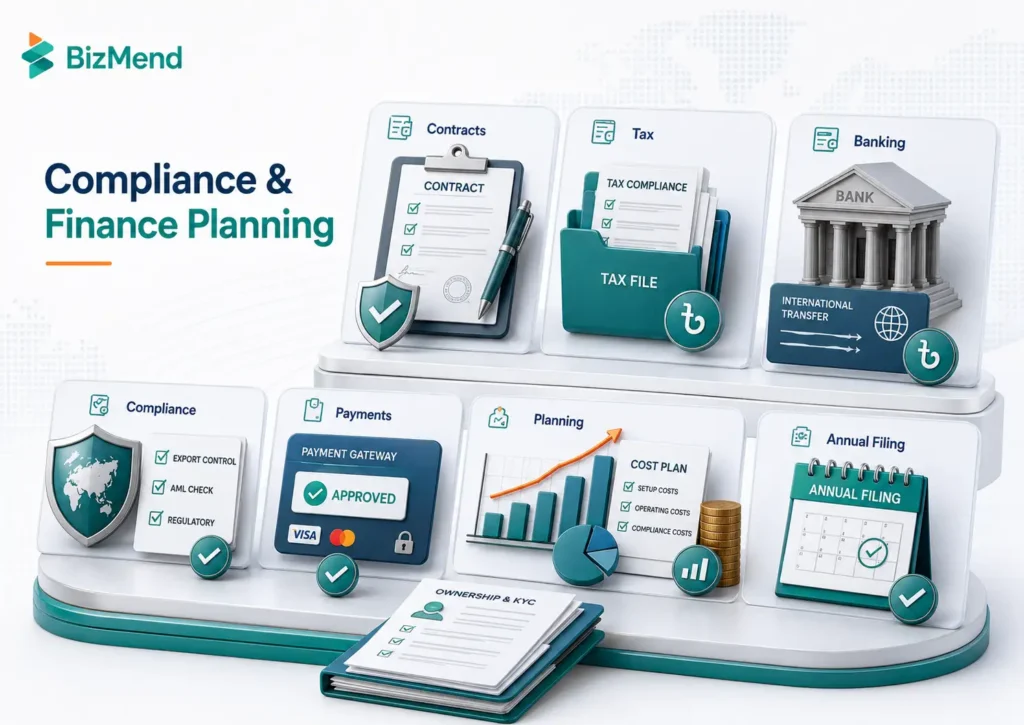
A foreign entity does not remove Bangladesh-side compliance. Exporters and service providers should understand trade licensing, foreign exchange rules, income tax in Bangladesh 2026, and how export proceeds or overseas income is received.
Bangladesh Bank’s foreign exchange guidance includes sections on outward remittances, inward remittances, imports, exports, and dealings in foreign currency. For goods exports, Bangladesh Bank guidance refers to export declaration through EXP forms and payment receipt through authorised dealer banks. CCI&E is the relevant authority for importer and exporter registration processes.
Because rules vary by sector and transaction type, businesses should confirm current requirements with their bank, accountant, and relevant regulator before moving funds, lending to a foreign company, paying overseas vendors, or transferring intellectual property.
Contracts and documents you should prepare
Global expansion becomes risky when agreements are informal. Even friendly overseas customers, distributors, or partners should be handled with written documents.
- Customer contracts with scope, delivery terms, payment timing, refund rules, governing law, and dispute process.
- Distributor or agency agreements with territory, exclusivity, sales targets, brand rules, and termination rights.
- Export documents such as commercial invoice, packing list, shipping documents, certificates, and bank-required papers.
- Intercompany agreements if a Bangladeshi parent works with a foreign subsidiary.
- Data protection, privacy, and IP ownership clauses for software, ecommerce, and service businesses.
- Board resolutions, ownership records, tax registrations, accounting files, and beneficial ownership information.
Documentation is not just paperwork. It helps banks, payment gateways, tax authorities, partners, and auditors understand why the structure exists.
Cost planning for overseas expansion
The cost of internationalization Bangladesh company owners face is wider than registration fees. Budget for the full annual lifecycle.
| Cost area | Examples |
| Setup | Name reservation, incorporation, license, registered office, notarization, translations, professional support |
| Operations | Bookkeeping, bank or EMI fees, payment gateway fees, renewals, website updates, compliance software |
| Tax and filings | Corporate tax return, VAT/GST registration when applicable, annual accounts, confirmation statements, local agent fees |
| Market entry | Localization, packaging, trade fairs, ads, distributor onboarding, product testing |
| Risk buffer | Refunds, chargebacks, shipment delays, exchange rate movement, legal review |
A lean service business may test a market with modest fixed cost. A product exporter may need more budget for certification, logistics, warehousing, insurance, and local representation.
Step-by-step global expansion checklist
- Define the expansion objective: payment access, export sales, local hiring, investor readiness, or market entry.
- Validate demand in one country before building a multi-country plan.
- Map legal requirements, licensing, tax, product rules, and banking options.
- Compare Bangladesh’s export and foreign exchange obligations with target-country requirements.
- Choose the setup route: export-only, partner, marketplace, branch, subsidiary, or foreign company.
- Prepare ownership, tax, accounting, website, contract, and KYC documents.
- Open banking and payment channels only with accurate business information.
- Set pricing with taxes, gateway fees, refunds, shipping, compliance, and currency movement included.
- Create contracts for customers, distributors, suppliers, employees, or local partners.
- Review the structure annually and close unused entities before they become compliance liabilities.
Common mistakes to avoid
- Choosing a country because it sounds prestigious, not because customers or banks require it.
- Assuming a company registration automatically guarantees bank or gateway approval.
- Using borrowed payment accounts, fake addresses, or nominee arrangements that can trigger account closure.
- Ignoring Bangladesh Bank, tax, export, and authorised dealer bank requirements.
- Signing exclusive distributor agreements without sales targets or termination rights.
- Forgetting annual filing, renewal, accounting, and local representative costs.
- Treating tax advice from social media as a final legal opinion.
The practical rule is simple: if the structure cannot survive a bank review, tax review, or customer due diligence check, it is not a strong expansion structure.
Key takeaways
- Global expansion Bangladeshi business owners can sustain starts with demand, not paperwork.
- UAE, UK, and Singapore routes solve different problems; none is universally best.
- International payment gateway access depends on real compliance, not just incorporation.
- Bangladesh export, remittance, tax, and banking rules still matter after overseas formation.
- Contracts, documentation, and annual compliance should be budgeted before launch.
Frequently asked questions
Can I expand globally without registering a foreign company?
Yes. Many businesses start by exporting from Bangladesh, selling services directly, using distributors, or testing marketplaces. A foreign company becomes useful when you need local contracts, banking, payment gateway access, employees, or stronger market presence.
Which country is best for overseas expansion from Bangladesh?
There is no single best country. UAE may fit Gulf trade and regional presence. The UK may fit international credibility and online company setup. Singapore may fit Asia-facing operations. The right answer depends on customers, banking, tax, compliance, and cost.
Can a Bangladeshi business open Stripe through an overseas company?
A foreign company in a Stripe-supported country may be eligible only if it meets Stripe’s requirements for that country and business model. The company, owners, bank account, website, tax details, and operations must be real and consistent.
Do I need an Export Registration Certificate from Bangladesh?
Goods exporters generally need to follow Bangladesh export registration and authorised dealer bank processes. Requirements can vary by product and transaction, so confirm with CCI&E, your bank, and professional advisers before shipping.
Should I choose a distributor or my own company abroad?
A distributor can be better for early product testing because it lowers fixed cost. Your own company may be better when you need direct control, local staff, payment accounts, or long-term contracts. Many businesses test through partners before forming an entity.
What is the biggest risk in overseas expansion BD founders face?
The biggest risk is building an overseas structure without a real market, clean documents, or compliant money movement. That can lead to bank rejection, payment holds, tax penalties, partner disputes, and unnecessary annual costs.
Conclusion
Learning how to expand business from Bangladesh is really about sequencing. First confirm demand, then choose the market, then decide whether export, distributor, marketplace, branch, or foreign company setup is the right route. UAE, UK, and Singapore can all be useful, but only when they match the business model.
The strongest expansion plans are boring in the best way: clear records, honest banking information, realistic cost planning, strong contracts, and regular compliance reviews. A foreign entity can open doors, but disciplined execution keeps those doors open.