
How to Become a Daraz Seller in Bangladesh: Registration, Fees & Growth
Learn how to become a Daraz seller in Bangladesh, register an account, list products, understand fees, manage orders, and grow…
 by Sheikh Ornob

Learn how to open company in UAE from Bangladesh, compare free zone and mainland setup, and understand costs, documents, visas, banking, tax, and renewals.
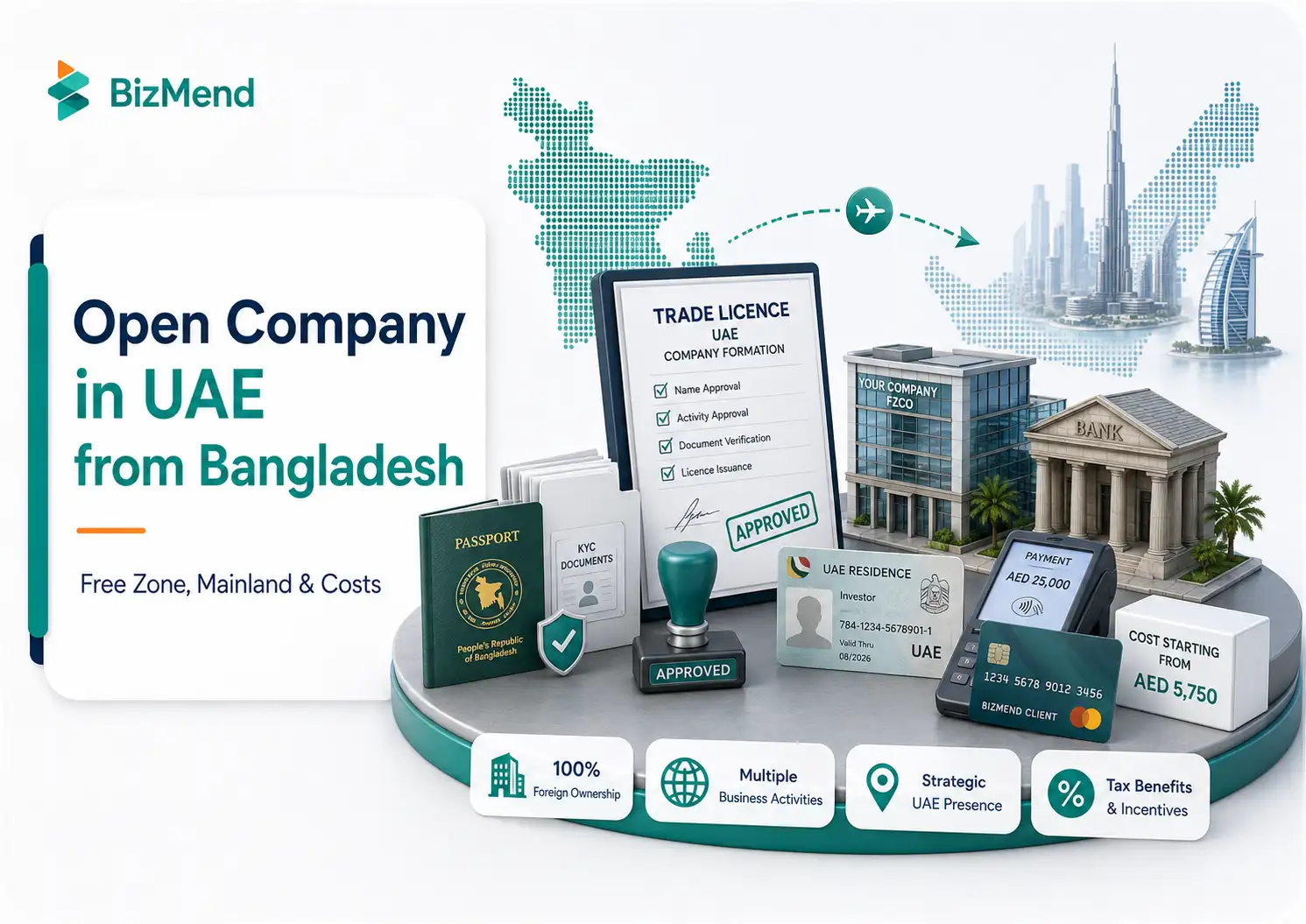
Opening a UAE company from Bangladesh is possible, but founders should first understand how to expand business from Bangladesh, because the right setup depends on customers, activity, visa needs, banking, and local-market access.
Dubai is a major business hub, but it is only one option. Bangladeshi founders can also compare free zones and mainland licences across Abu Dhabi, Sharjah, Ras Al Khaimah, Ajman, and other emirates before committing to a structure or cost.
Quick Answer: Bangladeshi entrepreneur can generally open a UAE company by selecting an approved business activity, choosing a free zone or mainland licensing authority, reserving a trade name, submitting identification and KYC documents, paying the authority’s fees, and obtaining the licence and incorporation documents. Many straightforward free-zone applications can begin remotely, and some eligible digital packages may complete licence issuance online, but visa, Emirates ID, medical fitness, banking, and payment-gateway steps remain separate. However, incorporation does not automatically guarantee a UAE residence visa, business bank account, or payment gateway. Those are separate approval processes. Total cost depends on the authority, activity, office or desk requirement, visa quota, external approvals, and annual renewal package.
Yes. UAE company-formation rules generally allow foreign founders to establish companies, and UAE corporate tax applies based on the entity and its activities rather than the owner’s nationality. A Bangladeshi passport holder may therefore apply for a suitable mainland or free-zone structure, subject to the licensing authority’s KYC, security screening, business-activity rules, and any sector-specific approval.
The licence must match the real business model. Consultancy, e-commerce, trading, food, fintech, and construction activities can require different authorities, premises, approvals, and budgets.
A trade licence creates the legal business. Residence, Emirates ID, bank onboarding, and payment processing are separate procedures with independent approval.
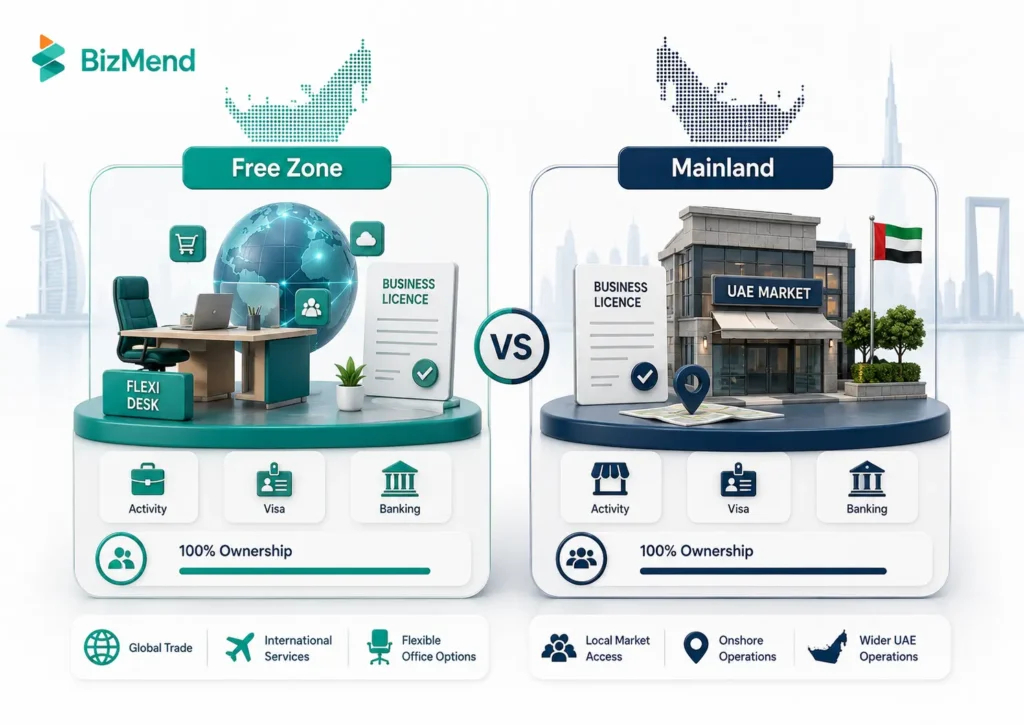
The main choice is a free zone or mainland licence. They are issued by different authorities and support different commercial routes.
A free-zone company is registered with its zone authority and may use a desk, office, warehouse, or visa package. A mainland company is licensed by the relevant emirate authority and generally suits direct onshore operations.
| Point | Free-zone company | Mainland company |
| Licensing authority | The selected free-zone authority | The emirate’s economic or licensing authority |
| Typical fit | International services, digital businesses, selected trading, logistics, or sector clusters | Direct UAE local-market operations, physical outlets, field services, and wider onshore activity |
| Workspace | May offer flexi-desk, office, warehouse, or facility packages | Premises and tenancy requirements depend on the activity and emirate |
| UAE market access | Depends on the licence, activity, distribution route, branch or dual-licence options, and other approvals | Generally designed for direct onshore business within the licensed activities |
| Foreign ownership | Commonly 100% foreign-owned | Many UAE mainland activities allow 100% foreign ownership, but activities with strategic impact or regulated sectors may require special approvals, restrictions, or different ownership conditions. |
| Corporate tax | Within the UAE corporate-tax system, 0% may apply only to qualifying income of a qualifying free-zone person, while non-qualifying income can be taxed at 9%. | Within the UAE corporate-tax system under the normal applicable rules |
| Cost pattern | Often packaged, but visas, facilities, immigration files, and approvals may be extra | Licence, approvals, tenancy, and activity-specific costs are usually quoted separately |
A free zone often suits freelancers, agencies, software firms, consultants, exporters, and founders running e-commerce in Bangladesh who serve customers outside the UAE. Specialized zones and flexible workspace options can simplify the setup.
A mainland licence often suits shops, restaurants, salons, contracting, on-site services, and businesses needing broad direct access to UAE customers.
Compare customer location, activities, office and visa needs, logistics, banking profile, tax treatment, and renewal cost. A cheap but unsuitable licence can cost more later.
| Note: Practical rule: choose the activity and commercial route first; choose the emirate and package second. Do not select a licence only because its advertisement shows the lowest headline price. |
1. Define the real business activity: Define how the company earns money, services, trading, e-commerce, import-export, manufacturing, or a regulated activity. The licensed wording must cover the real work.
2. Compare the emirate and jurisdiction: Shortlist authorities that license the activity. Compare Dubai with specialized or lower-overhead options in other emirates.
3. Choose the legal form and shareholders: Choose the permitted legal form and confirm shareholder, manager, share capital, and corporate-shareholder rules.
4. Reserve the trade name: Submit several compliant names. Restricted wording, trademarks, or misleading descriptions can be rejected.
5. Prepare and submit KYC documents: Submit passport, contact, application, address, and KYC documents. Corporate shareholders and regulated activities usually need more evidence.
6. Obtain approvals and arrange workspace: Obtain sector approvals and arrange the required flexi-desk, office, warehouse, or tenancy.
7. Pay the official quotation and receive documents: Pay through the official channel, receive the licence and incorporation documents, and check all names, activities, owners, managers, and expiry dates.
8. Complete post-license registrations: Open any required immigration file, apply for eligible visas, register for corporate tax, assess VAT, arrange bookkeeping, and start banking and gateway onboarding.
9. Check the Bangladesh remittance route: Before moving funds, founders should understand how to receive international payments in Bangladesh and what documentation banks may require. A UAE licence alone does not authorize outward remittance from Bangladesh.
Requirements vary by authority, activity, and shareholder profile. Ask for an authority-specific checklist. A simple individual application commonly starts with:
| Note: Passport and visa basics: keep a passport with sufficient validity for the authorities and travel process. A company licence is not a residence visa. When a residence application is available under the package, immigration approval, entry or status procedures, medical fitness, biometrics, Emirates ID, and insurance requirements may still apply. |
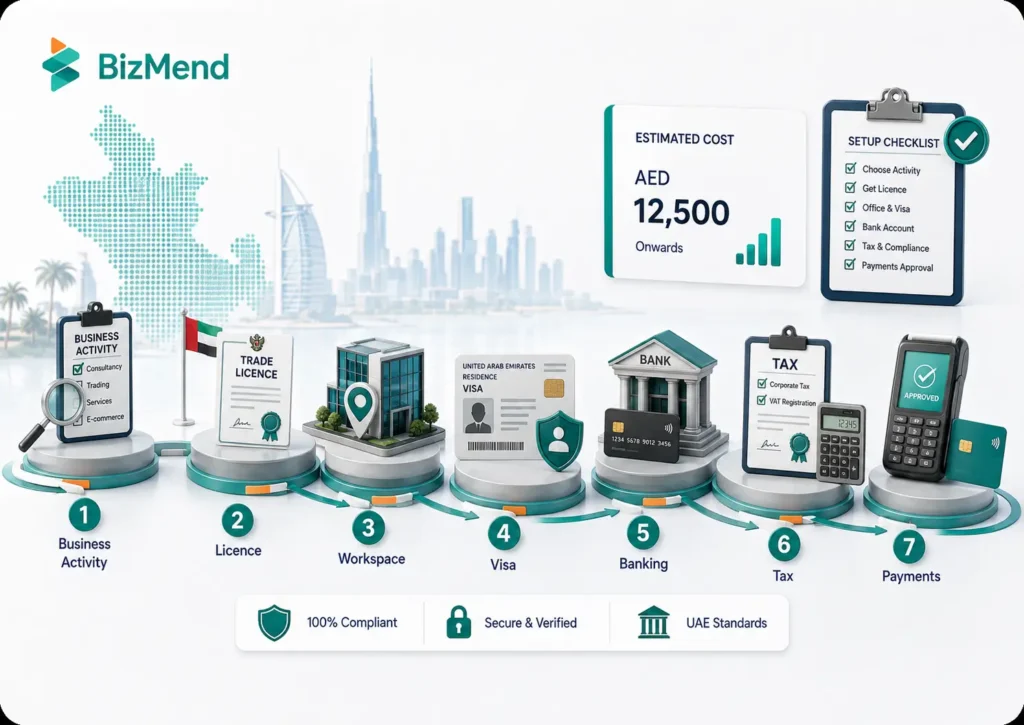
There is no reliable single answer to UAE business setup cost. The amount shown in an advertisement may cover only the licence, while the usable first-year setup may also need registration, workspace, establishment card, visa allocation, medical and ID costs, regulatory approvals, customs registration, insurance, bookkeeping, and banking preparation.
As one current official free-zone example checked on 14 July 2026, Meydan Free Zone advertised business setup from AED 12,500 and a Fawri instant licence from AED 15,000; visas, Emirates ID, banking, bookkeeping, and other add-ons are not included in the base cost. These are authority-specific starting prices, not a UAE-wide benchmark, and optional visas, facilities, immigration services, or other add-ons can change the final invoice.
For a mainland setup, request an itemized quotation from the relevant emirate authority or authorized channel after the activity and premises are confirmed. Rent or specialized approvals can cost more than the licence itself.
| Cost component | Why it changes |
| Trade licence and registration | Authority, legal form, number and type of activities, and package |
| Trade-name and initial approvals | Name category, activity, and emirate |
| External approvals | Health, education, finance, media, food, transport, engineering, and other regulated sectors |
| Workspace or premises | Flexi-desk, office size, shop, warehouse, Ejari or tenancy, and location |
| Immigration and visas | Establishment file, visa quota, entry or status process, medical, ID, and insurance |
| Customs and logistics | Importer code, warehouse, product registration, customs, and logistics model |
| Professional support | Document legalisation, translation, accounting, tax, audit, and compliance |
| Annual renewal | Licence, premises, visas, establishment file, insurance, and regulatory renewals |
The licence timeline depends on the authority and the complexity of the application. Official free-zone examples show why one promise cannot fit every setup: Meydan promotes rapid digital issuance for eligible applications, including Fawri issuance in under 60 minutes, while DMCC says company registration typically takes around 10 working days depending on document completeness and setup requirements.
Regulated activities, a corporate shareholder, document legalization, security checks, external approvals, or a physical tenancy can extend the process. Visa, bank, and payment-gateway applications should not be included in a guaranteed company-formation timeline because each has its own review.
| Stage | Planning expectation |
| Activity and authority selection | Depends on how clear the business model and approval route are |
| Licence approval and issuance | Can be rapid for eligible digital packages; some established zones quote about 10 working days |
| Residence and Emirates ID | Separate immigration process; timing depends on approval and completion of required steps |
| Business bank account | Separate KYC and risk review; no licence provider can guarantee approval or a fixed time |
| Payment gateway | Separate underwriting, website and business-model review |
After incorporation, the company can apply for a UAE business bank account, but approval is not guaranteed. Banks may review KYC, AML, sanctions, source of funds, expected transactions, business substance, UAE address, website, contracts, invoices, and owner profile.
Prepare the licence, incorporation and constitutional documents, passports, UBO details, address evidence, plan, contracts or invoices, website, expected markets and currencies, and source-of-funds evidence. A bank may also request UAE residence, Emirates ID, office evidence, or a meeting.
Keep the licence, website, invoices, and bank explanation consistent. Vague activity, weak commercial evidence, or unrealistic turnover can delay review.
A UAE entity may evaluate Stripe global availability, Amazon Payment Services, Network International, PayTabs, Telr, or other suitable gateways before choosing a payment route while Bangladeshi founders should also understand payment gateways in Bangladesh before comparing local and overseas options. Confirm current availability, pricing, settlement, reserves, and industry restrictions directly.
A gateway review commonly checks the licence, settlement account, website, products, prices, delivery and refund terms, privacy policy, contact details, KYC, and sometimes supplier or fulfillment evidence.
Do not buy a package based on a promised gateway. Payment providers make their own onboarding decisions.
UAE companies, including free-zone companies, fall within the federal corporate-tax framework unless a specific exemption applies. Under the UAE corporate-tax framework, the standard rate is 0% on taxable income up to AED 375,000 and 9% on taxable income above AED 375,000, subject to applicable exemptions, reliefs, and free-zone rules. A qualifying free-zone person may receive 0% on qualifying income, while non-qualifying taxable income is subject to 9%. Free-zone registration alone does not create an automatic 0% result.
Taxable persons generally need to meet corporate-tax registration and filing obligations, and UAE FTA guidance says tax returns and any corporate tax payable must be submitted within nine months from the end of the tax period. Keep proper accounting records from the first transaction, not from the first tax deadline.
The UAE’s standard VAT rate is 5%. FTA says mandatory VAT registration applies when taxable supplies and imports exceed AED 375,000, while voluntary registration may be available when taxable supplies, imports, or taxable expenses exceed AED 187,500, subject to the applicable tests. Registration thresholds are not the same as corporate-tax thresholds, even when the number looks similar.
Maintain accurate ownership, UBO, accounting, and licence records; follow sector rules, and renew licences, premises, visas, insurance, and permits. Audit requirements vary.
A UAE company does not automatically remove Bangladesh tax, reporting, foreign-exchange obligations, or income tax in Bangladesh 2026 planning. Treatment depends on residence, control, income source, remittance, and treaty rules, so obtain case-specific advice.
The safest way to approach Dubai business setup from BD is to start with the commercial reality, compare official requirements, and review UAE company formation support only after the activity, banking, visa, and tax route are clear. Define the activity, customer location, office and visa needs, banking profile, and Bangladesh remittance route. Then compare suitable mainland and free-zone authorities using written first-year and renewal quotations. A well-matched licence can support international growth, but the company, residence visa, bank account, payment gateway, and tax position must each be planned separately. Before paying, verify the current authority rules and obtain professional legal or tax advice where the activity, ownership, funding, or cross-border tax position is complex.
Many free-zone applications can be started and, in some cases, completed remotely. Travel may still be needed for residence procedures, medical fitness, biometrics, bank onboarding, premises, or an authority-specific requirement.
There is no universal Dubai price. Cost depends on the activity, mainland or free-zone authority, office or desk, visa quota, immigration services, approvals, and renewal package. Use only a written, itemised quotation.
A free zone is often simpler for a freelancer or agency serving international clients, provided the activity and customer route fit. A mainland licence may be better when services are delivered directly across the UAE local market.
Many mainland activities and most free-zone structures allow 100% foreign ownership. However, strategic-impact, regulated, or specially controlled activities may have different ownership or approval conditions.
Not automatically. The company must have an eligible visa allocation, and the applicant must complete the separate immigration process and receive approval. Avoid anyone promising a guaranteed visa based only on licence purchase.
No. Banks independently review the business, owners, source of funds, countries, expected transactions, and commercial evidence. Strong, consistent documentation improves the application but cannot guarantee approval.
Only if it qualifies under the corporate-tax rules and the income is qualifying income. A free-zone licence by itself is not enough, and non-qualifying taxable income may be taxed at 9%.

Learn how to become a Daraz seller in Bangladesh, register an account, list products, understand fees, manage orders, and grow…
by Sheikh Ornob

Compare the cost of living in Bangladesh in 2026, including Dhaka and Chittagong rent, food, transport, utilities, inflation, and monthly…
by Sheikh Ornob

Learn MoA and AoA requirements in Bangladesh, key clauses, drafting basics, RJSC filing steps, amendments, and common company-registration mistakes. Suggested…
by Sheikh Ornob