
How to Become a Daraz Seller in Bangladesh: Registration, Fees & Growth
Learn how to become a Daraz seller in Bangladesh, register an account, list products, understand fees, manage orders, and grow…
 by Sheikh Ornob

Learn how Bangladeshi founders can open a Singapore company, including CSP and resident director rules, costs, taxes, banking, and annual compliance.
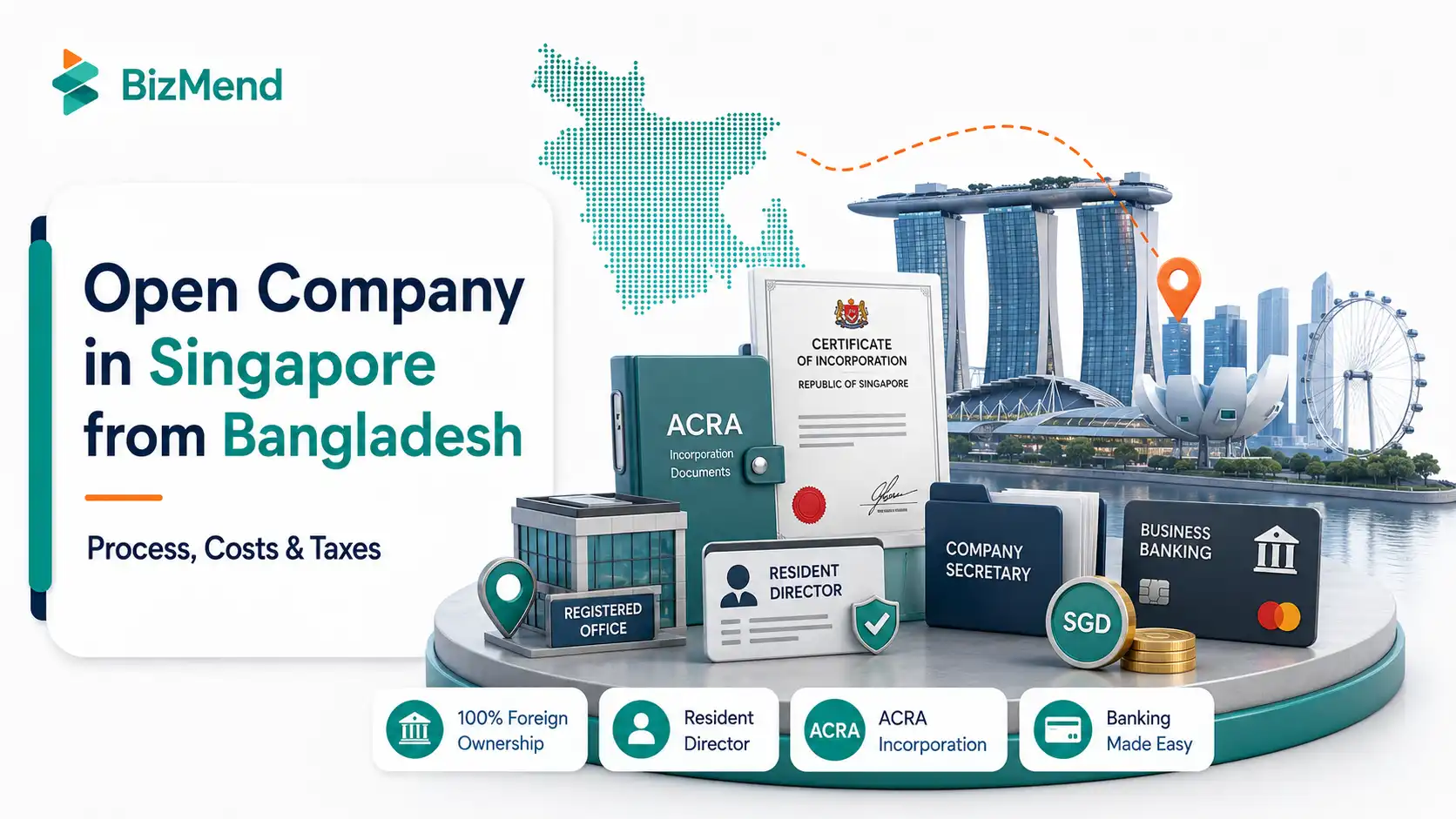
Open a company in Singapore from Bangladesh is possible, but founders should first understand how to expand business from Bangladesh, because incorporation is only the first part of the job. A foreign founder must plan the resident director, registered office, company secretary, ownership structure, banking evidence, and annual compliance before filing.
For most founders, a private company limited by shares is the practical structure, while founders comparing Gulf options can also review how to open company in UAE from Bangladesh. Incorporation may be fast when the filing is complete, but bank and payment approvals remain separate decisions.
Quick Answer: A Bangladeshi founder can open a Singapore company by engaging a registered corporate service provider, reserving an ACRA-approved name, selecting the correct business activity, appointing at least one director who meets Singapore local residency requirements, providing a Singapore-registered office, issuing at least S$1 in share capital, and filing the incorporation through Bizfile. The company secretary must be appointed within six months after successful registration, and the position cannot remain empty for more than six months. ACRA charges S$15 to apply for a new business entity name and S$300 to register a new business entity; these are government filing fees only, not the full cost of a foreign-founder setup. Professional, resident-director, office, accounting, tax, banking, and renewal costs are separate. Incorporation does not automatically provide a Singapore visa, tax residency, bank account, or payment gateway approval.
Yes. A Bangladeshi individual or overseas company can hold shares in a Singapore company. The main local-presence requirements concern the resident director, secretary, and registered office.
ACRA requires foreign founders to use a registered Corporate Service Provider, or CSP. The company must also have at least one director who meets Singapore’s local residency rules; the Bangladeshi founder may remain a shareholder and foreign director.
Incorporating a company also does not give the founder a residence visa. Anyone who plans to move to Singapore and actively work there needs an appropriate work pass. Eligibility depends on the founder, the business, and the applicable Ministry of Manpower rules.
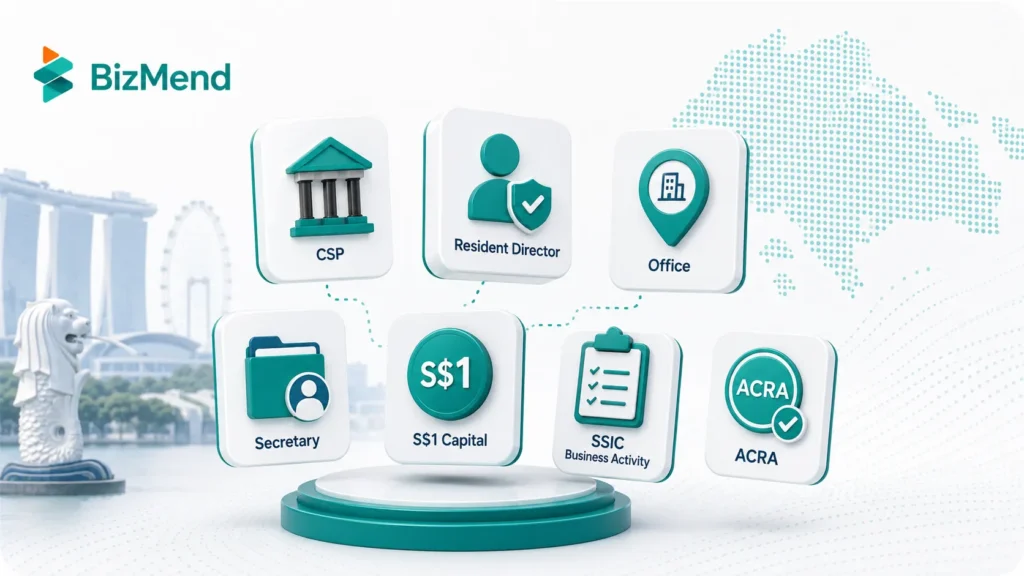
Most overseas founders choose a private company limited by shares, commonly shown as “Pte. Ltd.” It is a separate legal entity from its shareholders.
Before paying, confirm whether the quote includes the resident director, office, secretary, compliance checks, and annual services.
| Requirement | Practical rule |
| Corporate Service Provider | Foreign founders must use a registered CSP to reserve the name and file the incorporation. |
| Shareholder | At least one shareholder is needed. Shares may be held by an individual or another legal entity. |
| Director | At least one director must meet Singapore’s local residency rules. Additional foreign directors may be appointed. |
| Company secretary | An individual meeting local residency requirements must be appointed within six months. The sole director cannot also be the secretary. |
| Registered office | A physical Singapore address is required and must be accessible during normal business hours. A P.O. Box is not sufficient. |
| Share capital | At least S$1 in share capital is required to start, but founders should choose paid-up capital that also fits banking, licensing, supplier, and operating needs. |
| Business activity | The name application must state the most relevant SSIC activity code. Regulated activities may need separate approval or licensing. |
| Constitution and registers | The company needs a constitution and must maintain required ownership, controller, nominee, and corporate records. |
The legal filing is handled in Singapore, but most planning can be completed remotely from Bangladesh. The following sequence reduces avoidable delays.
The checklist depends on the CSP, ownership, activity, and risk profile. Documents must be current and consistent.
A document accepted for incorporation may not satisfy a bank or payment provider.
There is no reliable single “all-inclusive” cost for every Bangladeshi founder. Only the ACRA filing fees are fixed at the government level; most other costs depend on the provider, business profile, ownership, and required services.
| Cost item | What to budget for |
| Name application | S$15 ACRA fee; non-refundable if the name is unavailable or withdrawn. |
| Company incorporation | S$300 ACRA registration fee. |
| CSP professional fee | Preparation, due diligence, Bizfile filing, constitution, and post-incorporation records. Scope varies. |
| Resident director | May be a major recurring cost when the founder has no qualifying director. Security deposit, risk limits, and enhanced due diligence may apply. |
| Registered office | Recurring fee if the company does not maintain its own compliant Singapore premises. |
| Company secretary | Recurring statutory and administrative service. Basic packages may charge separately for resolutions or changes. |
| Accounting and tax | Bookkeeping, financial statements, ECI, corporate tax return, GST work, and audits are required. |
| Banking and payments | Potential account, transfer, card, FX, platform, and merchant fees after approval. |
| Licences and work passes | Separate government and professional fees when the activity or relocation plan requires them. |
Request a written first-year and renewal breakdown covering government fees, director, address, secretary, KYC, bookkeeping, tax, changes, and closure. Low first-year pricing may exclude essential renewals.
A straightforward filing may be approved quickly after payment and officer endorsement, but same-day approval is not guaranteed because name review, authority referrals, due diligence, officer endorsement, and document checks can extend the timeline.
ACRA notes that a proposed name requiring review can take up to three working days, while referrals may take up to 15 working days. A complex company registration may take up to 15 working days, and a filing requiring another authority’s approval can take 14 to 60 days.
The full project takes longer because due diligence, director onboarding, licensing, banking, and payment reviews are separate stages.
A Singapore company can apply for a business account in its own name, but incorporation does not guarantee approval. Banks and regulated payment institutions apply their own customer due diligence, sanctions screening, risk appetite, and product rules.
Expect questions about beneficial owners, source of funds, business model, customers, countries, currencies, transaction sizes, and the reason for using Singapore. Weak commercial evidence can extend review.
Prepare one consistent file with the company profile, ownership chart, IDs, UEN, constitution, address evidence, contracts, invoices, and realistic transaction estimates. Never manufacture local substance or trade evidence.
Payment gateways are separate from bank accounts, and Bangladeshi founders should also understand payment gateways in Bangladesh before comparing Singapore-based payment options. Make the website and legal company details consistent before applying.
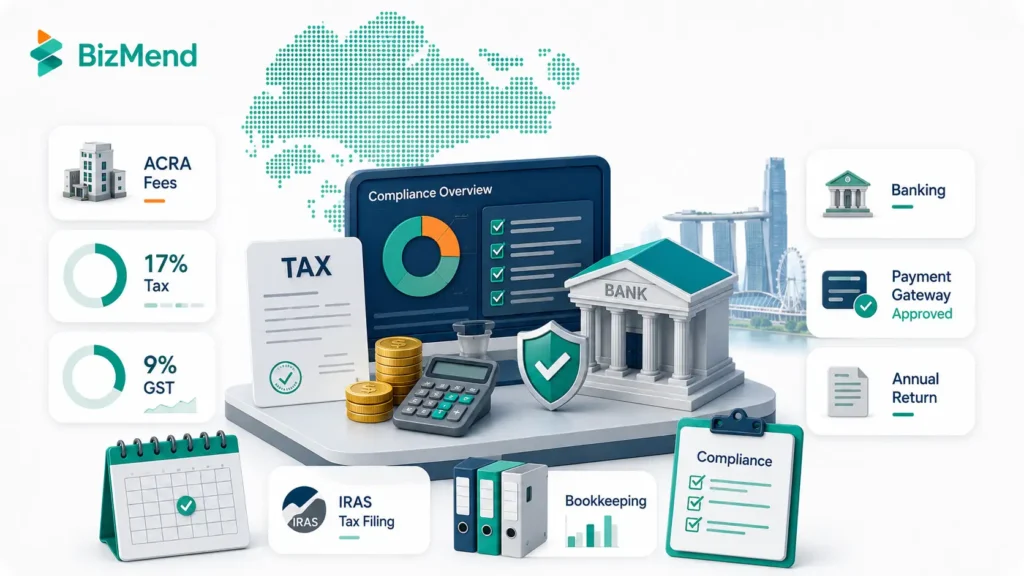
Singapore’s prevailing corporate income tax rate is 17% of chargeable income. This is not 17% of revenue; taxable profit, adjustments, and reliefs matter.
A qualifying Singapore-incorporated start-up may receive a 75% exemption on the first S$100,000 of normal chargeable income and 50% on the next S$100,000 for its first three consecutive years of assessment, but it must meet IRAS conditions and exclusions.
Incorporation does not automatically create Singapore tax residence. IRAS looks at where control and management are exercised, including strategic decisions and board facts.
The current GST rate is 9%. IRAS says compulsory GST registration applies when taxable turnover is more than S$1 million under the retrospective view or is expected to be more than S$1 million in the next 12 months under the prospective view. Cross-border supplies and zero-rating require transaction-specific review.
A Bangladesh-based owner should also review income tax in Bangladesh 2026, foreign-exchange, remittance, and reporting obligations. and how to receive international payments in Bangladesh. Singapore incorporation does not remove liabilities created elsewhere.
Directors remain responsible even when a CSP, accountant, or secretary handles administrative work.
Choose the FYE carefully and keep separate calendars for ACRA, IRAS, GST, licences, and renewals.
For a Bangladeshi founder, the safest way to open a Singapore company is to plan beyond the incorporation certificate, and business consulting can help review the activity, ownership, resident director, banking evidence, tax position, and annual budget before filing.
Singapore offers a clear corporate system, but it also expects accurate records and responsible directors. Treat incorporation, immigration, banking, payments, tax residency, and ongoing compliance as separate workstreams. A realistic plan and qualified Singapore and Bangladesh advice will usually save more than a low-cost package that leaves essential requirements unresolved.
Incorporation can usually be coordinated remotely through a CSP. Banking, licensing, payment, or work-pass reviews may still require extra verification or an in-person step.
No Singapore shareholder is required merely because the founder is Bangladeshi. The company instead needs a qualifying resident director, a local office, and a secretary arrangement.
No. ACRA states that directors cannot avoid responsibility by being described as inactive, sleeping, or nominee directors. Every director must understand the appointment and comply with statutory duties.
S$1 meets the starting rule but may be commercially insufficient. Choose capital that reflects operations, licences, contracts, and funding needs.
No. The headline corporate tax rate is 17%, and exemptions have eligibility conditions. Tax residency depends on control and management, while transactions and operations may also create tax obligations in Bangladesh or elsewhere.
It can apply to suitable providers, but approval is not automatic. Providers assess the activity, ownership, website, customer countries, risk, policies, settlement account, and evidence of genuine trade.
It may still need annual returns, tax filings or a waiver, records, a secretary and office services, and updated registers. Manage dormancy formally.

Learn how to become a Daraz seller in Bangladesh, register an account, list products, understand fees, manage orders, and grow…
by Sheikh Ornob

Compare the cost of living in Bangladesh in 2026, including Dhaka and Chittagong rent, food, transport, utilities, inflation, and monthly…
by Sheikh Ornob
Learn MoA and AoA requirements in Bangladesh, key clauses, drafting basics, RJSC filing steps, amendments, and common company-registration mistakes. Suggested…
by Sheikh Ornob