
How to Become a Daraz Seller in Bangladesh: Registration, Fees & Growth
Learn how to become a Daraz seller in Bangladesh, register an account, list products, understand fees, manage orders, and grow…
 by Sheikh Ornob

Learn how Bangladeshis can register a UK LTD remotely, including Companies House rules, costs, tax, banking, and annual filing duties.

A Bangladeshi founder can register a UK private limited company without moving to the United Kingdom. The process is largely online, and a director does not have to live in the UK.
Incorporation is only the first step. The company must also receive official mail, complete identity checks, prepare for banking, pay taxes correctly, and meet annual filing deadlines.
Quick Answer: UK company formation for Bangladeshis is possible remotely. A private company limited by shares needs at least one director aged 16 or over, at least one shareholder, a valid UK-registered office, a registered email address, an approved company name, a SIC code, and details of any person with significant control. Directors do not have to live in the UK. As of 2026, identity verification is a legal Companies House requirement for directors and PSCs. Online incorporation costs £100 and is usually processed within 24 hours, but address services, professional support, accounting, banking, and payment onboarding create additional costs and separate approval processes.
Yes. UK law does not require the director of a private limited company to be resident in the UK. A Bangladeshi citizen can act as the only director and shareholder, provided the company has a compliant registered office in the UK and all required identity and incorporation information is supplied.
The usual structure is a private company limited by shares, a legal entity separate from its owners. It is not the same as operating as a sole trader, and incorporation does not give the founder a UK visa, residence, or permission to work in the UK.
Companies House is the public registrar, while HM Revenue and Customs, or HMRC, administers Corporation Tax, VAT, PAYE, and other taxes.
Identity verification is now central to UK company formation. From 18 November 2025, Companies House identity verification became a legal requirement for directors and people with significant control, commonly called PSCs.
Successful verification produces a personal code. New directors may need it during incorporation or appointment, while existing directors use it to connect their identity through the confirmation-statement process.
Verification can be completed through GOV.UK One Login where supported, or through an Authorised Corporate Service Provider, known as an ACSP. Companies House states that an ACSP can verify someone from any country, although the agent may charge a professional fee and will require approved identity evidence.
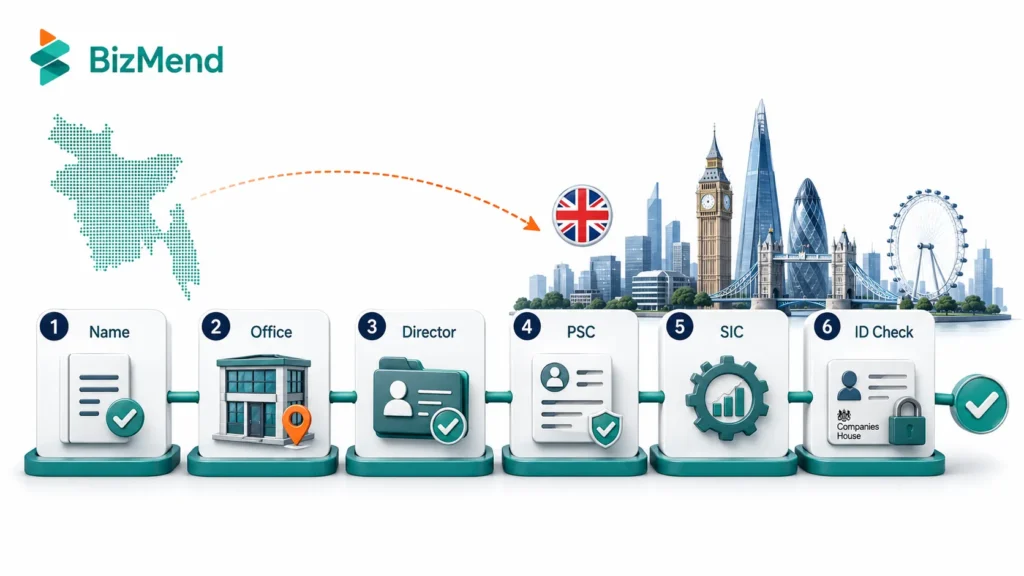
Most commercial founders choose a private company limited by shares. Decide who will be the director, shareholder, and PSC before submitting the application. A company needs at least one director and one shareholder, and the same person may hold both roles.
The name cannot be identical to an existing registered company name. It must normally end in “Limited” or “Ltd” and cannot use offensive or sensitive words without permission. Also check UK trademarks, because Companies House approval does not protect a brand from a later trademark dispute.
A simple single-founder company commonly issues one ordinary share with a nominal value such as £1. The value can be different, but the share structure should match the real ownership and voting arrangement. Anyone with more than 25% of the shares or voting rights will usually be a PSC and must be reported.
The registered office must be a physical address in the UK and in the same jurisdiction where the company is incorporated; it must also be an appropriate address where official mail can reach the company or its authorised representative. For example, an England and Wales company needs an address in England or Wales. The address must be “appropriate,” meaning company mail will reach the company or its authorized representative and delivery can be acknowledged.
A Royal Mail PO Box is not enough. A professional address provider can be used with permission, but it must genuinely receive and forward official correspondence. The registered office appears on the public register, so founders should not use a private address they do not want publicly displayed.
Companies House requires a registered email address; it is not published on the public register, but the company must read any emails Companies House sends to that address. Use a company-controlled address rather than an employee’s temporary personal inbox.
A Standard Industrial Classification code describes the company’s business activity. Companies House requires codes from its condensed SIC list. Choose the code that best matches the real activity, and use more than one only when the company genuinely operates in multiple areas.
The company needs a memorandum of association, articles of association, and a statement of capital. Most straightforward online incorporations use the standard model articles generated through the registration process. Bespoke ownership, investor, or voting arrangements may require tailored articles and legal review.
Verify each relevant director and PSC and obtain their personal codes where required. Make sure the spelling of names, dates of birth, and identity details matches the incorporation application. Small inconsistencies can delay verification or onboarding with an agent, bank, or payment provider.
The official Companies House registration fee is £100 for online incorporation, and a complete application is usually registered within 24 hours. Postal registration costs £124 and normally takes 8 to 10 days. A founder may also use an authorized agent or approved third-party software.
Once approved, Companies House issues a certificate of incorporation showing the company number and formation date. This confirms that the company legally exists.
Keep the Companies House authentication code secure because it is used for many online filings and acts like an electronic signature for the company. Also monitor the registered office for the company’s Unique Taxpayer Reference and other HMRC letters. Do not let an address provider, agent, or former employee become the only person with access to these records.
Companies House mainly collects information, but identity verification, agents, banks, and payment providers may request supporting evidence. Prepare:
Documents must be genuine, current, and consistent. A formation agent may require certified or translated copies depending on its compliance procedures.
The official filing fee is only one part of the cost. A realistic budget should separate mandatory government fees from services needed by a remote founder.
| Cost item | Current position | What to check |
| Companies House online incorporation | £100 | Official online filing fee |
| Postal incorporation | £124 | Slower alternative; usually unnecessary for a simple company |
| Registered office service | Provider-specific | Mail handling, renewal, jurisdiction, and document scanning |
| Identity verification | Free through GOV.UK where available; ACSP may charge | Accepted documents and support for overseas founders |
| Formation or legal support | Provider-specific | Included filings, share structure, PSC work, and aftercare |
| Confirmation statement | £50 online each review period | Separate from annual accounts and tax returns |
| Accounting and tax compliance | Depends on activity and complexity | Bookkeeping, accounts, Corporation Tax, VAT, payroll, and advice |
Avoid packages advertised as a complete lifetime setup for a tiny one-off price. The registered office, filing support, accounting, and compliance services usually renew, and banking or payment approval is never included merely because the company was incorporated.
A clean online Companies House application is usually processed within 24 hours. The total project may take longer because identity verification, document corrections, sensitive company names, agent due diligence, and address setup happen before or around incorporation.
Bank and payment onboarding should be treated as separate stages for founders who need to receive international payments in Bangladesh. They may take days or weeks and may involve further questions. The company should not promise clients a payment date until the operating account and processor are actually active.
A certificate of incorporation does not guarantee a UK business bank account, merchant account, or payment gateway in Bangladesh as an alternative. Every provider applies its own eligibility, country, risk, and compliance rules. Some traditional UK banks require directors or controlling persons to live in the UK, while some digital providers accept wider structures subject to their current policies.
Prepare a credible onboarding file and keep your bank account records consistent with ownership, contracts, invoices, and source-of-funds evidence.
Company records, addresses, website, ownership, and stated activity should be consistent. Vague business models or weak operational evidence can cause delays or refusal. Never buy or rent an account or use a false nominee.
A UK limited company must consider Corporation Tax once it starts doing business. HMRC treats activities such as buying, selling, advertising, renting property, or employing someone as signs that the company has started trading. The company will need its UTR and access to corporation tax services.
The current UK Corporation Tax main rate is 25% for profits above £250,000, while the small profits rate is 19% for profits of £50,000 or less; marginal relief may apply between those amounts, and thresholds can be reduced for short accounting periods or associated companies. The thresholds can be reduced for short accounting periods and associated companies, so a simple rate headline is not a final tax calculation.
VAT registration is not automatic when the company is incorporated. The normal UK taxable-turnover threshold is £90,000, but a business based outside the UK may need to register regardless of taxable turnover if it supplies, or expects to supply, goods or services to the UK. The correct treatment depends on where the business is actually established, what it sells, where customers are located, and whether goods enter the UK.
A Bangladeshi owner may also have personal, remittance, reporting obligations, and income tax in Bangladesh 2026 considerations outside the UK.
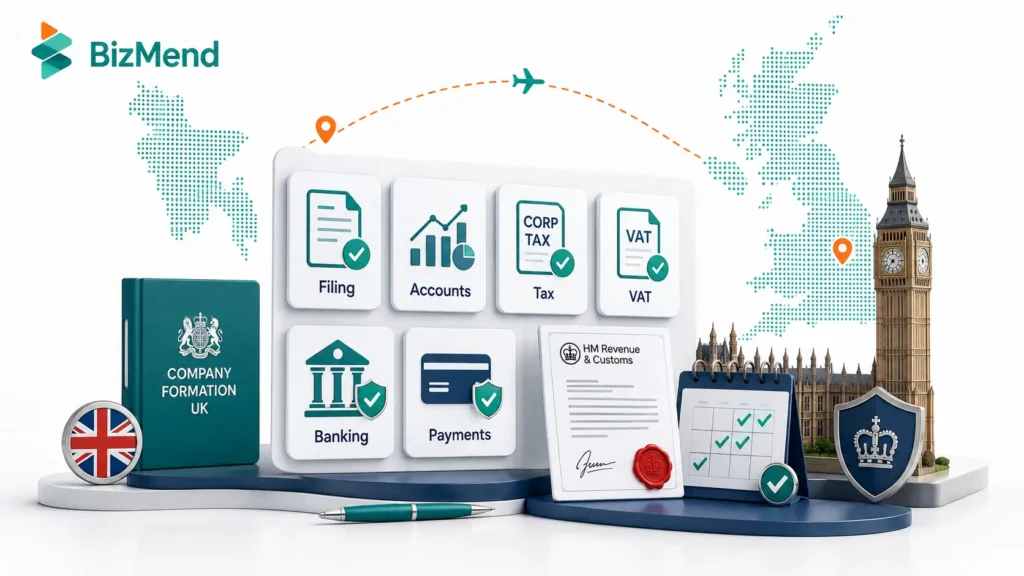
A company remains responsible for filings even when it has little activity. The main recurring duties include:
The confirmation statement is not the same as annual accounts, and neither replaces the Company Tax Return. Missing one filing because another was completed is a common and expensive mistake.
Yes. One person can generally be the sole director and sole shareholder of a private company limited by shares. The director must be at least 16, complete the required identity verification, and provide accurate address and role information.
No physical visit is normally required for a standard online incorporation. However, an identity verifier, bank, or payment provider may have its own document, interview, or geographic requirements.
No. Company ownership and immigration permission are separate. Registering a company does not grant a visa, residence, or permission to work in the UK.
You may use a service provider’s address with permission if it is a physical UK address and meets the Companies House “appropriate address” rules. A simple PO Box or an address that does not reliably handle mail is not acceptable.
Only after a suitable bank, electronic-money account, merchant account, or payment processor approves and activates the company. Formation alone does not make the business payment-ready.
You may still have Companies House and HMRC duties, including dormant-company filings where applicable. Whether professional help is necessary depends on the company’s activity, records, ownership, and tax position.
UK company formation for Bangladeshis is practical when the structure has a genuine business purpose. Treat incorporation as the beginning, not the finished product. Verify every director and PSC; use a reliable registered office; choose accurate SIC codes; secure the filing credentials; and prepare real evidence for banking and payment onboarding. After registration, maintain records and track the confirmation statement, accounts, corporation tax, and VAT duties. Cross-border advice becomes important when the company starts trading, or its ownership and transactions grow more complex, and founders may review UK company formation for non-residents support before moving ahead.

Learn how to become a Daraz seller in Bangladesh, register an account, list products, understand fees, manage orders, and grow…
by Sheikh Ornob

Compare the cost of living in Bangladesh in 2026, including Dhaka and Chittagong rent, food, transport, utilities, inflation, and monthly…
by Sheikh Ornob

Learn MoA and AoA requirements in Bangladesh, key clauses, drafting basics, RJSC filing steps, amendments, and common company-registration mistakes. Suggested…
by Sheikh Ornob