How to Become a Daraz Seller in Bangladesh: Registration, Fees & Growth
Learn how to become a Daraz seller in Bangladesh, register an account, list products, understand fees, manage orders, and grow…
 by Sheikh Ornob

Is cryptocurrency legal in Bangladesh? Learn Bitcoin and Binance rules, Bangladesh Bank warnings, crypto risks, penalties, and safer alternatives in 2026.
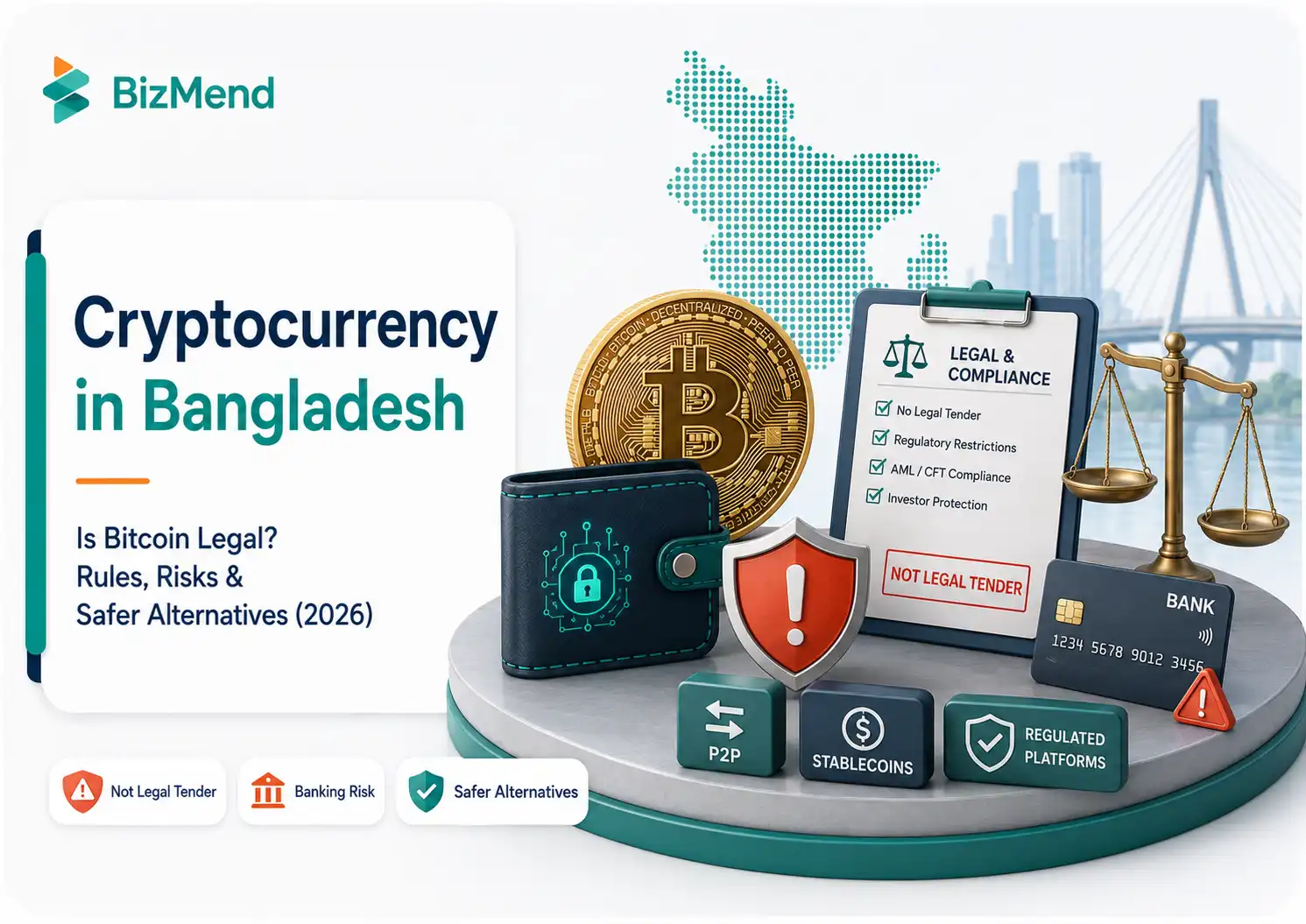
Cryptocurrency in Bangladesh remains a high-risk legal and regulatory topic in 2026. Bitcoin, USDT, and other tokens are not legal tender, and Bangladesh Bank has not approved them as foreign exchange, currency, transaction, or investment instruments for retail use in Bangladesh.
Anyone asking, “Is cryptocurrency legal in Bangladesh?” needs more than a careless one-line answer. The real exposure depends on what a person does, how money moves, and whether foreign exchange, money laundering, fraud, terrorism financing, payment system, or other laws are involved. This guide explains the practical position without offering trading workarounds or investment advice.
Quick Answer: Cryptocurrency in Bangladesh is not legal tender, and the Bangladesh Bank has stated that transactions made in, from, or to Bangladesh for obtaining virtual assets or virtual currencies are not permitted. Using Bitcoin, USDT, Binance, or peer-to-peer trades can create banking, foreign-exchange, fraud, and compliance risks. Technical access to an app does not mean local authorization.
For an ordinary user, the safest practical answer is that cryptocurrency is not legal tender, is not approved by Bangladesh Bank as a retail payment or investment channel, and transactions in, from, or to Bangladesh for obtaining virtual assets or virtual currencies are not permitted under Bangladesh Bank’s 2022 circular. Bangladesh Bank’s Payment and Settlement Systems page describes regulated channels such as MFS, PSPs, PSOs, BEFTN, NPSB, RTGS, and TakaPay. Crypto exchanges and privately issued tokens are not listed as authorized domestic payment rails.
Bangladesh Bank also states that Authorized Dealer banks conduct foreign-exchange transactions and that the central bank monitors and regulates the foreign-exchange market. Moving taka into offshore crypto markets, receiving value through stablecoins, or settling transactions outside authorized channels can therefore raise foreign-exchange and source-of-funds questions.
| Update Note: Legal-status update checked on 14 July 2026: No current official source located during this review showed a Bangladesh Bank-licensed retail cryptocurrency exchange or approved crypto payment method for the public; Bangladesh Bank’s 2022 circular also states that transactions for obtaining virtual assets or virtual currencies are not permitted. |
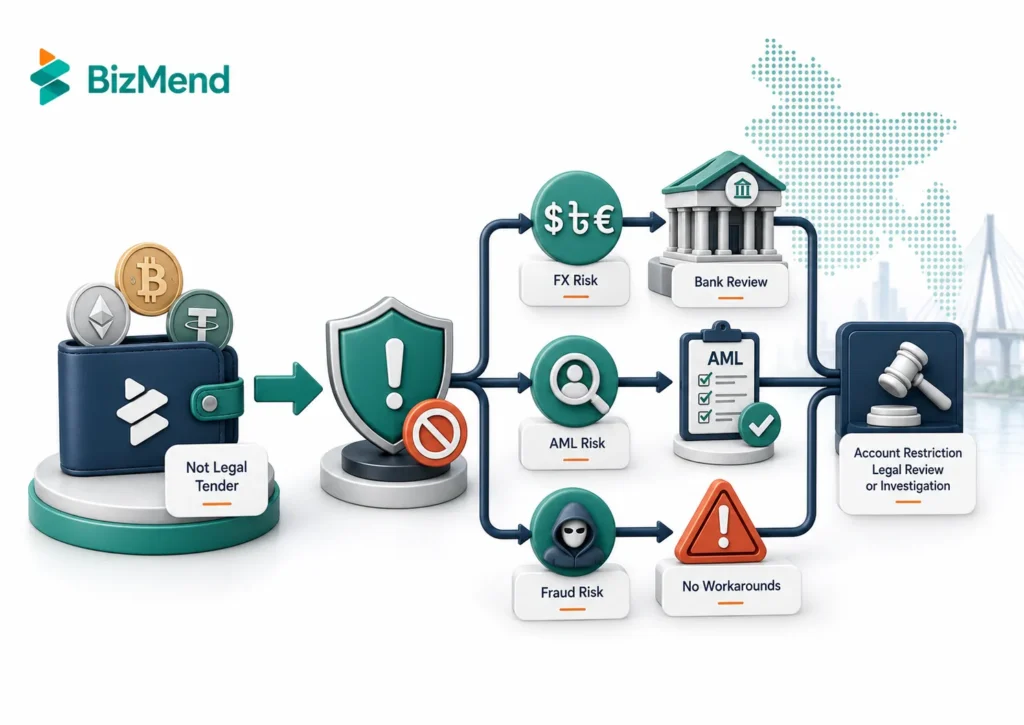
Bangladesh Bank regulates the country’s banking, payment, and foreign-exchange infrastructure. Its Payment Systems Department handles licensing and oversight of domestic payment systems, including MFS providers and licensed PSPs and PSOs. Bangladesh Bank states that MFS is permitted for domestic services such as cash-in, cash-out, P2P, P2B, B2P, P2G, and G2P, and that no cross-border money transfer is allowed through MFS except local disbursement of inward remittance received through banking channels.
Cryptocurrency does not fit neatly into those approved retail rails. A decentralized token is not issued by Bangladesh Bank, does not have taka legal-tender status, and does not come with the dispute procedures, deposit protection, chargeback rights, or regulator-supervised settlement structure that users may expect from a bank, card, or licensed wallet.
· Fraud, money laundering, and terrorist-financing concerns can bring additional laws into play.
BFIU describes itself as Bangladesh’s central agency to fight money laundering and terrorist financing, and its legal resources include the Money Laundering Prevention Act, 2012, and related amendments. Its official legal resources include the Money Laundering Prevention Act, 2012, as amended. Crypto can become relevant when funds are concealed, layered through multiple accounts, sent to unidentified counterparties, or connected to criminal proceeds.
Bitcoin has the same core problem as other virtual currencies in Bangladesh: Bangladesh Bank does not recognize virtual currencies as currency, does not approve them as foreign exchange or investment instruments, and does not permit transactions in, from, or to Bangladesh for obtaining them. Calling Bitcoin “digital money” does not give it the legal status of taka, a bank deposit, or a licensed mobile wallet balance.
The practical risk increases when Bitcoin is bought through informal peer-to-peer deals, paid for with bank or MFS accounts, used to receive commercial or freelance income, or converted in ways that avoid authorized foreign-exchange channels. The technology may be global, but the funding and cash-out points usually touch regulated accounts and real-world identities.
A crypto website or app being technically accessible from Bangladesh does not mean the platform is locally licensed, approved, or safe to fund through Bangladeshi bank or MFS channels. The key question for “Binance Bangladesh” is not whether someone can open the interface; it is whether the service, funding method, transaction, and purpose comply with Bangladeshi law and the rules of the bank or payment provider involved.
Peer-to-peer trading creates extra risk because the person sending taka may not be the verified owner of the exchange account. Payments can involve third-party accounts, stolen credentials, fraud proceeds, disputed transfers, or intermediaries who misdescribe the transaction. That can lead to account restrictions, requests for documents, frozen balances, police complaints, or financial intelligence review.
The restrictions are easier to understand when viewed through the responsibilities of a central bank and financial-intelligence authority. Crypto can move value across borders quickly, often through addresses that do not visibly identify the beneficial owner. That creates challenges for foreign-exchange control, financial-crime monitoring, consumer protection, and recovery of stolen funds.
| Regulatory concern | Why it matters |
| Foreign-exchange control | Offshore token purchases and settlements can move value outside authorized banking channels. |
| Money laundering and terrorist financing | Layered wallets, P2P transfers, and pseudonymous addresses can obscure source and destination. |
| Consumer protection | There may be no licensed local operator, compensation scheme, or guaranteed complaint process. |
| Price instability | Tokens can lose substantial value quickly and are not deposits with a promised principal. |
| Fraud and cybercrime | Irreversible transfers make recovery difficult after scams, account takeovers, or key theft. |
| Payment-system integrity | Unlicensed settlement systems can bypass rules applied to banks, MFS providers, PSPs, and PSOs. |
These concerns do not mean blockchain technology itself is prohibited. They explain why a regulator may support digital innovation while restricting unapproved private currencies and payment channels.
Blockchain is a way to record and verify data across a distributed network. Cryptocurrency is one possible application of that technology. A company can explore blockchain for document verification, supply-chain records, credentials, audit trails, or shared databases without issuing a speculative token or using it as money.
This difference matters because discussions often jump from “blockchain is useful” to “therefore crypto trading must be legal.” That conclusion does not follow. A technology can have legitimate enterprise uses while a specific financial product or payment model remains unlicensed or restricted.
| Blockchain use | Does it require public crypto trading? |
| Tamper-evident records | No |
| Academic credential verification | No |
| Supply-chain tracking | No |
| Internal settlement ledger | Not necessarily |
| Buying Bitcoin or USDT for speculation | Yes, this involves a crypto asset and separate legal risks |
| Risk | How it appears | Practical consequence |
| Legal and regulatory | Unapproved payment, foreign-exchange, or suspicious transaction | Investigation, account review, document requests, or possible proceedings |
| Bank or MFS account | P2P payments to unknown persons or misleading references | Temporary restriction, closure, reversal dispute, or reporting |
| Market volatility | Rapid price rise or fall | Loss of principal with no guaranteed recovery |
| Exchange failure | Withdrawal freeze, insolvency, hacking, or jurisdiction dispute | Funds may be inaccessible and local remedies limited |
| Custody and security | Lost seed phrase, malware, SIM swap, phishing, or fake wallet | Irreversible loss or theft |
| Counterparty fraud | Seller takes payment but does not release tokens, or buyer uses stolen funds | Financial loss and possible involvement in a complaint |
| Tax and accounting uncertainty | Unclear records, offshore balances, or business receipts in tokens | Difficulty explaining income, assets, and source of funds |
Stablecoins such as USDT reduce some price volatility against the US dollar, but they do not remove legal, counterparty, custody, reserve, platform, or foreign-exchange risks. “Stable” describes the intended price relationship, not a government guarantee.
Scammers use cryptocurrency because transactions are fast, global, and difficult to reverse. The victim may see a fake dashboard showing profit, while the criminal controls the only real wallet.
No legitimate wallet support team needs a seed phrase. Anyone who obtains it can control the assets. If money has already been sent, stop further payments, preserve chats and transaction records, and contact the bank, MFS provider, exchange, and law-enforcement channel relevant to the case.
There is no responsible way to quote one universal “crypto penalty” for every person; Bangladesh Bank’s 2022 circular links prohibited virtual-asset transactions and facilitation to contraventions under the Foreign Exchange Regulation Act, while other facts may involve AML, fraud, cybercrime, or terrorism financing laws. The outcome depends on the facts, the amount, the payment route, the purpose, the source of funds, and the law used by authorities.
Possible legal areas include foreign-exchange regulation, money-laundering prevention, terrorist-financing rules, fraud, cheating, cybercrime, unauthorized payment activity, and offences connected to criminal proceeds. A person who is merely curious about crypto is not in the same position as someone operating a fraudulent investment scheme or moving illicit funds.
| Update Note: Caution: do not rely on social-media posts that promise a fixed fine, a guaranteed arrest, or a “completely safe” loophole. Case-specific legal advice is necessary when money has already moved or an account has been restricted. |
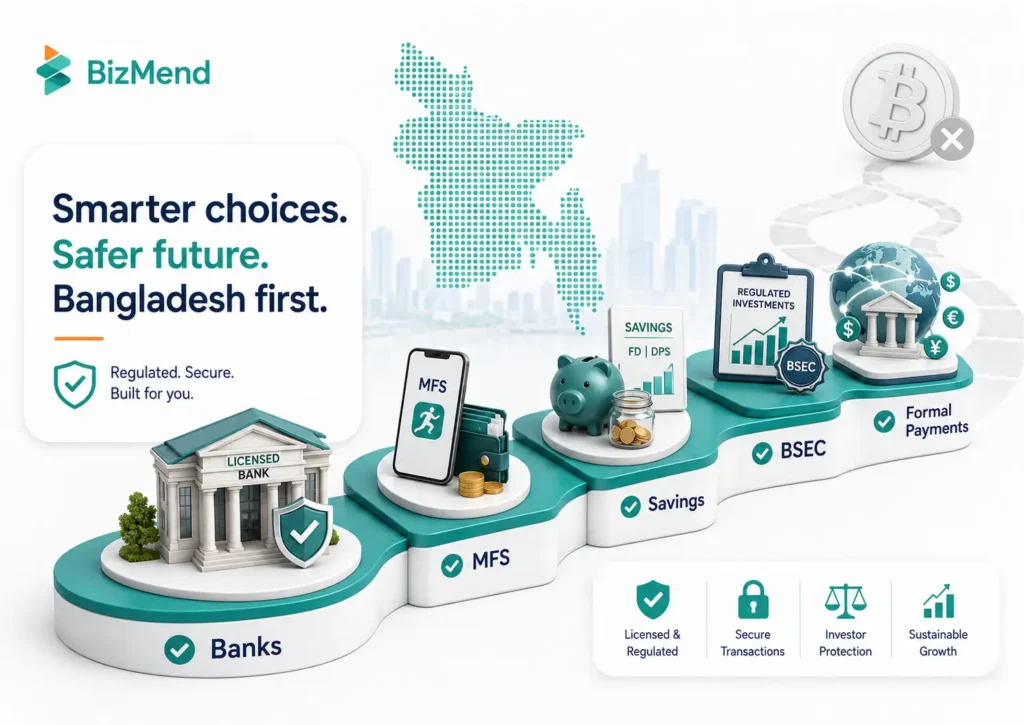
The right alternative depends on whether the goal is payment, saving, investing, receiving foreign income, or learning about financial technology. Regulated does not mean risk-free, but it provides clearer rules, identifiable institutions, and complaint channels.
| Goal | More regulated alternative | Important note |
| Daily digital payments | Licensed banks, MFS, Bangla QR, cards, and authorized PSPs | Use providers listed or supervised by Bangladesh Bank. |
| Domestic transfers | BEFTN, NPSB, RTGS, bank apps, and MFS | Choose the rail based on amount, speed, and fees. |
| Savings | readers can compare FD vs DPS in Bangladesh instead of treating crypto as a safer store of value. | Check liquidity, rate, tax, and early-closure terms. |
| Capital-market investing | BSEC-regulated securities, mutual funds, bonds, or approved funds through registered intermediaries | Market loss is still possible; verify the intermediary. |
| Government-backed instruments | Treasury bills, bonds, savings instruments, or sukuk through authorized channels | Eligibility and availability vary. |
| Freelance or export income | Freelancers should use authorized routes to receive international payments in Bangladesh instead of accepting USDT or other crypto tokens. | Keep contracts, invoices, and source-of-funds records. |
| Blockchain learning | Courses, coding projects, private ledgers, and non-token prototypes | Technology study does not require speculative trading. |
BSEC is the regulator of Bangladesh’s capital market and works to protect investor interests and develop the securities market; this makes BSEC-regulated products legally different from offshore crypto platforms, though investment risk can still remain. Using a registered intermediary does not guarantee profit, but it is legally and operationally different from sending funds to an offshore crypto platform with no local license.
Recovery is never guaranteed. Acting quickly improves the chance that a regulated payment provider can preserve records or restrict remaining funds, but blockchain transfers themselves are generally irreversible.
Cryptocurrency in Bangladesh should not be treated as an ordinary investment app, a legal payment shortcut, or an easy method for receiving foreign income. Bitcoin and stablecoins are outside the country’s approved retail payment framework, and transactions can create foreign-exchange, banking, fraud, money-laundering, and consumer-protection problems. For founders working with global clients, US company formation should be part of a proper legal structure, banking, and compliance plan, not as a crypto workaround.
The careful approach is to identify the real goal first. Use licensed banks and payment providers for transactions, authorized channels for foreign income, and regulated products for saving or investing. People who already have exposure should avoid concealment or workarounds, preserve complete records, and obtain case-specific legal advice. Rules and enforcement can change, so verify the latest Bangladesh Bank, BFIU, BSEC, and government information before relying on any online claim.
Is cryptocurrency legal in Bangladesh?
Cryptocurrency is not recognized as legal tender and there is no Bangladesh Bank-approved retail crypto exchange or payment framework identified in the current official sources reviewed. Transactions can create exposure under foreign-exchange, AML, fraud, payment, and other laws.
Is Bitcoin legal in Bangladesh?
Bitcoin is not legal tender or an approved domestic payment instrument. The exact legal consequence depends on how it is acquired, funded, transferred, or used; one automatic penalty should not be claimed for every situation.
Can I use Binance in Bangladesh legally?
Technical access does not equal local authorization. Funding or cashing out through bank, card, or MFS accounts may create regulatory, source-of-funds, fraud, and account-restriction risks. This guide does not provide a workaround.
Can a freelancer receive payment in USDT?
That can bypass or complicate authorized foreign-income and foreign-exchange channels. Freelancers should use permitted banking or remittance routes and keep contracts, invoices, and payment records.
Is blockchain illegal in Bangladesh?
Blockchain is a technology, not automatically a cryptocurrency. It can be used for records, credentials, supply chains, and software projects without issuing or trading a public token.
What penalties may apply to crypto trading in Bangladesh?
There is no single verified penalty that applies to every case. Liability depends on the conduct and the laws involved, including possible foreign-exchange, money-laundering, fraud, cybercrime, or payment-system provisions.
What are safer cryptocurrency alternatives in Bangladesh?
For everyday wallet use, readers can compare bKash vs Nagad vs Rocket instead of using crypto as a payment shortcut. For savings or investment, consider regulated bank products, government instruments, or BSEC-regulated securities through registered intermediaries after assessing risk.

Learn how to become a Daraz seller in Bangladesh, register an account, list products, understand fees, manage orders, and grow…
by Sheikh Ornob
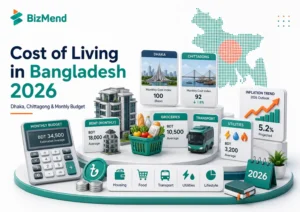
Compare the cost of living in Bangladesh in 2026, including Dhaka and Chittagong rent, food, transport, utilities, inflation, and monthly…
by Sheikh Ornob
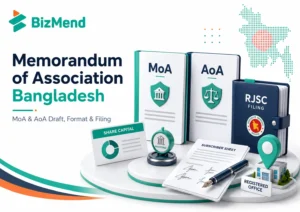
Learn MoA and AoA requirements in Bangladesh, key clauses, drafting basics, RJSC filing steps, amendments, and common company-registration mistakes. Suggested…
by Sheikh Ornob