How to Become a Daraz Seller in Bangladesh: Registration, Fees & Growth
Learn how to become a Daraz seller in Bangladesh, register an account, list products, understand fees, manage orders, and grow…
 by Sheikh Ornob

Compare FDR, DPS, and savings accounts in Bangladesh by returns, liquidity, risk, flexibility, taxes, and current 2026 rate examples.
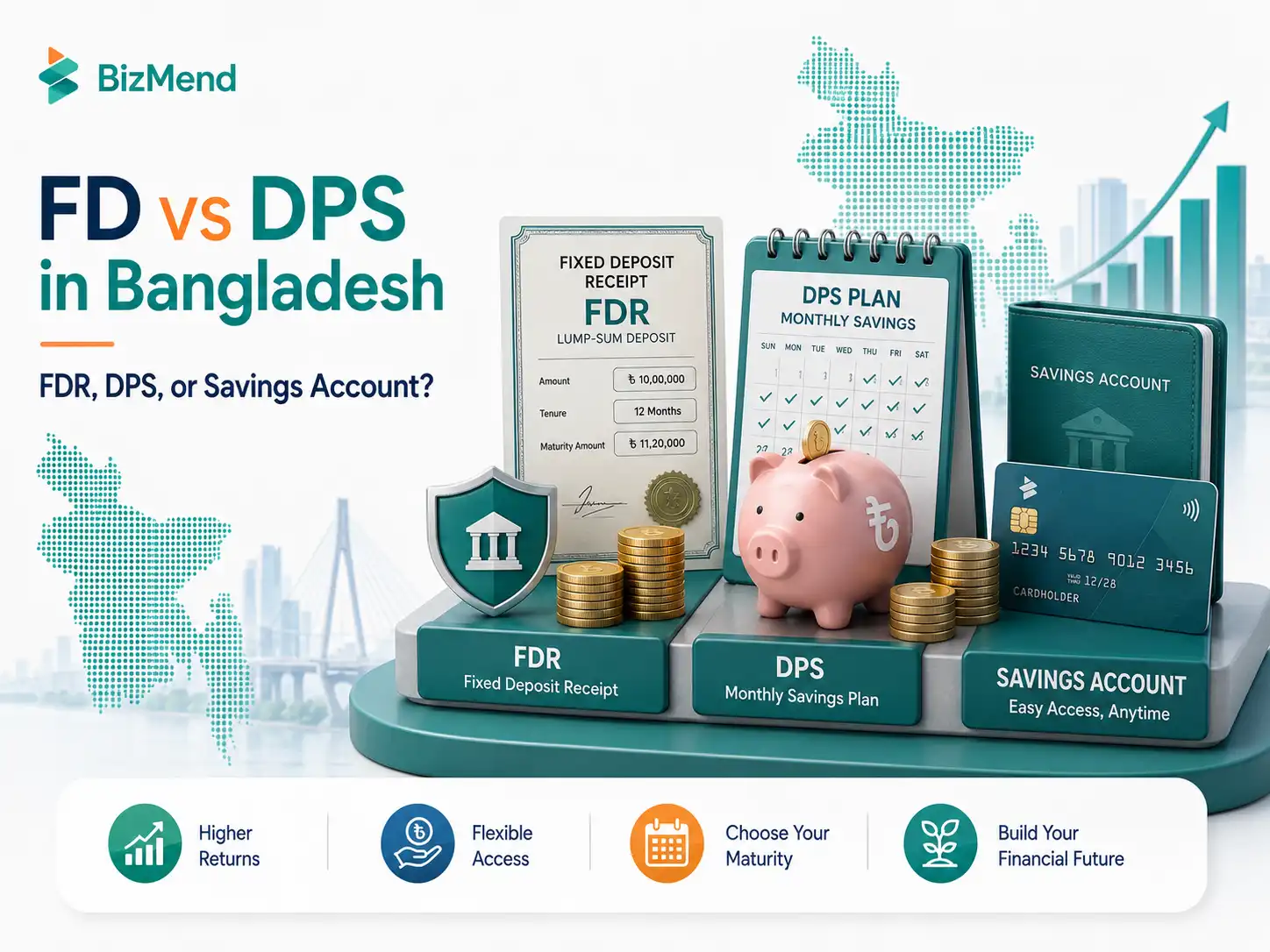
FD vs DPS in Bangladesh is not just a contest between the highest advertised rates. An FDR works best when you already have a lump sum, a DPS helps you build savings through monthly deposits, and a savings account keeps money readily available for everyday needs.
The right option depends on when you need the money, how regularly you can save, and whether you can accept early-withdrawal restrictions. This guide compares returns, liquidity, flexibility, deductions, and current 2026 bank-rate examples without treating one product as universally best.
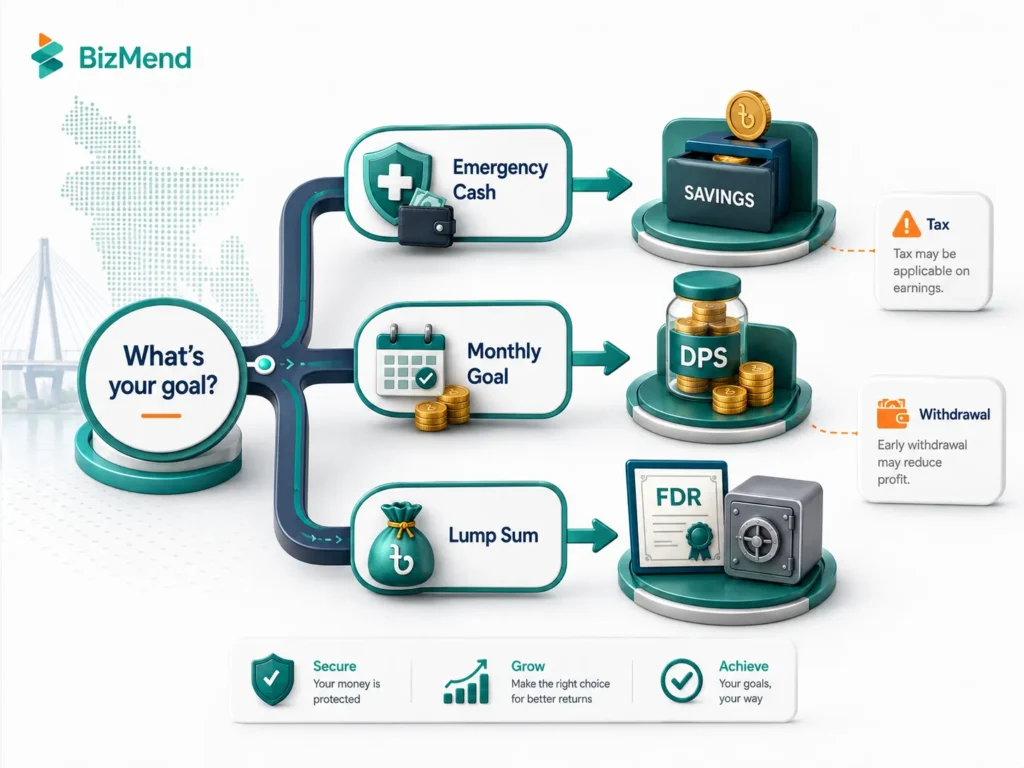
Quick Answer: An FDR is usually better when you have a lump sum that can remain untouched for a fixed period, while a DPS is better when you want to build a fund through disciplined monthly installments. A savings account is the strongest choice for emergency money and frequent access, but it normally pays less. For many Bangladeshi savers, the practical solution is not choosing only one: keep an emergency reserve in savings, use DPS for a planned future goal, and place genuine surplus cash in an FDR after checking the bank’s current rate, premature-encashment rule, tax deductions, and maturity terms.
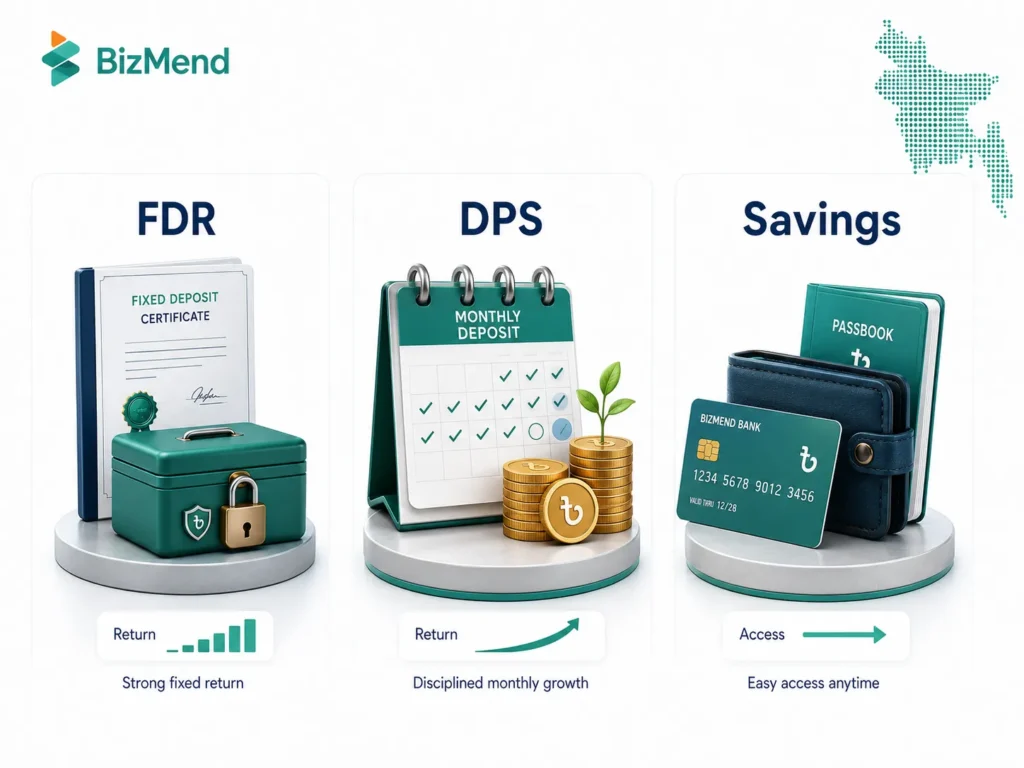
All three products hold money with a bank, but they solve different problems. An FDR starts with a single lump-sum deposit. A DPS grows through fixed monthly instalments. A savings account remains transactional, allowing deposits and withdrawals whenever the account rules permit.
| Feature | FDR | DPS | Savings account |
| Best use | Investing an existing lump sum | Building a goal fund monthly | Emergency cash and regular transactions |
| Deposit pattern | One-time amount | Monthly instalments | Flexible deposits |
| Typical access | Restricted until maturity | Restricted; missed-instalment rules apply | High access through branch, card, app, or ATM |
| Return pattern | Fixed or stated rate for a tenure | Compounded return over the plan | Usually lower and balance-tier based |
| Main risk | Losing return on early encashment | Missing instalments or closing early | Low return and spending the balance too easily |
This comparison also explains why the word “best” needs context. A product with a higher rate may still be unsuitable if it locks the money past the date you need it.
FDR means Fixed Deposit Receipt. In everyday Bangladeshi banking, people often use FD and FDR interchangeably. Technically, the fixed deposit is the deposit arrangement, while the receipt or account record confirms the principal, tenure, rate, maturity date, and maturity value.
You place a lump sum for a selected period, such as three months, six months, one year, or longer. The bank calculates interest according to the product terms. Some deposits pay at maturity; others may offer monthly or periodic interest.
An FDR is not ideal for money that may be needed suddenly. Even when early encashment is allowed, the bank may recalculate interest using a lower rate or apply the product’s premature-closure rule.
A Deposit Pension Scheme, commonly called DPS, is a recurring-deposit plan. You choose a monthly instalment and tenure, then continue depositing until maturity. It is designed for people who earn gradually rather than holding a large lump sum on day one.
DPS works through routine. The product encourages a saver to treat monthly saving like a regular bill. Depending on the bank, instalments may be collected from a linked account, deposited through digital channels, or paid at a branch.
For example, UCB’s Super Flex DPS page lists tenures of 1, 2, 3, 5, and 10 years, monthly compounding, a seven-day grace period, auto installment transfer, and a possible credit facility of up to 90% after one year, subject to timely installments and approval.
A savings account is a flexible bank account for holding money, receiving funds, paying bills, using cards, and withdrawing through supported channels. Interest is normally calculated using the bank’s balance rules, but the rate is usually lower than an FDR or DPS.
The biggest advantage is liquidity. You can keep an emergency fund available instead of breaking a long-term deposit when a medical bill, family need, or business expense appears.
Savings products can have minimum-balance rules, account-maintenance fees, transaction limits, and tiered rates. A high headline rate may apply only to a large balance band, while smaller balances may earn little or no interest. Always read the complete slab table rather than the maximum advertised rate.
| Update Note: Rate update: Checked on 14 July 2026. The figures below are dated examples from official bank sources, not a market-wide average or a promise that the same rate will remain available. |
Bank Asia’s deposit-rate page, effective 18 June 2026, lists individual FDR rates of 9.00% for three months and 9.50% for six months, one year, two years, and three years; these should be treated as dated examples, not guaranteed future rates. Its standard savings account is listed at 2.00% for balances below Tk 1 crore and 3.00% for Tk 1 crore and above.
Eastern Bank’s rate sheet, effective 3 May 2026, shows why product names matter. Its standard retail FD examples range from 6.35% for three months to 7.25%-7.75% for two- and three-year deposits, depending on the balance. Several special retail term deposits are listed around 8.25%-9.75%. EBL’s deposit rate sheet effective 3 May 2026 shows recurring-deposit products mostly around 9.50%-9.75% for available tenures, while standard savings products commonly range from 0% to 2% by balance tier.
| Official example | Effective date | Illustrative rates | What it shows |
| Bank Asia individual FDR | 18 Jun 2026 | 9.00%-9.50% | Straightforward tenure-based FDR pricing |
| Bank Asia standard savings | 18 Jun 2026 | 2.00%-3.00% | Savings yield depends on balance tier |
| EBL standard retail FD | 3 May 2026 | 6.35%-7.75% | Ordinary FD can differ from promotional deposits |
| EBL special retail deposits | 3 May 2026 | Up to 9.75% | Special tenor and product conditions matter |
| EBL recurring deposits | 3 May 2026 | Mostly 9.50%-9.75% | DPS return depends on product and tenure |
Do not compare a DPS rate with an FDR rate as though the same principal is invested from the beginning. With an FDR, the full lump sum earns for the whole tenure. With a DPS, later instalments remain invested for less time. Compare the maturity value, total instalments paid, effective return, and all deductions.
Liquidity means how quickly you can use your money without losing value. A savings account has the highest liquidity, an FDR has limited liquidity until maturity, and a DPS is usually the least convenient for irregular withdrawals because it is built around a continuing instalment schedule.
| Question | FDR | DPS | Savings account |
| Can you withdraw anytime? | Often possible through early encashment, but return may fall | Usually requires closure or a permitted loan facility | Normally yes, within account and channel limits |
| What happens before maturity? | Lower interest or penalty may apply | Reduced maturity value and scheme rules apply | No maturity penalty, but fees or minimum balance may matter |
| Can it support emergency cash? | Only if you accept breakage terms or borrow against it | Weak choice unless a loan facility is available | Strongest option |
Bank rules are not identical. EBL’s 3 May 2026 deposit sheet states that the penal interest rate or early-encashment rate for TD products is 2.00%, while RD products follow the relevant product guidelines. UCB notes that a credit facility may be available against a DPS after one year, subject to timely installments and approval. These examples show why the product agreement matters more than assumptions.
FDR, DPS, and savings accounts are generally lower-volatility choices than shares or market-linked investments because their balances do not normally move with daily market prices. However, “low risk” does not mean “no risk.”
Choose a licensed scheduled bank, verify the product on the bank’s official website or branch documentation, keep nominee information updated, and retain statements and deposit records. Avoid selecting a product only because a social-media post claims an unusually high return.
The best choice is the one that matches the cash-flow pattern and deadline.
| Saver profile | Better starting option | Reason |
| Employee saving from salary | DPS plus savings | Automates a monthly goal while keeping emergency cash accessible |
| Freelancer with irregular income | Savings first, then short FDRs | Income may not support a fixed monthly instalment every month |
| Family holding idle lump-sum cash | FDR | Locks surplus funds for a defined period and predictable return |
| Student or first-time saver | Savings or small DPS | Builds habit without overcommitting |
| Small business owner | Savings plus staggered FDRs | Keeps working capital liquid while investing genuine surplus |
| Goal with a fixed future date | DPS | Matches regular contributions to a planned maturity |
Many savers benefit from using all three. A savings account holds three to six months of essential expenses, a DPS funds a long-term goal, and one or more FDRs hold money that is not needed for current spending. A staggered or “laddered” approach can reduce the risk of locking every taka until the same date.
Scenario 1: Rafi receives a Tk 300,000 project payment but may need Tk 100,000 for taxes and business costs. If his income comes from global clients or a foreign business structure, he should separate savings decisions from US company formation planning.
Scenario 2: Nabila wants Tk 500,000 for postgraduate study in five years but does not have a lump sum. A DPS is more suitable because the goal can be funded through monthly deposits. She should choose an installment she can maintain even during expensive months.
The amount shown in a maturity illustration may not equal the cash you finally receive. Banks may deduct income tax on interest or profit, so savers should understand income tax in Bangladesh 2026 before comparing only the advertised rate.
UCB’s DPS terms specifically state that income tax on interest and excise duty apply according to prevailing regulatory guidelines. Because tax rates, exemptions, taxpayer documentation, and duty slabs can change, confirm the current treatment with the bank before opening or renewing a product.
For a fair decision, compare net maturity proceeds rather than the headline annual rate. This article provides general information, not personal tax advice.
1. Choosing the highest rate without checking the effective date, minimum deposit, or eligibility.
2. Using emergency money for a long FDR and then breaking it early.
3. Opening a DPS with an installment that does not fit monthly cash flow.
4. Comparing FDR and DPS rates without comparing total cash contributed and time invested.
5. Ignoring tax, excise duty, fees, and early-closure rules.
6. Relying on unofficial rate tables after banks have revised their products.
There is no single winner for every saver. FDR is the stronger option for a lump sum that can stay invested, DPS is better for building a future fund through regular monthly deposits, and a savings account is the right home for emergency money and day-to-day access.
Start with liquidity, not the advertised rate. Keep essential cash available, choose a DPS instalment that remains affordable, and place only genuine surplus in an FDR. Before opening any product, verify the bank’s current rate sheet, effective date, tax treatment, early-closure rule, and maturity instructions. That process produces a better decision than chasing the highest percentage.
Is FDR better than DPS in Bangladesh?
FDR is usually better when you already have a lump sum. DPS is usually better when you want to save from monthly income. The better option depends on cash flow, goal date, and need for early access.
Which gives more return: FDR or DPS?
The answer depends on the bank, tenure, compounding method, and product rules. A higher DPS rate does not automatically create more earnings because each monthly instalment is invested for a different length of time.
Can I close an FDR before maturity?
Many banks allow premature encashment, but the interest may be recalculated at a lower rate or under a penalty rule. Check the exact product terms before opening.
What happens if I miss a DPS instalment?
The bank may allow a grace period, charge a penalty, require arrears to be cleared, or apply closure rules. The treatment differs by product, so read the missed-instalment policy.
Should emergency money be kept in a DPS?
Usually not. Emergency funds need quick access, so a savings account is generally more suitable. A DPS is designed for a planned future goal, not unpredictable expenses.
Are FDR and DPS returns tax-free?
Do not assume so. Banks may deduct income tax on interest or profit, excise duty, and applicable charges under current rules. Confirm the net maturity value and required tax documents with the bank.
How often should I check deposit rates?
Check before opening, renewing, or adding a large amount. Use the bank’s official rate sheet and note its effective date because rates and product terms can change without matching older online comparisons.

Learn how to become a Daraz seller in Bangladesh, register an account, list products, understand fees, manage orders, and grow…
by Sheikh Ornob
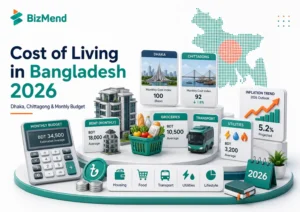
Compare the cost of living in Bangladesh in 2026, including Dhaka and Chittagong rent, food, transport, utilities, inflation, and monthly…
by Sheikh Ornob
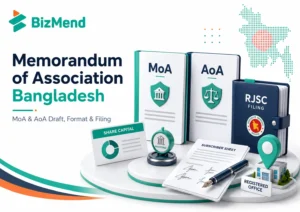
Learn MoA and AoA requirements in Bangladesh, key clauses, drafting basics, RJSC filing steps, amendments, and common company-registration mistakes. Suggested…
by Sheikh Ornob