How to Become a Daraz Seller in Bangladesh: Registration, Fees & Growth
Learn how to become a Daraz seller in Bangladesh, register an account, list products, understand fees, manage orders, and grow…
 by Sheikh Ornob

Compare government loans in Bangladesh for SMEs, youth, women, ICT, and green businesses with current rates, eligibility, and application steps.
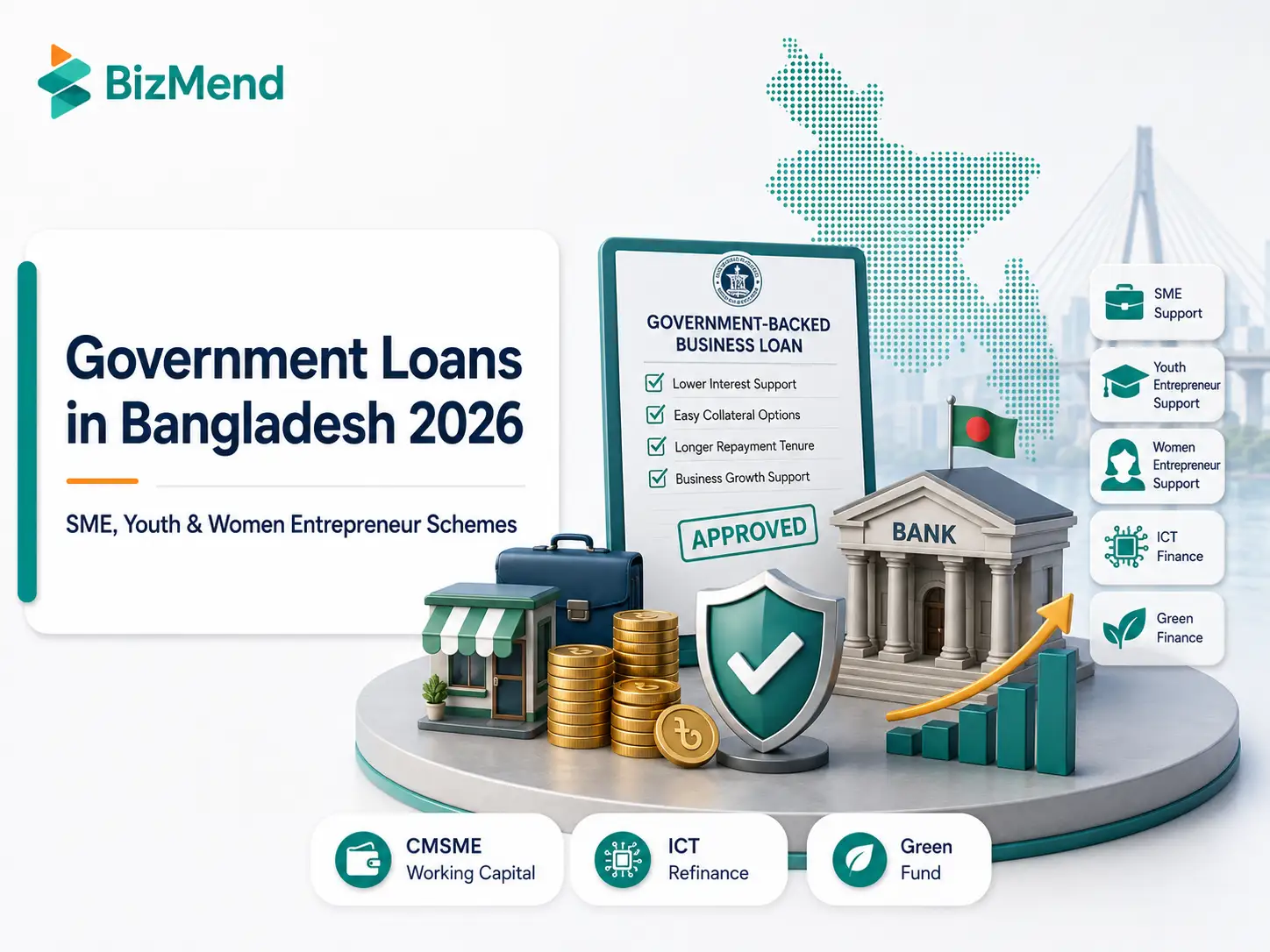
Government loans in Bangladesh can help eligible businesses access working capital, technology finance, green investment support, and entrepreneur-focused credit through banks or government-linked institutions. The important catch is that there is no single universal government loan or guaranteed approval portal.
Most current schemes work through participating scheduled banks and finance companies. The lender still checks your business records, repayment ability, CIB status, equity contribution, and documents before approving a loan. This guide explains the main 2026 routes, who they suit, and how to apply without relying on fake agents or outdated rates.
Quick Answer: Government loans in Bangladesh are usually delivered through participating banks, not paid directly by Bangladesh Bank. Current 2026 routes include Bangladesh Bank-backed CMSME working-capital refinance, ICT sector refinance, green-transformation refinance, and notice-based youth or women-entrepreneur programs through relevant offices, banks, or partner institutions. Eligibility, rates, security, and availability depend on the specific scheme and lender.
The phrase “government loan” can be misleading. In many cases, the government or Bangladesh Bank creates a fund, refinance window, subsidy, guarantee, or policy incentive. A scheduled bank or finance company then evaluates the borrower and disburses the loan.
This means the government-backed feature may reduce the lender’s funding cost or set a customer-level rate cap, but it does not remove normal credit checks. A bank can still reject an application because of weak cash flow, incomplete licences, poor repayment history, unsuitable business activity, or an adverse CIB record.
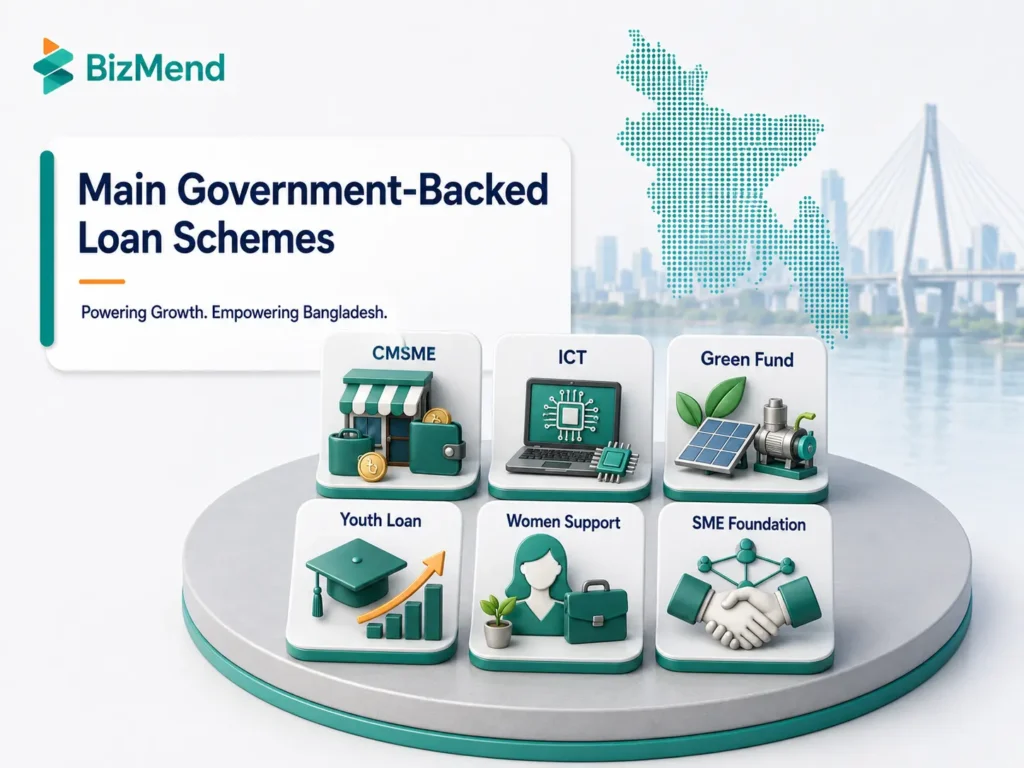
Bangladesh Bank’s circular directory should be checked before quoting any current refinance scheme or rate cap. The following options are among the most relevant for small businesses, technology ventures, rural enterprises, and women entrepreneurs.
Bangladesh Bank created a Tk 5,000 crore revolving refinance fund on 8 June 2026 to improve working capital access for cottage, micro, small, and medium enterprises. The scheme is designed for operating CMSMEs that cannot run at full capacity because they lack working capital.
Participating scheduled banks may charge a customer-level interest or profit rate of no more than 9% under the circular, with a possible 3- or 6-month grace period; the circular also states that no additional customer charge or fee may be collected except charges allowed under Bangladesh Bank’s schedule-of-charges policy. The borrower must not be classified as a defaulter in the CIB database, and the scheme is mainly for active CMSME businesses that cannot operate at full capacity due to a working-capital shortage.
This is not a direct Bangladesh Bank application. The business applies to a participating bank, and the bank assesses the requested limit, security, cash flow, and purpose. It is best suited to an existing business that needs inventory, raw materials, payroll support, or operating funds rather than an idea with no trading history.
The ICT refinance scheme can support eligible technology-related businesses, and founders planning cross-border online sales may also explore US e-commerce business registration after their local loan, records, and repayment plan are properly structured. Artificial intelligence, cybersecurity, cloud services, healthtech, edtech, robotics, and related fields.
The customer-level interest or profit rate is capped at 4%. The refinance period can run from 3 to 10 years, including a grace period of up to 6 months. The scheme requires borrower equity, with a minimum debt-equity structure of 80:20, and a single borrower cannot receive more than Tk 50 crore under the fund. The circular also gives priority to women entrepreneurs in the ICT sector.
A low headline rate does not mean automatic approval. Applicants should show a workable product or service, realistic revenue assumptions, ownership of required technology or intellectual property, a capable team, and a clear use of funds.
Bangladesh Bank’s May 2026 circular allocated Tk 1,000 crore from the existing Tk 5,000 crore Green Transformation Fund for rural and local industries, covering qualifying machinery or equipment linked to renewable energy, energy efficiency, water conservation, waste management, resource efficiency, recycling, and workplace improvements.
Under the circular, the customer-level interest or profit rate is capped at 5%. The financing period is generally two to five years, with a grace period of up to six months. Financing may cover up to 80% of the project cost, while the borrower contributes at least 20%. A single borrower may receive up to Tk 5 crore, and the project must meet the circular’s conditions, including the renewable-energy use requirement where applicable.
This option is more suitable for an established rural or local enterprise buying qualifying equipment than for ordinary shop rent, personal expenses, or an unrelated trading business.
Young founders often search for a single “youth loan Bangladesh” form, but youth finance is usually linked to a specific training program, specialised bank product, district office, or periodic government project. The Department of Youth Development and Karmasangsthan Bank are practical starting points for current notices and branch-level guidance.
Applicants should verify any training, age, residency, guarantor, experience, and owner-contribution rules with the issuing office. Do not rely on social-media screenshots that omit the effective date.
A youth applicant with a registered, revenue-generating business may also qualify under mainstream CMSME or sector-specific schemes. Being young is not always the main eligibility test; business viability and repayment capacity usually matter more.
Women entrepreneurs can apply through regular CMSME lending channels and targeted programs operated by banks, government-linked organisations, or sector-specific refinance schemes. The 2026 ICT refinance circular expressly gives priority to women entrepreneurs in the ICT sector.
Joyeeta Foundation’s official site includes entrepreneur registration, training, and earlier Revolving Capital Support Fund materials through partner banks, but current loan availability should be verified from the latest notice before describing any open loan window. However, a June 2026 notice also referred to finalising loan-disbursement guidelines and memoranda of understanding. That makes it important to confirm whether a particular lending window is currently open before preparing an application.
Women founders should ask the bank for its women entrepreneur or CMSME desk, but they should not assume that gender alone guarantees a concession or collateral-free approval. The business must still meet the applicable scheme and credit requirements.
SME Foundation provides entrepreneurship development, training, market linkage, policy support, and credit/financing-related support through partner-bank or notice-based programs; applicants should verify the current partner-bank list and active application window. Credit support is often channelled through partner banks or finance companies rather than handed out as unrestricted cash from the foundation’s office.
| Route | Best for | Published 2026 terms | Where to apply |
| CMSME Working Capital Fund | Operating CMSMEs needing inventory or operating cash | Customer rate capped at 9%; possible 3- or 6-month grace; CIB-clean borrower required | Participating scheduled bank |
| ICT Sector Refinance | Software, e-commerce, fintech, BPO, AI, hardware and other eligible ICT ventures | Up to 4%; 3-10 years; up to 6-month grace; minimum 20% borrower equity | Participating bank or finance company |
| Green Transformation Fund | Rural or local enterprises investing in qualifying green improvements | Up to 5%; 2-5 years; up to 6-month grace; up to Tk 5 crore; minimum 20% equity | Participating scheduled bank |
| Youth/self-employment routes | Young people with training, a viable project, or an operating small business | Varies by program and current notice | DYD local office, Karmasangsthan Bank, or relevant lender |
| Women entrepreneur support | Women-owned CMSMEs, ICT ventures, and registered Joyeeta entrepreneurs | Varies; ICT scheme gives women priority, while other windows are notice-based | Bank women/CMSME desk, Joyeeta partner bank, or participating PFI |
| SME Foundation-linked support | Entrepreneurs needing training, linkage, and periodic partner finance | Project- and partner-specific | SME Foundation notice and named partner institution |
Eligibility is scheme-specific, but lenders commonly look for a legally identifiable business, an eligible activity, a clear financing need, and evidence that the loan can be repaid from business cash flow. A new company may be considered under some schemes, but founders should first understand how to start a business in Bangladesh before applying with only an idea.
The lender may check owners, directors, guarantors, related businesses, and existing liabilities. A clean CIB status and genuine owner equity are especially important.
Ask the chosen lender for a written checklist before collecting documents. Requirements differ for sole proprietorships, partnerships, and limited companies, but the following items are common.
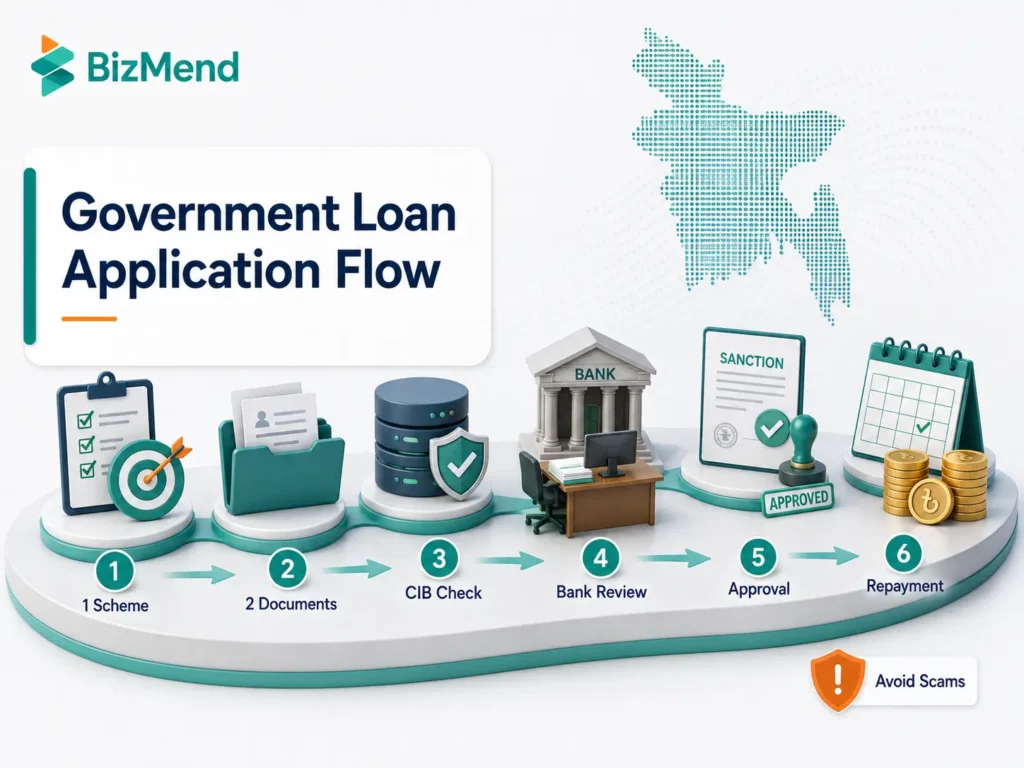
The fastest way to waste time is to submit the same generic file everywhere. First identify the scheme that matches the activity and the exact purpose of the loan.
A published scheme rate is normally a ceiling or special customer rate under specified conditions. It does not mean every business loan in that sector must carry the same rate. If the application falls outside the scheme, the lender may offer a regular commercial product instead.
Ask for the annual rate, calculation method, processing fee, legal or valuation cost, insurance, early-settlement terms, and late-payment consequences.
Never pay a personal account, unofficial agent, or “approval officer” to secure a government loan. Legitimate fees should appear in official documents or the lender’s schedule of charges.
Loan approval is only useful when the repayment schedule matches the business cycle. A monthly instalment may be unsuitable for a seasonal business that earns most of its revenue after harvest, a festival, or an export delivery. Discuss the cash-flow pattern before the loan is structured.
Use the grace period for installation, production, or customer acquisition, not personal spending. Missing instalments can damage the business’s CIB position and future access to finance.
The best government-backed financing option is the one that matches your business activity, funding purpose, cash-flow cycle, and ability to repay. An operating retailer may need CMSME working capital, while a software company may fit the ICT refinance scheme and a rural factory may qualify for green-transformation finance.
Start with the newest official circular, then confirm the participating lender and request its current checklist. Do not treat a rate cap as a guaranteed offer, and do not borrow simply because a scheme sounds cheap. A carefully sized loan with complete documents is safer than a larger loan that strains monthly cash flow.
Can I apply directly to Bangladesh Bank for a business loan?
Usually no. Bangladesh Bank creates refinance or policy schemes, while participating banks and finance companies receive applications, assess borrowers, and disburse approved loans.
What is the lowest verified government-backed business loan rate in 2026?
Among the schemes reviewed, the ICT refinance circular caps the customer rate at 4%, while the rural and local Green Transformation Fund caps it at 5%. Eligibility is narrow, and lender approval is still required.
Is there a guaranteed youth loan in Bangladesh?
No loan should be treated as guaranteed. Youth-focused credit may be linked to training, a specialised bank, a district office, or a current project. Check the Department of Youth Development and Karmasangsthan Bank for active terms.
Can a woman entrepreneur get a loan without collateral?
Possibly under a specific product or small-ticket policy, but there is no universal collateral-free guarantee. The lender can request security, guarantees, cash-flow evidence, or owner equity based on the scheme and risk assessment.
Does SME Foundation give loans directly?
Support may be delivered through partner banks or finance companies and can be project-based. Confirm the active notice, partner institution, application window, and current terms before applying.
Can a new startup qualify for government SME finance?
Some project or term-loan schemes may consider a new venture, but the founder must still present credible experience, equity, licences, market evidence, projections, and a workable repayment source.
How can I avoid government loan scams?
Use official government and bank websites, verify the circular date and participating institution, pay only documented fees, and reject anyone who requests money to a personal account for guaranteed approval.

Learn how to become a Daraz seller in Bangladesh, register an account, list products, understand fees, manage orders, and grow…
by Sheikh Ornob
Compare the cost of living in Bangladesh in 2026, including Dhaka and Chittagong rent, food, transport, utilities, inflation, and monthly…
by Sheikh Ornob
Learn MoA and AoA requirements in Bangladesh, key clauses, drafting basics, RJSC filing steps, amendments, and common company-registration mistakes. Suggested…
by Sheikh Ornob