
 by Sheikh Ornob
Banking did not change in a boardroom. It changed in a Bangladeshi village, where tiny loans exposed a huge blind spot in traditional finance.
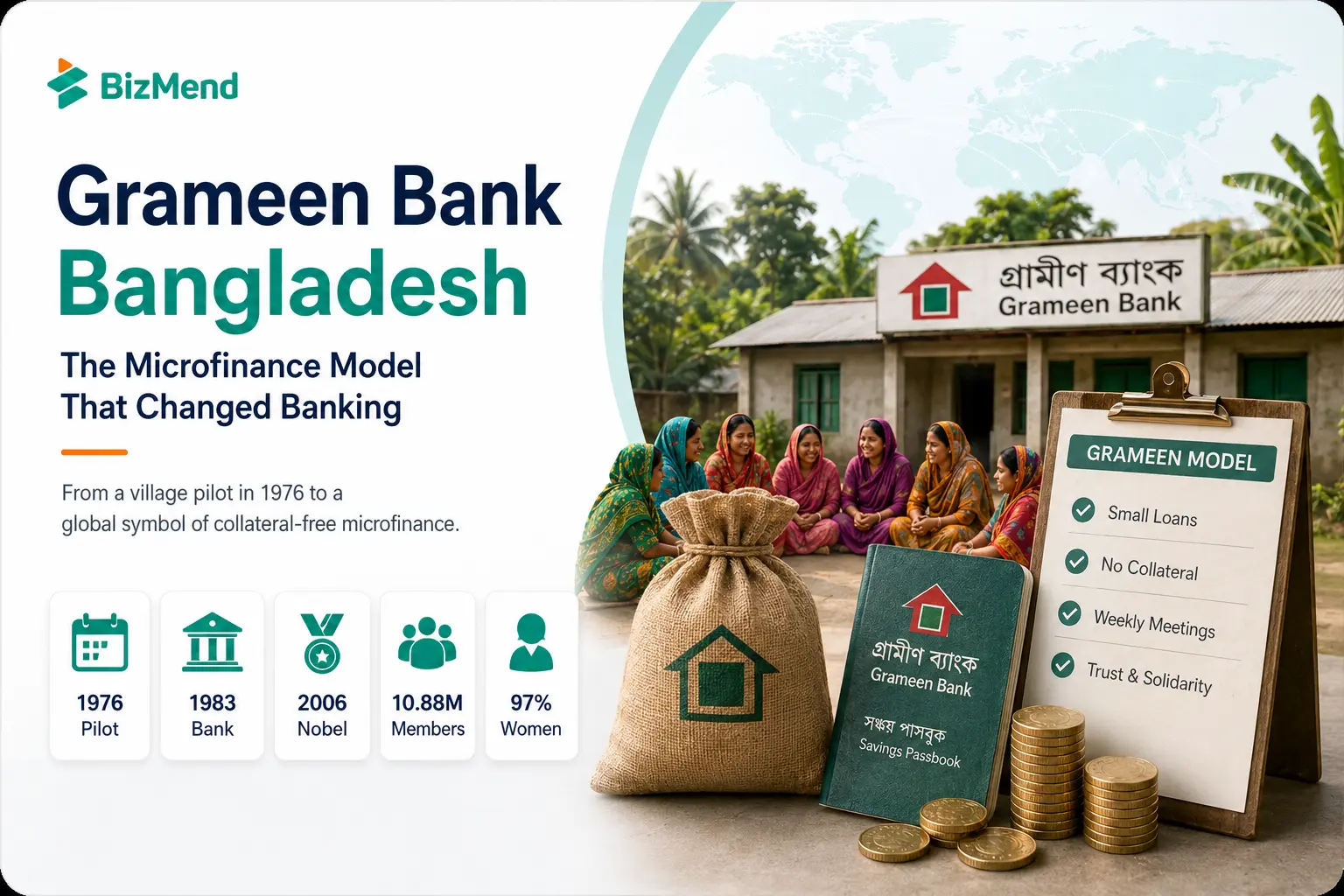
To understand why Grameen Bank matters, focus on three dates: 1976, when Muhammad Yunus tested the idea in Jobra; 1983, when the institution became an independent bank; and 2006, when the Nobel Peace Prize pushed it onto the world stage. What started as a local lending experiment gave Bangladesh one of the most influential stories in modern finance and sparked a debate that still shapes development economics.
Quick answer: Grameen Bank is a Bangladesh-based microfinance bank born from Muhammad Yunus’s 1976 pilot and formalized in 1983. It gives collateral-free loans, mostly to women, through village-level meetings, and by April 2026 it reported 10.88 million borrower members across 81,678 villages.
Key Takeaways
- Grameen Bank grew from a US$27 experiment during the post-famine years into one of the best-known names in microfinance.
- Its core idea was simple but disruptive: lend without collateral to poor borrowers whom mainstream banks usually ignored.
- The Grameen Bank model relies on village-level meetings, weekly repayment discipline, and social accountability rather than physical security.
- Women became the center of the system, and official Grameen figures now put female borrower membership at about 97 percent.
- The institution is broader than tiny startup loans because it also runs housing, education, savings, pension, and microenterprise products.
- Grameen Bank and founder Muhammad Yunus won the Nobel Peace Prize in 2006, which turned a Bangladesh banking experiment into a global reference point.
- Its success shaped policy thinking around financial inclusion, but later research found microcredit’s impact is usually useful and modest, not miraculous.
- The bank still stands out because borrower-members own most of it, giving clients a bigger stake than in a typical commercial lender.
What is Grameen Bank, exactly?
Grameen Bank is not just a bank in Bangladesh. It is the institution most closely associated with modern microcredit. The story starts in the mid-1970s, when economist Muhammad Yunus tested the idea that very small loans could help poor households earn income without falling into predatory debt.
According to Grameen Bank’s official history, Yunus made a personal loan of US$27 to 42 families during the 1974 famine period, then began a formal pilot in Jobra village in 1976 with support from a national commercial bank and the University of Chittagong. In 1983, that pilot became a full bank. In 2006, the Nobel Committee recognized Grameen Bank and Yunus for creating ‘economic and social development from below.’
| Year | Why it matters |
|---|---|
| 1974 | Yunus’s small personal loan helped shape the original idea. |
| 1976 | The Jobra pilot began as an action-research project in rural Bangladesh. |
| 1983 | Grameen Bank became an independent bank under Bangladeshi law. |
| 2006 | Grameen Bank and Muhammad Yunus won the Nobel Peace Prize. |
That timeline matters because it shows Grameen was not born as a charity slogan. It grew from a field experiment into a regulated institution on a national scale.
How does the Grameen Bank model work?
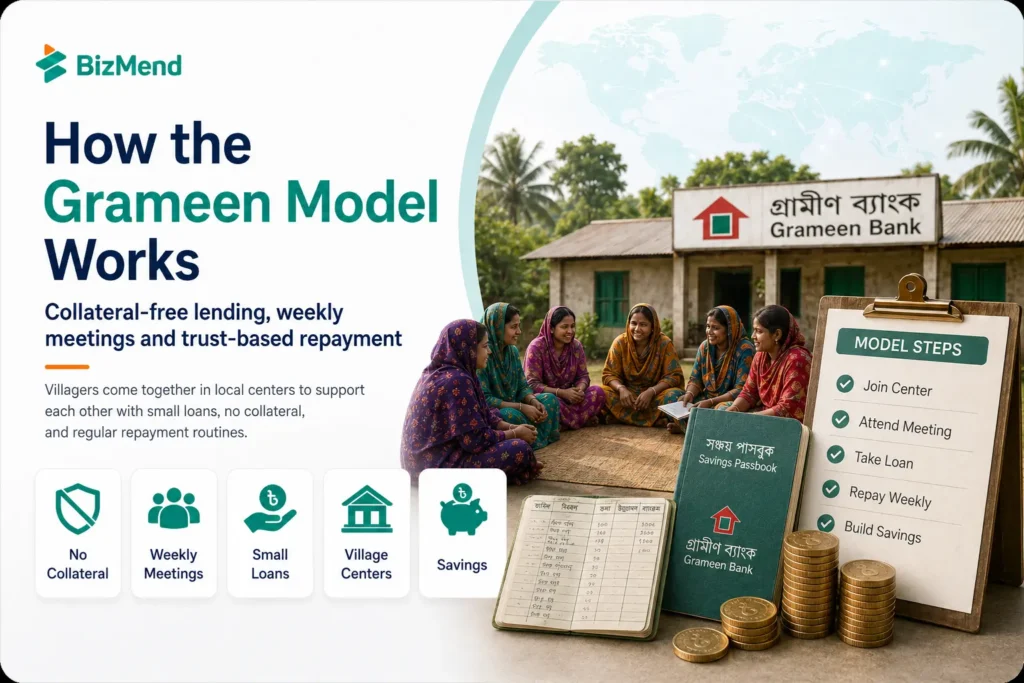
The most famous feature is the absence of collateral. A borrower does not need land titles, large deposits, or a wealthy guarantor to qualify. Instead, the model uses close contact, local knowledge, and frequent repayment routines to manage risk.
Official Grameen materials say banking transactions, except loan disbursement, are handled in village-level center meetings organized by center managers. The bank quite literally goes to the borrower rather than forcing the borrower into a formal branch setting. That approach cuts distance, keeps collections visible, and turns repayment into a shared routine instead of a distant monthly obligation.
- Basic loans are startup capital for new members and are repaid weekly.
- The current official ceiling for a newcomer’s basic loan is BDT 50,000 in the first year and BDT 55,000 in the second year.
- Loan size later depends on business type, repayment history, capacity, and attendance at weekly center meetings.
- The model blends credit with savings habits, record-keeping, and regular in-person accountability.
Grameen changed the lending question from ‘What assets do you own?’ to ‘What earning chance can this loan unlock?’
That is why the Grameen Bank model became so influential. It was not just about smaller loans. It was about redesigning delivery, trust, and follow-up for people outside standard banking channels.
Why are women at the center of the system?
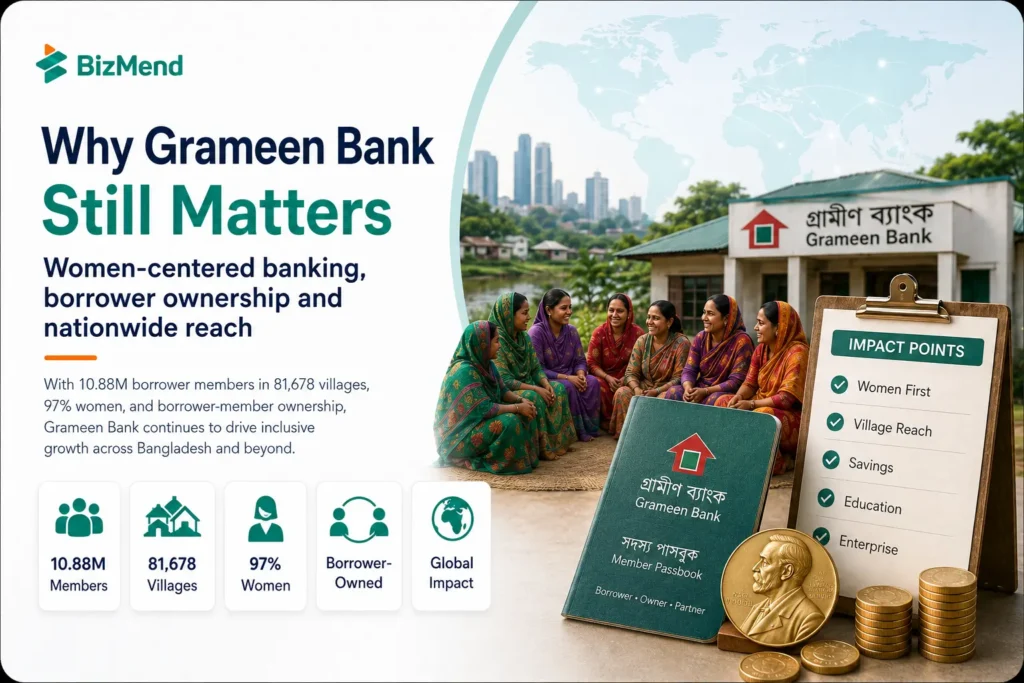
This is one of Grameen Bank’s clearest departures from standard banking. Nobel Prize materials noted that by 2006, more than 95 percent of Grameen loans went to women or women’s groups. Grameen’s own current figures put female borrower membership at about 97 percent.
That choice was partly practical and partly social. Grameen argued that lending to women improved repayment security while also improving household welfare, because income in the hands of women was more likely to support food, schooling, and basic stability. In Bangladesh, that gave the bank a role in women’s economic participation long before ‘financial inclusion’ became a global buzzword.
The social side of the model went beyond credit. Since 1984, the bank’s ‘Sixteen Decisions’ have tied borrowing to habits around sanitation, housing, education, family welfare, and mutual support. That made Grameen feel less like a narrow lender and more like a disciplined village development system built around women borrowers.
Supporters see that focus as one of Grameen’s strongest ideas. Critics sometimes see it as moral pressure layered onto finance. Both views matter if you are trying to judge the model honestly.
How far did Grameen grow beyond tiny village loans?
Very far. As of April 2026, Grameen Bank reported 10.88 million borrower members, service in 81,678 villages, 2,568 branches, and cumulative disbursements above US$42.12 billion. That is no longer a boutique pilot. It is a large, nationwide financial network with deep rural reach.
The product range also widened over time. Beyond basic loans, Grameen runs housing loans, microenterprise loans, education finance, savings accounts, pension products, and short-term bridge loans. Its housing loan program dates to 1984, and the current official ceiling for a simple tin-roof house loan is BDT 60,000 with weekly repayment over as much as five years.
- Higher education loans began in 1997 for borrowers’ children admitted to public, agricultural, engineering, and medical programs.
- Those education loans do not require installments during study and carry a 5 percent annual service charge after the final disbursement month.
- The struggling member program offers interest-free loans to people who beg, aiming to help them build income without forcing them out of survival mode overnight.
- Borrower-members also hold most of the bank’s equity. In the 2024 financial statements, they held 76.06 percent of shares.
The real story is not that Grameen stayed small. It is that a village-credit experiment grew into an entire banking architecture.
That ownership point is easy to miss, but it matters. Grameen is unusual because its customers are not just clients. They are also the majority owners of the institution.
Why did Grameen become globally famous, and where did debate begin?
The Nobel Prize in 2006 gave Grameen global symbolic power, but its influence was already spreading. Nobel Prize materials say the bank had inspired similar institutions in more than 100 countries. For policymakers, donors, and development agencies, Grameen became shorthand for the idea that finance could reach poor households without collateral and still remain disciplined.
That was the hopeful side. The harder side came later, when researchers asked whether microcredit reliably lifts households out of poverty. A 2015 World Bank summary of six randomized evaluations across Bosnia and Herzegovina, Ethiopia, India, Mexico, Mongolia, and Morocco found that microcredit can help expand business activity and improve financial choice, but usually does not produce large gains in household living standards or major reductions in poverty.
That does not mean Grameen failed. It means the early myth of microcredit as a universal cure was too simple. Small loans can help some borrowers smooth cash flow, start a trade, or gain breathing room. They do not erase weak markets, poor infrastructure, health shocks, or low wages on their own.
This is where the Grameen story becomes more useful than inspirational. It reminds readers to separate a smart banking design from exaggerated promises about what finance alone can fix.
What does Grameen Bank still teach banking today?
First, it proved that poor borrowers were bankable in the first place. That sounds obvious now, but it was not obvious in 1976 or even 1983. Grameen helped move lending away from the assumption that poverty automatically equals unreliability.
Second, it showed that distribution matters as much as product design. Weekly meetings, doorstep service, and simple loan structures were not side details. They were the operating system. Many later fintech and mobile-money ideas rest on the same basic lesson: if you want excluded customers, the service has to fit their daily lives.
Third, it offers a warning against turning one successful model into a universal formula. Even Grameen’s own evolution shows that clients need savings, education finance, housing support, and emergency options alongside credit. The 2015 World Bank evidence pushes the same point from another angle. Access helps, but one product rarely solves everything.
So the lasting importance of Grameen Bank is not that it found a magic answer. It is that it changed the questions bankers, regulators, and development thinkers ask about who deserves financial access and on what terms.
Final Thoughts
Grameen Bank matters because it changed banking from the edges. Bangladesh gave the world a model that treated poor women as borrowers, savers, and owners when many institutions barely saw them as clients. The model deserves respect, but also clear-eyed reading: it expanded access in a big way, even if access alone was never enough to solve poverty.
Frequently Asked Questions
What is Grameen Bank known for?
Grameen Bank is best known for popularizing collateral-free microcredit in Bangladesh. Its reputation comes from lending to poor borrowers, especially women, through village-level meetings and disciplined repayment systems rather than traditional collateral.
Who founded Grameen Bank?
Muhammad Yunus founded the Grameen experiment after testing small loans in Jobra village in 1976. The pilot became Grameen Bank in 1983, and Yunus later shared the 2006 Nobel Peace Prize with the institution.
How is the Grameen Bank model different from a normal bank?
The Grameen Bank model removes collateral, works closely through local meetings, and is built for borrowers who often lack formal banking history. It also ties credit to savings habits and ongoing field-level contact instead of relying mainly on branch visits and conventional security.
Does Grameen Bank only lend to women?
No, but women are the clear center of the system. Nobel Prize materials said more than 95 percent of loans went to women by 2006, and Grameen’s current official figures say about 97 percent of borrower members are female.
Did microcredit solve poverty in the way people first hoped?
Not fully. Later research summarized by the World Bank found that microcredit often helps business activity and financial flexibility, but usually does not create large, broad reductions in poverty on its own. It works better as one useful tool than as a single grand answer.