
 by Sheikh Ornob
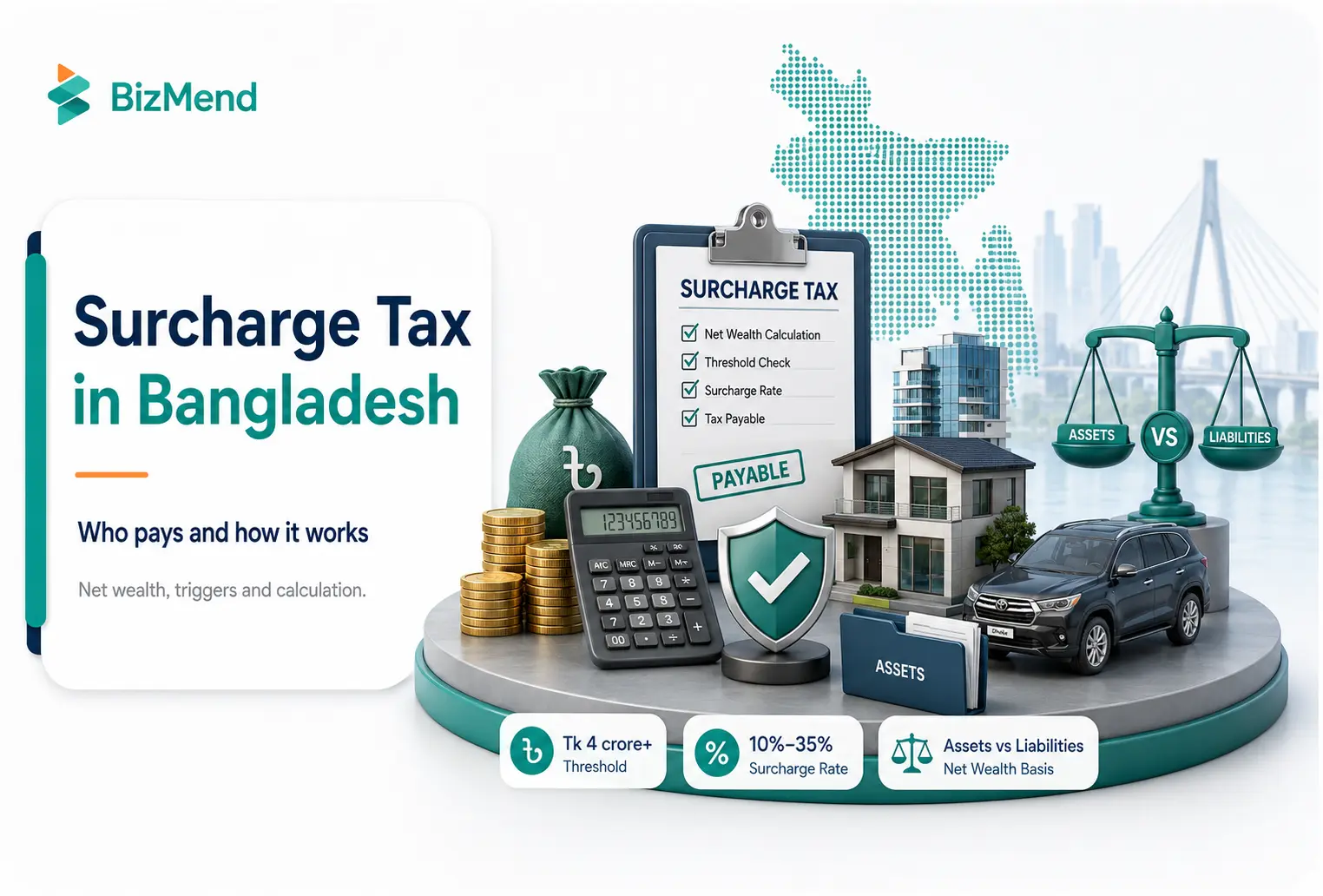
A surcharge tax in Bangladesh is not a blanket wealth tax on every rich person. In most cases, it is an extra amount added to your individual income tax once your net wealth, or certain asset ownership, places you inside the rule.
That distinction matters because many taxpayers mix up income tax, wealth tax, and the wealth statement filed with a return. They’re connected, but they aren’t the same thing. If you’re trying to work out whether a surcharge applies to you, the real questions are simple: how much net wealth you show, what assets you own, and how your base income tax was calculated first.
Quick answer: In Bangladesh, surcharge tax is an extra charge on an individual’s income tax, not a separate tax for everyone. Under the currently published framework reviewed on May 17, 2026, it generally starts once net wealth goes above Tk 4 crore, with rates from 10% to 35%, and some ownership conditions can also pull you into the rule.
Key Takeaways
- Surcharge in Bangladesh is usually an add-on to your personal income tax, not a standalone tax charged to every taxpayer.
- Under the current published framework reviewed for this article, no wealth-linked surcharge applies up to Tk 4 crore of net wealth.
- Once net wealth crosses Tk 4 crore, the surcharge rate moves through bands of 10%, 20%, 30%, and 35%, depending on the disclosed amount.
- Published 2025 Bangladesh tax summaries also show a 10% surcharge trigger for people who own more than one motor vehicle or have at least 8,000 square feet of house property.
- Net wealth means assets minus liabilities, so the quality of your valuation and loan records matters just as much as the headline asset value.
- The statement of assets and liabilities threshold is much lower than the surcharge threshold, which is why many people must disclose wealth even when no surcharge is due.
- If you are a non-resident Bangladeshi or a foreign individual with Bangladesh tax exposure, the scope of assets reported in Bangladesh can differ from a resident taxpayer’s position.
- Before filing, you should check the latest NBR notices because rates, forms, and filing dates can change by budget or public notice.
What surcharge tax in Bangladesh actually means
Think of surcharge as a second layer added after your regular income tax is computed. You calculate taxable income first. You apply the normal income tax rules next. Only after that do you ask whether your disclosed net wealth or certain ownership conditions put you in scope for a surcharge.
That is why people often get tripped up by the phrase “wealth tax Bangladesh.” In everyday conversation, they use “wealth tax” and “surcharge” as if they were the same thing. Legally and practically, they are not the same step. The current rule works as a wealth-linked surcharge on income tax liability.
This also means the effect is uneven. Two people can have the same salary, but if one person’s net wealth is far higher, that person can end up with a larger final tax bill even before you talk about penalties or interest.
Who may have to pay surcharge
| Current published trigger | Surcharge rate on income tax |
|---|---|
| Up to Tk 4 crore net wealth | Nil |
| Over Tk 4 crore up to Tk 10 crore | 10% |
| Over Tk 10 crore up to Tk 20 crore | 20% |
| Over Tk 20 crore up to Tk 50 crore | 30% |
| Over Tk 50 crore | 35% |
As of May 2026, the current published Bangladesh tax summaries keep the wealth-based surcharge structure in place for assessment years 2026 to 2027 and 2027 to 2028. If you are filing for a later period, pause and confirm the latest budget before relying on any table you see online.
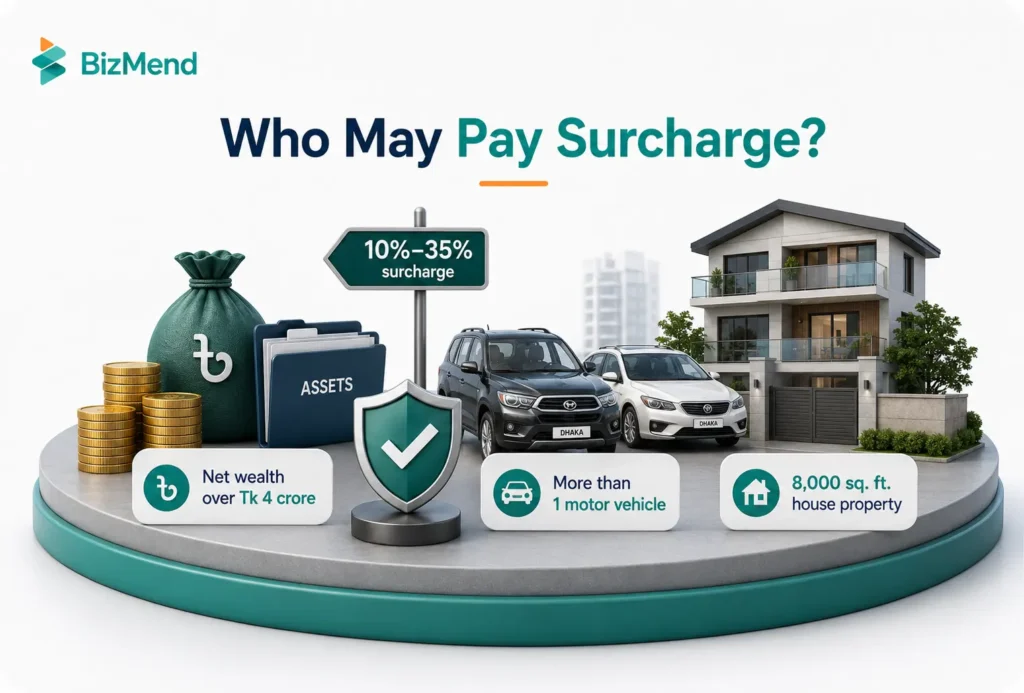
There is another part many people miss. Published Bangladesh tax summaries also note a 10% surcharge trigger for natural individuals who:
- own more than one motor vehicle in their own name.
- own at least 8,000 sq. ft. of house property.
So yes, a person can be dragged into the surcharge conversation even before crossing the top wealth bands they keep hearing about.
The short version is simple: if you are comfortably below Tk 4 crore and none of those ownership triggers apply, surcharge is usually not your issue. If your asset base is creeping up, or your property and vehicle profile looks more high-value than your income alone suggests, you should check it carefully.
Surcharge is not about what you earned alone. It is about what your tax return says you own.
How net wealth is looked at
Net wealth is the value of your assets after deducting relevant liabilities. In plain English, you do not look only at what you own. You also look at what you still owe. Land, apartments, cash, deposits, investments, business interests, vehicles, and other reportable assets can all matter. Loans and other genuine liabilities can matter too.
This is where paperwork quietly becomes the whole game. A flat in Dhaka, a plot in Chattogram, listed shares, gold, bank balances, and a business stake do not all raise the same valuation questions. If you guess instead of documenting, you can distort your position in either direction.
The filing side is broader than many people expect. Under section 167 of the Income Tax Act, 2023, an individual may need to file a statement of assets and liabilities if total assets exceed Tk 50 lakh, if they own a motor vehicle, if they invest in a house, property, or apartment in a city corporation area, if they own any asset abroad, or if they are a shareholder director of a company.
Residents and non-residents are not treated the same in scope. The same act says resident Bangladeshis file statements covering assets in Bangladesh and outside Bangladesh. Non-resident Bangladeshis and foreign individuals filing in Bangladesh report assets situated in Bangladesh. That does not answer every cross-border question, but it is a very important starting point.
How the surcharge is calculated
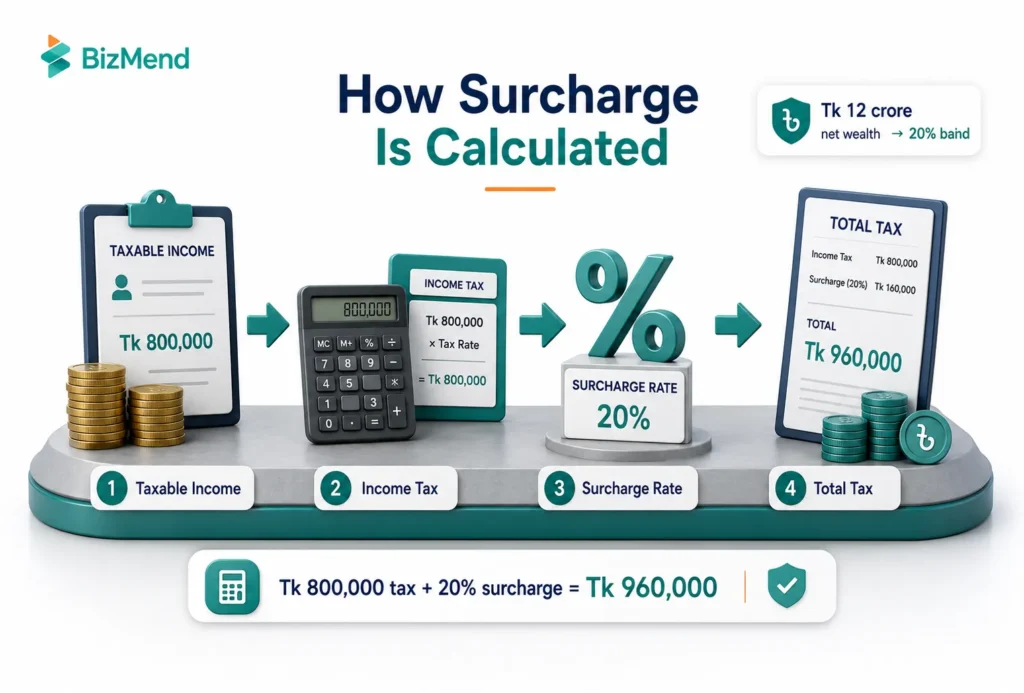
- Work out your taxable income under the normal individual income tax rules.
- Calculate the regular income tax payable.
- Determine your disclosed net wealth and check whether any non-wealth trigger also applies, such as more than one motor vehicle or at least 8,000 square feet of house property.
- Pick the relevant surcharge rate.
- Apply that rate to the income tax amount, then add it to the tax payable.
Here is a simple example. Suppose your regular income tax comes to Tk 800,000 after all normal computation. Suppose your disclosed net wealth is Tk 12 crore. That places you in the 20% surcharge band under the currently published framework reviewed for this article. Your surcharge would be Tk 160,000. Your total before interest, penalties, or any other separate charge would become Tk 960,000.
The key thing to notice is that the 20% is not applied to your wealth figure. It is applied to the income tax amount. That is the part people mix up all the time.
What to verify before filing
- Get support for every major asset value. Property papers, bank statements, portfolio records, loan statements, and business ownership papers should match the numbers you disclose.
- Separate disclosure threshold from surcharge threshold. A taxpayer can be required to file an asset statement at Tk 50 lakh of assets and still owe no wealth-linked surcharge.
- Check whether family assets are being reported correctly. The Act requires spouse or minor children’s information in some asset statements where they do not have separate TINs.
- Do not ignore the vehicle and property triggers. The published rules are not only about crossing Tk 4 crore.
- Confirm the latest NBR notices before submission. Filing methods and deadlines can move, and Bangladesh has recently pushed individual taxpayers toward the e-Tax system.
If your facts sit anywhere near a threshold, valuation discipline matters more than clever tax language. A weak number on a flat, private business stake or unpaid liability can change the surcharge band, and sometimes that is the whole difference between a manageable filing and a painful correction later.
If you also want the bigger compliance picture around Bangladesh tax filing, Bizmend already has a broader background guide on taxation essentials for foreign entrepreneurs in Bangladesh.
Common misunderstandings to clear up
First, surcharge is not the same thing as saying Bangladesh has a universal annual wealth tax. For most readers, the practical question is whether a wealth-linked extra charge increases their individual income tax bill.
Second, a high asset statement does not automatically mean the surcharge number itself will be huge. The surcharge rate is applied to your income tax. So the final cash effect depends on both your tax liability and your surcharge bracket.
Third, people often assume only ultra-rich taxpayers need to think about disclosure. That is wrong. The asset statement rules can catch people far below the Tk 4 crore surcharge line, especially if they own a vehicle, city property, or foreign assets or hold shares as a company director.
Final Thoughts
Surcharge in Bangladesh becomes much easier to handle once you separate three ideas: income tax, asset disclosure, and wealth-linked extra tax. Keep those steps clean, verify your values, and check the latest NBR position before you file.
Frequently Asked Questions
Is surcharge tax in Bangladesh the same as a separate wealth tax?
Not in the way most people mean it. For individual taxpayers, the current rule works as an extra charge on income tax once your net wealth or certain ownership conditions place you inside the surcharge framework. That is why people often call it wealth tax, even though the calculation usually sits on top of income tax.
At what net wealth does surcharge usually start in Bangladesh?
Under the current published framework reviewed for this article on May 17, 2026, the wealth-based surcharge starts when net wealth goes above Tk 4 crore. The published bands then rise to 10%, 20%, 30%, and 35%. Because budget rules can change, check the latest NBR position before filing.
Can surcharge apply even if my net wealth is not far above the threshold?
It can, because the published rules for the current period also point to a 10% surcharge trigger for individuals who own more than one motor vehicle or at least 8,000 square feet of house property. That is one reason the issue catches people who were only watching the main wealth bands.
Do non resident Bangladeshis have to think about surcharge and asset statements?
Yes, if they have Bangladesh tax exposure. The Income Tax Act, 2023, says non-resident Bangladeshis file statements for assets situated in Bangladesh, while residents report both Bangladeshi and foreign assets. The exact surcharge result still depends on the taxpayer’s facts, filing position, and the current year’s rules.
What documents matter most before I file?
Start with property papers, bank and investment statements, vehicle information, business ownership records, and proof of liabilities such as loan balances. If those numbers are not supported, your net wealth figure can move, and that can shift the surcharge outcome.