

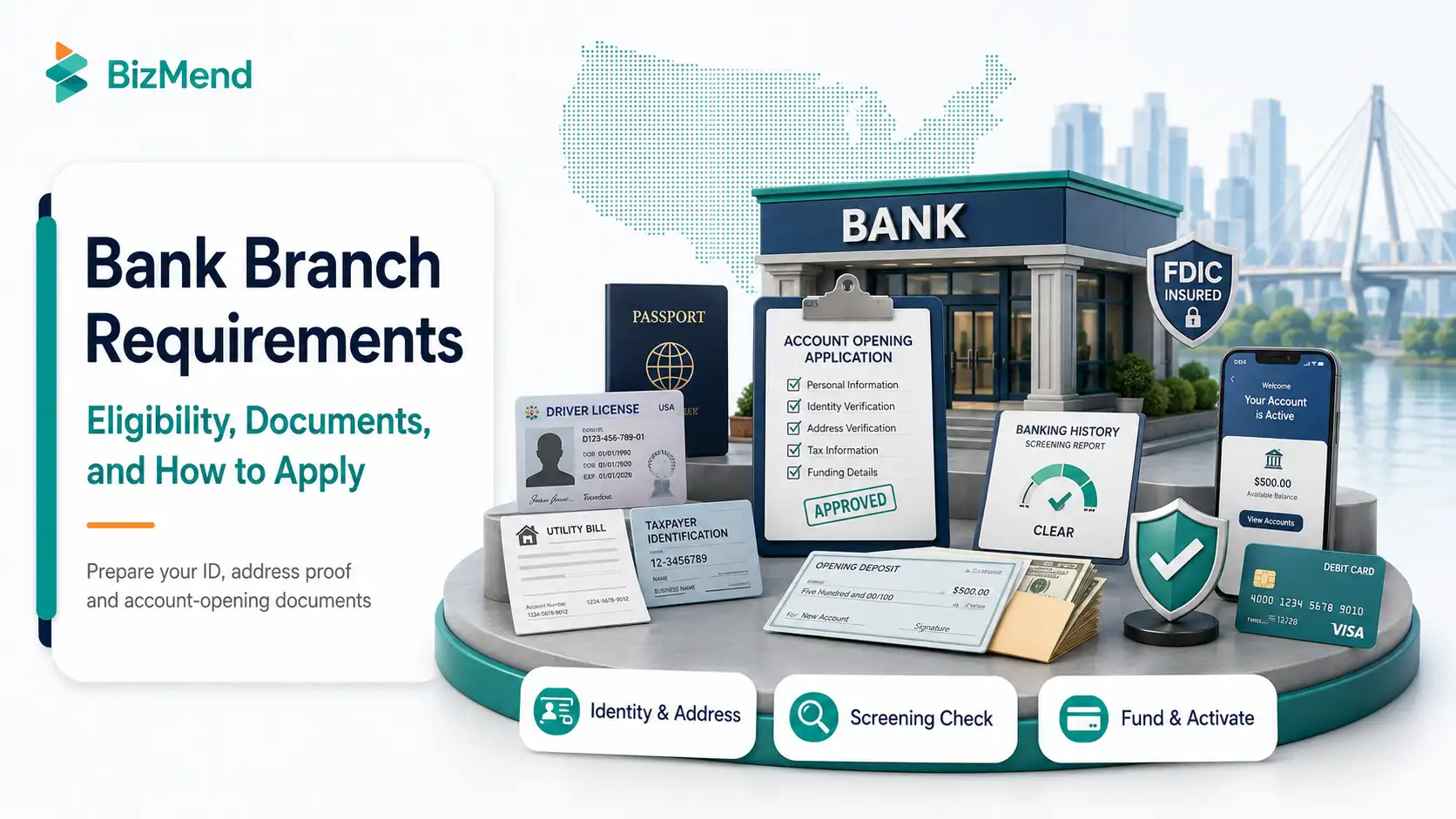
Bank branch requirements come down to the same four checks every US bank uses: proof of who you are, proof of where you live, a taxpayer number, and a banking history clean enough to pass a screening report, verified in person by a teller instead of through a screen. Walking in rather than logging on changes how you prove these things, not what you actually need to bring along.
This guide lists the exact eligibility rules, the documents to bring, the application steps in order, and the reasons applications get rejected, so nothing catches you off guard at the counter.
Quick Answer: To meet bank branch requirements, you generally need to be 18 or have a joint adult owner, a government-issued photo ID, a US address, and a Social Security number or ITIN, and pass a ChexSystems screening. Most branches also ask for a small opening deposit, often $25 to $100, confirmed on the spot by a teller.
Bank Branch Requirements: Eligibility Checklist
Age. Opening an account alone generally requires being 18 or the age of majority in your state, since minors cannot enter a binding contract on their own. Interagency guidance from federal banking regulators confirms no federal law sets this age; state contract law does, which is why every branch asks for a parent or guardian to serve as a joint owner or custodian on a minor’s account. The same age rule applies across every branch-based charter type, including the process for choosing a state bank, so this checklist holds regardless of which specific bank’s branch you visit.
Identification. A branch needs a current government-issued photo ID, such as a driver’s license, a state ID card, a passport, or a military ID, which a teller checks visually against you in person, a faster process for most applicants than a remote photo match. A second document sometimes confirms your address if it does not match the ID, and a banker can usually tell you on the spot whether a specific document will work rather than leaving you to guess from a general list.
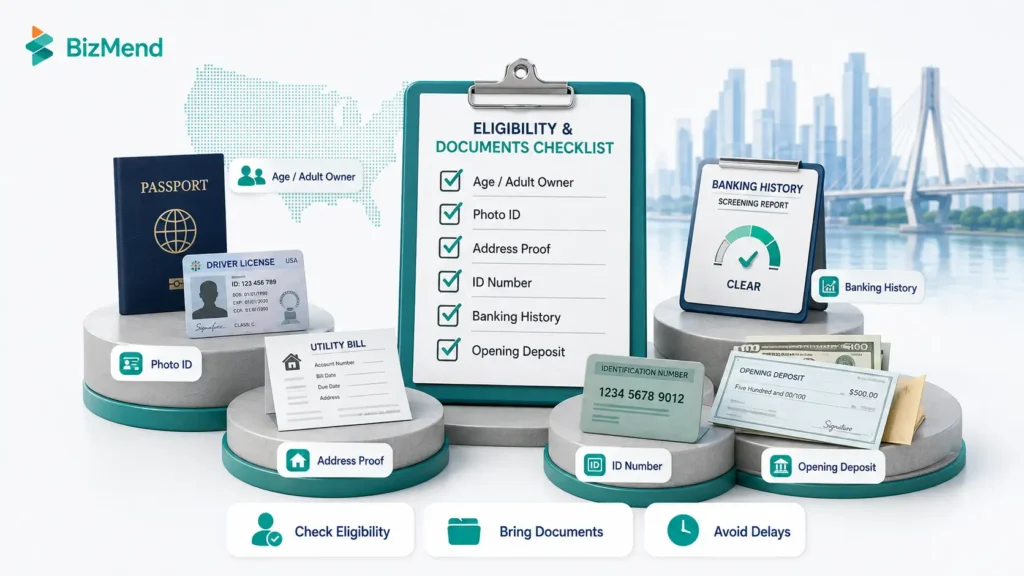
Taxpayer number. Federal customer identification rules require every bank to collect a taxpayer identification number before opening an account, and a branch collects it the same way any channel does. US citizens and most residents use a Social Security number; non-citizens without one can generally use an Individual Taxpayer Identification Number instead, and a teller can often answer questions about this in real time rather than routing the question to a support line.
Screening check. Most banks review a ChexSystems report at account opening regardless of channel, a specialty consumer file tracking past account problems such as unpaid overdrafts or suspected fraud, kept separately from your credit score.
Opening deposit. A branch typically asks for a small minimum deposit to activate the account, commonly $25 to $100, and unlike most online-only applications, you can usually fund it immediately with cash handed directly to the teller rather than waiting on a transfer to clear over one or more business days.
Documents Needed to Open an Account at a Bank Branch
For each document, a branch asks for maps to a specific legal or risk requirement, not a random preference, even though a person reviews it instead of an algorithm.
A government-issued photo ID, such as a driver’s license, state ID, passport, or military ID, confirms your identity and satisfies the bank’s federal customer identification obligations, and a teller can often resolve a minor mismatch on the spot that would stall a fully digital application entirely. A Social Security card or ITIN letter documents the taxpayer number the bank must collect, though many branches accept the number stated verbally once your ID or existing records confirm it, so carrying the physical card is a convenience rather than a strict requirement. Proof of a US address, such as a lease, a recent utility bill, or a piece of official mail, matters most when your ID shows an old or out-of-state address, since the bank needs a current mailing address on file for statements, a physical debit card, and legally required notices.
Business applicants add formation documents and an Employer Identification Number, and a banker at the branch can often review these on the spot rather than routing them through an automated review queue. Reviewing the national bank requirements checklist alongside this list is useful for founders comparing branch banking against a larger institution before applying. The state bank requirements checklist covers the equivalent list for a state-chartered branch specifically, in case the institution you are visiting turns out to be organized that way.
Large cash deposits carry one more requirement worth knowing in advance. Under the Bank Secrecy Act, a branch must file a currency transaction report for cash transactions over $10,000 in a single business day, a routine compliance step rather than a sign of suspicion, so do not be surprised if a teller asks a few extra questions when handling a large amount of cash, since the paperwork is completed on the bank’s side and rarely slows down the transaction itself.
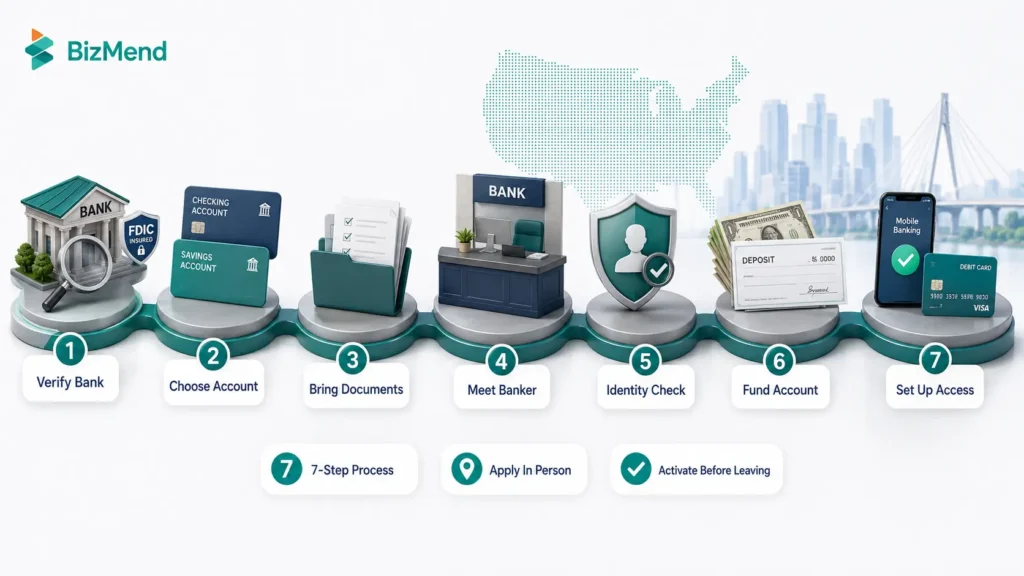
Step-by-Step Process to Open an Account at a Bank Branch
1. Confirm the bank is FDIC-insured and the branch is open for new accounts. Search the FDIC’s BankFind tool or call ahead, since hours and services can vary by location even within the same bank.
2. Choose the account type before you arrive. Decide between checking, savings, or a business account, since document and minimum-deposit rules can differ slightly by product, and knowing this in advance speeds up the visit.
3. Gather your documents. Bring a government-issued photo ID, your Social Security number or ITIN, and proof of address if your ID does not already show it, along with a second ID if you have one available.
4. Meet with a banker or teller. Most branches route new account openings to a personal banker rather than a teller window, so expect a seated conversation rather than a quick counter transaction, and bring a few minutes of patience for the paperwork.
5. Complete identity and screening checks. The banker verifies your identity against your documents directly and typically pulls a ChexSystems report before finalizing the account, often within the same visit rather than a separate follow-up.
6. Fund the account. Hand over cash, a check, or a card to meet the minimum opening deposit where one applies; a branch is often the fastest way to fund an account immediately compared with waiting on an electronic transfer to post.
7. Set up account access before you leave. Activate online banking, request a debit card, and ask about any specialty services like notary work or safe deposit boxes while a banker is still available to walk you through it in person.
Working through the same steps used when choosing a national bank applies here too, since the underlying document and funding requirements stay similar whether you open the account at a counter or through an app.
Common Reasons Bank Branch Applications Get Rejected
A negative ChexSystems record causes most denials, whether the account is opened in person or online. Unpaid overdrafts, a forced account closure, or suspected fraud on a past account can trigger a rejection even when your credit score is fine, since ChexSystems tracks banking history separately from credit history entirely, using its own scoring model built around deposit account conduct rather than borrowing.
Mismatched or expired identification is the second common cause, though a branch often catches and resolves this faster than a digital application would. An ID that has expired, or a name and address that do not match your other documents, forces a pause until something lines up, but a banker can sometimes suggest an acceptable alternative document on the spot rather than leaving you to guess what might work instead.
Insufficient proof of a US address trips up newcomers most often. Someone exploring a non-resident bank account may not yet have a utility bill in their own name, so a lease agreement or a bank-accepted alternative document usually solves this, and a branch banker can often confirm on the spot whether a specific document will work.
An incomplete or mistyped taxpayer number also stalls approval, though a teller entering the number directly reduces the risk of a typo compared with a rushed mobile form. Double-checking your Social Security number or ITIN before you go avoids a delay that a few minutes of review can prevent either way.
To avoid a denial, request your free ChexSystems report before applying if you have had banking trouble before, bring a current unexpired ID, and confirm your taxpayer number matches your records exactly. Reviewing the report yourself first also catches identity theft early, since an account you never opened can appear on your file and cause a confusing denial you would otherwise not understand or know how to address quickly.
What Happens After You Apply
Most branch applications are approved or denied the same visit, since a banker can review your ChexSystems record and documents directly rather than routing them to a separate review queue elsewhere. An application flagged for additional verification, sometimes triggered by a document that looks altered or a detail that needs a second look, can still take one to a few extra business days to fully clear.
If approved, the account is typically active before you leave, with account and routing numbers available immediately and a physical debit card mailed within about seven to ten business days, though some branches can issue an instant card printed on the spot. If denied, federal rules require the bank to send an adverse action notice naming the screening company involved, and you can request a free copy of that report to review and dispute anything inaccurate rather than assuming the decision is final.
Trying a national bank is worth considering if a specific branch cannot approve your application, since document requirements stay largely the same across charter types. The national bank charter background is worth a quick read too, since it explains how that alternative is regulated. Reviewing this state bank overview is also worth a look if a smaller, more local institution ends up being a better fit once the underlying issue behind a denial is resolved.
Key Insights
- Four requirements cover most applicants: ID, taxpayer number, US address, and a passable ChexSystems record.
- A teller’s in-person ID check often resolves a mismatch faster than a fully digital application would.
- Most rejections trace back to ChexSystems history, not an applicant’s credit score.
- Non-citizens can generally use an ITIN instead of a Social Security number to open an account.
- Cash deposits over $10,000 trigger a routine federal reporting requirement, not a denial risk alone.
- Opening deposits commonly run $25 to $100, and branches often let you fund the account immediately.
Final Thoughts
Meeting bank branch requirements comes down to four checks: a valid photo ID, a Social Security number or ITIN, a US address the bank can verify, and a ChexSystems history clean enough to pass review. Applying in person often clears every step in one visit, since a banker can resolve document mismatches on the spot that a digital process would route to a delay instead.
Before visiting, pull a free copy of your ChexSystems report if you have had banking trouble before, and confirm your ID and taxpayer number match your records exactly. If a branch denies the application, request the notice, review the reason in writing, and correct the underlying issue before trying again at a different branch nearby.
Frequently Asked Questions
What do I need to open an account at a bank branch?
You generally need a government-issued photo ID, a Social Security number or ITIN, proof of a US address, and a passable ChexSystems record. Most branches also require a small opening deposit, and applicants under 18 need a joint adult owner on the account.
Can I open a bank branch account without an SSN?
Yes, in most cases. Non-citizens without a Social Security number can generally use an Individual Taxpayer Identification Number instead, since federal rules require a taxpayer number but not specifically an SSN for every applicant, provided a valid photo ID is still presented at the counter.
What is the minimum deposit for a bank branch account?
It varies by bank and account type, but a common range is $25 to $100, and a branch often lets you fund it immediately with cash rather than waiting on a transfer to clear. Confirm the current figure directly with the specific branch before applying.
How long does it take to open an account at a bank branch?
Most in-person applications are approved the same visit when the applicant has a clean ChexSystems record and matching documents, since a banker reviews everything directly. Applications needing additional verification can take a few extra business days to fully clear.
What is ChexSystems and why does it matter?
ChexSystems is a specialty consumer reporting agency that tracks past banking problems, such as unpaid overdrafts or suspected fraud, separately from your credit score. Most banks, whether you apply at a branch or online, review this report before approving a new account, and a negative record is the most common reason applications are denied.
Is it easier to open an account at a bank branch than online?
Often yes for applicants with a document mismatch or an unusual situation, since a banker can review your ID and paperwork directly and sometimes resolve a small issue on the spot rather than routing it to a delayed manual review. The core requirements themselves stay the same either way.
Do I need an appointment to open an account at a bank branch?
Not always, though calling ahead or scheduling online can reduce wait time, especially since most branches route new account openings to a personal banker rather than a teller window, and bankers are not always immediately available for a walk-in visit.
