Depository Institution Requirements: What You Need
Depository institution requirements come down to the same handful of checks no matter which type of institution you pick. A…

Get your Export Registration Certificate (ERC) in Bangladesh. Full document checklist, exact fees, online OLM steps, and renewal rules. Clear guide for new exporters.
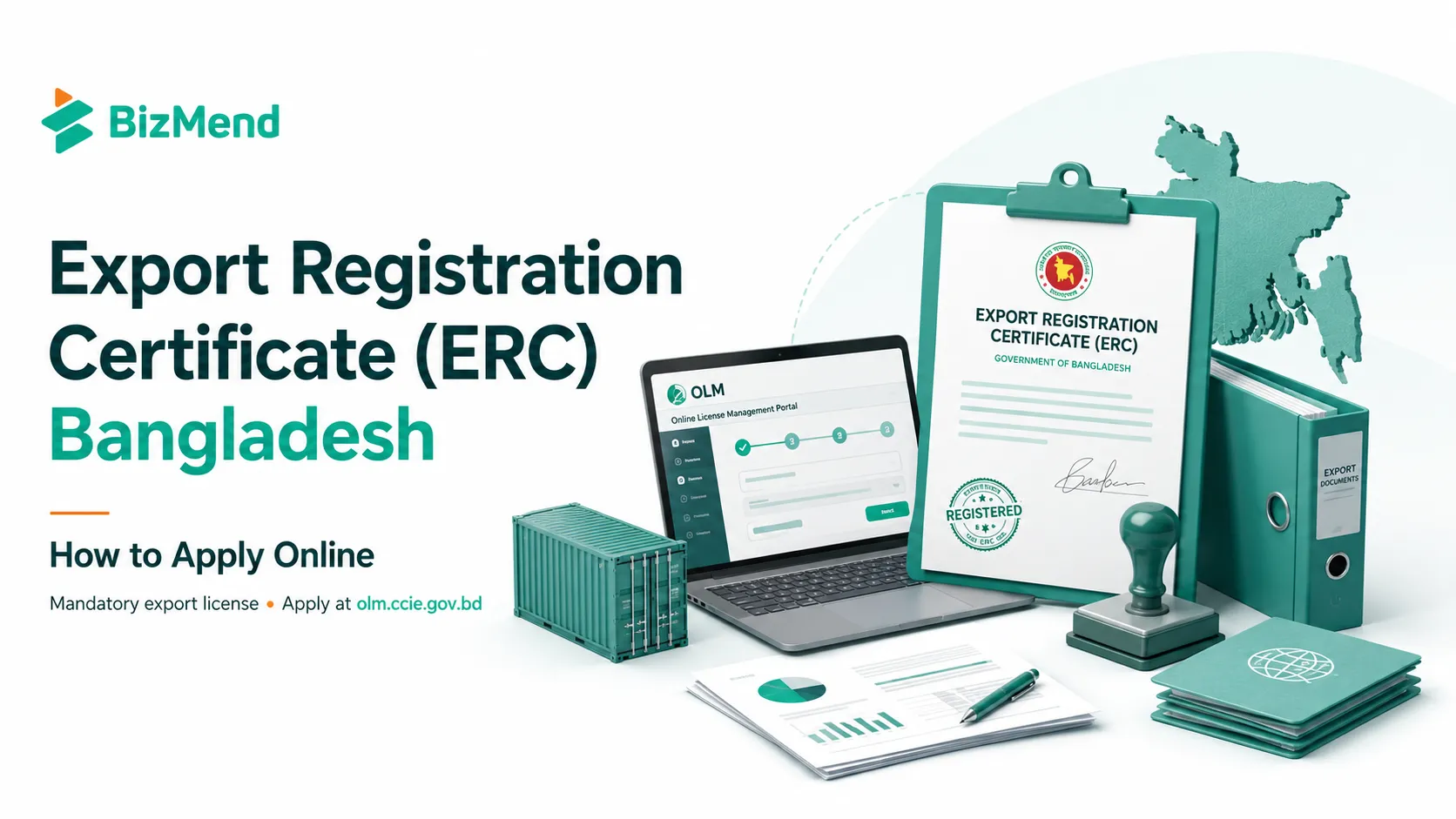
Try shipping goods internationally without an ERC in Bangladesh. Your bank won’t touch the Letter of Credit. Customs won’t clear your container. And you’ll be operating in violation of the law. Illegally.
The Export Registration Certificate is the starting point for every legal exporter in Bangladesh. It’s not complicated to get. But you need to know the exact steps, documents, and fees. This guide gives you all of that, plus some things most other guides miss.
Quick Answer: The Export Registration Certificate (ERC) in Bangladesh is a mandatory export license issued by the Office of the Chief Controller of Imports and Exports (CCI&E) under the Ministry of Commerce. The registration framework is governed by the Importers, Exporters and Indentors (Registration) Order, 1981. Apply online at olm.ccie.gov.bd. The fee is BDT 11,500 for new registration (BDT 10,000 + 15% VAT) and BDT 8,050 for annual renewal. Official processing time is around 3 working days after complete submission, though practical timing may vary.
The ERC is the government-issued license that authorizes your business to export goods from Bangladesh. Without it, you can’t legally send a single commercial shipment abroad.
The legal basis rests on two laws. The Imports and Exports (Control) Act, 1950 provides the overarching authority for trade control in Bangladesh. The actual registration framework for exporters is handled under the Importers, Exporters and Indentors (Registration) Order, 1981. It’s this 1981 Order that established the ERC system: who must register with CCI&E, how registration works, what conditions apply, and on what grounds registration can be refused, suspended, or cancelled.
The ERC is issued by the Office of the Chief Controller of Imports and Exports (CCI&E), which operates under the Ministry of Commerce.
Once you have an ERC, you can export any permissible goods from Bangladesh without quantity or value restrictions. Banks won’t open a Letter of Credit for you without a valid ERC. Customs won’t process your export declaration. Foreign buyers increasingly ask for it as a trust signal. So yes, it matters.
Any individual or business entity planning to commercially export goods from Bangladesh needs an ERC. This includes sole proprietors, partnerships, private limited companies, and foreign-owned companies registered in Bangladesh.
There’s no minimum export value. Whether you’re shipping BDT 50,000 worth of handicrafts or BDT 5 crore of garments, the ERC requirement applies.
ERC vs. IRC: The ERC is for exporters. The Import Registration Certificate (IRC) is for importers. Some businesses apply for both if they do two-way trade. Both are issued by CCI&E.
General ERC vs. Indenting ERC: Most new exporters apply for the General ERC (manufacturer-exporter or commercial exporter). If you’re acting as an indenting agent, arranging deals between foreign buyers and local manufacturers without directly handling goods, you need an Indenting ERC, which carries a much higher fee. Under the 1981 Registration Order, indentors are classified separately from exporters.
If you’re still figuring out your business structure before applying, this guide on company types and restrictions in Bangladesh will help you pick the right entity.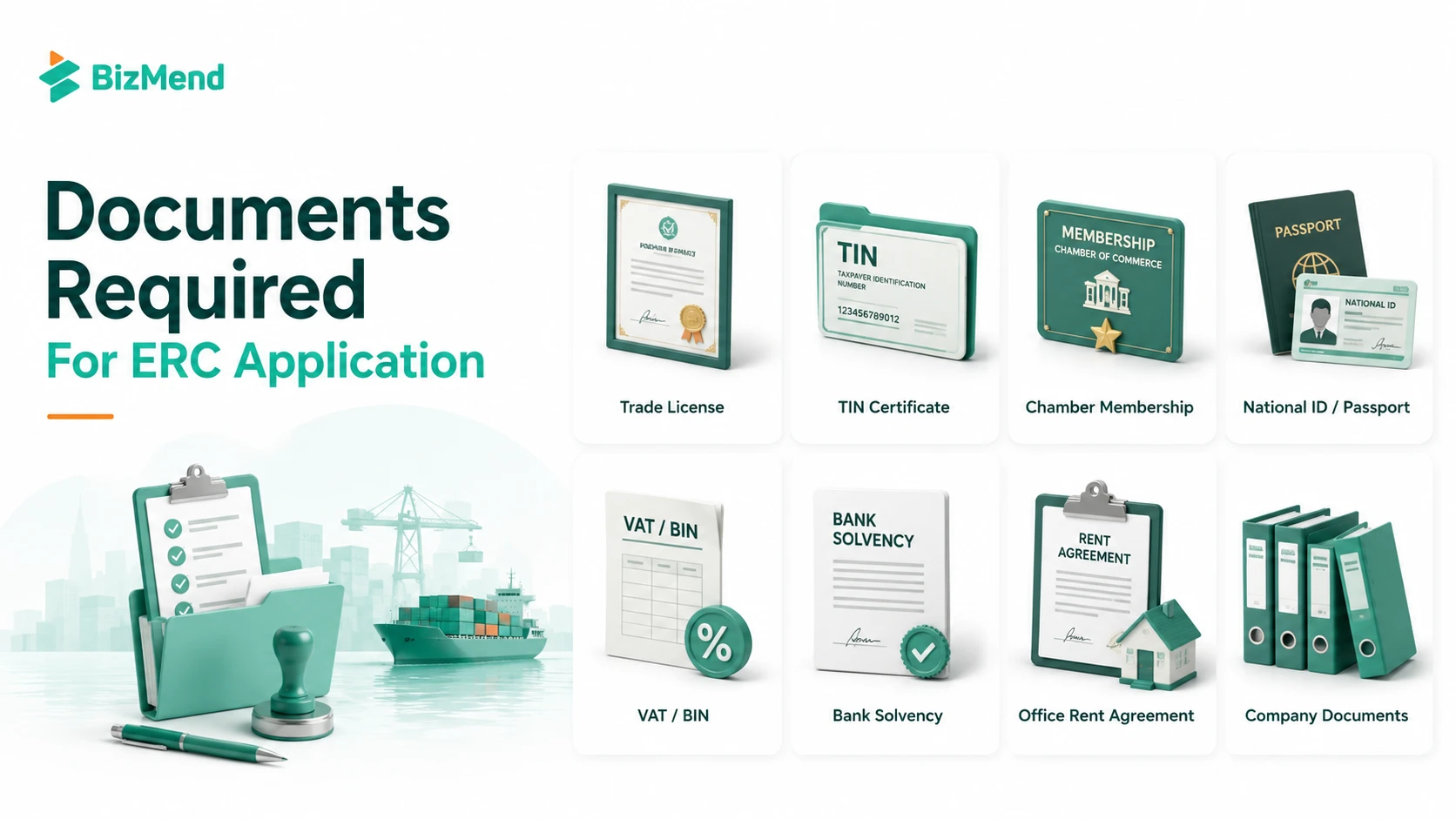
The OLM portal shows required documents as you fill the application form. The list below reflects what applicants typically need, but always check what the portal requests for your specific applicant type, as some documents are case-specific and not mandatory for everyone.
Depending on your business type, application category, or what the OLM form asks at the time of your application, CCI&E may also require some or all of the following:
If you don’t have a trade license yet, this article on how to set up a business in Bangladesh walks through the full legal setup. All documents should be attested or clearly scanned. The OLM portal will indicate the exact format required for upload.
The fee table below reflects current government charges effective from September 1, 2022, per CCI&E’s revised fee schedule.
| Certificate Type | Base Registration Fee | Total (incl. 15% VAT) |
|---|---|---|
| General ERC (new) | BDT 10,000 | BDT 11,500 |
| General ERC (renewal) | BDT 7,000 | BDT 8,050 |
| Indenting ERC (new) | BDT 50,000 | BDT 57,500 |
| Indenting ERC (renewal) | BDT 25,000 | BDT 28,750 |
Payment is made through the option shown in the OLM portal during your application. Online payment may be available directly through the portal. If the portal directs you to offline payment, deposit the fee at any Sonali Bank or Bangladesh Bank branch under treasury code 1-1731-0001-1801 and upload the scanned challan. Keep your payment receipt regardless of which method you use.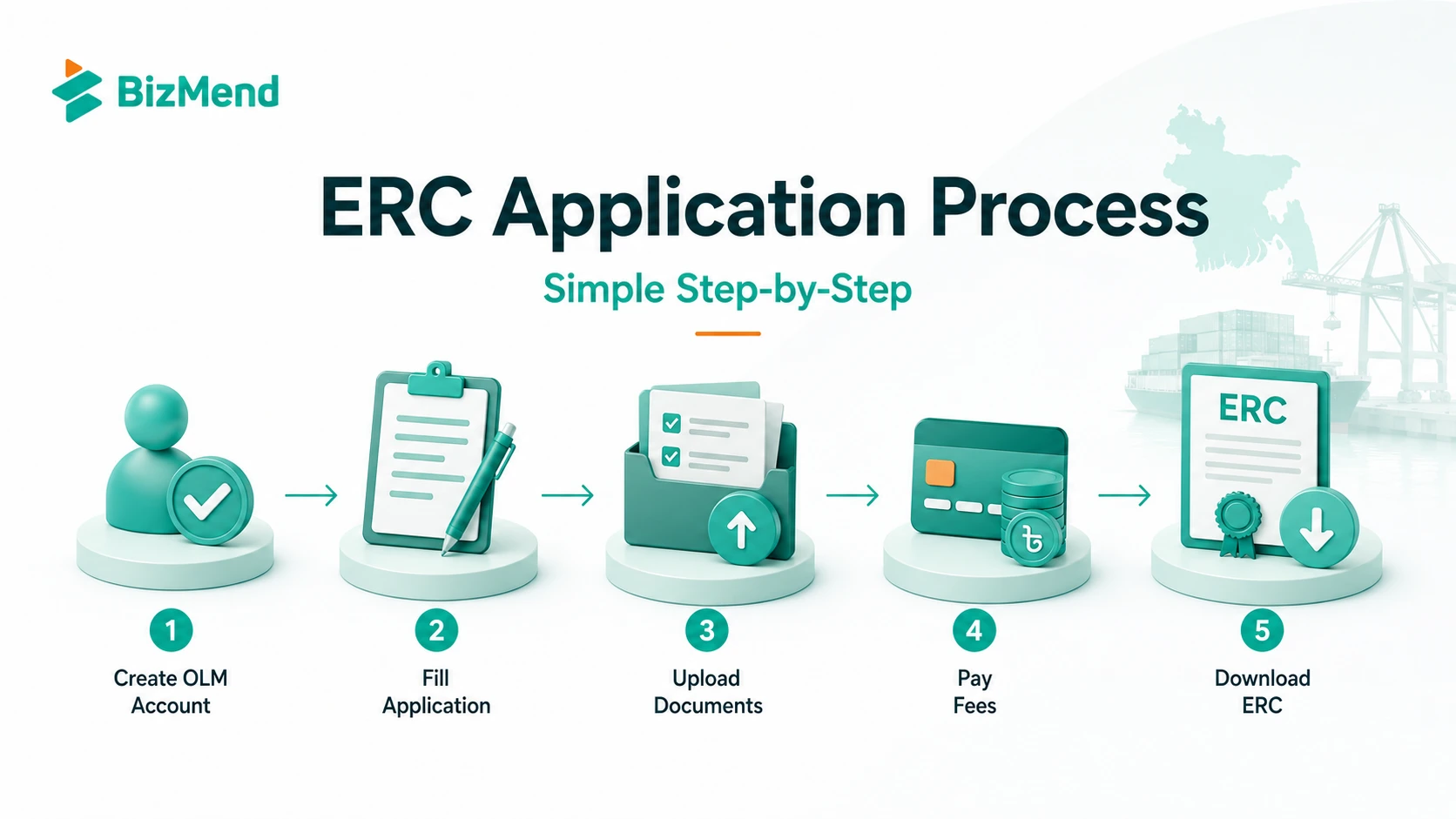
CCI&E launched its Online Licensing Module (OLM) in July 2019. All ERC applications now go through olm.ccie.gov.bd. No more collecting forms in person. No more queuing at government counters. You can complete everything online.
Official processing time is listed as around 3 working days after complete submission. Practical timing may vary if documents need correction, verification, or a field inspection is triggered.
ERC renewal is now much more flexible than it used to be. According to the OLM portal, you can renew for any full-year period between 1 and 5 years in a single renewal transaction. Previously, exporters had to renew annually. Now you can renew for up to 5 years at once.
Key renewal rule: Apply at least 60 days before your ERC expiry to avoid penalties. The OLM portal explicitly recommends this window.
Documents required for renewal:
Steps for renewal: Log into OLM, go to the renewal section, enter your ERC number, upload updated documents, complete payment, and submit. Clean applications typically process within a few working days.
Chamber membership mismatch. Your chamber membership must match your product sector and company name exactly. If you recently renamed your company, update the membership before applying.
Trade license expired or from wrong authority. Make sure your trade license is current and issued by the correct city corporation or municipal authority for your registered office location.
Nominating a non-AD bank branch. Only scheduled commercial banks with Authorized Dealer (AD) license can be nominated. Not every branch of every bank qualifies. Verify before selecting.
Submitting General ERC when Indenting ERC is needed. If you arrange deals between foreign buyers and manufacturers without taking direct ownership of goods, you need an Indenting ERC. Getting the category wrong wastes money and time.
Not renewing on time. A lapsed ERC means you legally cannot export until it’s renewed. Set a reminder 60 days before your expiry date, as CCI&E explicitly recommends this window.
Getting the ERC isn’t the finish line. It’s the starting gun. Here’s what opens up once you have it:
For a deeper look at the full set of export documents in Bangladesh — including the EXP Form, Certificate of Origin, and Bill of Export — that guide covers everything from customs to payment documentation.
Some Bangladeshi exporters also set up a US company to receive payments via Stripe or PayPal. This guide on starting a US business from Bangladesh explains exactly how that works.
If you want to understand which sectors offer the strongest export potential right now, this overview of top export-oriented industries in Bangladesh is worth reading before you decide what to export.
The Export Registration Certificate (ERC) in Bangladesh is a mandatory export license issued by the Office of the Chief Controller of Imports and Exports (CCI&E) under the Ministry of Commerce. ERC registration is governed under the Importers, Exporters and Indentors (Registration) Order, 1981. Without a valid ERC, no business can legally export goods from Bangladesh, open export Letters of Credit, or receive export proceeds through the banking system.
ERC registration in Bangladesh rests on two legal instruments. The Imports and Exports (Control) Act, 1950 (Act No. XXXIX of 1950) provides the overarching authority for trade control. The Importers, Exporters and Indentors (Registration) Order, 1981 is the specific order that established the ERC system and governs who must register, how registration is processed, and on what grounds it can be refused, suspended, or cancelled.
A new General ERC costs BDT 11,500 (BDT 10,000 + 15% VAT). Annual renewal costs BDT 8,050 (BDT 7,000 + 15% VAT). For Indenting ERCs, new registration is BDT 57,500 and renewal is BDT 28,750. Payment is made through the method shown in the OLM portal. Online payment may be available; if directed offline, use Sonali Bank or Bangladesh Bank under treasury code 1-1731-0001-1801.
Official processing time is listed as around 3 working days after complete submission. In practice, timing may vary if documents need correction, require additional verification, or trigger a field inspection of your office premises. Submitting complete, accurate, and clearly scanned documents is the best way to stay close to the official timeframe.
Core documents typically required include a valid Trade License, TIN Certificate, Chamber Membership Certificate, and National ID or Passport. Additional documents such as VAT/BIN certificate, Bank Solvency Certificate, passport-size photos, and Office Rent Agreement may be requested depending on your business type. Limited companies also need the Certificate of Incorporation, MOA, and AOA. Partnerships need an attested Partnership Deed. The OLM portal confirms the exact list for your applicant category.
Yes. Sole proprietors, partnerships, and limited companies can all apply for an ERC. Sole proprietors don’t need RJSC incorporation documents. Their core requirements include a Trade License, TIN, Chamber Membership, and National ID. The OLM portal at olm.ccie.gov.bd handles all applicant types through the same online process.
Log into the OLM portal at olm.ccie.gov.bd and submit a renewal application. Pay BDT 8,050 per year through the portal’s payment method and upload your updated Trade License, Chamber Membership, and Bank Solvency Certificate. Apply at least 60 days before your ERC expiry to avoid penalties. You can renew for up to 5 years at once in a single transaction.
Exporting without a valid ERC violates the Imports and Exports (Control) Act, 1950 and the Importers, Exporters and Indentors (Registration) Order, 1981. Customs will not clear your goods. Banks will refuse to certify EXP Forms or process export LCs. Your shipment can be held at the port. Legal action from the Ministry of Commerce is possible. Your ERC must be valid on the date of each export transaction.
A General ERC is for manufacturers and commercial exporters who own and physically ship goods. An Indenting ERC is for indenting agents who arrange export deals between foreign buyers and Bangladeshi manufacturers without taking direct ownership of the goods. Under the Importers, Exporters and Indentors (Registration) Order, 1981, indentors are classified separately from exporters. The Indenting ERC costs BDT 57,500 (new) versus BDT 11,500 for a General ERC.
CCI&E’s Dhaka office is located at NSC Tower (15th Floor), 62/3 Purana Paltan, Dhaka-1000. Phone: +88-02-9553349. Website: ccie.gov.bd. Still, most ERC applicants today should start through the OLM portal at olm.ccie.gov.bd rather than visiting the office first. The online process handles applications, payments, tracking, and certificate download without requiring an in-person visit.
After getting your ERC, you can export any permissible goods without quantity or value restrictions, open export Letters of Credit with banks, register with the Export Promotion Bureau (EPB) for preferential Certificates of Origin (GSP Form A, SAFTA, APTA), claim government export cash incentives through Bangladesh Bank, and open an Export Retention Quota (ERQ) account to retain a percentage of your export earnings in foreign currency.
Honestly, the ERC process in Bangladesh is much less painful than it used to be. Before the OLM portal in 2019, you had to physically collect forms from government offices, wait in line, and submit everything in person. Now you do it from your desk.
The real challenge isn’t the online form. It’s getting your prerequisite documents right, especially the chamber membership certificate, which takes its own time to process. If I were starting this today, I’d apply for chamber membership first, then collect everything else in parallel.
One more thing: don’t let your ERC lapse. Set a calendar reminder 60 days before your expiry date, right now. A lapsed ERC doesn’t just mean a fine. It means you can’t ship anything until it’s reinstated. And if you have active orders, that’s a problem no buyer wants to hear about.
Start with olm.ccie.gov.bd. The rest follows.

Depository institution requirements come down to the same handful of checks no matter which type of institution you pick. A…
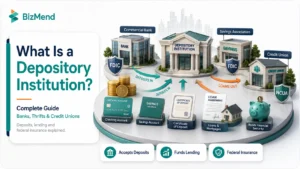
What is a depository institution, and why does the term matter more than “bank”? A depository institution is any financial…
 by Sheikh Ornob
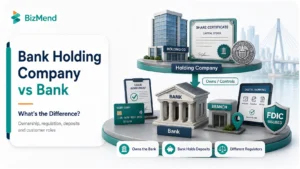
Searching for a bank holding company vs bank makes it sound like a choice between two competing products, but it…
by Sheikh Ornob