
 by Sheikh Ornob
Bangladesh shipped $39.35 billion worth of ready-made garments in FY 2024-25. That’s roughly 81% of the country’s total export earnings packed into a single industry. So if you’re thinking about RMG export in Bangladesh as a business, you’re not chasing some hidden niche. You’re walking into the biggest export engine the country has. The problem? Most new exporters get the paperwork right but lose buyers on compliance. Or the other way around. This guide breaks down how to actually start a garments export business in Bangladesh, from company setup to first shipment, in plain English.
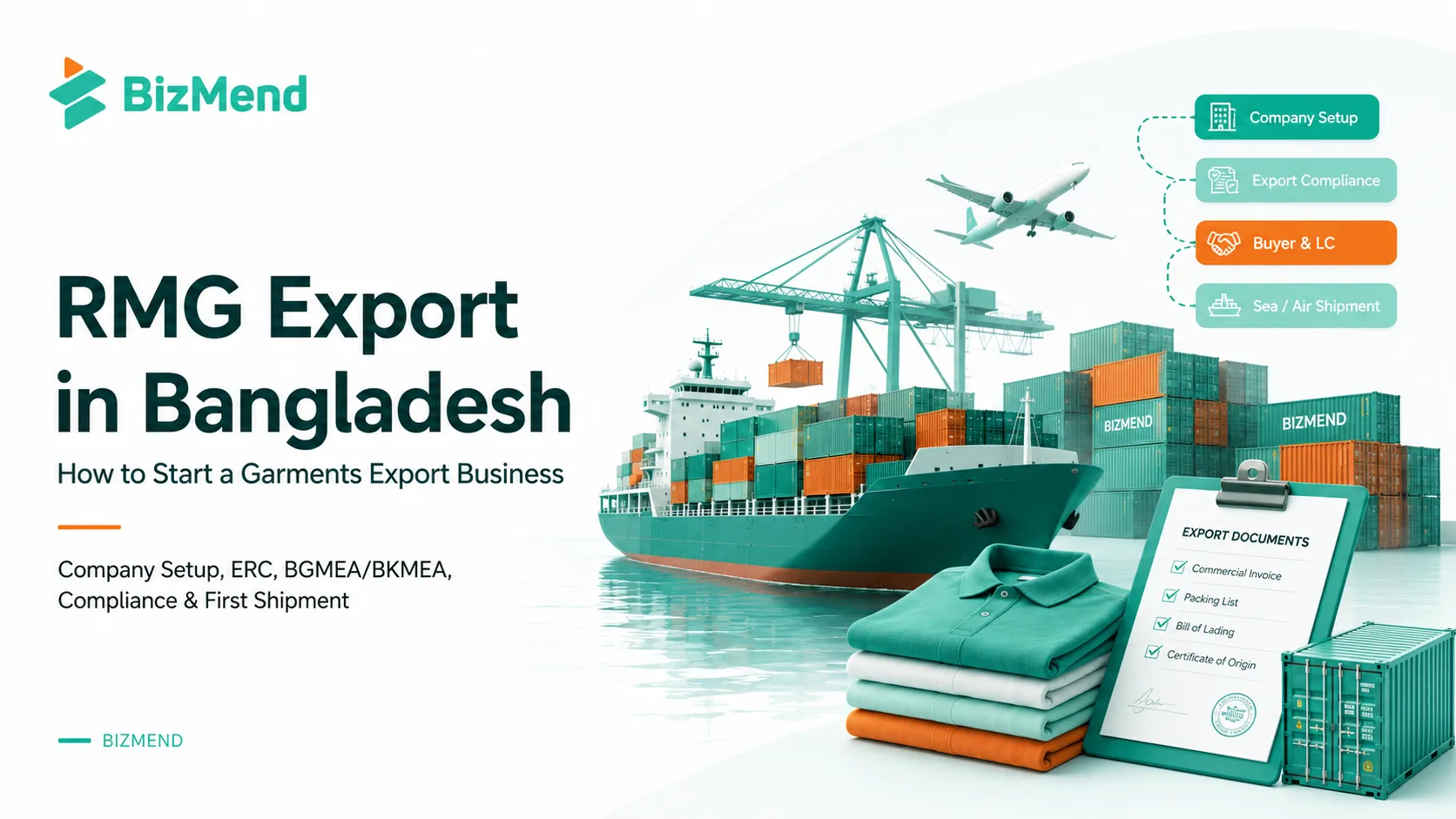
Quick answer: RMG export from Bangladesh means manufacturing or sourcing ready-made garments locally and shipping them to overseas buyers. To start, register a private limited company, secure an Export Registration Certificate (ERC) and BGMEA or BKMEA membership, lock in compliance audits, find a buyer, and ship through Chattogram port under a letter of credit. Expect 8 to 14 months from registration to first shipment.
Why RMG export from Bangladesh still leads the world
The numbers do the talking. In FY 2024-25, knitwear exports hit $21.16 billion (up 9.73%) and woven garments fetched $18.18 billion (up 7.82%). The EU bought 50.10% of all Bangladesh apparel ($19.71 billion), the US took 19.18% ($7.54 billion), the UK pulled in $4.35 billion, and Canada added $1.30 billion.
But the size of the industry isn’t the whole story. Bangladesh now has more than 230 LEED-certified green factories, 92 of them platinum-rated. That’s the highest count of any country in the world. The sector employs roughly 4 million workers across about 4,000 factories, and local textile mills cover around 85% of the demand for knit fabric.
So when you start a garments export business here, you’re stepping into infrastructure that took 40 years to build. Yarn, fabric, accessories, packaging, banking, customs, freight forwarders. It’s all already plugged in. For a broader look at why the sector still ranks among the top industries for foreign investment in Bangladesh, the playbook is similar: low cost, large workforce, mature supply chain.
The real question isn’t “can Bangladesh export garments?” It’s “what kind of garments will be profitable for the next five years?”
Step 1: get your company structure right
You can’t legally export from Bangladesh without a registered company. Most new exporters go for a Private Limited Company through the Registrar of Joint Stock Companies and Firms (RJSC). That’s the structure global buyers expect on a contract.
If you’re new to the legal setup, our walkthrough on starting a business in Bangladesh as a foreigner covers name clearance, RJSC filing, trade license, TIN, VAT, and BIDA notification when foreign capital is involved. The company types and restrictions for foreigners in Bangladesh matter here too, especially if you’re an NRB or a non-Bangladeshi co-founder.
Two things change when you’re setting up to export. First, your trade license must clearly list “garment manufacturing and export” as the business activity. Second, your registered office and factory addresses matter. Banks, customs, and bond licensing treat them separately, and your bonded warehouse rights depend on it.
Step 2: lock down your export licenses
This is where most first-timers spend three to six months. The licenses you need before a single shirt leaves the country:
- Export Registration Certificate (ERC). Issued by the Office of the Chief Controller of Imports and Exports (CCI&E) under the Ministry of Commerce. Apply through CCI&E’s Online Licensing Module at olm.ccie.gov.bd. The treasury challan is paid at Sonali Bank. ERC is valid for one year and must be renewed.
- Import Registration Certificate (IRC), if you also plan to import fabric, accessories, or machinery directly.
- BGMEA or BKMEA membership. BGMEA covers woven, knit, and sweater factories (around 4,000 members). BKMEA is knitwear-focused. Both issue Utilization Declarations (UDs) for raw material imports.
- Export Promotion Bureau (EPB) enrollment. Submit your trade license, ERC, association membership, fire license, factory license, TIN, VAT, and approved factory layout plan.
- Bond License. Without it, you pay full duty on imported fabric. With it, you import raw materials duty-free under the bonded warehouse arrangement. This is the single document that keeps Bangladeshi apparel price-competitive.
- Fire License, Factory License, Environmental Clearance. All three are non-negotiable for any audited factory.
Setting up inside an Export Processing Zone (EPZ) or a BEZA economic zone or Hi-Tech Park usually gives you faster onboarding. Tax, duty, and regulatory benefits may apply depending on the zone, entity type, current Finance Act, and sector-specific rules, but the conditions differ from a regular private limited company outside the zone.
Step 3: build a compliant factory or pick the right partner
You have two routes. Build your own factory, which runs $1.5 million to $5 million for a small 200-machine setup, or partner with a compliant tier-1 factory and operate as a sub-contractor or buying house. Either way, the gate is compliance.
International buyers won’t review your samples until at least one of these audits has been passed cleanly:
- BSCI (Business Social Compliance Initiative)
- WRAP (Worldwide Responsible Accredited Production)
- SMETA (Sedex Members Ethical Trade Audit)
- Higg Index
- Accord / RMG Sustainability Council (RSC) for fire, electrical, and building safety
- OEKO-TEX, GOTS, or ZDHC for textile chemistry and water
The post-Rana Plaza era is real. Walmart still maintains a non-supplier list of factories it has blacklisted, and global brands now want supply-chain transparency: a real factory map, real worker rosters, a real grievance system.
Decide your product line early. Knitwear (t-shirts, polos, sweaters) needs less imported fabric and benefits from local backward linkage. Woven (jeans, shirts, trousers) needs imported fabric but commands higher margins. The fastest-growing slices in 2026 are man-made fiber wear, technical wear, outerwear, and denim, where Bangladesh still lags Vietnam.
Step 4: find real buyers, not just leads
Anyone can list on Alibaba. Few convert. The four channels that actually move volume:
- Buying houses in Dhaka. They already work with H&M, Inditex (Zara), Marks & Spencer, Walmart, Primark, C&A, Levi’s, and Uniqlo. For a first-time exporter, becoming a sub-contractor to a tier-1 factory through a buying house is the cleanest start. H&M and Walmart each source over $4 billion of garments from Bangladesh annually.
- BGMEA-led trade fairs and B2B matchmaking. Made in Bangladesh Week, Apparel Summit Bangladesh, and DIFE-organized expos pull in real procurement teams, not just curious browsers.
- International apparel exhibitions. Texworld Paris, Première Vision, MAGIC Las Vegas, CHIC Shanghai, SaigonTex. Face time matters when you’re new and unranked.
- B2B platforms with verified buyers. Alibaba, Global Sources, EC21, Volza, ThomasNet. Cold leads need fast samples and faster follow-up, or they go cold within a week.
One overlooked move: get a DUNS number from Dun & Bradstreet for global buyer credibility. Walmart, Target, Costco, and most US retailers run supplier checks through D&B before approving a purchase order. No DUNS, no PO, simple as that.
Step 5: master the LC and back-to-back LC flow
Most new exporters get blindsided here. RMG runs on letters of credit (LCs). The flow for a standard woven order:
- The buyer opens a Master LC through their bank in your favor.
- You receive the LC at your authorized dealer (AD) bank in Bangladesh.
- You open a Back-to-Back LC against the master LC to import fabric and accessories. Back-to-back LCs in Bangladesh allow up to 180 days credit.
- Fabric arrives at Chattogram. You produce. You ship. You submit shipping documents to your bank.
- The buyer’s bank pays against compliant documents.
The bank you pick matters more than founders realize. Some AD banks process apparel back-to-back LCs in two days. Others take two weeks. Compare options through our guides on foreign banks in Bangladesh and commercial banks in Bangladesh before committing. For working-capital flexibility, especially for leasing machinery or financing growth orders, non-bank financial institutions in Bangladesh sometimes offer terms commercial banks won’t match.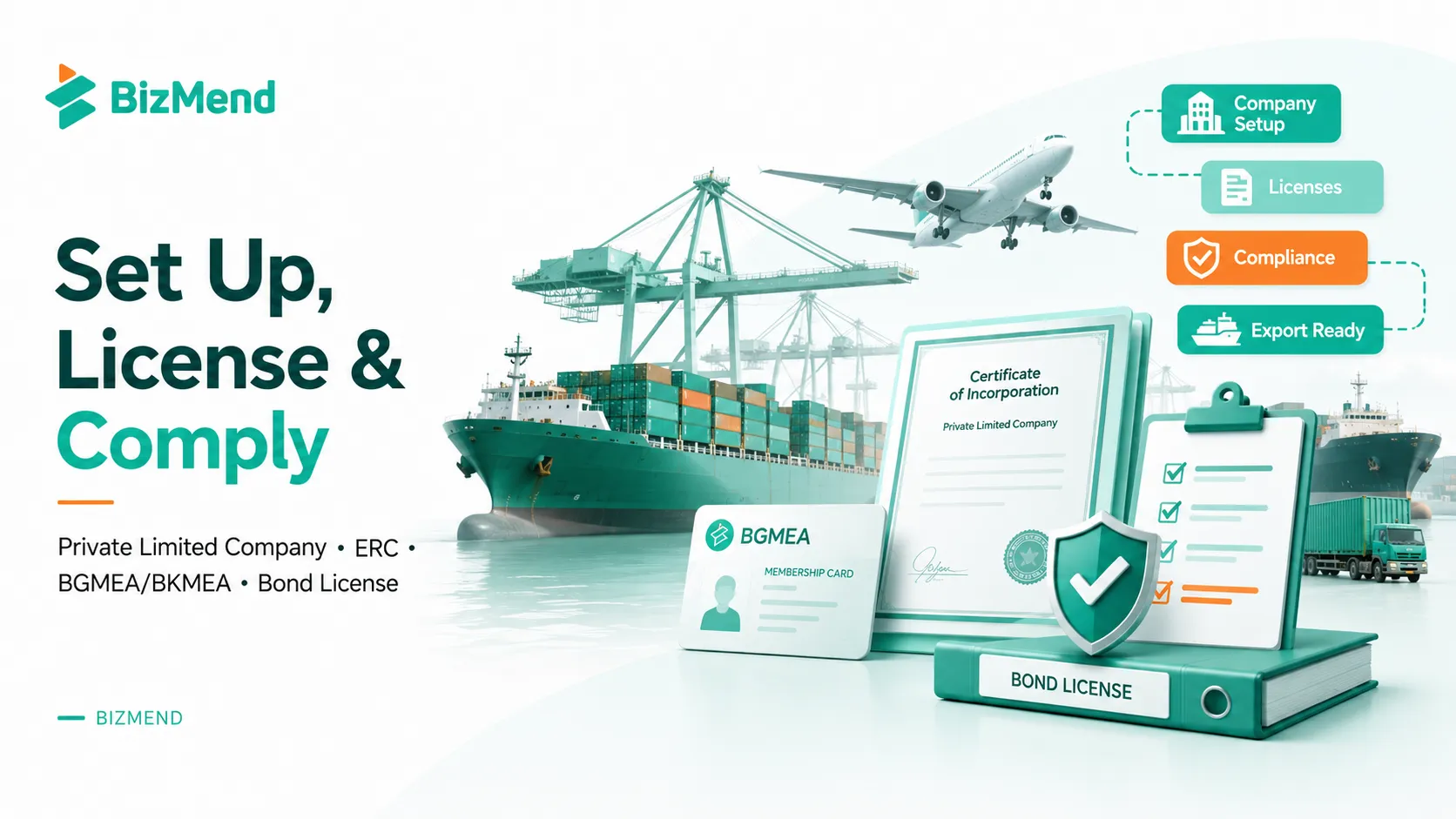
Step 6: get every export document right
Per shipment, your document pack includes:
- Commercial Invoice
- Packing List
- Bill of Lading (sea) or Air Way Bill (air)
- Certificate of Origin (issued by BGMEA, BKMEA, or Chamber of Commerce)
- Utilization Declaration (UD) for raw materials consumed
- EXP Form (foreign exchange declaration to Bangladesh Bank)
- Truck Challan
- Beneficiary Certificate
- Inspection Certificate, if the buyer’s LC requires it
One typo on the LC versus the documents, and the bank flags a discrepancy. A discrepancy can delay payment by 14 to 30 days and costs a fee. Read the LC line by line before you produce, not after.
Step 7: ship and collect your cash incentive
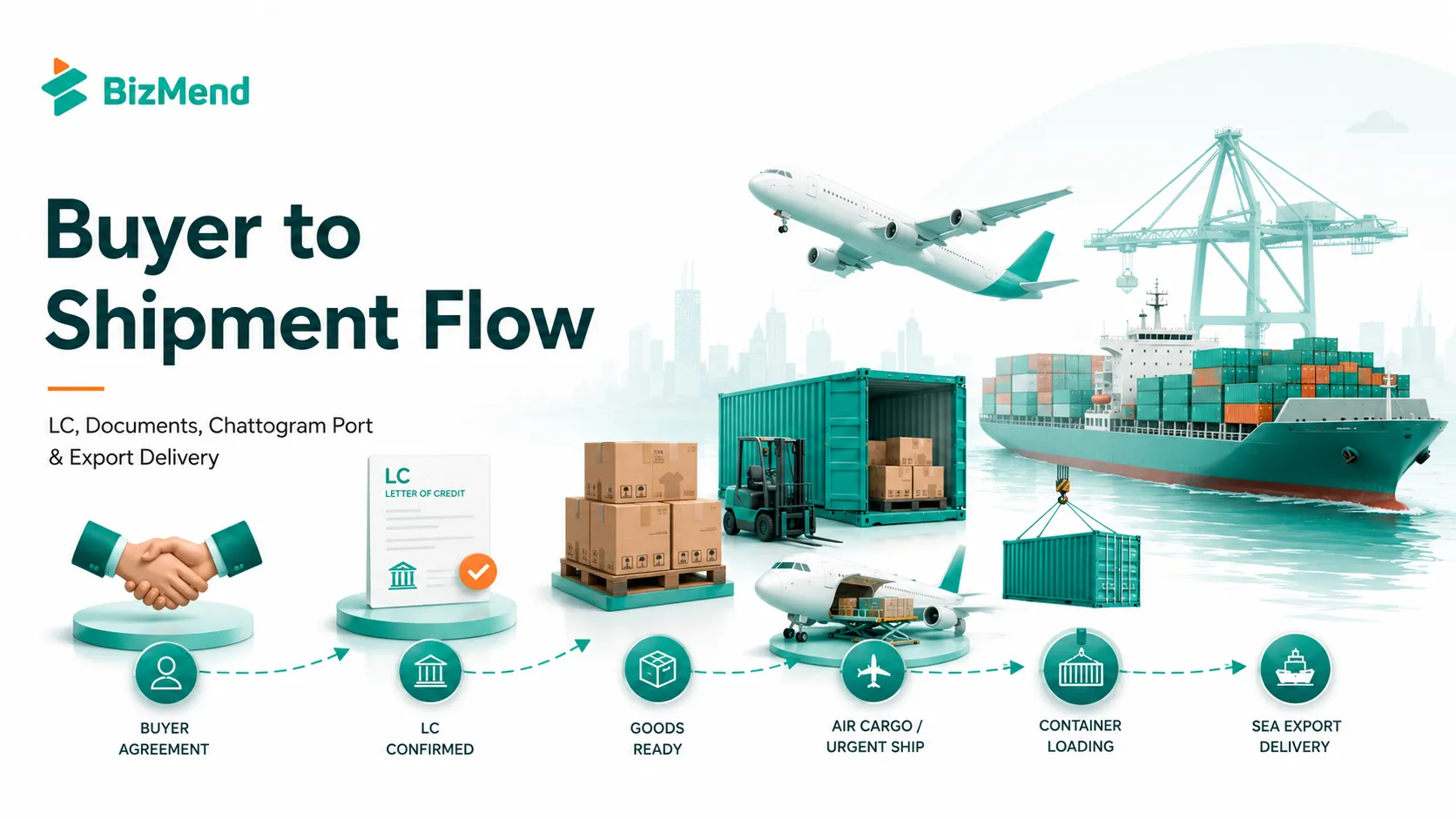
About 90% of Bangladesh’s apparel exports leave through Chattogram Port. Air cargo through Hazrat Shahjalal International Airport (HSIA) in Dhaka handles fashion-forward and short-lead orders. Mongla and Payra ports are growing for bulk.
Most RMG ships on FOB (Free On Board) terms. CIF and DDP are less common but rising for direct-to-retailer deals.
Once proceeds come in, you’re eligible for the export cash incentive. Per the Foreign Exchange Policy Department (FEPD) Circular No. 28, textile exports earn between 0.3% and 3% in cash incentive depending on product category and destination market. Current cash assistance rates apply up to June 30, 2026, unless Bangladesh Bank issues a further extension or revised circular. Apply through your bank with the shipping bill, EXP form, BL, and the bank credit voucher.
The 2026 reality: LDC graduation, US tariff, and China Plus One
Three big shifts are reshaping RMG export from Bangladesh right now.
LDC graduation on November 24, 2026. Bangladesh officially graduates from Least Developed Country status. The EU, UK, and Canada have agreed to a three-year transition period, so duty-free access under Everything But Arms (EBA) continues until late 2029. After that, exports face standard tariffs of 9% to 12% in the EU unless Bangladesh qualifies for GSP+. Negotiations are active, and recent ratification of ILO Conventions 155, 187, and 190 strengthens the case.
The US tariff at 19%. As of the February 2026 US-Bangladesh reciprocal trade framework, the US dropped its reciprocal tariff on Bangladeshi imports to 19% from 20%. The deal also creates a mechanism for certain Bangladeshi apparel using US-grown cotton or man-made fiber to enter at zero reciprocal tariff. Note that the 19% rate and the zero-tariff mechanism are subject to the agreement entering into force and to implementing procedures still being finalized. Vietnam sits at 20%, India at 18%. Bangladesh is still competitive, but the cushion is thin.
China Plus One sourcing. Global retailers are diversifying away from China. Bangladesh is one of the biggest beneficiaries. Hong Kong-based Handa committed $250 million in mid-2025 to build high-tech garment factories here, expected to create 25,000 jobs. The new orders shifting in are increasingly for man-made fiber wear, outerwear, and athleisure, segments where Vietnam currently leads. There’s room to grow if you can produce technical fabric, not just basic cotton.
Mistakes that kill new RMG exporters
After watching first-timers cycle through this industry, the same mistakes keep showing up:
- Underquoting lead time. A 90-day order quoted as 60 days falls apart, costs goodwill, and gets you blacklisted with a buying house.
- Sloppy LC drafting. One typo in the consignee field can trigger a discrepancy and a 30-day payment delay.
- Skipping compliance to save money. A failed BSCI or RSC audit means no serious buyer touches you for six months. The cost of doing it right ($30,000 to $60,000) is a fraction of the cost of doing it wrong.
- Choosing the wrong bank. Some banks process apparel LCs in two days, others take two weeks. The difference can sink a margin.
- Ignoring cash incentive paperwork. That 0.3% to 3% incentive is often the difference between profit and loss on thin-margin orders. Skip the documentation and you forfeit it.
For founders who plan to grow through external capital, getting a loan from a Bangladeshi bank is doable but document-heavy, and the bank manager relationship is honestly worth more than the forecasts in your loan file.
Key Insights
- Bangladesh earned $39.35 billion from RMG in FY 2024-25, an 8.84% growth that keeps the sector at roughly 81% of total national exports.
- The EU buys half of Bangladesh’s apparel ($19.71 billion combined), with Germany alone at $4.95 billion. The US is the largest single-country market at $7.54 billion.
- Compliance is the new entry ticket. No BSCI, WRAP, SMETA, or RSC audit means no buyer meeting. Period.
- Back-to-back LCs and bond licenses are what keep Bangladeshi apparel price-competitive. Without them, margins evaporate.
- LDC graduation lands November 24, 2026, but the EU, UK, and Canada have given a three-year grace period. Plan GSP+ readiness now, not in 2029.
- The US deal at 19% keeps Bangladesh comparable with Vietnam (20%) and India (18%), but the smart move is shifting into value-added apparel, not basics.
- Cash incentives of 0.3% to 3% on textile exports apply through June 30, 2026 unless Bangladesh Bank extends or revises the circular. File the paperwork or leave money on the table.
Frequently Asked Questions
How much capital do I need to start a garments export business in Bangladesh?
A buying house or sub-contractor setup starts at roughly $20,000 to $50,000 in working capital. A small owned factory with 200 to 400 machines runs $1.5 million to $5 million, including land, machinery, and three months of working capital. Add another $30,000 to $60,000 for compliance audits, certifications, and licensing.
Do I need to own a factory to export RMG from Bangladesh?
No. You can register as a buying house and outsource production to compliant tier-1 or tier-2 factories. Most new exporters start this way to avoid the heavy capital outlay. Buying houses still need BGMEA associate membership, ERC, EPB enrollment, an authorized dealer bank, and a renewable annual buying house certificate (TK 10,000 fee in 2026).
What’s the difference between BGMEA and BKMEA membership?
BGMEA covers woven garments, knitwear, and sweater manufacturers, with around 4,000 member factories. BKMEA focuses exclusively on knitwear and is based in Narayanganj. Both issue Utilization Declarations (UDs) for raw material imports under the bonded warehouse arrangement. If your factory makes only knit items, BKMEA is often faster. Mixed factories typically go with BGMEA.
How long does it take to ship the first order?
From company registration to first shipment, expect 8 to 14 months on average. Company setup takes 1 to 2 months. Licenses, BGMEA/BKMEA membership, bond license, and a passed factory audit usually add another 4 to 6 months. Sample approval and the production cycle bring 3 to 6 months on top of that.
What’s a back-to-back LC and why does it matter?
A back-to-back letter of credit lets a Bangladeshi exporter open a second LC against the buyer’s master LC, used to import fabric and accessories on credit terms of up to 180 days. Without it, you’d pay full duty and the full cost of fabric upfront. With it, you import duty-free under bond and pay your fabric supplier after the buyer pays you.
Can foreigners own a 100% garments export business in Bangladesh?
Yes. Foreign nationals can own 100% of a Bangladeshi private limited company that exports garments. You’ll need BIDA notification, RJSC registration, trade license, TIN, VAT, an investor visa, and a local bank account. Most foreign entrants partner with a local team for compliance, factory operations, and banking introductions in the first two years.
How do I find buyers for RMG export in Bangladesh?
Real buyer channels include Dhaka-based buying houses, BGMEA-led trade fairs like Made in Bangladesh Week, international shows such as Texworld Paris and MAGIC Las Vegas, and B2B platforms like Alibaba, Global Sources, and Volza. Most first deals come through buying houses or sub-contracting for a tier-1 factory, then graduate to direct buyer relationships with H&M, Walmart, Inditex, or Primark.
What happens to RMG exports after LDC graduation in November 2026?
Bangladesh graduates from LDC status on November 24, 2026. The EU, UK, and Canada have committed to a three-year transition, so duty-free access under Everything But Arms continues until late 2029. After that, Bangladesh needs to qualify for GSP+ or face EU MFN tariffs of 9% to 12%. The US has no LDC scheme, so the existing 19% reciprocal tariff applies regardless.
Is the US tariff still 19% on Bangladeshi garments in 2026?
Yes, in principle. Under the February 2026 US-Bangladesh reciprocal trade framework, the US reduced its reciprocal tariff on Bangladeshi imports to 19% from 20%. A special mechanism also allows certain Bangladeshi apparel made with US-grown cotton or man-made fiber to enter at zero reciprocal tariff. Both the 19% rate and the zero-tariff mechanism are subject to the agreement entering into force and to implementing procedures still being finalized. Vietnam sits at 20%, India at 18%.
What’s the most profitable type of garment to export from Bangladesh?
Higher-margin segments in 2026 include outerwear, denim, performance and technical wear, athleisure, and man-made fiber apparel. Basic cotton t-shirts and polos remain the highest-volume category but with the thinnest margins. Buyers shifting from China under “China Plus One” are placing more value-added orders, which is where new factories should aim from day one.
Final Thoughts
Look, RMG export from Bangladesh isn’t easy money. It hasn’t been since 2013. Buyers want compliance proof before they want price. Banks want clean paperwork before they want your business. And the LDC clock is ticking down to November 2026.
But here’s what I keep telling people who ask me about getting into this industry in 2026: the easy era is over, and that’s actually good news. Margins now go to the careful ones, the compliant ones, the ones who can produce a $40 technical jacket, not just a $4 cotton tee.
If I were starting today, I wouldn’t build a factory. I’d register as a buying house, partner with one compliant tier-1 manufacturer, and use my first 18 months to land just one anchor buyer. After that, scale. The door is still open. It’s just narrower than it used to be.