How to Become a Daraz Seller in Bangladesh: Registration, Fees & Growth
Learn how to become a Daraz seller in Bangladesh, register an account, list products, understand fees, manage orders, and grow…
 by Sheikh Ornob

A data-backed look at Bangladesh economy in 2026. Covers GDP growth forecasts from ADB, IMF, and World Bank, inflation, record remittances, reserves, and key risks.
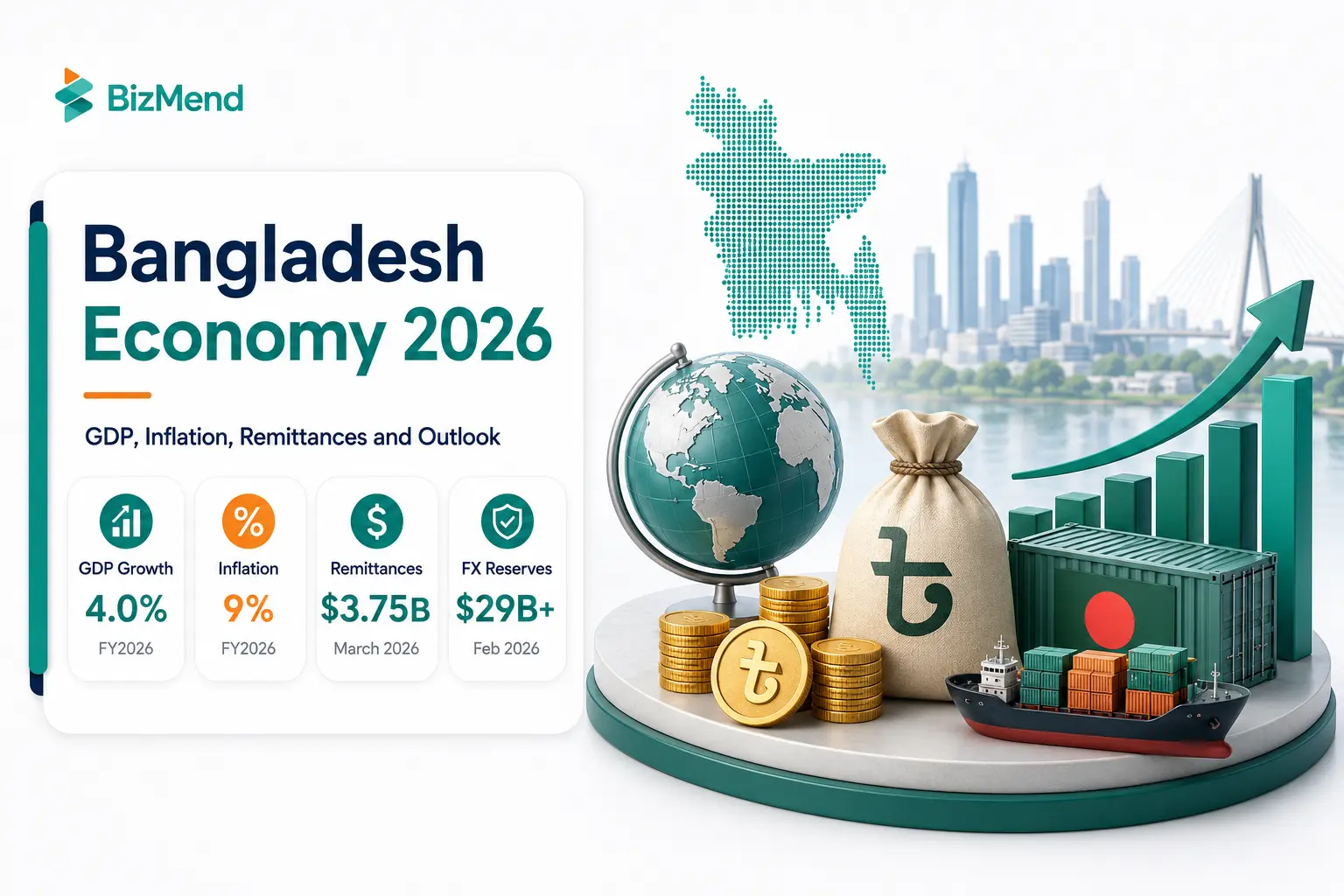
Depending on which institution you ask, Bangladesh’s economy is either recovering moderately or still fighting structural headwinds. The ADB projects 4.0% GDP growth for FY2026. The IMF says 4.7%. The World Bank has cut its forecast to 3.9%. All three agree the picture is complex. And honestly, they’re all right. This guide pulls together the most current data from Bangladesh Bank, ADB, IMF, and other primary sources so you get the clearest possible picture of the Bangladesh economy in 2026.
Quick Answer: Bangladesh’s economy in 2026 is in a gradual recovery phase; ADB estimates FY2025 growth at 3.5%, while provisional BBS data put FY2024-25 growth at 3.97%. The ADB April 2026 report forecasts 4.0% GDP growth in FY2026, while the IMF projects 4.7%. Inflation remains elevated at around 9-9.2%. Remittances hit an all-time monthly record of $3.75 billion in March 2026, and foreign exchange reserves crossed $29 billion in February 2026, the highest since mid-2023.
Bangladesh’s GDP grew at approximately 3.5% in FY2024-25, per the ADB’s Asian Development Outlook April 2026 report (released April 10, 2026). That’s the lowest growth rate in years and reflects the combined weight of political disruption from the July 2024 uprising, banking sector stress, energy shortages, and cautious private investment.
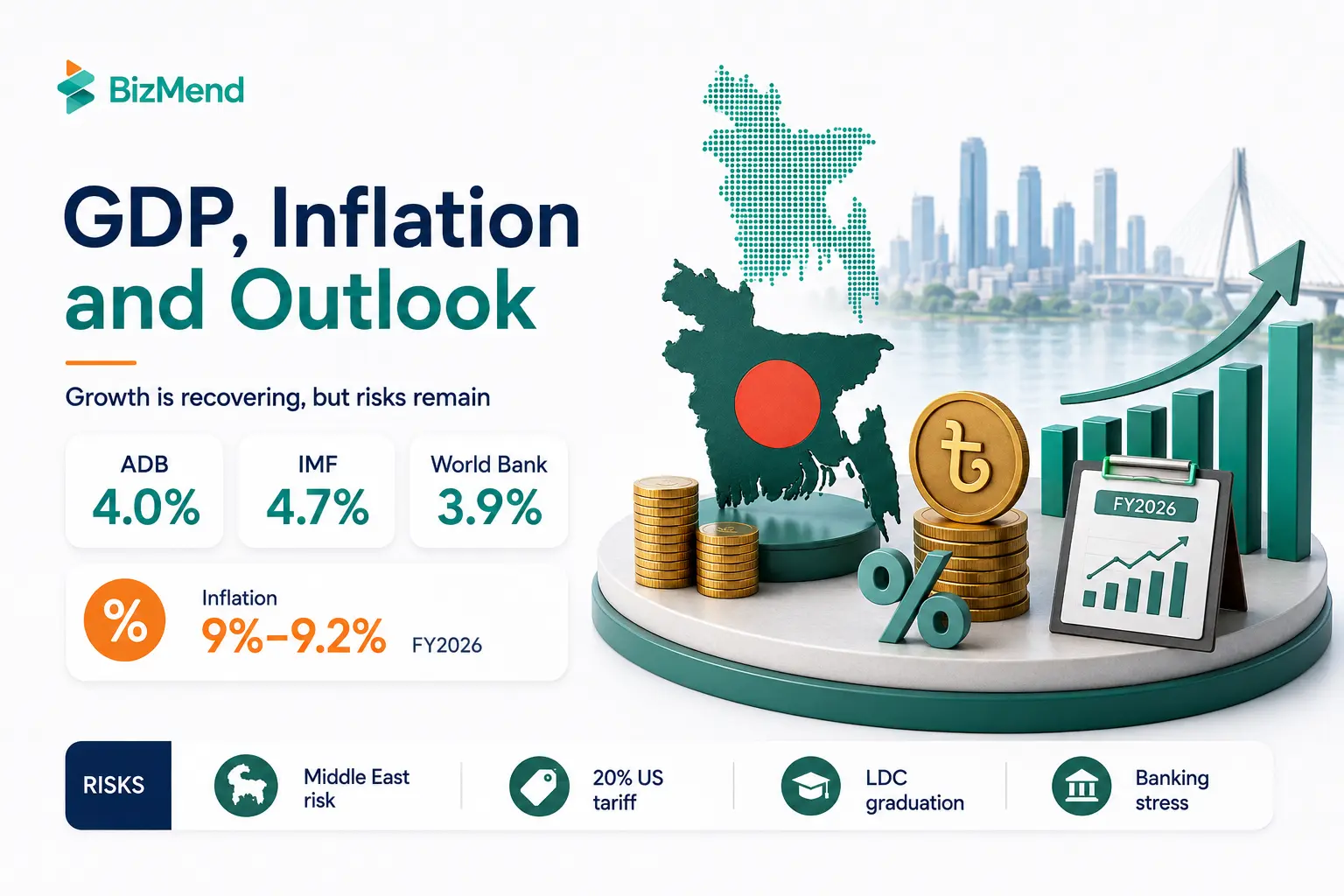
For FY2025-26, the recovery is real but modest. Here’s where the three major institutions stand right now, per their most recent April 2026 releases:
| Institution | FY2026 GDP Forecast | FY2027 Forecast |
|---|---|---|
| ADB (April 10, 2026) | 4.0% | 4.7% |
| IMF (April 14, 2026) | 4.7% | 4.3% |
| World Bank (April 2026) | 3.9% | Improving |
Per capita GDP growth is expected at 2.8% in 2026 and 3.7% in 2027, per the ADB April 2026 report. The ADB attributes the FY26 recovery to moderate growth in consumption and investment, supported by strong remittance inflows and election-related public spending, alongside services sector rebound as household purchasing power improves.
The gap between 3.9% (World Bank) and 4.7% (IMF) is quite large for organizations analyzing the same economy with the same data. It comes down to how they weight political risk and banking sector fragility. Former World Bank lead economist Zahid Hussain noted in October 2025 that the World Bank relies on “more grounded assessments,” while some institutional projections lean more optimistic.
The government itself has set a provisional growth target of 6.5% for the next fiscal year, per TBS News (April 2026). That’s considerably higher than what any multilateral lender projects. The ADB April 2026 figure of 4.0% is the most recent major estimate and was issued after accounting for the Middle East conflict impact and US tariff changes. It’s probably the most current, most cautious credible baseline to use right now.
Bangladesh’s inflation story in 2026 is one of gradual, difficult easing. Inflation remained elevated in 2026, with ADB forecasting 9.0% average inflation for FY2026 and latest reported inflation around 9.04% in April 2026. That’s the kind of number that hurts ordinary households significantly.
The ADB April 2026 report projects inflation at 9% for FY2026. The IMF’s April 2026 World Economic Outlook raised that estimate slightly to 9.2% for FY26. Both agree it will moderate further to 8.5% (ADB) and 6% (IMF) in FY2027 as external shocks subside. Prices remain elevated due to high energy costs, exchange-rate pressure, and supply-side disruptions, according to recent ADB inflation analysis.
Bangladesh Bank raised its policy interest rate five times during 2024 to combat inflation. The tight monetary policy has had some effect on bringing numbers down from their peak, but the transmission is slow through a banking system under stress. If you’re making investment decisions based on Bangladesh’s macro environment, understanding how the country’s banking system operates matters a great deal. The commercial banks in Bangladesh guide covers the landscape and which institutions are positioned for stability in a high-rate environment.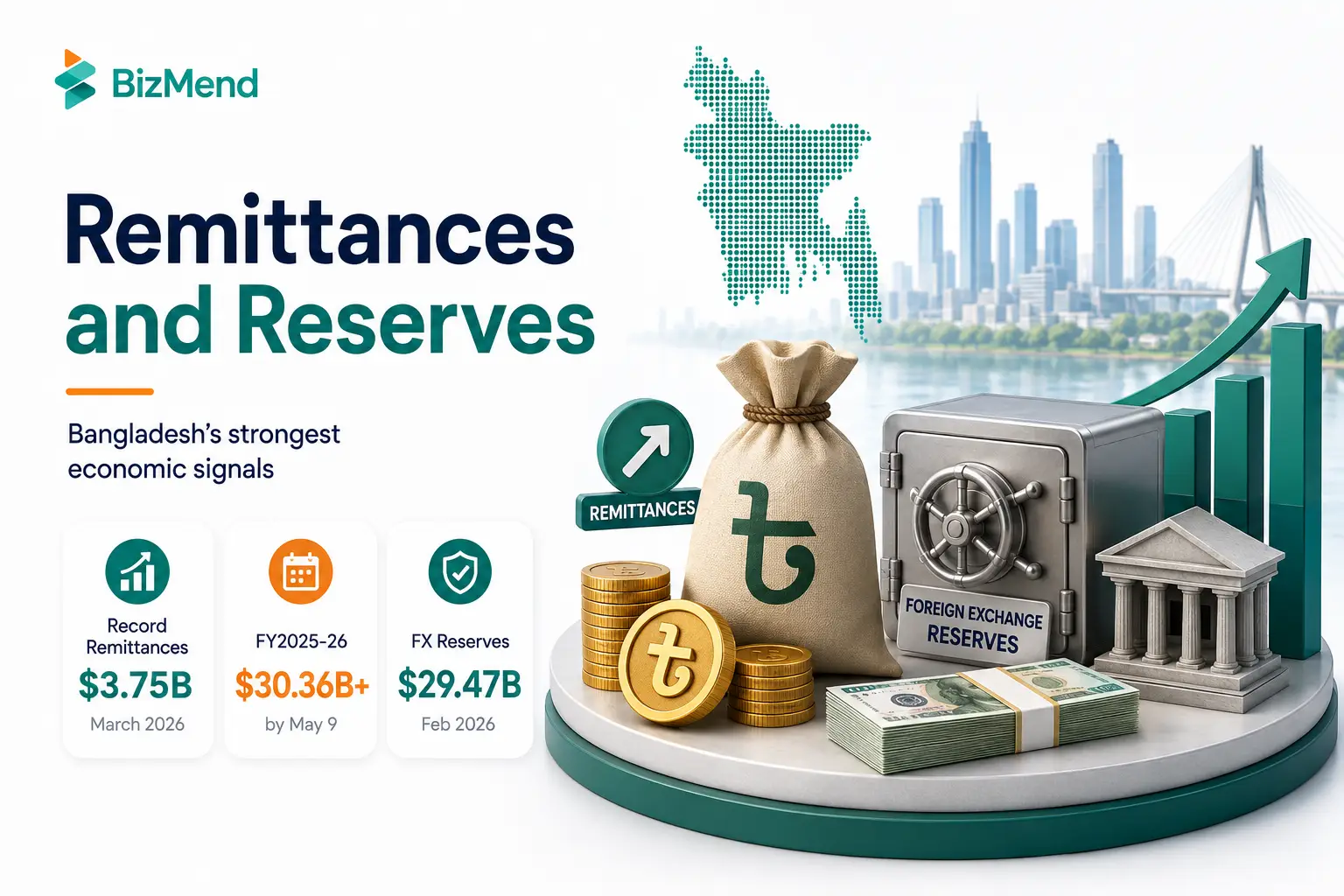
This is where Bangladesh’s economic story gets genuinely positive. The numbers are remarkable.
Remittances in Bangladesh hit an all-time monthly record of $3.75 billion in March 2026, a 14% increase over March 2025’s previous record of $3.29 billion, per The Daily Star citing Bangladesh Bank data (April 1, 2026). Five consecutive months (November 2025 through March 2026) saw remittance inflows above $3 billion per month. For FY2024-25, Bangladesh received over $30 billion in remittances, marking a record fiscal-year inflow, a more than 25% increase over FY2023-24’s $23.9 billion, per Bangladesh Bank data (BSS, April 2026).
By May 9, 2026, with roughly 1.5 months left in FY2025-26, Bangladesh had already received $30.36 billion for the current fiscal year, per The Financial Express (May 10, 2026). FY2026 remittances have surpassed the entire FY2025 total before the year even ended. Year-on-year growth through July to April of FY2025-26 stands at approximately 20%, per Bangladesh Bank data cited by BSS (April 2026). The shift from informal hundi channels to formal banking is a significant driver, alongside increased labor migration (around 4.6 million Bangladeshis went abroad for employment in the past six years, per Bangladesh Bank data).
Nearly half of Bangladesh’s annual remittances come from the Middle East. Saudi Arabia, Oman, Qatar, the UAE, and Kuwait together accounted for 86% of Bangladeshi migrant workers who secured jobs abroad in FY2025, per the Bangladesh Economic Review 2025. The Middle East conflict has disrupted Bangladesh-Middle East flights and affected migrant workers, but reported cancellation counts vary by source and date, mostly affecting migrant workers, per The Daily Star (April 2026).
The ADB, in its April 2026 report, explicitly warned that Bangladesh and other South Asian countries could face lower remittances from the Gulf as the conflict spreads. If Middle East remittances decline significantly in H2 of FY2026, the positive momentum could shift fast. It’s the key downside risk to watch alongside the GDP forecast numbers.
Bangladesh’s foreign exchange reserves have been one of the economy’s genuine recovery stories. Reserves crossed $29 billion in February 2026 for the first time since Bangladesh Bank began computing reserves using the IMF’s BPM6 method in July 2023, per The Daily Star citing Bangladesh Bank (February 2026). The exact figure stood at $29.47 billion on that date.
In September 2025, reserves stood at $31.4 billion (under a slightly broader calculation method), covering approximately 4.2 months of imports, per Coface’s Bangladesh country risk analysis. The turnaround has been driven primarily by the surge in remittances and by Bangladesh Bank’s active dollar purchases from commercial banks. Since July 2025, Bangladesh Bank bought nearly $4 billion through dollar auctions, per TBS News. The current account also returned to a very slight surplus ($149 million) in FY2025, the first time in eight years, per Coface. The current account is expected to return to a slight deficit in FY2026 as import demand picks up.
Bangladesh’s export picture in 2026 carries two compounding stresses. The first is the US tariff. In April 2025, the US imposed 37% reciprocal tariffs on Bangladesh. The tariff situation changed again in February 2026, when the US-Bangladesh reciprocal trade framework set a 19% reciprocal tariff on Bangladeshi-origin goods and created a possible zero-tariff route for selected products. Multiple US buyers halted orders. By March 2026, goods exports had fallen year-on-year for eight consecutive months, per FocusEconomics.
The second is LDC graduation in November 2026. Bangladesh is scheduled to graduate from LDC status on November 24, 2026, but EU EBA preferences are expected to continue during a transition period until November 2029. RMG still accounts for about 81.49% of Bangladesh’s total exports ($39.35 billion of $48.28 billion in FY2024-25, per BGMEA data). The concentration risk is stark, and both the tariff shock and LDC graduation hit the same sector at the same time.
Understanding Bangladesh’s top industries and how they’re positioned for these challenges is useful context. The major industries in Bangladesh guide covers RMG, pharmaceuticals, IT, and other sectors in detail. For investors looking at the broader picture, investment opportunities in Bangladesh maps where capital is flowing right now.
The Bangladesh economy’s investment climate has a very specific structural problem: the banking sector is under serious stress, and credit is expensive and difficult to access. Bangladesh’s non-performing loan (NPL) ratio stood at 24.1% in March 2025, per Coface’s Bangladesh country risk file. That’s compared to an average of 7.9% for South Asian banks. Bangladesh’s banking sector faced serious stress in 2025, with defaulted loans reported at nearly 36% of total disbursed loans by September 2025.
Private investment has been constrained by high borrowing costs and banking sector fragility. The interim government’s reform agenda is focused on addressing this, with IMF support. Bangladesh struck a reform breakthrough with the IMF, which is releasing $1.3 billion in loan funds, per Trading Economics data (May 2026). BIDA’s One-Stop Service portal has simplified several investor services, but exact registration timelines should be verified from the current BIDA/OSS portal before publishing.
For savers and investors in the current environment, understanding which banks are financially sound matters. The red, yellow, and green zone bank classification in Bangladesh provides the clearest framework for assessing bank health. And for those tracking investment options right now, gold investment in Bangladesh and FDR fixed deposits remain two of the most practical instruments given the current high-rate environment.
The IMF, ADB, and World Bank all point to the same structural agenda. First: expand the tax base. At less than 8% of GDP in tax revenue, Bangladesh is severely under-collecting. Second: fix the banking sector. Capital adequacy, NPL resolution, and governance reforms are the single biggest drag on private investment. Third: diversify exports beyond RMG. Pharmaceuticals, IT services, and leather and footwear are the three most viable candidates, all needing targeted policy support. Fourth: use the IMF reform process as a forcing mechanism. The $4.7 billion extended credit facility, with $1.3 billion now being released, comes with conditions that address these structural weaknesses.
NRBs (Non-Resident Bangladeshis) who want to understand how to invest in and build businesses around Bangladesh’s economic recovery can start with how to start a business in the USA from Bangladesh as a complementary pathway. And for those tracking the best private banks in Bangladesh for deposit safety and business banking, the landscape looks markedly different post-reform than it did two years ago.
Bangladesh’s GDP growth is forecast at 4.0% for FY2026 by the ADB (Asian Development Outlook April 2026, released April 10, 2026), while the IMF projects 4.7% (April 14, 2026) and the World Bank approximately 3.9%. All three represent a recovery from FY2025 growth of approximately 3.5%. The differences reflect varying assessments of banking sector risk and political uncertainty.
Bangladesh’s inflation is projected at around 9% for FY2026, per the ADB April 2026 report, and 9.2% per the IMF’s April 2026 World Economic Outlook. This is down from a peak of 10.87% in September 2025. Inflation is expected to moderate further to 8.5% (ADB) and 6% (IMF) in FY2027 as global energy pressures ease and tight monetary policy has more effect.
Bangladesh received a record $3.75 billion in March 2026, the highest monthly remittance inflow ever, per Bangladesh Bank data cited by The Daily Star (April 2026). For FY2025-26, total remittances already exceeded $30.36 billion by May 9, 2026, surpassing the entire FY2024-25 record of $30.33 billion with 1.5 months remaining, per The Financial Express.
Bangladesh’s foreign exchange reserves crossed $29 billion in February 2026 (under the IMF BPM6 calculation method), the highest level since July 2023, per The Daily Star citing Bangladesh Bank. In September 2025, reserves stood at $31.4 billion under a slightly broader measure, covering approximately 4.2 months of imports, per Coface.
Per capita GDP growth for Bangladesh is expected at 2.8% in 2026 and 3.7% in 2027, per the ADB April 2026 report. This reflects total GDP growth adjusted for population growth and represents a real but modest improvement in living standards compared to the slowdown years of FY2024-25.
The biggest near-term risk is the Middle East conflict affecting remittance inflows. Nearly half of Bangladesh’s $30+ billion in annual remittances come from Gulf countries. The ADB’s April 2026 report explicitly warned of lower remittances from the Middle East as the conflict spreads. About 800 Middle East-bound flights from Bangladesh were already cancelled by April 2026, mostly affecting migrant workers.
Bangladesh’s non-performing loan (NPL) ratio stood at 24.1% in March 2025, compared to South Asia’s average of 7.9%, per Coface. Under some measures, the NPL ratio peaked at nearly 36% in late 2025. High NPL ratios reduce banks’ ability to lend to businesses, constraining private investment and economic growth. Banking sector reform is tied to Bangladesh’s ongoing IMF extended credit facility.
The US imposed 37% reciprocal tariffs on Bangladesh in April 2025, later reduced to 20% from August 1, 2025. Multiple US buyers halted orders. Goods exports fell year-on-year for eight consecutive months through March 2026, per FocusEconomics. The tariff compounds the challenge of LDC graduation in November 2026, which will reduce trade preferences in other markets including the EU.
The ADB forecasts Bangladesh GDP growth of 4.7% in FY2027, while the IMF projects 4.3%. Both expect inflation to moderate significantly, with the IMF forecasting a sharp decline to 6% in FY2027. The ADB attributes the improved outlook to easing external shocks, political stabilization after elections, and ongoing reform implementation. Banking sector recovery and export diversification remain the main conditions for hitting the higher end of projections.
Bangladesh’s economy in 2026 is not in crisis, but it’s not in a comfortable recovery either. The remittance numbers are genuinely impressive and the reserve rebuild is real progress. But 9% inflation, a 24% NPL ratio, a US tariff that hasn’t gone away, and LDC graduation in November 2026 are all structural tests that don’t resolve quickly.
The institutions that matter most to Bangladesh’s trajectory right now are not banks or garment factories. They’re the reform-implementing agencies: the NBR, Bangladesh Bank, and BIDA. How they perform on structural changes in the next 12-18 months will determine whether the 2026 forecasts look modest or prescient. Which of these risks do you think Bangladesh is best positioned to handle?

Learn how to become a Daraz seller in Bangladesh, register an account, list products, understand fees, manage orders, and grow…
by Sheikh Ornob
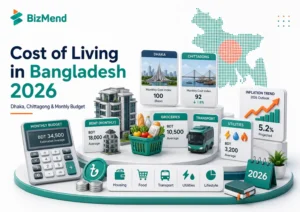
Compare the cost of living in Bangladesh in 2026, including Dhaka and Chittagong rent, food, transport, utilities, inflation, and monthly…
by Sheikh Ornob

Learn MoA and AoA requirements in Bangladesh, key clauses, drafting basics, RJSC filing steps, amendments, and common company-registration mistakes. Suggested…
by Sheikh Ornob