How to Become a Daraz Seller in Bangladesh: Registration, Fees & Growth
Learn how to become a Daraz seller in Bangladesh, register an account, list products, understand fees, manage orders, and grow…
 by Sheikh Ornob

Learn how crop insurance in Bangladesh works in 2026, including coverage, premium factors, claim process, providers, documents, exclusions, and current availability.
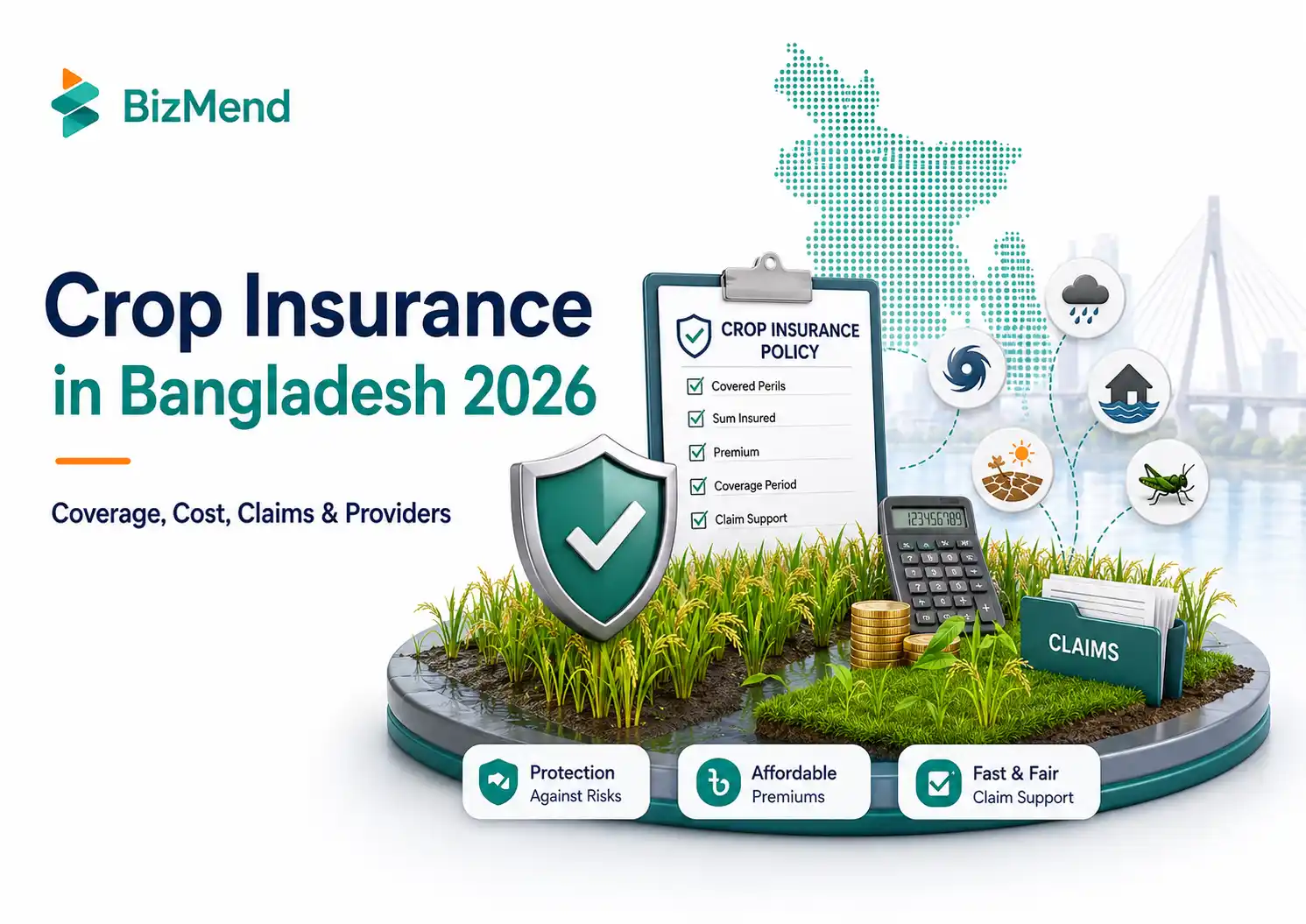
Crop insurance in Bangladesh can help farmers manage financial losses caused by severe weather or other risks, but it is not yet a standard nationwide product available for every crop and district. Coverage may be offered through a specific insurer, bank, microfinance institution, NGO, agricultural project, or time-limited pilot. Farmers should confirm the covered crop, insured area, premium, payout trigger, exclusions, and claim deadline before paying.
This guide explains how crop loss insurance may work, the role of Sadharan Bima Corporation and other regulated insurers, typical eligibility and documents, premium factors, claims, and practical limitations. It also separates insurance from disaster relief, agricultural loans, and general compensation programs, which may follow different rules and do not create an insurance contract.
Quick Answer: Crop insurance in Bangladesh is available mainly through selected insurers, partner programs, and pilots rather than one nationwide scheme. Coverage, premiums, crops, districts, and claim rules vary by policy. Confirm current availability with the insurer or enrollment partner and obtain the policy schedule before paying any premium.
Crop insurance is a financial risk-transfer product designed to compensate an insured farmer when a covered event causes a qualifying crop loss. The policy does not prevent floods, drought, cyclone, pest attack, or disease. Instead, it may provide a payment after the policy’s conditions, loss threshold, or index trigger are satisfied.
These risks are especially important because agriculture in Bangladesh remains highly exposed to floods, cyclones, heavy rain, drought, salinity, heat, and disease. The World Bank describes Bangladesh as highly vulnerable to climate change and natural disasters such as floods and cyclones, while World Bank employment data shows agriculture remains a major employment sector in Bangladesh. This makes insurance potentially useful, but difficult to price and operate at scale.
A product mentioned in an old report may no longer be available to farmers. Treat every offer as location-, crop-, season-, and provider-specific until confirmed in writing.

Coverage depends on the policy wording. Crop insurance does not automatically include every cause of damage. A policy may cover named perils, an area-yield shortfall, or a weather index such as rainfall or flood depth.
| Risk or loss | Possible treatment under a policy | What the farmer must verify |
| Flood or waterlogging | May be covered as a named peril or through a rainfall/flood index | Covered area, trigger, waiting period, and whether local waterlogging qualifies |
| Drought or rainfall shortage | May use rainfall data or a defined seasonal index | Weather station, measurement period, trigger, and payout formula |
| Cyclone, storm, or excessive rain | May be named directly or linked to weather data | Wind/rain threshold, crop stage, and post-harvest rules |
| Pest or disease | Sometimes covered, often restricted or excluded | Named pest/disease, required farm practices, and proof of preventive action |
| Fire or lightning | May be covered in a traditional indemnity policy | Cause of fire, reporting deadline, and excluded negligence |
| Price decline | Usually not covered by basic crop-loss insurance | Whether the policy covers physical yield loss only or also revenue loss |
Pest and disease claims require special caution. An insurer may exclude avoidable loss, poor farm management, late treatment, unapproved inputs, or a disease not listed in the schedule. Never assume that a visible crop loss is automatically insured.
Crop insurance generally follows one of two models: loss-adjusted insurance or index-based insurance. Some projects may combine crop insurance with agricultural credit, input distribution, farmer groups, digital records, extension support, or existing microfinance in Bangladesh.
The farmer reports a covered loss, and a surveyor checks the field and records. Payment depends on verified loss, insured value, deductible, and policy limit. This can reflect individual damage but is costly for many small farms.
Payment depends on a predefined measurable index, such as rainfall, flood, or weather data, rather than field-by-field loss assessment; this can reduce survey cost but creates basis risk. It may trigger when rainfall or flood data crosses a threshold. Processing can be faster, but a farmer may suffer damage without payment if the index does not trigger; this is basis risk.
Enrollment may run through a bank, MFI, NGO, cooperative, agribusiness, or project. The channel may collect premiums, while a licensed insurer carries the risk. Ask for the insurer, policy number, certificate, and complaint route.
Bangladesh does not currently have one verified national portal covering every crop and district under uniform terms. Options may come through non-life insurers, MFIs, NGOs, cooperatives, development-partner pilots, or loan-linked programs involving specialized banks in Bangladesh. Past participation does not prove enrollment is open in 2026.
Sadharan Bima Corporation is Bangladesh’s state-owned general insurer, but its official weather-index crop-insurance information describes a project-based initiative rather than confirming nationwide retail enrollment, so farmers must verify current availability directly. Do not assume an SBC agriculture product is nationwide. Request written confirmation of crop, district, season, insured amount, exclusions, and claims.
The Insurance Development and Regulatory Authority, or IDRA, is Bangladesh’s insurance regulator; farmers should verify that the insurer or distribution channel is legitimate before paying any premium. A private general insurer may offer agricultural cover directly or through a partner, but product availability can change. Verify that the insurer and product are legitimate, and pay only through an approved channel that provides a receipt and policy document.
Agricultural insurance has often appeared through pilots or bundled programs testing indices, digital enrollment, satellite data, group policies, or credit-linked cover. A pilot may end, pause, change districts, or close enrollment while old references remain online.
| Update note: 2026 availability note: During the July 15, 2026 source review, no stable official public source was found showing one nationwide retail crop-insurance tariff and enrollment process for all Bangladeshi farmers. Confirm live availability directly with the insurer, partner bank/MFI, or project office. |
Eligibility is policy-specific. A farmer may need an approved crop, area, season, and enrollment before the cut-off. Tenant farmers or sharecroppers qualify only where accepted and supported by required evidence.
Typical eligibility conditions may include:
A valid NID or other accepted identity document
Proof of land ownership, lease, tenancy, sharecropping, or cultivation rights
An eligible crop, variety, season, and geographic area
Enrollment before sowing or before the policy cut-off date
Accurate farm size, plot location, and crop information
Payment of the required premium or participation in an approved subsidized scheme
A bank account or mobile financial account accepted for refunds or payouts
Land records alone may not be enough when cultivation is informal. Ask the provider what alternative proof it accepts, such as a lease agreement, local certification, farmer-group record, input purchase receipt, geo-tagged plot record, or financing document.
The exact document list varies, but preparing records before the season can prevent delays. Farmers, agri-business owners, and partner organizations should keep both paper and digital copies where possible.
NID and recent photograph
Policy proposal or enrollment form
Land deed, khatian, lease, tenancy, or cultivation evidence
Plot location, acreage, crop type, sowing date, and expected harvest date
Bank, MFS, or agricultural loan account information
Premium receipt and policy certificate
Input receipts, production records, photographs, or geo-tagged evidence if requested
Contact details for the farmer group, cooperative, bank, NGO, or project channel
There is no reliable universal premium rate for crop insurance in Bangladesh. Publishing one percentage as the standard price would be misleading because agricultural risks differ sharply by crop, district, season, irrigation, flood exposure, farm size, and policy design.
The premium may be influenced by:
Crop type and expected production cost
District, plot location, and historical weather or loss pattern
Season and length of the insured growing period
Selected perils and insured amount
Traditional loss assessment versus index-based payout
Deductible, excess, co-payment, or coverage percentage
Group enrollment, government support, donor support, or premium subsidy
Administrative cost, data availability, and distribution channel
Ask for the total amount payable, not only the headline premium. Check fees, taxes, service charges, financing costs, deductions, and whether the premium is refundable when the crop is not planted. Also compare the maximum payout with the real cost of seeds, fertilizer, labor, irrigation, and other inputs.
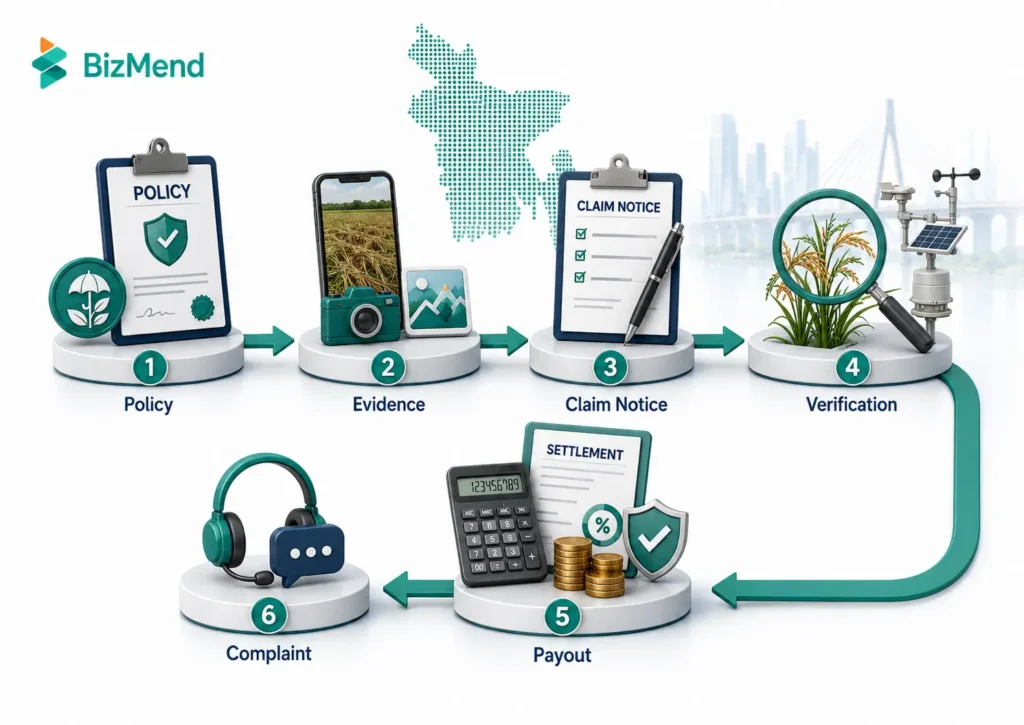
The policy controls the claim. This general sequence does not replace the insurer’s deadline or instructions.
Notify the insurer or authorized enrollment partner immediately after the loss or when you become aware of it. Do not wait until harvest unless the policy says so.
Record the date, location, crop stage, cause, and visible damage. Take clear photographs and videos without altering the field.
Protect the remaining crop and avoid actions that increase the loss.
Complete the claim form and submit the policy number, NID, premium receipt, land/cultivation evidence, crop records, and payment account details.
Allow the insurer, surveyor, bank, project officer, or local verification team to inspect the plot when the policy requires physical assessment.
For index insurance, confirm the data source, observation period, trigger level, and published index result. An individual field visit may not be required.
Obtain an acknowledgement or claim reference number. Keep copies of every document and record the names and dates of people contacted.
Review the settlement calculation, deductions, and reason for any rejection. Use the insurer’s complaint process and, where appropriate, the regulator’s grievance channel.
Crop insurance usually pays only for insured losses occurring within the policy period. A farmer can have a genuine financial loss and still receive no payment when the cause, crop, area, date, or threshold falls outside the contract.
Loss before coverage starts or after it expires
A crop, variety, plot, or peril not listed in the policy
Late enrollment, late premium payment, or late claim notice
Incorrect acreage, crop, identity, or ownership information
Poor maintenance, intentional damage, or failure to reduce avoidable loss
Ordinary production variation below the policy’s loss threshold
Price decline when only physical crop damage is insured
Pest or disease not specifically covered
Index not reaching the trigger despite visible field damage
Maximum payout, deductible, proportional settlement, or other policy limit
Scale is difficult because farms are small, tenancy records may be informal, and one flood or cyclone can affect thousands at once. Individual surveys are costly, while index products need reliable local data and create basis risk.
Other barriers include low awareness, limited pre-harvest cash, unclear terms, weak rural distribution, and fragmented weather, crop, land, and farmer records. Subsidies or group enrollment require stable funding and transparent administration.
For these reasons, crop insurance is often tested through pilots or bundled with loans, inputs, cooperatives, or development programs. Scale should not be confused with quality: a good product needs clear terms, dependable data, fair claims, and an accessible complaint process.
A suitable policy can reduce the financial shock of a severe covered event. For agri-business owners using business loans in Bangladesh, suitable crop insurance may reduce the cash-flow shock caused by a severe covered loss, although the loan remains repayable. Insurance can also encourage better recordkeeping because enrollment and claims require crop, plot, and financial information.
However, insurance should be one part of risk management. Farmers still need crop diversification, resistant varieties, drainage, irrigation planning, disease control, emergency savings, safe storage, weather alerts, and realistic borrowing. For an agribusiness owner, insurance does not guarantee profit or replace good farm management; operating through a separate legal entity may help separate business obligations from personal affairs, but it does not replace suitable crop coverage.
| Option | How support is triggered | Main advantage | Main limitation |
| Traditional crop insurance | Verified covered loss | Can reflect the farmer’s actual damage | Survey cost, documents, exclusions, and slower assessment |
| Weather/index insurance | Predefined data trigger | Potentially faster and easier to scale | Basis risk; payout may not match individual loss |
| Agricultural loan rescheduling or relief | Bank or government decision | May ease repayment pressure | Not an insurance payout and may not cover crop cost |
| Government disaster assistance | Official relief program and eligibility rules | Can support uninsured households | Availability, amount, timing, and targeting are uncertain |
| Emergency savings or cooperative fund | Member rules or personal decision | Flexible and immediately understandable | Limited by available savings and group resources |
Do not treat microcredit in Bangladesh, a savings plan, or a membership fee as crop insurance unless the documents identify the licensed insurer, insured risk, policy period, premium, sum insured, exclusions, and claim process.
Paying an agent without receiving an official receipt and policy certificate
Assuming flood, pest, disease, and cyclone are all covered
Ignoring the insured plot, crop variety, and seasonal dates
Using incorrect acreage or land information
Waiting too long to report damage
Destroying or replanting the field before evidence or inspection is complete
Confusing a project benefit, loan waiver, or disaster grant with insurance
Relying on an old pilot announcement without confirming current enrollment
Choosing only by low premium instead of comparing payout rules and exclusions
Confirm that the insurer is regulated and the enrollment channel is authorized
Check that your crop, plot, district, and season are eligible
Read the covered risks and exclusions
Ask whether the policy is loss-adjusted or index-based
Understand the trigger, deductible, sum insured, and maximum payout
Get the premium and all charges in writing
Confirm the claim-notification deadline and required evidence
Save the policy, receipt, contact numbers, and complaint route
Verify whether payouts go to you, a lender, or another beneficiary
Crop insurance can help when it matches the farmer’s crop, location, season, and main risks. The key is confirming live enrollment and understanding exactly what creates a payout.
Before paying, obtain the complete policy schedule and verify the insurer, partner, crop, area, premium, trigger, claim deadline, exclusions, and payment method. Farmers comparing a loan-linked policy with a small business loan in Bangladesh should remember that insurance transfers specified risks, while a loan creates a repayment obligation regardless of crop performance.
Is crop insurance available everywhere in Bangladesh?
No. Availability may be limited by crop, district, season, provider, partner program, or pilot. Confirm live enrollment and obtain written policy terms before paying.
Does Sadharan Bima Corporation provide crop insurance?
SBC is a relevant state-owned general insurance institution to contact about agriculture-related or project-linked coverage. However, current product availability, locations, crops, premiums, and claim rules must be confirmed directly.
Does crop insurance cover flood, drought, cyclone, pests, and disease?
Only when the policy includes the specific risk or an applicable index trigger. Pest and disease cover is especially policy-specific and may require evidence of proper farm management.
How is an index-insurance claim paid?
The insurer compares approved weather, yield, flood, or satellite data with the contract trigger. A payout may be calculated automatically when the trigger is reached, even without an individual field-loss survey.
What documents are needed for a crop insurance claim?
Common documents include the policy number, NID, receipt, cultivation evidence, claim form, plot details, photographs, payment details, and required verification records.
Can a tenant farmer or sharecropper apply?
Possibly, if the product accepts non-owner cultivators and the farmer can provide approved evidence of cultivation rights. The accepted proof varies by insurer or project.
What should I do if a claim is rejected?
Request the reason and calculation in writing, compare them with the policy, submit missing evidence, use the insurer’s complaint process, and contact the regulator or an adviser if needed.

Learn how to become a Daraz seller in Bangladesh, register an account, list products, understand fees, manage orders, and grow…
by Sheikh Ornob
Compare the cost of living in Bangladesh in 2026, including Dhaka and Chittagong rent, food, transport, utilities, inflation, and monthly…
by Sheikh Ornob

Learn MoA and AoA requirements in Bangladesh, key clauses, drafting basics, RJSC filing steps, amendments, and common company-registration mistakes. Suggested…
by Sheikh Ornob