
How to Become a Daraz Seller in Bangladesh: Registration, Fees & Growth
Learn how to become a Daraz seller in Bangladesh, register an account, list products, understand fees, manage orders, and grow…
 by Sheikh Ornob

Learn how to hire employees in Bangladesh legally, from recruitment and contracts to onboarding, payroll, tax, leave, probation, and records.
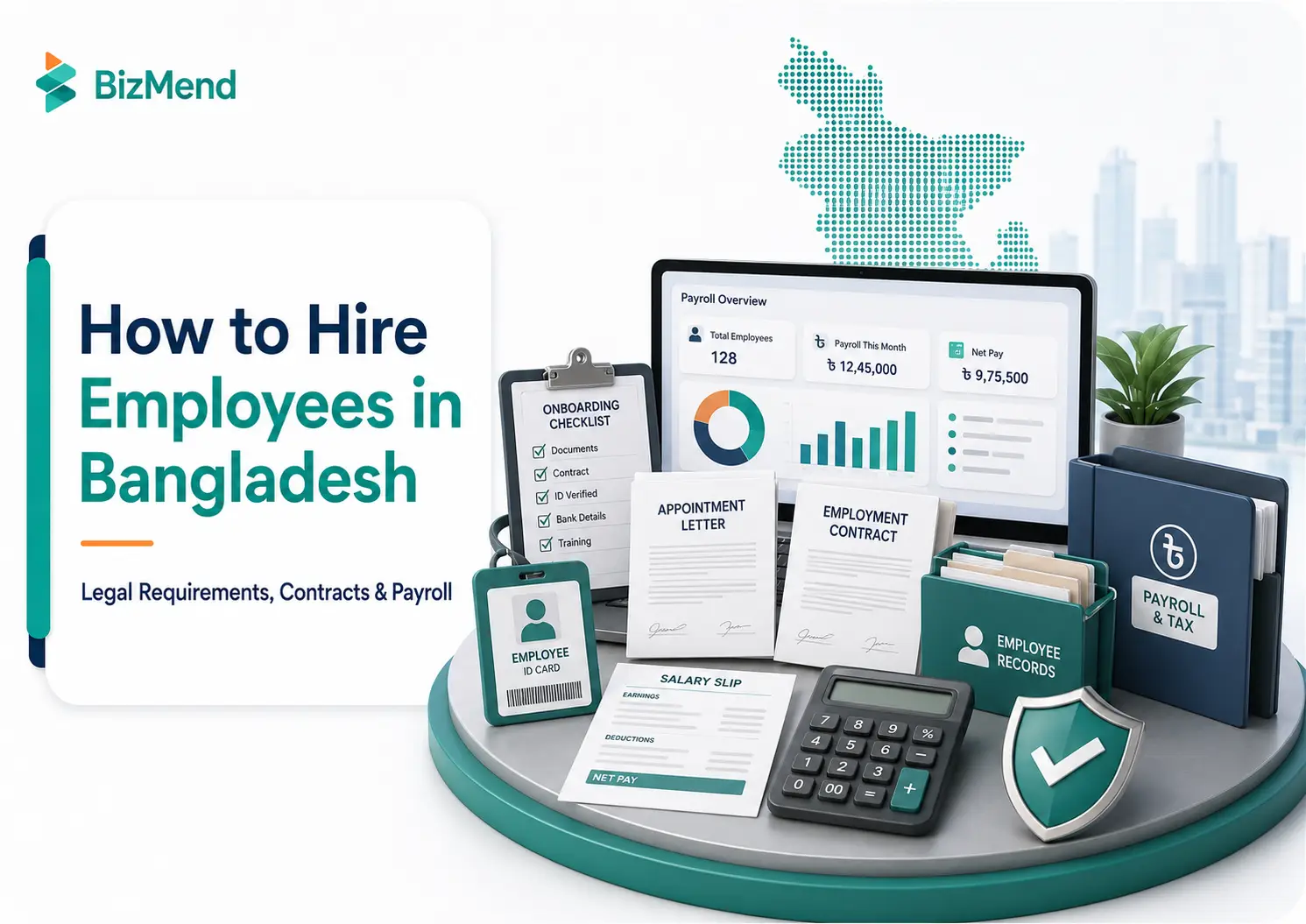
Learning how to hire employees in Bangladesh requires more than posting a vacancy and agreeing on a salary. Employers need a clear role, a fair recruitment process, written employment terms, verified employee records, lawful working conditions, and a payroll system that handles salary, tax, leave, and deductions correctly. The exact rules can differ by worker category, industry, establishment type, and seniority, and even a sole proprietorship in Bangladesh that hires staff must manage the relevant employment and payroll requirements.
A reliable hiring process should therefore connect recruitment, documentation, onboarding, payroll, and ongoing compliance from day one. This guide explains the practical steps for local startups, established businesses, HR teams, and foreign companies hiring in Bangladesh, while highlighting where an employment lawyer, tax professional, or payroll specialist should confirm the latest rule.
Quick Answer: To hire employees in Bangladesh, define the role, screen candidates fairly, issue a written offer and appointment letter, collect verified documents, complete onboarding, and set up compliant payroll and records. Confirm worker classification, probation, hours, leave, overtime, tax withholding, and termination terms under the rules that apply to your establishment.
Private-sector hiring is shaped by the Bangladesh Labour Act, Labour Rules, the 2026 labour amendment where applicable, income-tax law, sector wage orders, and the employer’s service rules or contract. The labor act does not apply identically to everyone called an employee; managers, consultants, outsourced staff, factory workers, and clerical workers may receive different legal treatment.
Start by classifying the role as an employment relationship, a worker category covered by labour legislation, an independent contractor arrangement, or a position under a special sector law. Misclassification can affect appointment letters, overtime, leave, termination, tax, and benefits.
| Important: Legal caution: Use the current official gazette and sector rules before finalizing a policy. Bangladesh labour legislation and wage orders can be amended, and export processing zones or regulated industries may follow additional frameworks. |
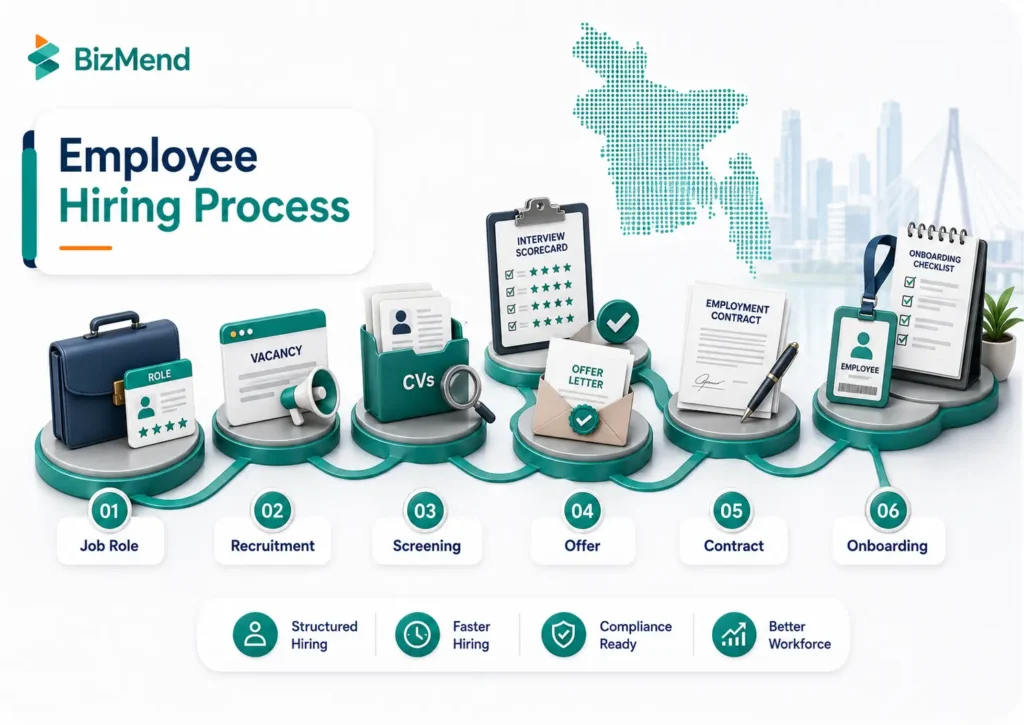
Write down the job purpose, reporting line, work location, schedule, required skills, decision-making authority, and measurable responsibilities. Decide whether the position is permanent, temporary, fixed-term, part-time, trainee, or project-based. The label alone is not enough; the real working relationship and duties matter.
Budget beyond basic salary, and compare the proposed pay with the applicable minimum wage in Bangladesh before adding allowances, bonuses, overtime exposure, paid leave, equipment, training, and possible separation liabilities.
A good job post states the title, responsibilities, required experience, location, schedule, employment type, and application method. Include the salary range when practical. Avoid discriminatory language, exaggerated promotion promises, hidden unpaid trial work, or requirements unrelated to the job.
Use consistent shortlisting criteria. Review only relevant education, experience, licences, references, and identity information. Obtain consent before background or reference checks and restrict access to collected personal data.
Prepare role-based questions and a simple scorecard covering technical ability, communication, judgment, and practical fit. Keep interview notes. Do not ask intrusive questions that have no clear connection with the work. For skill tests, use a reasonable task and explain whether it is paid, confidential, or retained.
The offer letter should summarize the proposed title, salary, work location, joining date, probation, key benefits, reporting line, and conditions such as document verification or reference clearance. It should not contradict the later appointment letter or employment contract. Mark the offer as conditional when approval or verification remains pending.
Under the Bangladesh Labour Act, employers hiring covered workers must issue an appointment letter and provide each appointed worker with a photo ID card. Written terms are also advisable for every other employee. Give the employee a signed copy by joining and retain an acknowledged copy.
Collect only documents needed for identity, payroll, tax, qualifications, benefits, or lawful checks. Confirm originals where appropriate and store copies securely.
| Document | Why It Is Commonly Needed | Practical Check |
| National ID or passport | Identity and personnel records | Match name, date of birth, photograph, and document number |
| Recent photograph and contact details | Employee file and emergency communication | Confirm current address and emergency contact |
| Academic or professional certificates | Qualification verification | Check only credentials material to the role |
| Experience letters or references | Employment-history verification | Obtain consent before contacting referees |
| Bank or mobile payroll details | Salary payment | Confirm account ownership and payment instructions |
| TIN and tax information, where relevant | Payroll tax estimation and reporting | Use current NBR requirements and employee declarations |
| Nominee or beneficiary details | Benefit funds or employer schemes | Use only when the relevant scheme requires it |
| Signed policies and acknowledgements | Proof of onboarding and workplace rules | Record version and acknowledgement date |
Do not retain original certificates or identity documents without a lawful and operational reason. Set retention periods, restrict access, and define how employee records will be corrected or deleted after employment ends.
| Document | Main Purpose | Typical Content |
| Offer letter | Confirms the proposed job before joining | Title, salary, joining date, conditions, major benefits |
| Appointment letter | Formally appoints the employee and records core service terms | Designation, classification, wages, probation, workplace, hours, leave, notice, rules |
| Employment contract | Explains detailed rights and obligations | Duties, confidentiality, intellectual property, benefits, conduct, data, termination, disputes |
One document may combine appointment and contract terms, but the content must be consistent. Avoid copying a foreign template without adapting it to Bangladesh law, local payroll, employee classification, and the employer’s actual policies.
Probation should be stated clearly, including its length, assessment criteria, confirmation process, and any lawful extension. For labor act-covered workers, probation is commonly tied to worker category: clerical work generally has a six-month probation period, other workers generally have three months, and skilled workers may have a further three-month extension where work quality cannot be determined within the first period. Employers should not assume that an indefinite probation clause overrides the applicable law.
Schedule a midpoint review and a final review before probation expires. Confirm employment in writing, lawfully extend it where permitted and justified, or follow the correct separation process. Silence creates uncertainty and weakens later performance or disciplinary decisions.
Onboarding converts a signed offer into a functioning employment relationship. Complete the following steps during the first week:
1. Verify identity and required qualifications, then create the personnel file.
2. Issue signed appointment and contract documents and explain key terms.
3. Enter the employee in attendance, leave, payroll, and access-control systems.
4. Explain the job, reporting line, targets, probation review, and escalation contacts.
5. Provide policies on conduct, harassment, safety, data, confidentiality, devices, expenses, and remote work.
6. Complete workplace safety and role-specific training.
7. Record equipment, credentials, benefit nominations, and policy acknowledgements.

Payroll should create a traceable link between the employment contract, attendance, leave, approved variable pay, deductions, bank payment, payslip, tax records, and general ledger. Use a written payroll calendar with cut-off dates for attendance, overtime, new joiners, resignations, bonuses, and reimbursement claims.
Separate basic salary, house or other allowances, bonuses, overtime, reimbursements, benefits, and deductions. The tax treatment of a payment does not depend only on its label. Under the Income Tax Act, 2023, salary includes salary, wages or remuneration, allowances, leave allowance, leave encashment, bonus, fees, commission, overtime, and advance salary.
Under section 86 of the Income Tax Act, 2023, employers must manage withholding tax in Bangladesh at the time of salary payment using the applicable rate based on the employee’s estimated employment income. IIn practice, payroll should estimate annual taxable income, consider valid declarations, deduct and deposit the correct amount, and provide salary and tax certificates that help the employee file an income tax return in Bangladesh accurately.
Do not apply one flat TDS rate to everyone, because income tax in Bangladesh depends on current thresholds, slabs, rebates, exemptions, residency status, other income, and Finance Act changes. Use current guidance from NBR Bangladesh, including applicable income-tax laws, e-TDS instructions, forms, payment procedures, and reporting requirements.
A payslip should show the pay period, basic salary, allowances, overtime or variable pay, gross earnings, each deduction, net pay, payment date, and year-to-date figures where the system supports them. The payroll register and bank transfer total should reconcile before payment approval.
For adult workers covered by the general Labour Act framework, the common reference is 8 hours per day and 48 hours per week, with overtime and spread-over limits subject to sections 102, 105, 108, and any sector-specific rules. For Labour Act-covered overtime, the worker generally receives overtime allowance at twice the ordinary rate of basic wage, plus dearness allowance and ad hoc or interim wage where applicable.
Leave commonly includes casual, sick, annual or earned leave, festival holidays, and maternity-related entitlements. Exact accrual, documents, and cash treatment vary by category and establishment. Employees outside the statutory worker definition may rely more on contract and service rules.
| Important: Payroll rule: Do not calculate overtime, leave encashment, or absence deductions from an informal spreadsheet formula without confirming the applicable wage definition and statutory method. |
Provident-fund arrangements differ across private employers. Some create a contributory fund through rules and a trust; others face sector requirements. The contract, policy, trust deed, deductions, contributions, vesting, nomination, withdrawal, and tax recognition must align.
Gratuity may arise from the applicable labour framework, service rules, an approved gratuity fund, or the employment contract. Eligibility and calculation can depend on employee classification, length of service, and the reason employment ends. Employers should model potential liability and avoid promising a formula that conflicts with law or the approved scheme.
The Income Tax Act recognizes approved gratuity funds and recognized provident funds for tax purposes, but approval and labour-law entitlement are separate questions. HR, finance, tax, and legal teams should review the same scheme document before deductions begin.
Maintain accurate records from recruitment to final settlement, including applicable appointment letters, registers, attendance, hours, overtime approvals, wages, payslips, leave, tax deductions, incidents, discipline, training, and separation documents.
A foreign company must decide whether a private limited company in Bangladesh or another approved local structure will legally employ, contract with, and pay the worker. Direct overseas hiring can raise registration, payroll, labor-jurisdiction, tax, and immigration issues, while companies hiring foreign nationals must separately confirm the applicable work permit in Bangladesh before employment begins. A contractor label does not remove those risks when the relationship is employment in practice.
Before the first hire, determine whether a branch office in Bangladesh, local subsidiary, professional employer, or another lawful structure should employ the worker, run payroll, deduct tax, maintain records, and handle disputes.
Before the first hire, confirm which authorized signatory has the legal authority to execute appointment letters and employment contracts on behalf of the employing entity.
| Stage | Employer Action | Evidence to Keep |
| Workforce planning | Approve role, status, budget, reporting line, and location | Job description and approval |
| Recruitment | Advertise, shortlist, interview, and verify fairly | Job post, scorecard, consent, references |
| Offer | Issue conditional written offer | Accepted offer letter |
| Appointment | Sign appointment letter and adapted contract | Signed copies and policy acknowledgements |
| Onboarding | Set up records, access, training, and equipment | Onboarding checklist and asset record |
| Payroll | Configure earnings, deductions, tax, payslip, and bank payment | Payroll register, tax records, payment proof |
| Ongoing HR | Track probation, leave, hours, performance, safety, and complaints | Registers, reviews, approvals, investigation files |
The safest way to hire employees in Bangladesh is to design one connected process: correct role classification, fair recruitment, consistent written terms, verified records, structured onboarding, and accurate payroll. Most compliance problems begin when one team makes promises that another team cannot lawfully or operationally deliver.
Before issuing the first appointment letter, confirm the current labour rules for the role and sector, review payroll tax obligations, and align HR policies with the employment contract. Employers with factories, foreign ownership, large workforces, benefit funds, or complex overtime should obtain local legal, HR, and payroll advice.
For workers covered by the Bangladesh Labour Act, issuing an appointment letter and maintaining prescribed employment records is a core requirement. Other employees should also receive written terms because they reduce disputes and support payroll, performance, and separation decisions.
An offer letter proposes employment before joining, often subject to conditions. An appointment letter formally records the employment after acceptance. A detailed employment contract may add confidentiality, intellectual property, benefits, conduct, and termination clauses.
Yes, but the period, extension, and confirmation process must match the employee’s legal classification and applicable rules. State the terms in writing and complete the review before the period ends.
Not necessarily. Statutory overtime depends on whether the person and establishment fall within the relevant labour-law provisions. Job title alone does not decide the issue; actual duties and legal classification matter.
When employment income is taxable, the person responsible for payment must calculate and deduct tax under the current Income Tax Act and NBR rules. Payroll should use estimated annual income rather than one flat percentage for everyone.
No single answer fits every employer. Entitlement can depend on labour-law coverage, establishment or sector rules, service length, employer policy, contract, and any approved fund. Obtain scheme-specific legal and tax advice.
Get professional support before hiring across borders, setting up PF or gratuity, using fixed-term or contractor models, terminating employees, handling misconduct, applying overtime exemptions, or operating in a regulated sector.

Learn how to become a Daraz seller in Bangladesh, register an account, list products, understand fees, manage orders, and grow…
by Sheikh Ornob

Compare the cost of living in Bangladesh in 2026, including Dhaka and Chittagong rent, food, transport, utilities, inflation, and monthly…
by Sheikh Ornob

Learn MoA and AoA requirements in Bangladesh, key clauses, drafting basics, RJSC filing steps, amendments, and common company-registration mistakes. Suggested…
by Sheikh Ornob