How to Become a Daraz Seller in Bangladesh: Registration, Fees & Growth
Learn how to become a Daraz seller in Bangladesh, register an account, list products, understand fees, manage orders, and grow…
 by Sheikh Ornob

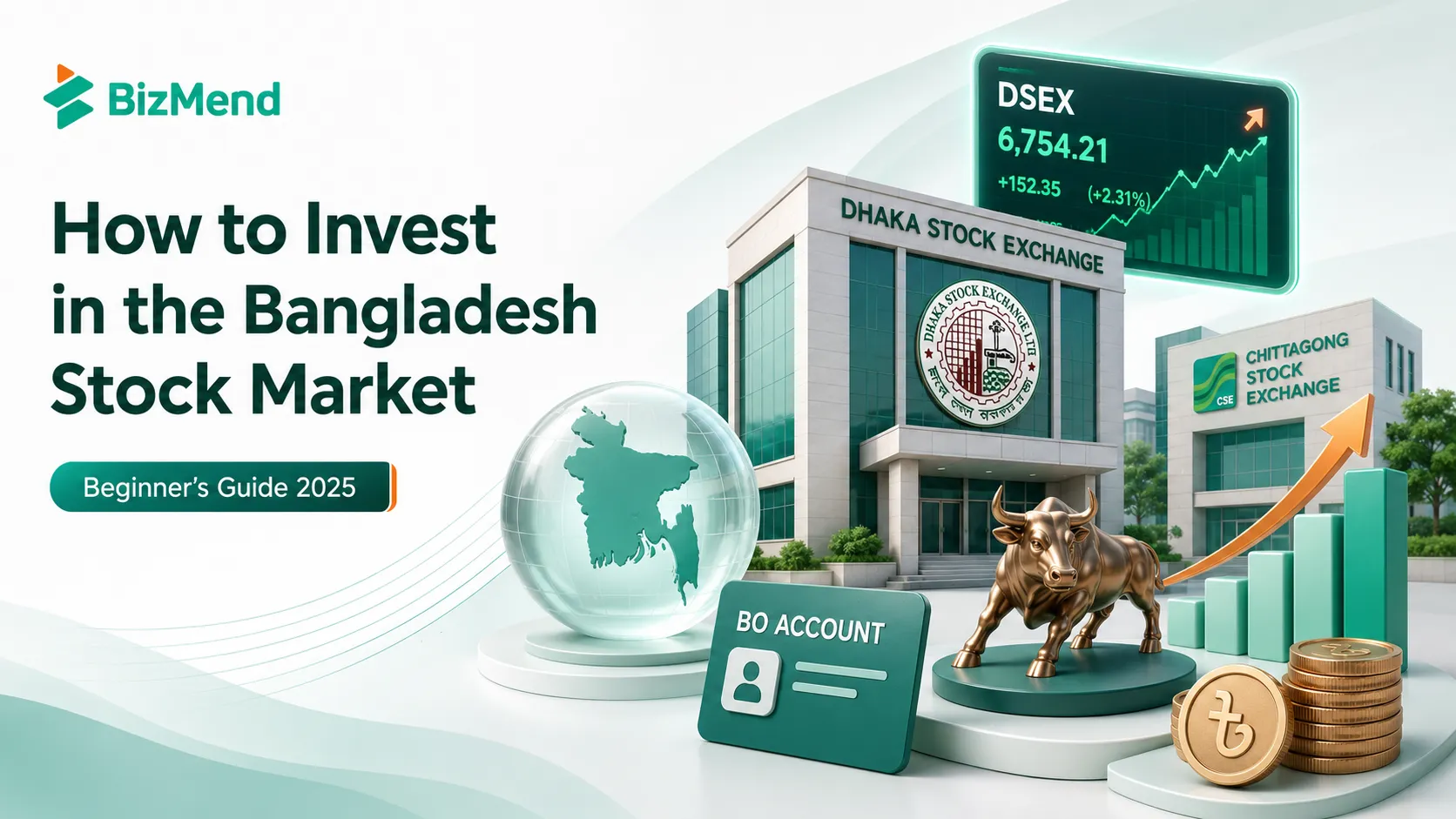
Learn how to invest in the Bangladesh stock market step by step. Covers DSE, CSE, BO account, broker selection, IPOs, taxes, and real investing tips.
Over a million and a half Bangladeshis now have active BO accounts. That number tells you something real: the stock market isn’t just for wealthy businesspeople anymore. Students, salaried professionals, and NRBs are all getting in. But most people still have no idea where to start.
This guide covers exactly how to invest in the stock market in Bangladesh, from opening your account to placing your first trade, understanding company categories, applying for IPOs, and getting your head around how taxes work. All the facts are current as of 2025.
Quick answer: To invest in the Bangladesh stock market, open a BO (Beneficiary Owner) account through a licensed broker registered with CDBL, fund your account, and buy shares on the Dhaka Stock Exchange (DSE) or Chittagong Stock Exchange (CSE). Both exchanges are regulated by BSEC. The annual BO account fee is Tk 150 (from FY2025-26). Capital gains up to Tk 50 lakh per year are exempt from tax for individual investors.
Bangladesh has two stock exchanges. The Dhaka Stock Exchange (DSE) is the main one, founded in 1954, and it lists over 600 companies and securities. The Chittagong Stock Exchange (CSE) is smaller and started operations in 1995. Most retail investors trade on the DSE.
Both exchanges are regulated by the Bangladesh Securities and Exchange Commission (BSEC), which licenses brokers, approves IPOs, and protects investors. If you’re ever unsure whether a broker or product is legitimate, bsec.gov.bd is where to check.
DSE trades from Sunday through Thursday, 10:00 AM to 2:30 PM BST (continuous trading 10:00 AM to 2:20 PM, trade-at-last from 2:20 to 2:30 PM). The market is closed on Fridays, Saturdays, and public holidays.
| Index | What It Tracks | Why It Matters |
|---|---|---|
| DSEX (DSE Broad Index) | All listed companies | The main benchmark; reflects overall market health |
| DS30 | Top 30 blue-chip companies | Tracks the largest, most liquid stocks |
| DSES (DSE Shariah Index) | Shariah-compliant companies only | For investors who prefer Islamic finance |
The DSEX closed at 4,865.3 points in December 2025, down from its all-time high of 7,329 points in September 2021. Knowing this context helps set realistic expectations. Bangladesh’s capital market has gone through real cycles. You need to be prepared for that.
To understand who regulates what and how the system is structured, this piece on investment banking regulations in Bangladesh is worth reading before you put money in.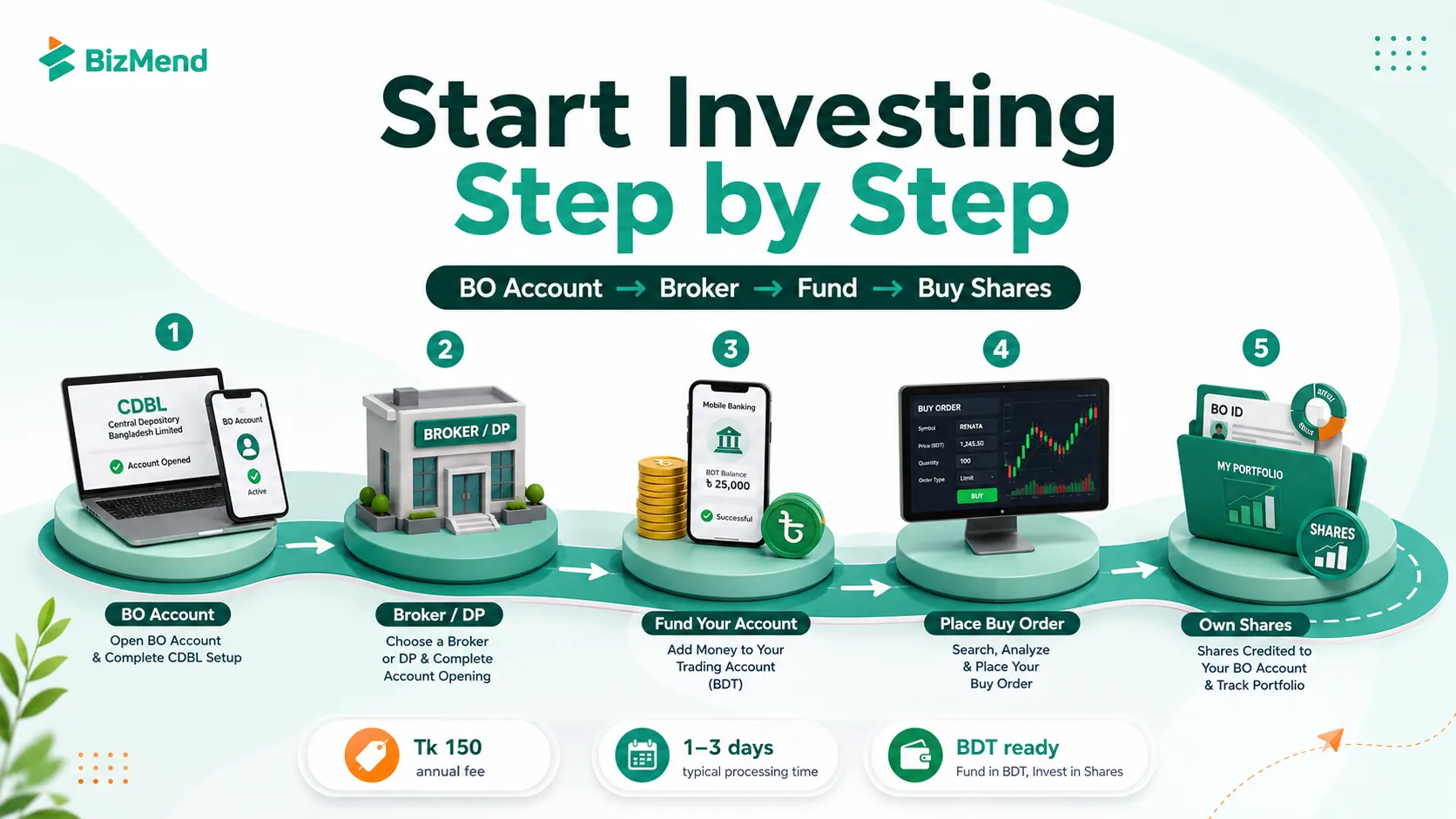
A BO (Beneficiary Owner) account is the foundation. Without one, you can’t buy a single share, apply for an IPO, or receive dividends. It’s your digital securities account, managed by Central Depository Bangladesh Limited (CDBL).
You can open a BO account online at cdbl.com.bd/bo or in person at any licensed broker. The annual maintenance fee dropped to Tk 150 from FY2025-26 (approved by BSEC in September 2025).
For a full step-by-step breakdown of the documents you need, the online vs. offline process, and how NRBs handle it differently, check out this complete guide on how to open a BO account in Bangladesh.
Once your account is active, CDBL assigns you a unique 16-digit BO ID. This is your permanent investor identity. Keep it safe.
Your broker, also called a Depository Participant (DP), is the firm through which you buy and sell shares. DSE lists its registered members under “TREC Holders” and CSE lists them under “All Stockbrokers.”
Here’s what to look for when picking one:
Some of Bangladesh’s established investment banks in Bangladesh have licensed brokerage subsidiaries if you want a research-backed approach. If you want Shariah-compliant investing, some of the top Islamic banks in Bangladesh operate licensed brokerage arms tracking DSES stocks. And for the linked bank account you’ll need, most commercial banks in Bangladesh connect well with brokerage systems. If you don’t have a bank account yet, here’s a guide on how to open a bank account in Bangladesh to sort that first.
Once your BO account is open, you need to deposit money. Most brokers accept:
There’s no legal minimum deposit. For IPO applications, many brokers require at least Tk 20,000 invested in the secondary market first. This is a broker-level requirement, not BSEC regulation, so verify with your specific broker. For general trading, start with whatever amount you’re comfortable with.
This is one of the most important things beginners miss. Every company on the DSE falls into a category that tells you something about its financial health and compliance.
| Category | What It Means | Settlement |
|---|---|---|
| A | Regular AGM + 10% or more annual dividend | T+2 days |
| B | Holds AGMs but pays less than 10% dividend | T+2 days |
| N | Newly listed companies | T+2 days |
| G | Government securities | T+2 days |
| Z | Fails to hold AGMs or pay any dividend | T+3 days |
The Z category is the riskiest. Settlement takes T+3 working days after the trade. Most experienced investors avoid Z-category stocks unless they have a specific reason. A-category companies are generally the safer, more established picks. But category alone isn’t enough for investment decisions. It’s a starting filter, not a final answer.
Once your account is funded, placing a trade is simple. You have three main options:
Through the broker’s mobile app. Most established brokers have apps where you can search stocks, check prices, and place orders directly.
Call or message your broker’s Authorized Representative (AR). Tell them the stock name, quantity, and price you want to buy at. They execute it on your behalf.
Visit the broker’s office. Old-school but still works, especially for larger transactions.
Shares are credited to your BO account on T+2 for A, B, N, and G category stocks. If you buy on Sunday, shares appear by Tuesday. For Z-category, settlement is T+3 working days.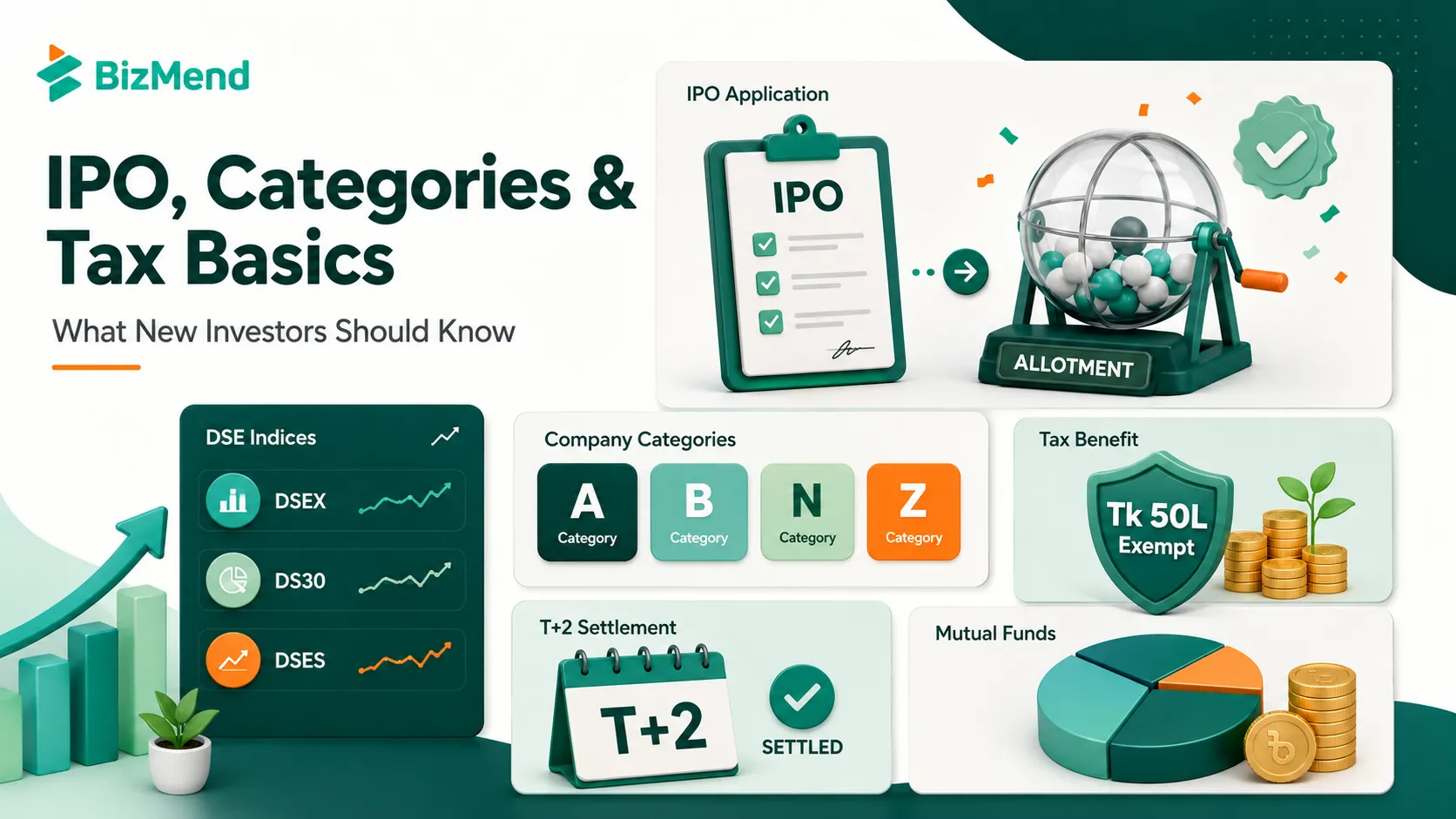
An IPO is when a company offers its shares to the public for the first time. In Bangladesh, IPO shares are allocated through a lottery system managed by BSEC. You apply, and if you’re drawn in the lottery, you get shares at the offer price.
NRBs can also apply for IPOs and receive a reserved quota. For NRBs thinking about broader financial infrastructure alongside stock investing, US LLC formation from Bangladesh is worth exploring if business expansion is also on the agenda.
One realistic note: with the IPO lottery system, allotment is not guaranteed for popular companies. Don’t put money into an IPO application counting on getting shares.
If picking individual stocks feels overwhelming, mutual funds are worth considering. Bangladesh has listed closed-end mutual funds and open-end mutual funds traded on the DSE.
Mutual funds pool money from many investors and a professional fund manager allocates it across a portfolio. For beginners, they offer diversification without requiring you to research every stock. Listed closed-end mutual fund units can be bought directly through your broker just like regular stocks.
The non-bank financial institutions in Bangladesh operate several of the country’s larger mutual funds, which is a useful starting point for exploring specific options.
Here’s what most beginner guides completely skip over.
| Gain Type | Rate for Individual Investors |
|---|---|
| Capital gains up to Tk 50 lakh/year (listed shares) | Exempt |
| Capital gains above Tk 50 lakh/year | 15% flat rate (effective November 2024) |
| Dividend income | 10% withholding tax deducted at source |
The capital gains picture changed significantly in late 2024. The NBR set a 15% flat rate on annual capital gains exceeding Tk 50 lakh from listed share transactions, regardless of holding period. For most small and medium retail investors, staying under Tk 50 lakh annually means no capital gains tax at all.
The 10% dividend withholding tax is automatically deducted before the dividend reaches you. If your situation is complex (large portfolio, NRB status, significant gains), consult a tax professional for advice specific to your circumstances.
Stock markets go up and they come down. Bangladesh’s DSEX dropped over 60% in daily trading volumes from 2021 to 2024 before recovering. Anyone who tells you there’s no risk is wrong.
Start by opening a BO account through a CDBL-registered broker using your NID, bank account details, and passport-size photos. Once approved, fund the account and buy shares on the DSE or CSE through your broker’s app, by phone, or in person. The annual BO account fee is Tk 150 from FY2025-26.
There’s no legal minimum for secondary market trading. You need enough to cover the share price plus the broker’s commission (0.25% to 0.50%). For IPO applications, many brokers require at least Tk 20,000 invested in the secondary market first, though this is a broker-level requirement, not a BSEC rule.
DSE (Dhaka Stock Exchange) is Bangladesh’s main and larger exchange, listing over 600 companies and founded in 1954. CSE (Chittagong Stock Exchange) is smaller and started in 1995. Both are regulated by BSEC. Most retail investors trade on DSE due to higher liquidity and a wider range of securities.
You need an active BO account. When a company announces an IPO, get the application form from your broker (most offer online or in-app application), fill it with your BO ID and bank details, and submit it. IPO allotment in Bangladesh uses a lottery system managed by BSEC. Unallotted funds are refunded within a few working days.
Capital gains from listed shares up to Tk 50 lakh per year are exempt from tax for individual investors (as per the November 2024 NBR announcement). Gains above Tk 50 lakh are taxed at a flat 15% rate. Dividend income has a 10% withholding tax deducted at source before it reaches the investor.
A-category companies hold regular AGMs and pay at least 10% annual dividends. B-category holds AGMs but pays less dividend. N-category covers newly listed companies. Z-category companies fail to hold AGMs or pay any dividend. Z-category stocks have a T+9 settlement cycle vs. T+2 for other categories, and are considered highest risk.
Yes. NRBs can open a BO account and invest in the DSE and CSE. They need a NITA (Non-Resident Investor’s Taka Account) at an authorized dealer bank in Bangladesh, plus an FC (Foreign Currency) account for remitting funds from abroad. NRBs also receive a reserved quota in IPO applications.
For A, B, N, and G category stocks, shares are credited to your BO account on T+2 (two working days after the trade date). For Z-category stocks, settlement takes T+9 working days. Dividends and bonus shares are credited separately based on the company’s declared record date.
DSEX is the DSE Broad Index, the main benchmark for Bangladesh’s stock market. It tracks all companies listed on the Dhaka Stock Exchange. The DSEX closed at 4,865.3 points in December 2025, having peaked at an all-time high of 7,329 points in September 2021. When DSEX rises, the overall market is generally performing well.
All stock markets carry risk, and Bangladesh’s has seen significant volatility, including the 2010-11 market crash and a prolonged correction from 2022 to 2024. Sticking with A-category stocks, avoiding margin loans, diversifying across sectors, and only investing money you don’t need short-term reduces your risk substantially.
Honestly, the Bangladesh stock market is more accessible than most people think. The account takes a few days to open, the annual cost is Tk 150, and you can start with whatever amount you’re comfortable with. The bigger barrier isn’t the process. It’s the mindset of expecting quick, guaranteed returns. That thinking has burned investors here before, and it’ll burn them again.
If you’re ready to move forward, the single most useful first step is opening a BO account today. Everything else flows from there. Have you decided which broker you’re going to use?

Learn how to become a Daraz seller in Bangladesh, register an account, list products, understand fees, manage orders, and grow…
by Sheikh Ornob
Compare the cost of living in Bangladesh in 2026, including Dhaka and Chittagong rent, food, transport, utilities, inflation, and monthly…
by Sheikh Ornob
Learn MoA and AoA requirements in Bangladesh, key clauses, drafting basics, RJSC filing steps, amendments, and common company-registration mistakes. Suggested…
by Sheikh Ornob