How to Become a Daraz Seller in Bangladesh: Registration, Fees & Growth
Learn how to become a Daraz seller in Bangladesh, register an account, list products, understand fees, manage orders, and grow…
 by Sheikh Ornob

Quick Answer: Bangladesh GDP growth in 2026 points to a slower but still important recovery story. The World Bank projects 3.9% growth in FY26, ADB expects 4.0% in 2026, and...
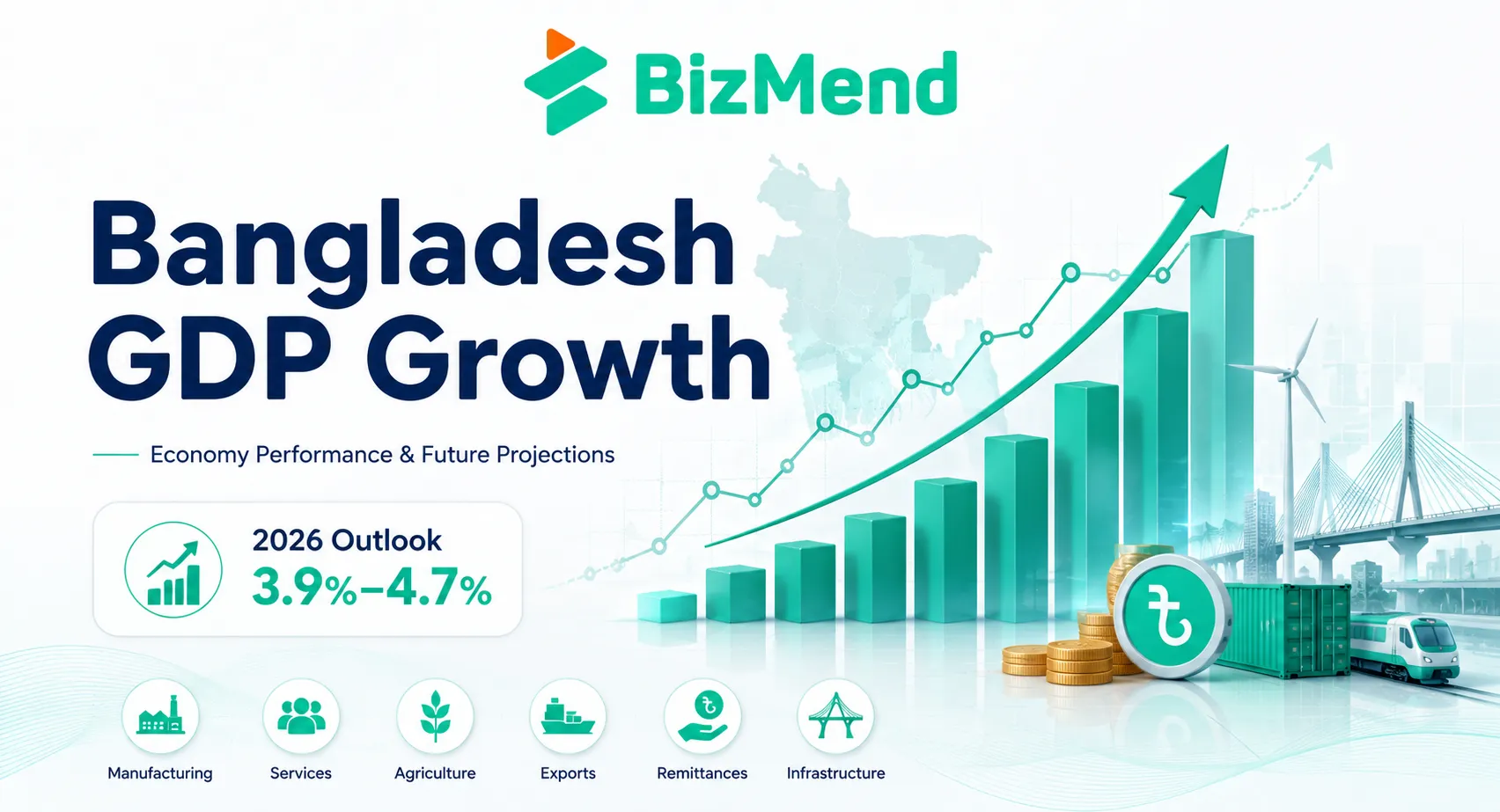
Quick Answer: Bangladesh GDP growth in 2026 points to a slower but still important recovery story. The World Bank projects 3.9% growth in FY26, ADB expects 4.0% in 2026, and the IMF projects 4.7%. The outlook depends on inflation control, remittances, exports, banking reform, and private investment.
Bangladesh’s growth story is entering a harder test. GDP still matters, but the headline number is not enough. In 2026, investors must read growth beside inflation, currency pressure, exports, jobs, and reforms.
For years, Bangladesh economy growth was viewed through a strong expansion story. Ready-made garments, remittances, a large domestic market, infrastructure work, and a young labor force helped the country move forward. That story still matters, but the pace has changed.
GDP measures the value of goods and services produced in an economy. Bangladesh GDP growth shows how fast that output is expanding after adjusting for price changes. It is one of the main ways analysts judge national economic momentum.
For businesses, GDP growth matters because it affects demand, investment, jobs, lending, trade, and public spending. A higher growth rate usually signals stronger activity. A lower rate can mean weaker consumer spending, slower imports, lower credit demand, or pressure on firms.
| Measure | What it shows | Why it matters |
| Real GDP growth | Change in economic output after inflation | Best for tracking economic momentum |
| Nominal GDP | GDP measured at current prices | Useful for economy size and market scale |
| GDP per capita | GDP divided by population | Helpful for average income context |
| Economic performance | Broader health of the economy | Includes inflation, jobs, exports, finance, and stability |
Bangladesh enters 2026 with a mixed economic picture. Growth has not collapsed, but it is clearly below the country’s stronger pre-shock trend. Inflation remains a major pressure, and businesses are still adjusting to tight monetary conditions, import costs, and exchange rate movement.
The World Bank’s April 2026 update says Bangladesh faces slowing growth, persistent inflation, banking sector stress, weak revenue mobilization, subdued private investment, and external risks linked to energy and global demand. It projects growth to slow to 3.9% in FY26.
The IMF also frames Bangladesh’s challenge around macroeconomic and financial stability. Its 2026 country page projects 4.7% real GDP growth and 9.2% average consumer price inflation for 2026, while its Article IV report highlights low fiscal revenue, banking weakness, high inflation, and exchange rate reform challenges.
The recent Bangladesh growth rate shows a clear moderation. World Bank data shows annual GDP growth at 7.1% in 2022, 5.8% in 2023, 4.2% in 2024, and 3.5% in 2025. That trend explains why the 2026 outlook is watched closely.
BBS remains the official national statistics source and has released final FY2024-25 GDP data and provisional FY2025-26 GDP files. However, international datasets and domestic fiscal-year estimates may not always look identical because they use different publication cycles, revisions, and reporting formats.
| Year | GDP growth signal | Main reading |
| 2022 | 7.1% in World Bank data | Strong post-pandemic recovery |
| 2023 | 5.8% in World Bank data | Growth slowed but stayed solid |
| 2024 | 4.2% in World Bank data | Pressure became more visible |
| 2025 | 3.5% in World Bank data | Slowest recent reading in the series |
| 2026 | 3.9% to 4.7% across major forecasts | Recovery depends on stability and reforms |
Bangladesh GDP per capita helps readers understand the average economic output per person. World Bank data shows Bangladesh GDP per capita at about $2,597.3 in 2025 in current US dollars. The country’s nominal GDP was about $456.3 billion in the same year.
GDP per capita does not show how income is distributed. It can rise while many households still feel pressure from inflation, food prices, rent, or job insecurity. That is why GDP per capita should be read beside wages, poverty, employment, and living costs.
It is also important not to mix GDP per capita with per capita income, GNI per capita, wages, or disposable income. These measures can use different concepts and sources. For a data-driven article, the label must match the number.
Bangladesh’s growth model is broad but not equally balanced. Services generate a large part of domestic activity, manufacturing supports exports and jobs, and agriculture remains important for food supply and rural income. Remittances also support household spending and foreign exchange.
ADB’s 2026 outlook notes that growth slowed in 2025 due to political unrest and floods but is expected to improve as services rebound. This matters because services connect factories, consumers, trade, banking, transport, and local demand.
Bangladesh GDP growth slowed because several pressures arrived together. Inflation reduced purchasing power. Tight monetary policy made credit more expensive. Import controls and foreign exchange shortages affected inputs. Energy and utility costs also increased uncertainty for factories and SMEs.
Political uncertainty and labor disruption added another layer of caution. When firms are unsure about demand, policy direction, or financing, they delay hiring, expansion, and capital investment. That delay can show up quickly in lower private investment and weaker employment generation.
External risks matter too. Bangladesh depends on imported fuel and imported industrial inputs. A shock in oil prices, shipping costs, global apparel demand, or exchange rates can affect inflation, factory costs, export margins, and the current account.
A country can report positive GDP growth while ordinary people still feel economic stress. That is not a contradiction. GDP growth measures output, not the full quality of life. Inflation, job quality, wage growth, inequality, and access to services also matter.
BD economic performance should be judged through a wider dashboard. GDP growth tells whether the economy is expanding. GDP per capita adds population context. Inflation shows purchasing power pressure. Remittances, exports, reserves, and bank health show external and financial stability.
| Question | Best indicator to check |
| Is the economy producing more? | Real GDP growth |
| Is the market size rising? | Nominal GDP |
| Is average output per person improving? | GDP per capita |
| Are people feeling better off? | Wages, inflation, jobs, poverty, and consumption |
| Can businesses expand safely? | Credit, FX access, demand, policy stability, and infrastructure |
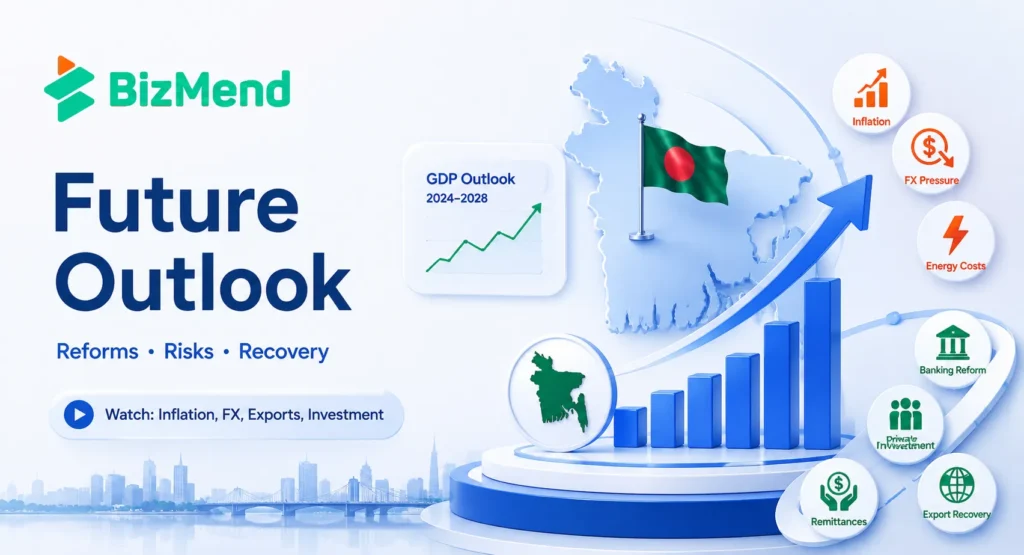
The Bangladesh GDP forecast for 2026 is positive but cautious. Different institutions use different models, time periods, and assumptions. So the safer reading is a range, not one guaranteed number.
| Source | Latest projection noted | How to read it |
| World Bank | 3.9% growth in FY26 | More cautious due to inflation, banking stress, and external shocks |
| ADB | 4.0% in 2026 and 4.7% in 2027 | Recovery expected as demand and services improve |
| IMF | 4.7% real GDP growth in 2026 | Recovery view, but with high inflation and reform risks |
| Domestic policy targets | Often higher than external forecasts | Should be treated as goals, not guaranteed outcomes |
This range shows that the GDP of Bangladesh in 2026 depends on reform execution. If inflation eases, remittances stay strong, exports recover, export incentives remain supportive, and banking reforms improve credit confidence, growth can strengthen. If energy costs, political uncertainty, or global demand worsen, the recovery can stay weak.
Inflation is the most visible challenge. High food and non-food prices reduce real purchasing power. They also force businesses to manage wage pressure, inventory costs, pricing decisions, and lower consumer confidence.
Foreign exchange pressure affects importers, manufacturers, banks, and investors. When access to dollars is tight, or the exchange rate moves sharply, firms face higher input costs and planning uncertainty. This is especially important for fuel, machinery, raw materials, and trade finance.
For entrepreneurs, Bangladesh GDP growth is a demand signal. Slower growth means buyers may become more price-sensitive, but it does not remove opportunity. Essentials, digital services, logistics, healthcare, education, food supply, export business support, and SME services can still grow.
For investors, the key is not only the growth rate but also sector demand, tax exposure, and annual compliance planning. They should study sector demand, FX exposure, tax and regulatory risk, utility reliability, import dependence, working capital needs, and payment cycles. A good market can still become difficult if cash flow planning is weak.
For ordinary people, GDP growth matters when it creates jobs, raises real wages, improves services, and reduces price pressure. If growth returns but inflation stays high, many households may not feel much improvement.
Bangladesh still has several long-term strengths. It has a large consumer base, competitive labor, an established export platform, strong remittance channels, and room to formalize small businesses. The domestic market remains important even when global demand is uneven.
Future opportunities are strongest where business solves practical problems. These include export diversification, cold chain, packaging, logistics, digital finance, affordable healthcare, skills training, renewable energy, agro-processing, and industrial services around economic zones.
The Bangladesh economic outlook will depend on a few measurable signals. Investors should track whether inflation moves down, whether reserves stabilize, whether export orders improve, and whether banks can clean up weak loans. These signs matter more than optimistic headlines.
Policy execution is equally important. Tax reform, better public revenue, faster customs processes, bank governance, transparent exchange rate management, and simpler business rules can support private investment. Without that, GDP growth may recover slowly but remain below potential.
| Signal to watch | Why it matters |
| Inflation trend | Shows pressure on consumers and interest rates |
| Remittance inflows | Supports households and foreign exchange |
| Export orders | Shows external demand and factory activity |
| Private-sector credit | Signals business expansion or caution |
| Energy supply | Affects factories, logistics, and services |
| Banking reform | Impacts confidence, credit, and investment |
Bangladesh GDP growth in 2026 is best understood as a recovery under pressure. The economy still has scale, resilience, and long-term opportunity. But growth is now more dependent on stability, reforms, and productivity than on momentum alone.
A balanced view is the safest view. Bangladesh remains an important emerging market, but the next phase of growth needs stronger institutions, better financial discipline, export diversification, and more reliable conditions for private investment.
Major forecasts differ. The World Bank projects 3.9% growth in FY26, ADB expects 4.0% in 2026, and IMF projects 4.7% real GDP growth for 2026. These are projections, not final actual results.
The final GDP of Bangladesh for 2026 will depend on official national accounts data and exchange rates. World Bank data shows nominal GDP at about $456.3 billion in 2025, while 2026 figures remain subject to official release and revision.
World Bank data shows Bangladesh GDP per capita at about $2,597.3 in 2025 in current US dollars. This is average output per person, not the same as personal income or wages.
The main drivers include services, manufacturing, agriculture, exports, remittances, infrastructure, and domestic consumption. Garments remain central to exports, but diversification is important for future resilience.
Growth slowed due to inflation, foreign exchange pressure, high import and energy costs, tight credit, political uncertainty, labor disruption, and weaker private investment. External risks also affect exports, remittances, and fuel prices.
Bangladesh still offers opportunity because of its market size, workforce, remittances, export base, and infrastructure needs. Foreign entrepreneurs should also check FX exposure, sector demand, tax rules, energy reliability, compliance, and financing conditions before entering.
No. GDP growth is important, but BD economic performance also depends on inflation, jobs, real wages, poverty, exports, remittances, reserves, banking health, and investment quality.

Learn how to become a Daraz seller in Bangladesh, register an account, list products, understand fees, manage orders, and grow…
by Sheikh Ornob
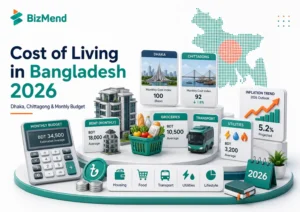
Compare the cost of living in Bangladesh in 2026, including Dhaka and Chittagong rent, food, transport, utilities, inflation, and monthly…
by Sheikh Ornob

Learn MoA and AoA requirements in Bangladesh, key clauses, drafting basics, RJSC filing steps, amendments, and common company-registration mistakes. Suggested…
by Sheikh Ornob