How to Become a Daraz Seller in Bangladesh: Registration, Fees & Growth
Learn how to become a Daraz seller in Bangladesh, register an account, list products, understand fees, manage orders, and grow…
 by Sheikh Ornob

Learn how venture capital in Bangladesh works, which verified funds support startups, what investors expect, and how founders prepare for funding.
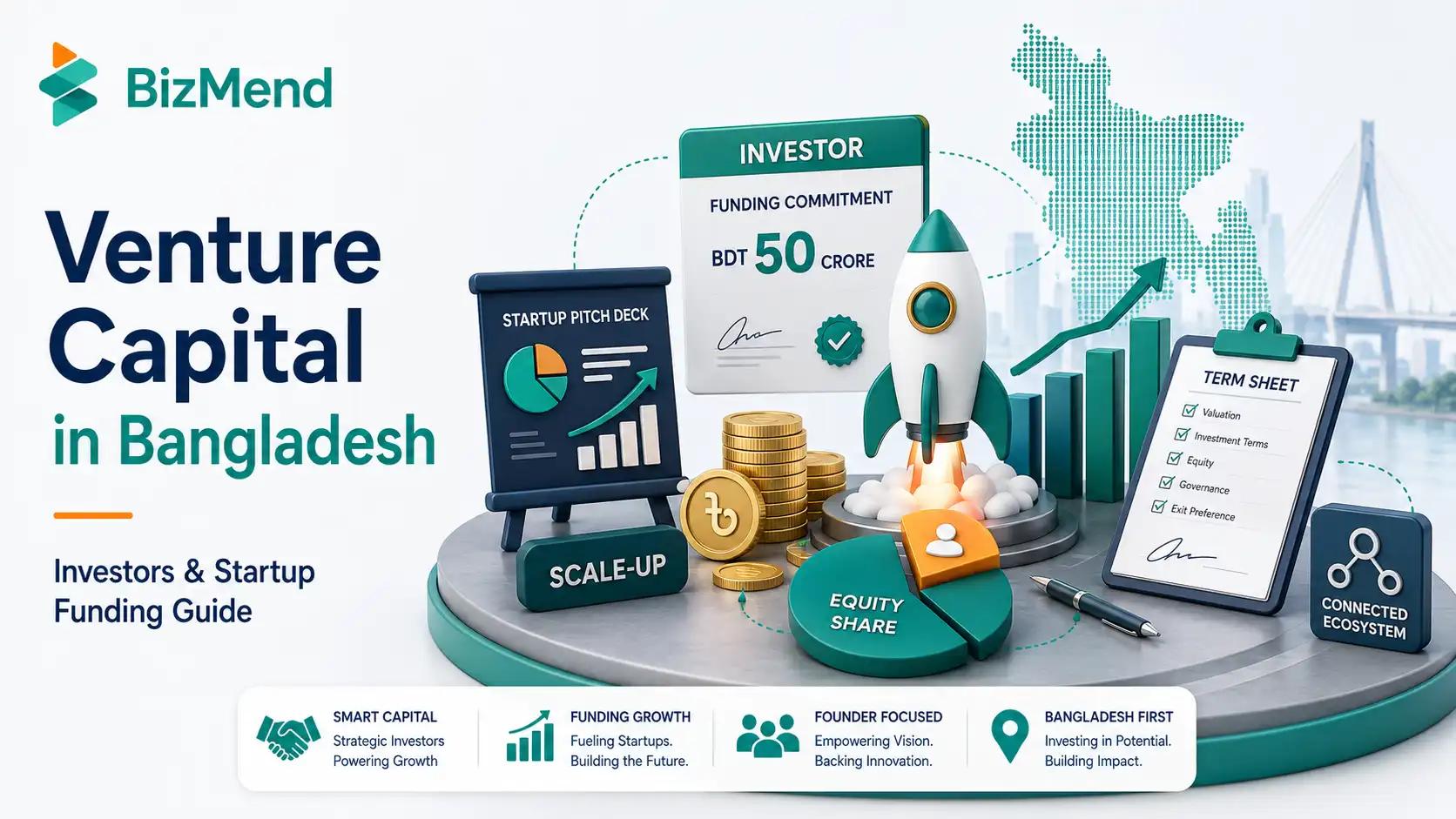
Venture capital in Bangladesh can help a high-growth startup fund product development, hiring, market expansion, and technology without taking a traditional business loan. In return, the investor normally receives company shares or another instrument that may convert into equity. The difficult part is not finding a list of investor names. It is proving that the business can grow, that customers want the product, and that the founding team can use outside capital responsibly.
This guide explains how venture funding works in Bangladesh, which current funding platforms founders can verify, what investors review, and how to prepare for a serious fundraising process.
Quick Answer: Venture capital in Bangladesh is equity-based funding for startups with strong growth potential. Investors provide capital in exchange for ownership, future conversion rights, or agreed investor protections. Founders usually need an MVP, a capable team, evidence of customer demand, clear financial records, and a credible plan for scaling the business..
Venture capital is money invested in a privately held company that is expected to grow quickly. Unlike a bank loan, the startup normally does not repay the investment through fixed monthly installments. The investor receives ownership, a convertible instrument, or contractual rights linked to a future equity round.
That difference matters. A lender mainly asks whether the borrower can repay. A venture investor asks whether the company could become much more valuable and eventually produce a return through a share sale, acquisition, founder buyback, or another exit. Because many startups fail, investors usually select only a small portion of the companies they review.
In Bangladesh, startup funding may come from government-backed investment companies, locally managed funds, impact investors, regional venture funds, corporate investors, accelerators, and individual angel investors. Their sectors, stages, cheque sizes, and application processes are not identical.
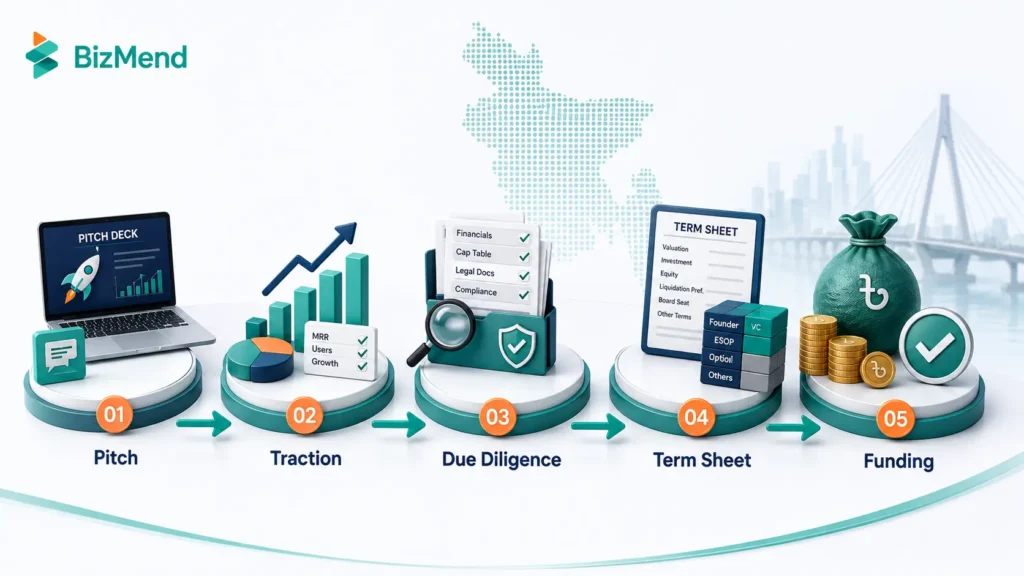
A typical funding process has several stages. The exact sequence changes by investor, but founders should expect more than a pitch meeting and a quick transfer.
1. Investor targeting: The founder identifies investors whose stage, sector, geography, and investment model match the startup.
2. Initial screening: The investor reviews the pitch deck, team, market, product, traction, and fundraising amount.
3. Meetings and data review: Founders explain the business model, customer acquisition, unit economics, financial position, competition, and use of funds.
4. Due diligence: The investor checks incorporation records, ownership, contracts, accounts, tax and regulatory matters, intellectual property, customer evidence, and founder background.
5. Term sheet and negotiation: The parties discuss valuation, ownership, board rights, investor protections, reporting, founder vesting, and exit-related terms.
6. Legal closing: Final agreements are signed, required corporate approvals are completed, and funds are released according to the agreed conditions.
Startup Bangladesh’s What We Do page explains that it can invest through equity, convertible debt, grants, co-investments, and fund-of-funds activity. Its investment application targets startups or enterprises registered in Bangladesh with high growth potential or significant social impact and asks for evidence such as an MVP, growing customer base, revenue, company details, traction data, previous funding information, and a pitch deck. That is a useful picture of the evidence serious investors may request.
| Stage | Typical Business Position | Common Funding Sources | Main Investor Question |
| Pre-seed | Idea, prototype, research, or early testing | Founders, friends and family, grants, accelerators, angels | Can this team solve a real problem? |
| Seed | MVP launched with early users, pilots, or revenue | Angels, seed funds, impact investors, government-backed investors | Is there early product-market evidence? |
| Series A | Repeatable revenue model and measurable growth | Institutional VC and regional funds | Can this model scale efficiently? |
| Growth stage | Established operations, larger revenue, and an expansion plan | Growth funds, strategic investors, later-stage VC | Can the company expand while controlling risk? |
These labels are not legal certificates. One investor may call a round “pre-seed” while another calls a similar company “seed.” The company’s traction, capital need, risk, and investor profile matter more than the label.
| Point | Angel Investor | Venture Capital Fund |
| Capital source | Usually the individual investor’s own money | Capital managed for a fund or investment vehicle |
| Common stage | Idea, pre-seed, or seed | Seed through growth, depending on the fund |
| Decision process | Can be relatively personal and flexible | Usually follows an investment committee and structured diligence |
| Support | Mentoring, introductions, sector experience | Governance, hiring, follow-on funding, strategy, and networks |
| Documentation | Maybe lighter, but legal documents still matter | Usually more detailed term sheets, diligence, and reporting |
Angel investors in Bangladesh can be especially useful before a company is ready for an institutional fund. However, founders should still document valuation, share issuance, investor rights, and board approvals properly. Informal investment arrangements often create cap-table disputes during the next round.
Investor activity changes quickly, so a responsible list should be treated as examples rather than a permanent ranking. Founders should verify current portfolio activity, stage, sector preference, and application channels before sending a pitch.
Startup Bangladesh Limited is the flagship government-sponsored venture capital company under Bangladesh’s ICT Division, with a stated mandate to support seed, early, and growth-stage startups and impact enterprises. Its current website says it supports seed and growth-stage startups through equity, convertible debt, grants, co-investment, and ecosystem support. Its portfolio page lists investments across education, health, software, commerce, logistics, and other technology-enabled sectors.
Startup Bangladesh also describes an initial USD 33 million fund of funds designed for investments with local and global venture fund managers that have a Bangladesh mandate; this is mainly a fund-manager route, not the same as a normal startup pitch application. Some investors prioritize sectors such as financial services, logistics, healthcare, education, agriculture, and e-commerce in Bangladesh.
YY Ventures is a Bangladesh-based incubation and investment social business focused on early-stage social and environmental ventures, especially businesses addressing poverty, unemployment, carbon emissions, and underserved communities. Its current website says it supports early-stage entrepreneurs with training, consultation, workspace, business services, investor access, and investment for ventures addressing poverty, unemployment, carbon emissions, and underserved communities.
Bangladeshi startups also raise from private local funds, regional funds, impact investors, corporate investors, and international funds with a Bangladesh thesis. Their activity can change between fundraising cycles. Instead of relying on an old directory, review recent portfolio announcements, the investor’s official thesis, partner backgrounds, and whether the fund has made Bangladesh investments recently.
An investor list is not a recommendation. A founder should check the fund’s legal identity, decision-makers, references from portfolio founders, proposed terms, and ability to complete the investment.
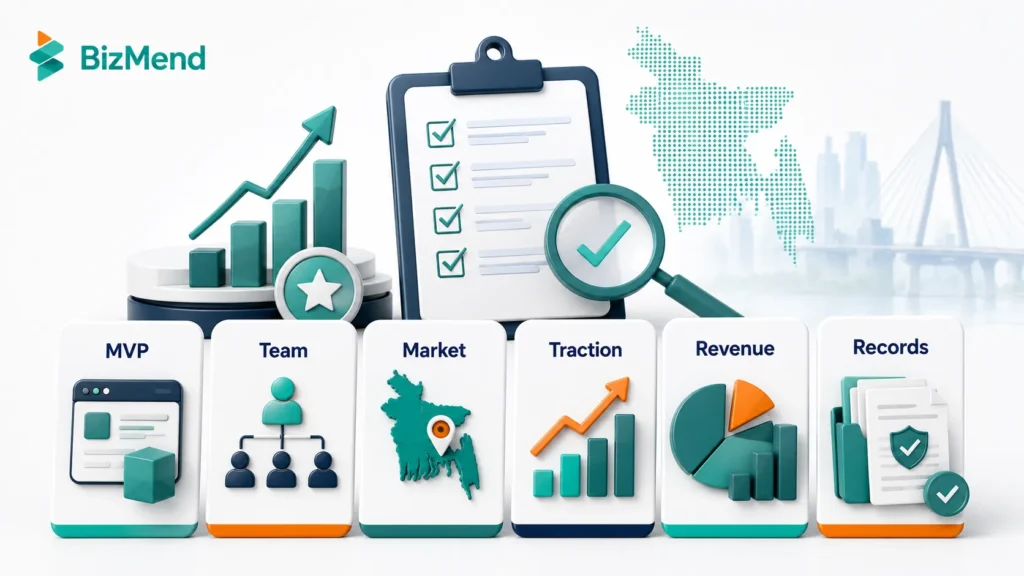
A useful pitch deck is usually concise enough to present in about 10 to 15 minutes. It should make the opportunity understandable without forcing the investor to decode dense slides.
The deck should not hide weak numbers behind design. Investors may accept an early business with limited revenue, but they are unlikely to trust inconsistent metrics or a forecast with no assumptions.
Before formal due diligence, organise a secure data room. The exact documents depend on the stage and sector, but common items include:
Before preparing incorporation papers and approvals, founders should understand how to start a business in Bangladesh properly.
Do not manufacture documents because an investor requested them. Missing records should be explained and corrected transparently.
Valuation is the negotiated value used to calculate how much ownership an investor receives. The pre-money valuation is the company value immediately before the new investment. The post-money valuation equals the pre-money valuation plus the new capital.
For a simple illustration, if an investor puts BDT 1 crore into a startup at a BDT 4 crore pre-money valuation, the post-money value is BDT 5 crore. The new investor would own 20% immediately after the round, before considering options, convertible instruments, or other adjustments. This is an example, not a recommended valuation.
Founders should examine more than the headline percentage. Option-pool expansion, liquidation preference, anti-dilution rights, board control, founder vesting, reserved matters, and future financing rights can materially change the economic result.
VC is not free money. It is a long-term ownership relationship with legal, reporting, and performance obligations.
Many good businesses should not raise VC. Alternatives can preserve ownership and reduce pressure:
Choose the funding source that matches the company’s cash flow, risk, growth speed, and founder objectives. The most visible funding option is not automatically the best one.
Venture capital in Bangladesh is becoming more structured, but funding remains selective. A polished deck alone will not compensate for weak customer evidence, unclear ownership, missing accounts, or an unrealistic growth plan.
Founders should first decide whether the business truly needs venture-scale capital. Then build traction, organize the company records, model the use of funds, and approach investors whose mandate fits the business. Treat every proposed investment as a legal and commercial partnership, not a prize. Before agreeing to equity, convertible instruments, board rights, or investor protections, founders planning overseas fundraising or US market entry may also review US company formation as part of their structure planning.
It is an investment in a privately held startup or growth company, usually in exchange for shares, conversion rights, and negotiated investor protections. The investor expects the company’s value to grow rather than receiving normal loan installments.
Build a shortlist using official investor websites, recent portfolio announcements, accelerator networks, founder referrals, startup events, and government-backed platforms. Check stage, sector, geography, and application requirements before pitching.
Not always, but evidence matters. Pre-revenue companies may show a working product, pilots, signed letters of intent, active usage, technical progress, or regulatory milestones. Revenue and retention usually strengthen the case.
Its current application information emphasizes Bangladesh registration, high growth or social impact, an MVP, a growing customer base or revenue, company and founder information, traction data, previous funding details, and a pitch deck.
There is no universal percentage. It depends on the investment amount, valuation, option pool, existing instruments, stage, risk, and negotiated terms. Founders should model dilution across several future rounds before signing.
No. Angels usually invest their own money and may decide more flexibly. VC managers invest through a fund or structured vehicle and typically use a more formal screening, diligence, and governance process.
It can, but many traditional businesses do not match VC return expectations. A company with steady local cash flow may be better suited to retained earnings, partners, or debt than to a fund seeking rapid scale and an eventual exit.

Learn how to become a Daraz seller in Bangladesh, register an account, list products, understand fees, manage orders, and grow…
by Sheikh Ornob

Compare the cost of living in Bangladesh in 2026, including Dhaka and Chittagong rent, food, transport, utilities, inflation, and monthly…
by Sheikh Ornob

Learn MoA and AoA requirements in Bangladesh, key clauses, drafting basics, RJSC filing steps, amendments, and common company-registration mistakes. Suggested…
by Sheikh Ornob