
 by Sheikh Ornob
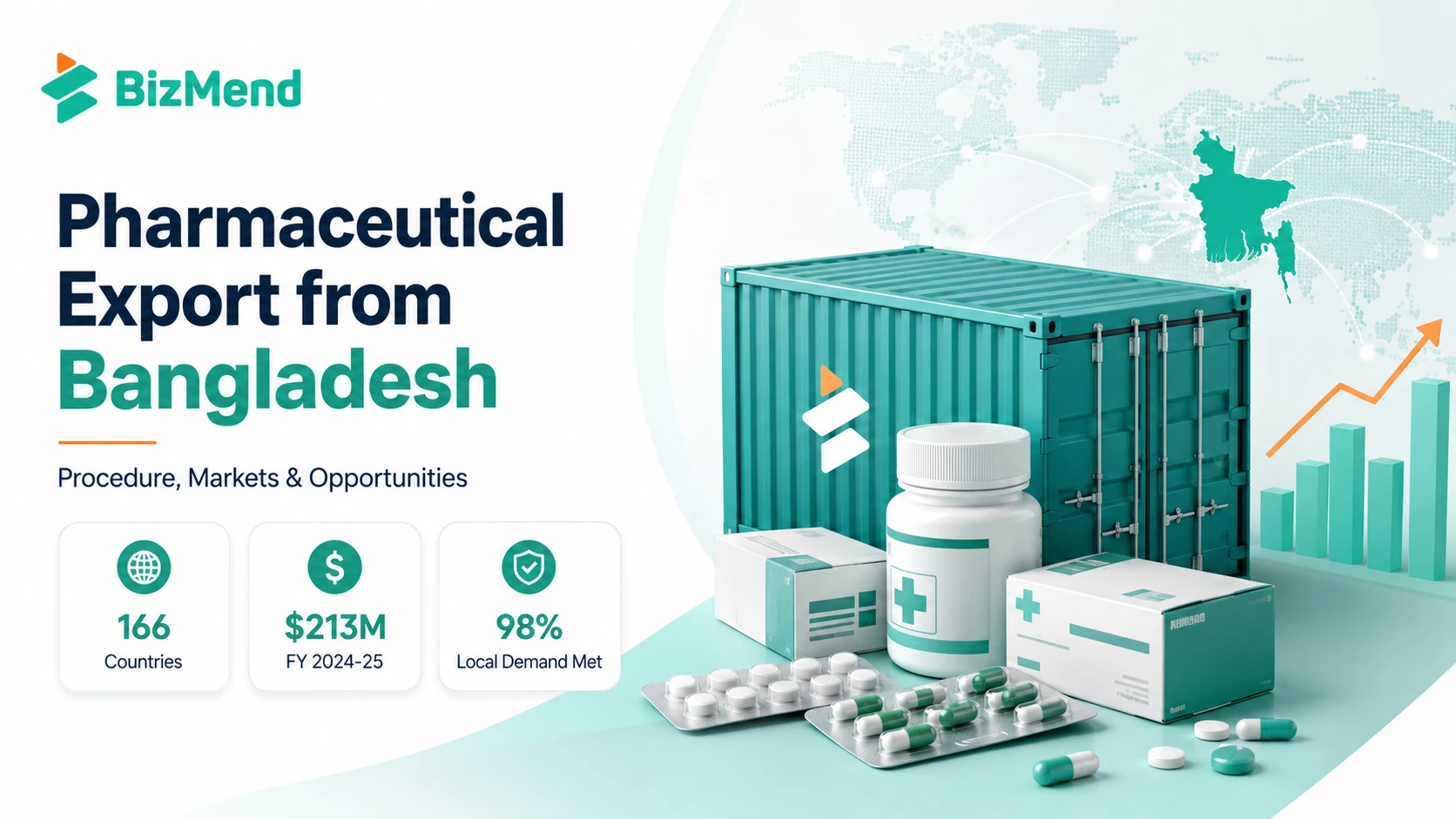
Bangladesh’s pharmaceutical sector just posted $213 million in export earnings in FY 2024-25. That’s more than double what the country exported seven years ago, now reaching 166 countries across six continents. And this is happening while 98% of the domestic medicine demand is met locally by Bangladeshi manufacturers. Not bad for a sector that was once heavily import-dependent. If you’re a pharma company owner, entrepreneur, or investor looking to understand how pharmaceutical export from Bangladesh actually works, this guide gives you the real picture: numbers, procedure, markets, and what’s genuinely coming next.
Quick answer: Pharmaceutical export from Bangladesh earned $213 million in FY 2024-25, reaching 166 countries. The process requires a drug manufacturing license from DGDA, WHO-GMP certification, an Export Registration Certificate (ERC), and product registration in each target country. Bangladesh exports mainly generic drugs, antibiotics, cardiovascular medicines, and increasingly, vaccines and biosimilars. The TRIPS waiver gives manufacturers a cost advantage on patented generics, though LDC graduation in November 2026 introduces transition considerations.
Bangladesh pharma today, the numbers that matter
Seven years ago, Bangladesh was shipping medicines to around 140 countries and earning roughly $100 million a year. By FY 2024-25, that’s grown to 166 countries and $213 million. The Daily Star reported this milestone in October 2025, confirming it as a genuine doubling of export earnings in seven years.
To be fair, the growth rate in the latest year was modest. FY 2024-25 saw 4% year-on-year growth, compared to $205 million in FY 2023-24. Industry insiders cite volatile exchange rates, dollar shortages in some developing country markets, and slow new-market onboarding as factors. But the long-term trend is unmistakably upward.
The sector is enormous domestically. Bangladesh has 307 registered pharmaceutical companies. According to BIDA, 213 are actively producing medicines, while BAPI has around 154 member companies. Local firms supply 98% of the country’s medicine demand. Among the top industries for foreign investment in Bangladesh, pharmaceuticals stand out because of manufacturing depth, low labor costs (15% below regional peers per BIDA), and the policy advantage of producing generic drugs at scale.
What Bangladesh actually exports
Bangladesh’s pharma export portfolio is wider than most people realize. The bulk is still generic medicines, but the mix is shifting.
- Generic drugs: Still the dominant segment. Bangladesh produces over 450 generic molecules under 5,300 registered brands.
- Antibiotics: A core strength, with consistent demand in Asia, Africa, and the CIS.
- Cardiovascular and anti-diabetic drugs: Growing significantly as chronic disease rates rise in developing markets.
- Vaccines: Incepta Pharmaceuticals currently produces over 16 human and 13 veterinary vaccines. This is a fast-growing area.
- Hormonal medicines and insulin: Renata PLC has 83 bioequivalent products; several companies now export insulin and hormone therapies.
- Anti-cancer (oncology) drugs: A smaller but rapidly growing segment. Beximco and others are investing here.
- Biosimilars and complex injectables: The high-margin frontier. Several companies are entering this space to reduce dependence on basic generics.
- Active Pharmaceutical Ingredients (APIs): Still nascent in exports, but growing as the API Industrial Park in Munshiganj develops.
The Remdesivir and Favipiravir export surge during COVID-19 was a turning point. Several companies got emergency DGDA approvals, reached global buyers fast, and earned credibility in markets they hadn’t reached before.
Where the buyers are
Bangladesh’s pharma export markets fall into two distinct tiers, and your strategy should reflect which tier you’re targeting.
Regulated markets (high barrier, high reward): The USA, EU countries, UK, Canada, and Australia. These markets require stringent regulatory approvals, typically from USFDA, UK MHRA, or EMA. Companies like Beximco (FDA-approved), Incepta (UK MHRA, Health Canada), and Square (UK MHRA, TGA Australia) have already broken in. Beximco is one of Bangladesh’s leading pharma exporters and was the first Bangladeshi company to export medicines to the US market, reporting a 33% jump in export income in FY 2024.
Semi-regulated and developing markets (faster to enter, large volume): This is where most Bangladeshi companies do most of their business. The CIS countries (Russia, Kazakhstan, Uzbekistan), Southeast Asia (Myanmar, Vietnam, Philippines), Africa (Nigeria, Kenya, Ethiopia), and Latin America are the fastest-growing destinations. The Middle East, particularly Turkey and Egypt, buys large volumes of generic drugs. WHO-GMP certification generally satisfies the regulatory requirements in these markets.
Arefin Ahmed, Executive Director (Marketing) at Incepta Pharmaceuticals, said it bluntly in an interview with The Daily Star in July 2025: “Drug registrations can take two to five years.” That’s the single biggest reason new exporters underestimate the time investment in regulated markets.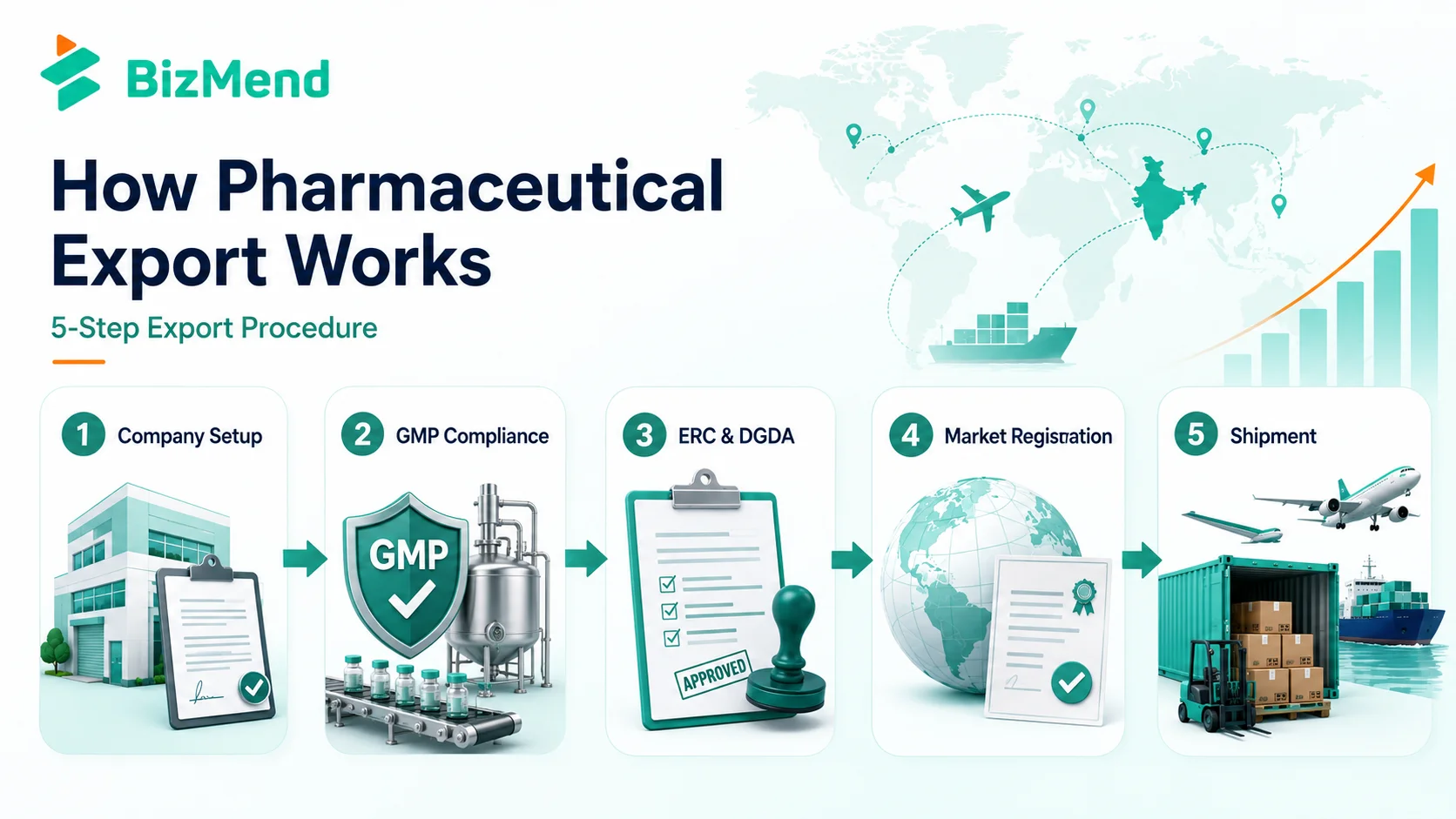
How to start pharmaceutical export from Bangladesh
Step 1, company setup and manufacturing license
You need a registered company first. A Private Limited Company is the standard structure. Our guides on starting a business in Bangladesh as a foreigner and company types and restrictions for foreigners in Bangladesh cover the registration process in detail.
Once registered, you apply to the Directorate General of Drug Administration (DGDA) for a Drug Manufacturing License under the Drug and Cosmetics Act 2023 (effective September 18, 2023, which updated the old 1982 Drug Ordinance). You’ll need manufacturing premises that meet DGDA standards, proper storage facilities, qualified pharmacists on staff, and documented quality control systems.
Step 2, DGDA certifications and GMP compliance
WHO-GMP (Good Manufacturing Practice) certification is the floor requirement for pharmaceutical export from Bangladesh. The DGDA inspects your facility and issues GMP compliance certification. Without it, no export moves forward.
For regulated markets, you’ll need additional certifications: USFDA inspection approval for the US market, UK MHRA certification for the UK, EU GMP for European countries, TGA Australia for Australia, and Health Canada for Canada. These take time and investment, but they’re the bridge to high-value markets.
Step 3, ERC and export clearance
Apply for an Export Registration Certificate (ERC) through the CCI&E’s Online Licensing Module at olm.ccie.gov.bd. You’ll need your trade license, TIN, bank solvency certificate, and GMP certificate. The Drugs Export License is a separate clearance from DGDA; the required documents include your GMP certificate, Certificate for Pharmaceutical Products (CPP), and a Purchase Order or LC from the buyer. Verify current processing steps and timelines through DGDA directly or the Bangladesh Trade Portal, as procedures can be updated.
Step 4, product registration in the target country
This is the step that catches most new exporters off guard. Every target country requires you to register your product with their national drug regulatory authority before you can legally sell there. Most semi-regulated markets accept the Certificate for Pharmaceutical Products (CPP) issued by DGDA, which certifies the product is approved for sale in Bangladesh. The CPP and Free Sale Certificate are both issued by DGDA; some destination markets may separately require a chamber certificate or certificate of origin in addition.
For regulated markets, the process is far more involved: product dossier submission, bioequivalence data, stability studies. Budget two to five years per major regulated market entry. Connecting with a local distributor or regulatory agent in the target country is essential.
Step 5, export documents and shipment
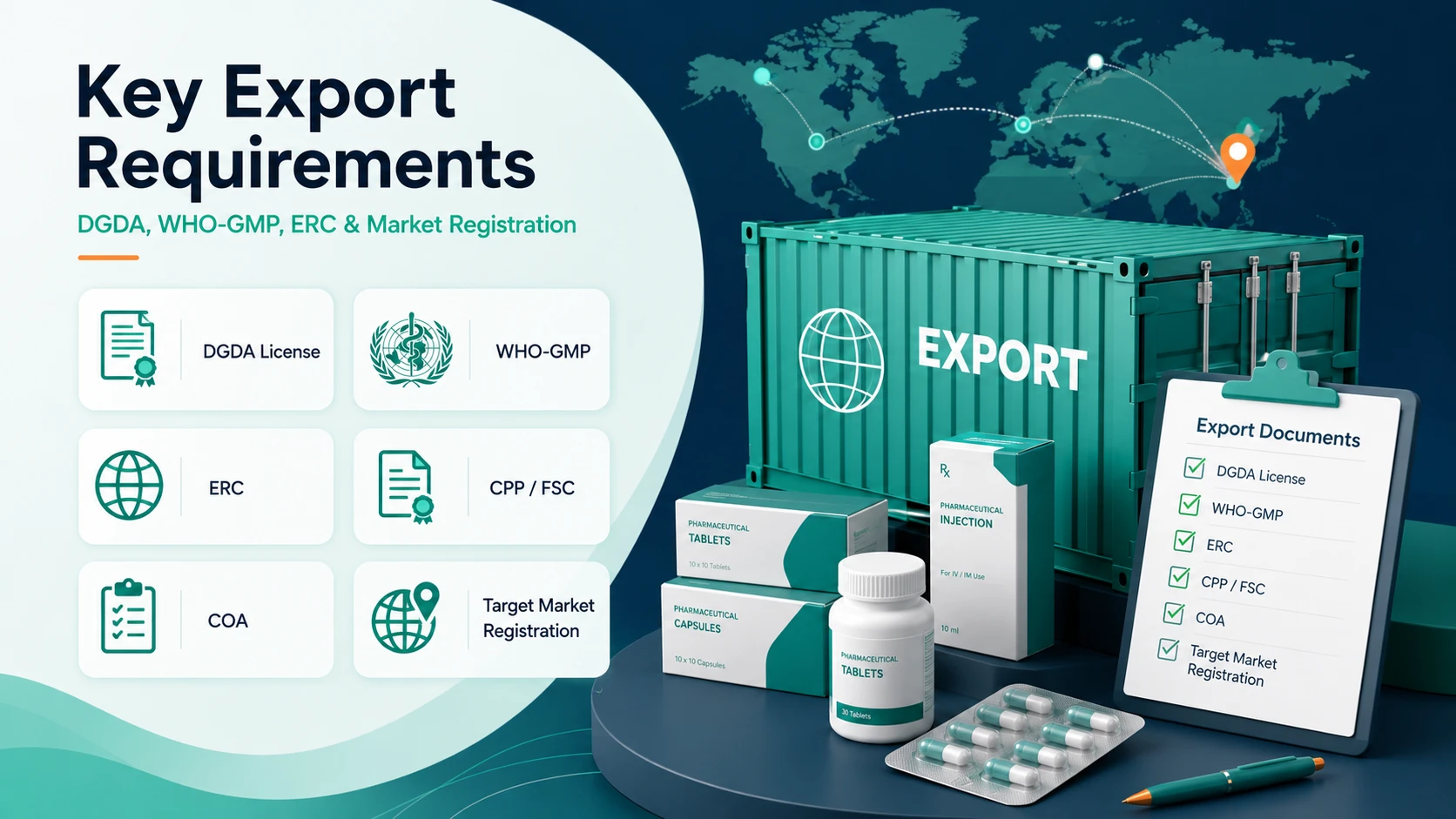
Your standard document pack per shipment:
- Certificate for Pharmaceutical Products (CPP) or Free Sale Certificate (FSC) from DGDA
- Certificate of Analysis (COA) for the specific batch
- Commercial Invoice and Packing List
- Certificate of Origin
- Bill of Lading (sea) or Air Way Bill (air)
- EXP Form (Bangladesh Bank foreign exchange declaration)
- Cold chain temperature records if shipping vaccines or injectables
Most pharma shipments leave through Chattogram Port or Hazrat Shahjalal International Airport (HSIA). For working capital to finance export production runs, getting a loan from a Bangladeshi bank with your export order documentation in order is workable. Commercial banks in Bangladesh with trade finance desks handle pharmaceutical LCs regularly. For alternative financing structures, non-bank financial institutions in Bangladesh also provide leasing and equipment finance useful for manufacturing expansion.
To get a DUNS number from Dun & Bradstreet for supplier credibility, especially when dealing with US and European buyers, adds a layer of trust that smooths procurement approvals.
Government incentives worth knowing
Several government incentives support pharmaceutical export from Bangladesh. But some have expiry clauses, so verify current status before planning around them:
- 6% export cash subsidy on pharmaceutical products: Pharmaceutical products were listed at 6% under FE Circular No. 28 for July to December 2025. Exporters should verify the latest Bangladesh Bank/FEPD circular for January to June 2026 and later shipments, as these rates are subject to revision each half-year.
- Export subsidy on API exports: API export incentive rates should be checked against the latest Bangladesh Bank/FEPD circular before quoting a rate or planning around a specific validity period.
- 100% tax holiday for producers of 5 specific API molecules: Extended from 2022 to 2032. Stable, confirmed by BIDA.
- 75% tax holiday for producers of 3 specific API molecules: Extended from 2023 to 2032. Stable.
- Customs duty exemption on API raw materials: Under S.R.O. No. 127-AIN/2020/78/Customs. Still in effect.
- TRIPS waiver advantage: The LDC pharmaceutical TRIPS transition runs until January 1, 2033, but it applies to LDCs; graduation in November 2026 may affect Bangladesh’s ability to rely on it. Industry groups are urging the government to negotiate continuation or extension of TRIPS-related pharmaceutical flexibilities. Manufacturers are trying to register products before LDC graduation because continuation of current TRIPS flexibilities after graduation is uncertain.
The real challenges
Pharmaceutical export from Bangladesh has structural problems that no amount of optimism fixes. You need to know these before you start:
- API import dependency remains very high. BIDA cites over 85% dependence on imported APIs from China and India. This means cost exposure to external price shocks. The API Industrial Park in Munshiganj has 200 acres and 27 allocated companies, but only 4 have started actual production due to gas shortages and infrastructure gaps as of 2025.
- Registration timelines are brutal. Two to five years per regulated market is not an exaggeration. Long lead times between distributor agreements and first shipments are normal.
- LDC graduation on November 24, 2026. BAPI’s secretary general stated in August 2025: “New drugs brought to market after November 2025 will be subject to patent protection and royalty costs.” Manufacturers are trying to register products before LDC graduation because continuation of current TRIPS flexibilities after graduation is uncertain. Bangladesh Patent Act 2023 and WTO transition discussions may affect the post-graduation pathway, but the final position should be verified from current government and WTO updates.
- Cold chain logistics costs. Vaccines and injectables require validated temperature control from factory to pharmacy. This infrastructure is improving but still thin in many target export markets.
Opportunities you shouldn’t ignore
The next growth phase in pharmaceutical export from Bangladesh won’t come from basic generics. It’ll come from three areas.
Biosimilars and complex injectables. Global branded biologics like insulin, monoclonal antibodies, and hormone therapies are coming off patent in waves. Bangladesh firms producing bioequivalent versions can access markets at significantly lower price points than originators. Renata’s portfolio of 83 bioequivalent products shows the direction the industry is moving.
Contract manufacturing. European and US pharma companies facing supply chain risk from China and India are actively looking for alternative manufacturers. Bangladesh, with WHO-GMP and FDA-approved facilities and a 15% cost advantage over regional peers, is well placed. Several companies are now winning their first contract manufacturing agreements.
Halal pharmaceuticals. The OIC (Organization of Islamic Cooperation) market, particularly Malaysia, Indonesia, and the UAE, is growing demand for Halal-certified medicines. Bangladesh, with its manufacturing environment, has an underutilized advantage here. CIS countries and Africa remain the fastest-growing destination markets overall.
Key Insights
- Bangladesh pharma exports hit $213 million in FY 2024-25, more than doubling in seven years, now reaching 166 countries. Growth in regulated markets like the US and EU is the primary quality driver.
- 98% of domestic demand is met by local manufacturers, making Bangladesh one of the most self-sufficient pharma nations in the developing world. This base funds export expansion.
- DGDA is the gatekeeper. Every pharma export starts with the Directorate General of Drug Administration: manufacturing license, GMP certification, and the CPP/FSC that importing countries require.
- TRIPS waiver flexibility allows Bangladesh to produce and export patented generics without royalty payments while it holds LDC status. The LDC pharmaceutical TRIPS transition runs until January 1, 2033, but it applies to LDCs; graduation in November 2026 may affect Bangladesh’s ability to rely on it. Bangladesh’s Patent Act 2023 and WTO transition discussions may affect the post-graduation pathway, but the final position should be verified from current government and WTO updates.
- API import dependency remains very high, with BIDA citing over 85% reliance on imports from China and India. The API Park in Munshiganj has promise but only 4 of 27 allocated companies are operational as of 2025.
- Drug registration takes 2 to 5 years per market. New exporters consistently underestimate this timeline. Start market registrations years before your target launch date.
- Biosimilars, oncology, and contract manufacturing are the high-margin frontier. Companies that move there now, while TRIPS flexibility still applies, will be positioned ahead of the graduation deadline.
Frequently Asked Questions
How much does Bangladesh earn from pharmaceutical exports?
Bangladesh earned $213 million from pharmaceutical exports in FY 2024-25, a 4% increase from $205 million the previous year. This figure has more than doubled in seven years, growing from roughly $100 million in FY 2016-17. The sector exports to 166 countries, ranging from the US and EU to Africa and Southeast Asia.
Which authority regulates pharmaceutical export from Bangladesh?
The Directorate General of Drug Administration (DGDA), under the Ministry of Health and Family Welfare, is the primary regulatory authority. It issues drug manufacturing licenses, GMP certifications, and the Certificate for Pharmaceutical Products (CPP) needed for export. The Drug and Cosmetics Act 2023 (effective September 18, 2023) is the current governing legislation.
What documents do you need to export medicines from Bangladesh?
Key export documents include the Certificate for Pharmaceutical Products (CPP) or Free Sale Certificate (FSC) from DGDA, Certificate of Analysis (COA) for the specific batch, Commercial Invoice, Packing List, Certificate of Origin, and a Bill of Lading or Air Way Bill. The EXP Form is also required for Bangladesh Bank’s foreign exchange records. Cold-chain shipments need validated temperature logs.
What is the TRIPS waiver and how does it help Bangladeshi pharma exporters?
The WTO TRIPS waiver allows Least Developed Countries to produce patented pharmaceuticals without paying royalties to patent holders. About 20% of drugs produced in Bangladesh are patented in other countries, but this waiver makes production legally allowed and cost-effective. The LDC pharmaceutical TRIPS transition runs until January 1, 2033, but it applies to LDCs; graduation in November 2026 may affect Bangladesh’s ability to rely on it. Bangladesh Patent Act 2023 and WTO transition discussions may affect the post-graduation pathway, but the final position should be verified from current government and WTO updates.
Which companies lead pharmaceutical export from Bangladesh?
Beximco Pharmaceuticals is one of Bangladesh’s leading pharma exporters and was the first Bangladeshi company to export medicines to the US market (FDA-approved). It exports to over 50 countries. Square Pharmaceuticals (market leader domestically, exporting to 40+ countries), Incepta (98 countries), Renata, ACME, Beacon, and Eskayef are other major exporters.
How long does it take to register a drug in an export market?
Drug registration timelines vary by market. Semi-regulated developing country markets, where WHO-GMP and CPP from DGDA are accepted, can take 6 to 18 months. Regulated markets such as the US, UK, EU, and Canada require USFDA, MHRA, or EMA approval, which typically takes 2 to 5 years per product. Starting registrations early, well before planned export, is essential.
What government incentives are available for pharma exporters in Bangladesh?
Pharmaceutical products were listed at 6% under FE Circular No. 28 for July to December 2025. Exporters should verify the latest Bangladesh Bank/FEPD circular for January to June 2026 and later shipments, as these rates are subject to revision. API export incentive rates should similarly be checked against the latest FEPD circular before quoting any specific figure. API molecule producers enjoy 100% tax holidays (for 5 molecules, until 2032) and 75% tax holidays (for 3 molecules, until 2032). Customs duty exemptions on API raw materials are also in effect.
Can foreigners invest in and own a pharmaceutical company in Bangladesh for export?
Yes. Foreign nationals can own 100% of a registered pharmaceutical company in Bangladesh. The sector is open to foreign direct investment. You’ll need RJSC company registration, DGDA manufacturing license, trade license, TIN, and BIDA notification for foreign capital. The pharma sector includes favorable tax incentives and duty exemptions for API production among its investment policies.
What is the API Industrial Park in Munshiganj?
The API (Active Pharmaceutical Ingredient) Industrial Park is a 200-acre facility in Gazaria, Munshiganj, about 40 km from Dhaka, developed by BSCIC. It was designed to reduce Bangladesh’s very high dependence on imported APIs; BIDA cites over 85% reliance on imports from China and India. Twenty-seven companies were allocated plots, but as of 2025, only 4 have begun actual production due to gas supply shortages and infrastructure gaps.
What are the most promising segments for pharmaceutical export growth?
The highest-growth opportunities are biosimilars and complex injectables (insulin, monoclonal antibodies, oncology drugs), contract manufacturing for international brands, halal-certified pharmaceuticals for OIC countries, and anti-cancer drug exports. CIS countries and Africa are the fastest-growing destination markets. These segments offer margins significantly above basic generic tablets and capsules.
Final Thoughts
Here’s something genuinely underappreciated: Bangladesh’s pharma sector built itself up from near zero in 40 years. It now covers 98% of its own medicine needs and exports to 166 countries. That’s not luck. That’s manufacturing discipline and regulatory investment at scale.
But $213 million in pharma exports, while impressive in context, is still small relative to what the sector could be. India exports roughly $27 billion in pharmaceuticals annually. Bangladesh has the manufacturing base, the cost advantage, and now the regulatory credibility to move toward serious numbers. It just takes time, registrations, and market relationships that don’t happen overnight.
If I were starting a pharma export company today, I’d pick one semi-regulated market in CIS or East Africa, get a local registration agent, and begin the product registration process now. The TRIPS clock is ticking. The time to register new products and lock in market positions is before November 2026, not after.