

What is Member FDIC, and why does that phrase appear on nearly every bank sign and ad? Member FDIC is the official statement a bank displays to show it carries FDIC deposit insurance, required by federal regulation, not chosen as a marketing slogan. It is a label a bank must display correctly, not a product a customer opens.
Seeing those words tells you something specific: deposits at that bank are insured up to $250,000 per depositor. It does not cover everything the bank sells, and knowing the difference protects you from a costly mix-up. This guide covers what the label means.
Quick Answer: Member FDIC is the official statement a bank displays to show it is insured by the FDIC, required by federal regulation. It means deposits at that bank, checking, savings, and CDs are insured up to $250,000 per depositor, per bank, per ownership category. It does not cover investments or insurance sold there.
| Important: Member FDIC is a bank’s insurance status, not a product you open or a type of account with variations. There is nothing to “choose” between different Member FDIC options; every FDIC-insured bank carries the identical coverage. Verify any specific bank directly through the FDIC’s BankFind tool. |
What Is Member FDIC?
Member FDIC is the official statement a bank uses to declare that it carries deposit insurance from the Federal Deposit Insurance Corporation, displayed under a specific federal regulation rather than chosen freely as a marketing phrase. Under 12 CFR Part 328, every FDIC-insured bank must continuously display an official sign and use an approved advertising statement, and “Member FDIC” is one of several accepted short forms of that statement, alongside “Member of FDIC,” “FDIC-Insured,” or the official FDIC symbol.
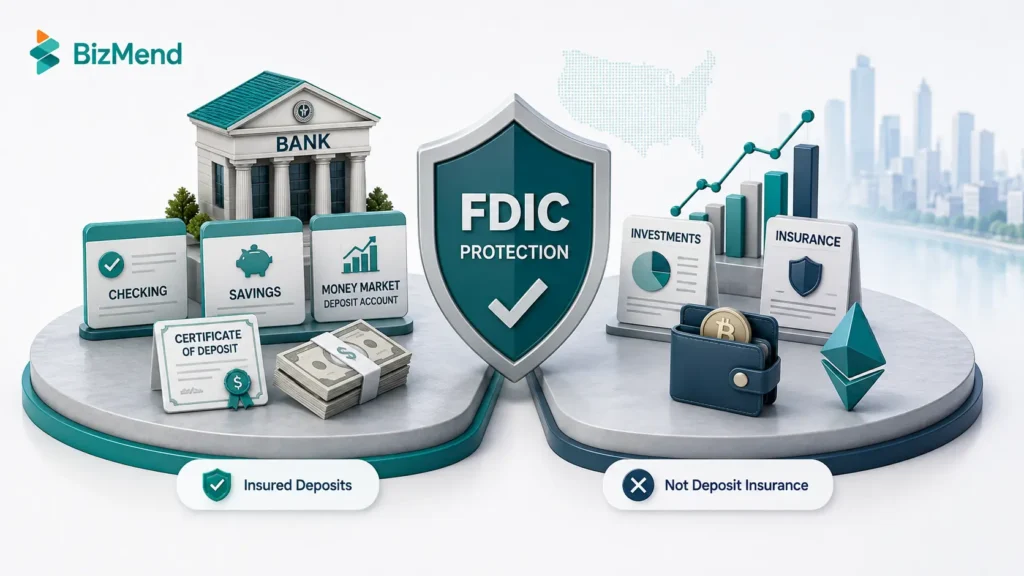
In practice, the phrase functions as a promise backed by law. When a bank displays it, that bank has applied for and received federal deposit insurance, and its deposit products, checking accounts, savings accounts, money market deposit accounts, and certificates of deposit, are insured up to $250,000 per depositor, per bank, per ownership category. The requirement applies at every branch, and since a 2023 federal rule modernized the regulation, it now extends to a bank’s mobile app, website, and ATMs as well, not just its physical lobby.
Nearly everyone who banks at a US bank, rather than a credit union, interacts with an institution that displays Member FDIC. The label differs from adjacent products in one critical way: it describes an insurance status attached to a specific institution’s deposit accounts, not a product itself, a type of bank, or something a customer separately signs up for.
How Member FDIC Differs From Adjacent Concepts
Member FDIC is easy to confuse with a few related ideas that mean something different. It is not the same as being a “member” of a credit union, which is an ownership relationship, not an insurance one, and which is protected by the NCUA instead of the FDIC. It is also not a guarantee that covers everything a bank sells; investment products, insurance policies, and annuities offered inside a bank branch are typically not FDIC insured even though the same building displays the Member FDIC sign, and federal rules specifically require separate signage clarifying that distinction wherever non-deposit products are sold alongside deposit accounts.
A Brief History of the Label
The requirement traces back to the Banking Act of 1935, which followed the FDIC’s creation in 1933 in response to the wave of bank failures during the Great Depression. Section 18(a) of the Federal Deposit Insurance Act has required insured banks to advertise their membership ever since, giving depositors a consistent, legally backed signal to look for regardless of which bank they were considering. The FDIC last made major changes to the underlying signage rules in 2006, a version of the regulation written before online and mobile banking existed in their current form. That gap became a real problem as more banking moved onto apps, websites, and ATMs rather than physical teller windows, and the FDIC’s December 2023 final rule closed it by extending the official sign and advertising statement requirements to digital deposit-taking channels and ATMs for the first time, with the same underlying purpose the 1935 requirement always had: making sure a depositor can tell, without guessing, whether their money is protected.
Which Types of Institutions Display Member FDIC
There is only one Member FDIC status, not multiple versions of it, but several different types of institutions carry it, and one major type of institution does not.
Commercial banks carry Member FDIC regardless of charter type. A national bank chartered by the Comptroller of the Currency displays it. A state bank chartered by a state banking department displays it too, whether or not that state bank belongs to the Federal Reserve System. Charter type determines the bank’s primary regulator, but it does not change whether the bank is FDIC insured.
Size does not change the label either. A small community bank displays the identical Member FDIC statement as any larger institution. A regional bank with branches across several states carries the exact same requirement. The insurance coverage and the display requirement are the same $250,000 per depositor regardless of the institution’s size.
Online banks are covered too, just through different signage. An online bank without physical branches still must display the Member FDIC statement on its website and mobile app under the FDIC’s digital signage rules. Any hybrid institution that also operates a physical bank branch must display the physical sign there as well.
Credit unions are the major exception. A credit union is not FDIC insured and does not display Member FDIC at all. Instead, federally insured credit unions display “Federally Insured by NCUA,” reflecting coverage from the National Credit Union Administration rather than the FDIC. The two programs offer the same $250,000 coverage limit, but they are legally separate systems, and a credit union displaying “Member FDIC” would be a serious, actionable misrepresentation under federal law.
How Member FDIC Works
The mechanics behind the label involve three separate pieces: how a bank earns the right to display it, how the display itself is regulated, and what happens if a bank fails.
A bank earns Member FDIC status by applying for and receiving federal deposit insurance. The FDIC reviews the bank’s capital, management, and business plan before granting insurance, and once approved, displaying the official statement is not optional; federal law requires it wherever the bank takes deposits.
Display rules are specific and enforced. Under the FDIC’s 2023 final rule, banks must show the official sign at every physical teller station, on ATMs, and on the initial page of digital deposit-taking channels such as websites and mobile apps. Where a bank also offers non-deposit products, such as investments sold through a third party, it must clearly disclose that those specific products are not FDIC insured, are not deposits, and may lose value, displayed at the moment a customer would transact with that product.
Insurance activates automatically if the bank fails. A depositor does not file a claim or prove anything to get insured funds back; the FDIC typically pays out or transfers accounts to another insured bank within a few business days of a failure, and the process has never failed to return insured funds to a depositor since the FDIC’s creation in 1933.
Requirements and Eligibility
“Requirements” for Member FDIC actually means two different things, and both matter.
From the bank’s side, becoming eligible to display Member FDIC means successfully applying for FDIC deposit insurance, which requires demonstrating adequate capital, competent management, and a viable business plan to the FDIC’s satisfaction. This is an institutional approval process, not something an individual customer applies for.
From a depositor’s side, there is no application or eligibility test to benefit from Member FDIC coverage. Simply opening a qualifying deposit account, checking, savings, money market, or CD, at an FDIC-insured bank automatically extends the $250,000 coverage to that depositor, up to the applicable limit, with no separate signup, fee, or form involved. The requirement that matters to a depositor is confirming the bank is actually insured in the first place, not meeting any personal eligibility criteria.
Confirming Member FDIC Status When You Open an Account
Every account-opening checklist in this cluster assumes Member FDIC status as a given, not a separate step, but it is worth confirming directly during the process itself. See national bank requirements for what a federally chartered bank asks for when you open an account. A state-chartered equivalent is covered instead in state bank requirements. Smaller institutions are covered separately in community bank requirements. Larger, multi-state institutions instead follow the process in regional bank requirements. Digital-only applicants should see online bank requirements instead. Anyone applying in person can review bank branch requirements for what to expect at a physical location. Our broader guide to depository institution requirements covers the full picture across every institution type at once.
Benefits and Potential Drawbacks
Benefits are straightforward: Member FDIC coverage protects deposit principal up to $250,000 per depositor, per bank, per ownership category, backed by the full faith and credit of the US government, at no cost to the depositor and with no enrollment required. The label also gives depositors an immediate, standardized way to recognize an insured institution without researching each bank individually, and the coverage extends automatically to every qualifying account a depositor opens at that bank, without needing to track which specific product carries the protection.
Drawbacks are less about the coverage itself and more about its limits. The $250,000 cap means very large balances at a single bank can exceed coverage unless spread across ownership categories or multiple banks, a real planning consideration for anyone holding a large emergency fund, a business account, or proceeds from a home sale. The label covers deposits only, so a customer who assumes it also protects an investment or insurance product purchased at the same bank can face a real, uninsured loss, sometimes discovering the gap only after the product has already lost value. The sign itself also cannot be verified for accuracy by sight alone; a fraudulent or unauthorized use of FDIC imagery is a real enough problem that federal rules explicitly prohibit it, and the FDIC has pursued enforcement action against companies that implied deposit insurance they never actually carried.
How to Verify a Bank Is Member FDIC
There is nothing to choose between different versions of Member FDIC, since only one status exists, but confirming a specific bank actually holds it is a real and worthwhile step.
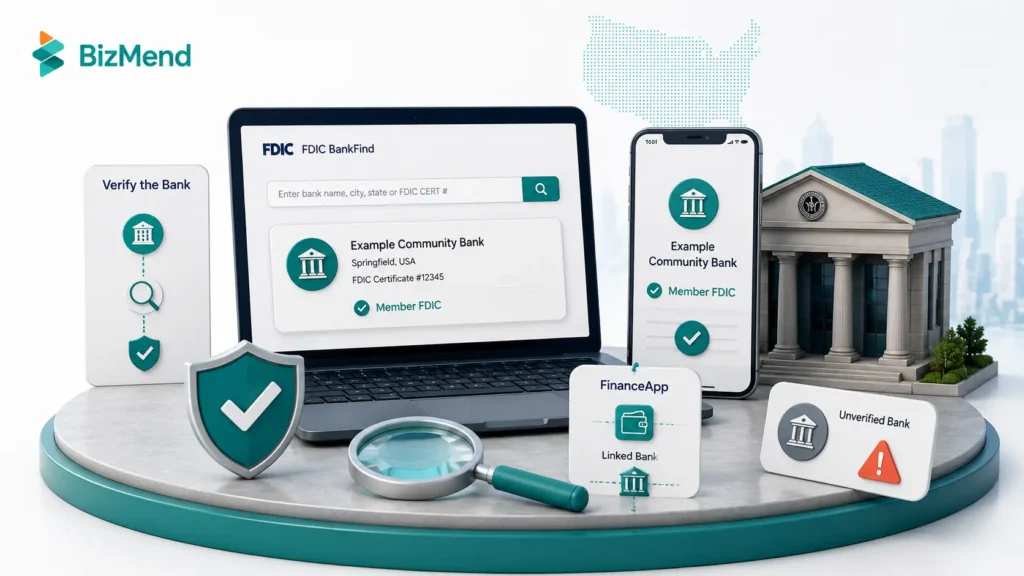
Check the FDIC’s BankFind tool directly. The FDIC maintains a free, public database at its own website where anyone can search a bank’s name and confirm its current insured status, charter type, and primary regulator in seconds, which is far more reliable than trusting a sign, logo, or a company’s own claims.
Look for the specific bank name, not just a brand name. Many fintech apps and payment platforms are not themselves banks; they partner with an FDIC-insured bank behind the scenes and pass insurance through to customers under specific conditions. Confirm the actual name of the partner bank and verify that name directly in BankFind, since the consumer-facing brand name often will not appear in the FDIC’s own records at all.
Watch for red flags around misuse of FDIC branding. The FDIC has taken enforcement action against companies, including several cryptocurrency platforms, for implying FDIC coverage they did not actually have. A company that references FDIC insurance vaguely, that cannot name the specific insured bank holding the funds, or that implies investment products are FDIC insured is misusing protected federal branding, and federal rules exist specifically to prohibit that. Federal regulations formally define this category of misconduct as misrepresentation of insured status, and the FDIC treats it as a serious enough problem to pursue directly rather than leaving it to state consumer-protection agencies alone.
Member FDIC vs Other Coverage and Accounts
Member FDIC is often confused with a short list of related but legally distinct concepts, and separating them clearly prevents costly mistakes.
Compared to NCUA coverage at a credit union, Member FDIC applies only to banks, while credit unions display “Federally Insured by NCUA” instead; both offer the same $250,000 limit through separate federal programs. Compared to SIPC coverage at a brokerage, Member FDIC protects deposit principal regardless of market conditions, while SIPC protects brokerage custody in the event of firm failure but does not protect against investment losses at all. Compared to an uninsured account or product, such as a cryptocurrency wallet, a stock brokerage balance, or an annuity, Member FDIC simply does not apply, and no amount of similar branding changes that fact.
Choosing a Bank, Not a Version of Member FDIC
Since Member FDIC does not come in different versions, choosing “the right Member FDIC” is not really a decision. The actual decision is which insured bank to use, and that comparison runs through ordinary factors like fees, rates, and access rather than insurance status, since every FDIC-insured bank offers identical coverage.
Readers ready to compare specific banks should see how to choose a national bank for nationwide branch access. State-chartered options are covered instead in how to choose a state bank. Readers who want a smaller, local relationship should see how to choose a community bank. Those weighing a larger multi-state footprint can instead review how to choose a regional bank. Digital-first users should start instead with how to choose an online bank. Every guide in that list already assumes Member FDIC status as a baseline requirement, not a differentiator.
For a broader foundation before narrowing down a specific bank, our complete guide to depository institutions covers banks, savings associations, and credit unions side by side, including how their insurance programs differ.
Key Insights
- Member FDIC is a legally required label, not a product, showing a bank carries FDIC deposit insurance.
- It covers deposits, checking, savings, money market accounts, and CDs, up to $250,000 per depositor, per bank.
- It does not cover investments, insurance products, or crypto, even when sold at the same bank.
- Credit unions never display Member FDIC; they display Federally Insured by NCUA instead.
- There is no application or eligibility step for depositors; the coverage applies automatically at an insured bank.
- Verify any bank’s actual status through the FDIC’s free BankFind tool rather than trusting a sign alone.
Final Thoughts on Member FDIC
Member FDIC is a label, not a product, and treating it as one is the single most common misunderstanding about it. The phrase tells you a bank’s deposits, checking, savings, money market accounts, and CDs, are insured up to $250,000 per depositor, backed by federal regulation requiring the bank to display it correctly at every branch, ATM, and digital banking channel it operates.
What the label does not do matters just as much. It says nothing about investments, insurance products, or cryptocurrency sold at that same bank, and confusing those products with an insured deposit is exactly where real financial harm happens. Verify a bank’s status directly through the FDIC’s BankFind tool rather than trusting a sign or logo alone.
Frequently Asked Questions
What is Member FDIC?
Member FDIC is the official statement a bank displays to show it is insured by the Federal Deposit Insurance Corporation, required under federal regulation. It means the bank’s deposit accounts are insured up to $250,000 per depositor, per bank, per ownership category.
How does Member FDIC work?
A bank applies for and receives FDIC deposit insurance, then must display the official sign and statement at every branch, ATM, and digital channel. If the bank fails, the FDIC automatically protects insured deposits up to the coverage limit, without any claim or application needed from the depositor.
Can I have accounts at more than one Member FDIC bank?
Yes, and there is no limit. Spreading deposits across separate FDIC-insured banks, or across different ownership categories at the same bank, is a standard way to extend coverage beyond the $250,000 limit that applies at any single institution.
Is Member FDIC safe?
Yes, for the deposits it actually covers. No depositor has lost insured funds at a failed FDIC-insured bank since the FDIC was created in 1933. The coverage does not extend to investments, insurance, or crypto products, so safety depends on confirming which specific product you hold.
What does “Member FDIC” actually mean?
It means the bank is a member of the federal deposit insurance system and is legally required to display that fact using specific, federally approved wording or symbols, rather than describing its own general trustworthiness or safety in any broader sense.
Who needs to know about Member FDIC?
Anyone opening a bank account, evaluating a fintech app that touches banking, or moving a large balance should understand it, since the difference between an insured deposit and an uninsured product at the same institution is where real financial mistakes happen.
How is Member FDIC different from other kinds of accounts?
A Member FDIC deposit is a direct, insured claim against the bank. An investment account, insurance product, or cryptocurrency balance, even one offered by the same bank, is a fundamentally different kind of claim without deposit insurance, regardless of how similar the marketing looks.
